

How to Evaluate a Satellite Internet Provider: SLA, Coverage, CIR, Support, and Hidden Costs
Use this practical checklist to evaluate a satellite internet provider, including coverage, SLA, CIR vs shared bandwidth, support model, terminal options, and deployment risks.
Choosing a satellite internet provider is fundamentally different from selecting a terrestrial ISP. There is no commodity broadband market in satellite — every deployment involves trade-offs between orbit type, capacity model, terminal hardware, gateway architecture, support logistics, and regulatory compliance. The provider you select determines not only your bandwidth and latency but also your resilience during weather events, your escalation path when something fails, and your total cost of ownership over a three- to five-year contract period.
This guide provides a structured evaluation framework for enterprise buyers, infrastructure managers, and telecom planners who need to compare satellite providers on substance rather than marketing claims. It covers the ten most important evaluation criteria, common procurement mistakes, red flags in proposals, and a reusable comparison matrix you can adapt for your own RFP process.
Quick Evaluation Checklist
Before diving into the detailed analysis, use this checklist as a starting point when screening satellite internet providers:
- Coverage verification — Provider's beam footprint covers all your sites at adequate EIRP and G/T levels, not just the country or region
- Orbit and latency fit — GEO, LEO, or MEO architecture matches your application's latency tolerance
- CIR vs shared bandwidth — Committed Information Rate (CIR) is clearly defined, or shared/contended model is explicitly documented with fair-use terms
- SLA with teeth — Uptime guarantee includes financial penalties, MTTR commitments, and clearly defined exclusion windows
- Terminal and installation model — Hardware is compatible with your environment (maritime, fixed, mobile) and installation responsibility is clearly assigned
- Support and NOC — 24/7 Network Operations Center with defined escalation tiers and response time commitments
- Gateway diversity — Provider has redundant gateway infrastructure to protect against single points of failure
- Total cost of ownership — All costs are itemized: hardware, installation, bandwidth, maintenance, shipping, licensing, and contract exit fees
- Regulatory compliance — Provider holds required landing rights and spectrum licenses for every jurisdiction you operate in
- Reference deployments — Provider can demonstrate successful deployments in your vertical or a comparable operating environment
Operator vs Service Provider vs Integrator
Before evaluating specific companies, understand who you are actually contracting with. The satellite value chain includes three distinct roles, and confusion between them leads to misaligned expectations.
Satellite Operators own and operate spacecraft in orbit. They sell raw transponder capacity or managed beams to downstream partners. Companies like SES, Intelsat, Eutelsat, and Arabsat are operators. Unless you are purchasing bulk capacity for your own ground infrastructure, you typically do not contract directly with an operator.
Satellite Service Providers purchase or lease capacity from operators and package it into managed connectivity services. They handle terminal provisioning, bandwidth management, network monitoring, SLA enforcement, and technical support. Some operators also act as service providers — SES and Viasat, for example, sell directly to end users in certain markets.
System Integrators design, deploy, and manage satellite-based solutions that may combine capacity from multiple providers with terrestrial infrastructure, SD-WAN overlays, or application-layer optimization. Integrators add value through multi-vendor orchestration, custom network design, and project management — but they add a layer between you and the underlying service provider.
When evaluating a satellite service provider, confirm which role they actually fill. A company marketing itself as a provider may in fact be a reseller or integrator with limited control over the underlying capacity, SLA enforcement, or NOC operations. Ask directly: do you own or lease the satellite capacity? Do you operate your own NOC? Who holds the spectrum license?
The 10 Most Important Evaluation Criteria
1. Coverage and Look Angle
Coverage maps in marketing materials show idealized footprints. Real-world performance depends on your specific coordinates, the satellite's beam pattern, and the look angle from your site to the satellite.
Request actual EIRP (Effective Isotropic Radiated Power) and G/T (Gain-to-Noise Temperature) contour maps for your sites. Locations near beam edges receive weaker signals, which translates to lower throughput or reduced link availability. Sites at extreme latitudes may have low elevation angles to GEO satellites, increasing susceptibility to rain fade and terrain obstruction.
For multi-site deployments, verify coverage at every location — not just the headquarters or the easiest site. A provider with excellent coverage in Southeast Asia may have marginal performance in Central Africa or the Arctic.
2. Orbit Type and Architecture
The orbit determines fundamental performance characteristics that no amount of ground-segment engineering can overcome.
GEO (Geostationary) satellites at 35,786 km provide stable, predictable coverage from fixed orbital positions. Round-trip latency is approximately 600 ms. GEO is the established choice for enterprise VSAT with dedicated CIR and SLA-backed uptime, and remains dominant in maritime, energy, and government sectors.
LEO (Low Earth Orbit) constellations at 300–2,000 km deliver 20–50 ms latency — comparable to terrestrial networks. LEO providers like Starlink offer simpler terminal installation and high aggregate throughput, but enterprise SLA offerings are still maturing. See our VSAT vs Starlink comparison for a detailed analysis.
MEO (Medium Earth Orbit) systems like SES O3b mPOWER operate at approximately 8,000 km with ~150 ms latency, offering a balance between GEO's stability and LEO's low latency.
Hybrid architectures combining multiple orbit types are increasingly common, using GEO for guaranteed CIR and LEO/MEO for burst traffic or low-latency applications. Read more in our hybrid satellite network guide.
Match orbit type to your application requirements. If your workload involves real-time voice, video conferencing, or interactive applications, LEO or MEO may be necessary. If you need guaranteed bandwidth with proven SLA enforcement, GEO VSAT remains the most mature option.
3. Latency Expectations
Latency is often oversimplified as a single number. In practice, you need to evaluate several latency components:
- Propagation delay — Determined by orbit altitude (fixed for GEO, variable for LEO/MEO)
- Processing delay — Added by modems, encryption, protocol optimization, and traffic shaping
- Jitter — Variation in latency over time, particularly relevant for LEO constellations during beam handovers
- Application-layer latency — End-to-end delay including server response time, which may dominate the total
Ask providers for measured latency statistics — not just theoretical minimums. Request 95th percentile and 99th percentile figures, not just averages. For a deeper analysis, see our satellite latency comparison and latency optimization guide.
4. CIR vs Shared / Contended Bandwidth
This is one of the most critical and most misunderstood aspects of satellite service evaluation.
Committed Information Rate (CIR) is the minimum bandwidth guaranteed to your terminal at all times, regardless of how many other users share the same beam or transponder. CIR is backed by the provider's network dimensioning and SLA.
Maximum Information Rate (MIR) or burst rate is the maximum speed available when the network is underutilized. You may reach MIR during off-peak hours but cannot rely on it.
Shared / contended bandwidth means your terminal competes with other users for available capacity. The contention ratio — the number of users sharing the same pool — directly affects your experienced throughput during peak periods.
For enterprise and mission-critical applications, insist on clearly defined CIR with SLA penalties for underdelivery. For best-effort connectivity at remote offices or backup links, shared bandwidth may be acceptable at lower cost — but ensure the fair-use policy and contention ratio are documented.
5. Terminal Options and Installation Model
The terminal (antenna, modem, and associated equipment) is your physical interface to the satellite network. Evaluate:
- Antenna size and type — Fixed VSAT (typically 0.98 m to 2.4 m), auto-pointing for mobile/maritime, or flat-panel electronically steered arrays. See our satellite antenna guide and terminal architecture overview
- Frequency band — C-band (resilient to rain fade, larger antenna), Ku-band or Ka-band (higher throughput, smaller antenna, more rain-sensitive)
- Modem platform — iDirect, Newtec/ST Engineering iDirect, Hughes, Comtech — each has different capabilities for QoS, encryption, and network management
- Ownership model — Purchase, lease, or provider-owned equipment. Leased equipment may lock you into a specific provider
- Installation responsibility — Who provides site survey, installation, commissioning, and acceptance testing? Is the provider's installer experienced with your site type (offshore platform, vessel, remote mine)?
For maritime and mobile applications, stabilized antenna platforms add significant cost and complexity. Ensure the terminal vendor and the service provider have a proven integration track record.
6. SLA Structure and Exclusions
A Service Level Agreement is only as strong as its specific commitments and enforcement mechanisms. Evaluate these elements:
- Availability target — 99.5%, 99.7%, 99.9%? The difference between 99.5% and 99.9% is 35 hours vs 8.7 hours of permitted downtime per year
- Measurement method — How is availability calculated? Some providers exclude scheduled maintenance, weather events, or power outages at the customer site
- CIR guarantee — Is the committed rate measured and enforced? What is the measurement interval?
- MTTR (Mean Time to Repair) — Committed response and resolution times for different fault severity levels
- Credit mechanism — Financial penalties for SLA breaches. Credits should be automatic, not requiring the customer to file a claim
- Exclusions — What events are carved out? Force majeure clauses, rain fade beyond design margins, regulatory actions, and third-party failures are common exclusions. Broad exclusions can render an SLA meaningless
For link availability planning, understand how the provider's SLA aligns with the inherent availability of the satellite link in your climate zone.
7. Support / NOC / Escalation Model
When your satellite link goes down at 2 AM on a Friday in a remote location, the provider's support infrastructure determines how quickly you are back online.
- NOC operations — Is the NOC staffed 24/7/365 or only during business hours? Is it the provider's own NOC or outsourced?
- Monitoring — Proactive fault detection vs reactive (waiting for the customer to report)? What network management tools are available to the customer?
- Escalation tiers — Defined escalation path from L1 helpdesk to L2 engineering to L3 satellite operations
- Field support — Does the provider have technicians in your region or rely on third-party subcontractors? What is the typical dispatch time for on-site repairs?
- Spare parts — Are spare modems, BUCs, LNBs, and feed assemblies pre-positioned near your sites or shipped from a central warehouse?
- Language and time zone — For multinational deployments, can the NOC communicate in the local language and operate in alignment with your business hours?
8. Gateway Diversity and Resilience
The gateway (teleport) is the ground station that connects the satellite network to terrestrial internet and private networks. Gateway failures can take down entire beams or regions.
Evaluate the provider's gateway diversity strategy:
- How many gateways serve your coverage area?
- Is there automatic failover between gateways?
- What is the geographic separation between primary and backup gateways?
- Are gateways connected to multiple terrestrial carriers?
- What is the gateway's power redundancy (generator, UPS, dual feed)?
Providers with a single gateway serving your region present a concentration risk that no SLA can fully mitigate.
9. Security and Private Network Integration
Satellite links traverse shared infrastructure — transponders, beams, and gateways — making encryption and access control essential.
- Encryption — Is traffic encrypted at the link layer (DVB-S2 BISS, modem-level AES-256) and/or at the application layer (IPsec, TLS)?
- Network segmentation — Can the provider deliver a private APN or VLAN that isolates your traffic from other customers?
- VPN compatibility — Does the satellite link work with your existing IPsec or SD-WAN solution without breaking WAN optimization or TCP acceleration?
- Compliance — Does the provider meet industry-specific security standards (ISO 27001, SOC 2, government/military accreditation)?
10. Total Cost of Ownership and Hidden Operational Costs
The monthly bandwidth fee is typically 30–50% of your actual satellite connectivity cost. A thorough TCO analysis must include:
| Cost Category | Typical Items |
|---|---|
| Hardware | Terminal, antenna, modem, BUC, cabling, mounting structure |
| Installation | Site survey, civil works, installation, commissioning, acceptance |
| Bandwidth | Monthly recurring charge (MRC), CIR fees, burst/overage charges |
| Licensing | Spectrum license, landing rights, import permits for equipment |
| Maintenance | Preventive maintenance visits, corrective maintenance, spare parts |
| Logistics | Shipping to remote sites, customs clearance, local transport |
| Power | Generator fuel, solar systems, UPS batteries for off-grid sites |
| Contract | Minimum commitment period, early termination fees, price escalation clauses |
| Upgrades | Bandwidth upgrade charges, hardware refresh, technology migration |
Request a fully itemized cost breakdown from every provider you evaluate. Compare on a cost-per-Mbps-per-month basis that includes all line items, not just the bandwidth fee.
CIR vs Shared Bandwidth: What Matters
The distinction between CIR and shared bandwidth deserves special emphasis because it is the single largest driver of both cost and service quality in satellite connectivity.
When CIR is essential:
- SCADA, telemetry, and industrial control systems where data must flow continuously
- VoIP and video conferencing where jitter and packet loss degrade call quality
- Financial transactions, point-of-sale, and ERP synchronization
- Regulatory reporting with time-sensitive submission requirements
- Any application where the business impact of degraded throughput exceeds the premium for CIR
When shared bandwidth is acceptable:
- General internet browsing and email at remote offices
- Software updates and file transfers that can tolerate variable speeds
- Backup connectivity where the primary link handles critical traffic
- Temporary or seasonal deployments where cost minimization is the priority
Most enterprise deployments benefit from a tiered approach: CIR for mission-critical applications and shared bandwidth for best-effort traffic, managed through QoS policies on the satellite modem.
Questions to Ask Before Signing
Use these questions during provider evaluation and contract negotiation:
- What is the exact CIR (in Mbps) included in the quoted price, and what is the contention ratio for shared capacity?
- How is SLA availability measured, and what specific events are excluded from the calculation?
- What are the financial credits for SLA breaches, and are they applied automatically?
- Who owns the terminal equipment at contract end, and what are the early termination penalties?
- What is the mean time to repair (MTTR) commitment, and do you have field technicians in my operating region?
- How many gateways serve my coverage area, and what is the failover mechanism between them?
- What is the total first-year cost including all hardware, installation, licensing, and shipping — not just the MRC?
- Can you provide references from customers in my industry or operating environment?
- What happens to my service if you lose capacity on the current satellite — do you have backup transponder arrangements?
- What is the contract's price escalation clause, and are bandwidth upgrades available mid-term without a new commitment?
Red Flags in Provider Proposals
Watch for these warning signs when reviewing satellite provider proposals:
Vague SLA language — "Up to 99.9% availability" or "best-effort uptime" with no financial penalty mechanism. A real SLA specifies measurement methodology, exclusion windows, and automatic credits.
Unrealistic throughput claims — Advertising peak or burst rates as typical performance. If the proposal quotes 50 Mbps but the CIR is 2 Mbps, the day-to-day experience will be closer to the CIR during busy hours.
No fair-use policy documentation — Shared bandwidth without a published fair-use or traffic management policy means the provider can throttle your service without warning or accountability.
Weak support windows — "Business hours" support for a service expected to operate 24/7. If the NOC closes at 6 PM but your operations run around the clock, you have an unacceptable gap.
No environmental or site assessment — A provider that quotes without asking about your site conditions (power availability, antenna sightline, climate zone, physical security) is likely to encounter costly surprises during installation.
Hidden escalation costs — Bandwidth upgrade fees, technology migration charges, or "re-pointing" fees buried in contract appendices.
Single-gateway dependency — All your traffic routed through one teleport with no documented failover plan.
Evaluation by Use Case
Different operating environments create different evaluation priorities.
Maritime
Maritime deployments face constant motion, saltwater corrosion, limited deck space, and crew welfare demands alongside operational connectivity needs. Prioritize stabilized antenna compatibility, maritime-specific SLAs that account for zone transitions, VSAT coverage across your routes, and hybrid solutions that combine VSAT with LEO for crew broadband. See also the maritime solutions page.
Energy and Oil & Gas
Offshore platforms and remote well sites require mission-critical reliability for SCADA and safety systems, often in challenging RF environments. Prioritize CIR for industrial applications, C-band resilience against rain fade, explosion-proof or hazardous-area-certified terminal options, and redundant connectivity paths. See also the energy and oil & gas solutions page.
Remote Branch and Enterprise
Enterprise branch offices in areas without terrestrial broadband need reliable connectivity for cloud applications, VoIP, and VPN. Prioritize SD-WAN compatibility, QoS for traffic prioritization, straightforward terminal installation, and responsive local support.
Disaster Recovery and Backup
Satellite as a backup link must activate quickly when the primary connection fails, and it must work reliably despite infrequent use. Prioritize automatic failover capability, minimal always-on cost, rapid activation SLA, and terminal portability if the backup link needs to serve multiple sites. For more on this topic, see our enterprise satellite internet guide.
Sample Provider Comparison Matrix
Use this template to systematically compare providers. Fill in columns for each provider you are evaluating.
| Criterion | Provider A | Provider B | Notes |
|---|---|---|---|
| Orbit type (GEO/LEO/MEO) | Match to latency requirement | ||
| Coverage verification (EIRP/G/T at site) | Request contour maps | ||
| CIR (Mbps) included | Compare like-for-like | ||
| MIR / burst rate (Mbps) | Document contention ratio | ||
| Frequency band | C/Ku/Ka implications for rain fade | ||
| Terminal model and ownership | Purchase vs lease | ||
| SLA availability (%) | Check exclusions | ||
| SLA credit mechanism | Automatic vs claim-based | ||
| MTTR commitment | By severity level | ||
| NOC hours and location | 24/7 vs business hours | ||
| Field support in region | Own technicians vs subcontractors | ||
| Number of gateways in coverage | Failover documented? | ||
| Encryption standard | AES-256, IPsec compatibility | ||
| Total Year 1 cost (all-in) | Include all line items | ||
| Total 3-year cost (all-in) | Include escalation | ||
| Contract term and exit penalties | Early termination fees | ||
| Customer references in your vertical | Request contact details |
Common Buying Mistakes
Buying on Mbps Alone
The highest Mbps number in the proposal is almost always the burst or MIR — not what you will experience under normal load. Compare on CIR, not headline speed.
Ignoring Installation and Field Support
A provider with a great network but no field support in your region means weeks of downtime waiting for a technician to arrive from another country. Local support capability is as important as bandwidth.
Overlooking Power, Weather, and Maintenance
Satellite terminals require stable power, clear line of sight, and periodic maintenance. Off-grid sites need generator or solar provisioning. High-rainfall zones need adequate link budget margins. These operational costs often exceed the bandwidth fee.
Assuming Low Latency Equals Business Suitability
LEO's 20–50 ms latency is impressive, but if the provider cannot offer CIR, enterprise SLAs, or managed services, the low latency alone does not make it suitable for mission-critical business applications.
Locking Into Long Contracts Without Pilots
A five-year commitment based on a coverage map and a proposal deck is high risk. Always negotiate a pilot deployment at one or two representative sites before full rollout.
FAQ
What is the difference between CIR and MIR in satellite internet?
CIR (Committed Information Rate) is the minimum bandwidth guaranteed at all times under your SLA. MIR (Maximum Information Rate) is the peak speed available when the network is underutilized. CIR is what you pay a premium for and can rely on; MIR is best-effort performance that varies with network load.
How do I verify a satellite provider's coverage at my specific site?
Request EIRP and G/T contour maps for the specific satellite beam serving your location. Provide your exact coordinates (latitude, longitude) and ask the provider to confirm the expected link budget, antenna size requirement, and achievable throughput at your site. Do not rely on country-level coverage shading.
Should I choose GEO or LEO satellite internet for my business?
It depends on your latency requirements and service maturity needs. GEO offers proven enterprise SLAs, dedicated CIR, and mature managed services with approximately 600 ms round-trip latency. LEO offers 20–50 ms latency but with evolving enterprise features. Many organizations are evaluating hybrid GEO + LEO architectures to combine the strengths of both.
What hidden costs should I watch for in satellite contracts?
Common hidden costs include terminal shipping and customs clearance, site survey and civil works, spectrum licensing fees, spare parts and preventive maintenance, bandwidth overage charges, price escalation clauses, and early termination penalties. Request a fully itemized first-year and three-year cost breakdown from every provider.
How important is gateway diversity when selecting a provider?
Gateway diversity is critical for service resilience. If a single gateway serves your region and it experiences a failure — power outage, fiber cut, equipment malfunction, or severe weather — your entire service goes down regardless of the satellite's health. Providers with multiple, geographically separated gateways and automatic failover offer significantly better resilience.
Related Articles
- Satellite Service Providers: Overview, Types, and Selection Criteria — Comprehensive guide to the provider ecosystem
- VSAT vs Starlink — Architecture, performance, and use case comparison
- Enterprise Satellite Internet Guide — Planning satellite connectivity for business operations
- Satellite Link Availability Explained — Understanding uptime, weather margins, and SLA design
- Satellite Gateway Diversity — Why redundant ground infrastructure matters
- QoS Over Satellite: Traffic Shaping — Managing bandwidth priorities on satellite links
- Satellite Backhaul Explained — How satellite connects to terrestrial networks
- Maritime Satellite Internet — Connectivity solutions for vessels and offshore platforms
Author

Organizational byline for SATCOM Index technical content. A named technical reviewer appears separately only when identity, scope, and permission are verified.
Categories
More Posts
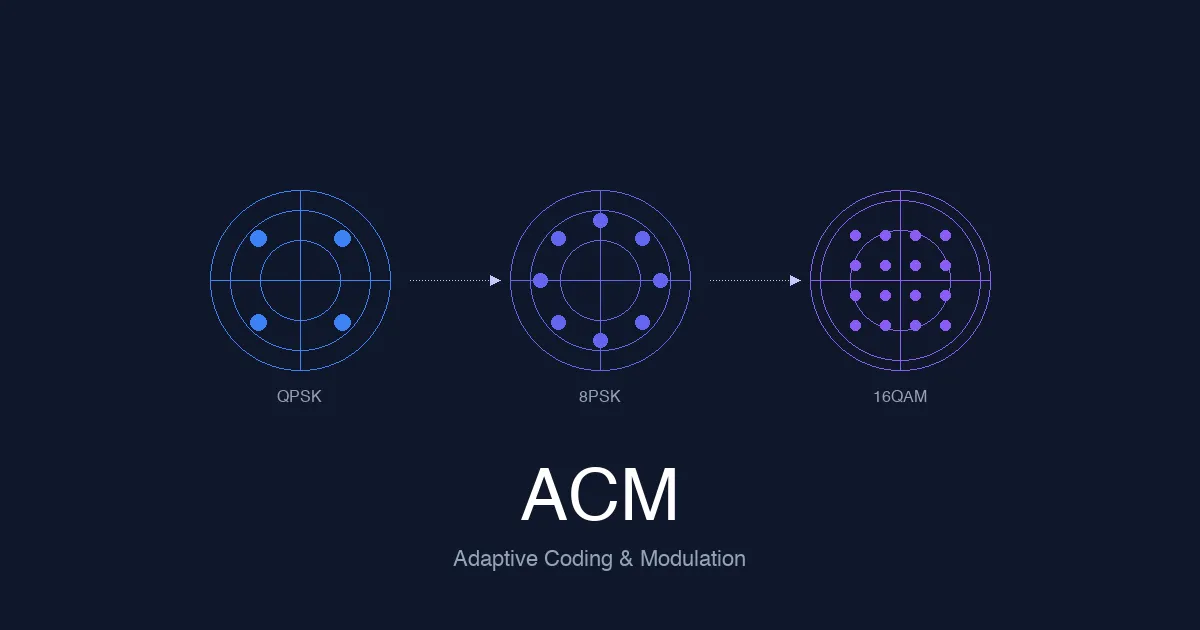
Adaptive Coding and Modulation (ACM) Explained: How Satellite Networks Maintain Link Quality
Engineering guide to adaptive coding and modulation in satellite systems covering signal quality measurement, MODCOD selection algorithms, DVB-S2/S2X ACM capabilities, rain fade response, and ACM design for HTS and LEO networks.

Enterprise Satellite Internet: Use Cases, Architecture, and Vendor Selection
Comprehensive guide to enterprise satellite internet covering use cases, hybrid WAN architecture, performance SLAs, vendor selection criteria, and procurement best practices.

4 Types of Satellite Antennas: Parabolic to Phased Array
Compare parabolic dishes (41 dBi at 1.2 m), phased arrays, flat panels, and stabilized maritime antennas — with gain, size, and VSAT selection guidance.