

Hybrid Satellite Networks: Multi-Orbit (LEO + GEO) Architecture and Design Considerations
Engineering guide to hybrid satellite network architecture—combining LEO and GEO orbits for latency, redundancy, and throughput optimization in enterprise and carrier deployments.
Introduction
No single satellite orbit satisfies every connectivity requirement simultaneously. A GEO satellite parked at 35,786 km offers continent-scale coverage from three spacecraft and stable, predictable link geometry—but imposes 480–600 ms round-trip latency that disqualifies it from latency-sensitive applications. A LEO constellation operating at 550–1,200 km delivers 20–40 ms round-trip times comparable to terrestrial broadband—but requires hundreds of satellites to maintain continuous coverage, and each satellite serves a narrower footprint with more frequent handovers.
Hybrid satellite networks combine LEO and GEO links within a single WAN design. The goal is to leverage the coverage stability and proven SLA track record of GEO while exploiting the low latency and capacity density of LEO—routing each traffic class to whichever orbit best serves its requirements.
This article is written for SATCOM architects, enterprise WAN engineers, and MSP/carrier network designers who are evaluating or deploying multi-orbit connectivity solutions. It covers the core architectural models, traffic steering strategies, redundancy design, engineering challenges, and near-term technology trends that will shape multi-orbit deployments over the next three to five years.
It does not duplicate the End-to-End Satellite System Architecture covered in the /basics/ section of this site, which addresses the full ground-to-space signal chain. Instead, it focuses specifically on the network design decisions that arise when two dissimilar satellite paths—LEO and GEO—must be managed as a coherent WAN.
GEO Characteristics Recap
Orbital altitude: GEO satellites orbit at 35,786 km above the equator, where their orbital period matches Earth's rotation. This geostationary relationship means a single satellite holds a fixed position in the sky relative to any point on Earth's surface—no tracking, no handover, deterministic link geometry.
Coverage: Three GEO satellites positioned 120° apart achieve near-global coverage excluding polar regions above approximately 75–80° latitude.
Latency: The one-way propagation delay from a ground terminal to a GEO satellite is approximately 240–280 ms. A full round-trip through the network—terminal → satellite → gateway → internet → reverse—yields 480–600 ms RTT. This is a physical constant of the orbital altitude; no modem or protocol optimization changes it.
Throughput: High-Throughput Satellite (HTS) GEO systems using Ka-band spot beams deliver 100–600 Mbps aggregate capacity per beam, shared across all active users in that beam. Individual enterprise links typically range from 10 to 100+ Mbps depending on service tier and beam loading.
Coverage stability: Fixed beam geometry means the link budget is consistent and well-characterized. Rain fade (see Satellite Frequency Bands Explained for Ka-band fade margin discussion) is the primary impairment; interference is manageable through frequency coordination.
Best-fit use cases: Broadcast distribution, bulk data transfer (database replication, software updates, video archival), maritime and aviation coverage where LEO constellations have sparse coverage, and rural enterprise backhaul where coverage footprint outweighs latency requirements. See VSAT Network Architecture for the full GEO VSAT topology.
LEO Characteristics Recap
Orbital altitude: LEO satellites operate between 200 and 2,000 km altitude. Starlink's operational shell is approximately 550 km; OneWeb operates at approximately 1,200 km. The lower the altitude, the lower the latency—but the smaller the coverage footprint per satellite, requiring more satellites for continuous global coverage.
Latency: At 550 km altitude, one-way propagation delay is approximately 2–4 ms. End-to-end RTT including ground network processing is typically 20–40 ms—comparable to a terrestrial broadband connection routed through a metro PoP. See Satellite Latency Comparison for a quantitative comparison across orbital regimes.
Constellation scale: Achieving continuous global coverage from LEO requires hundreds to thousands of satellites. Starlink has deployed over 6,000 satellites in its operational constellation. OneWeb operates approximately 650 satellites. This scale is the fundamental engineering and financial challenge of LEO constellations.
Handover: Each LEO satellite rises and sets relative to any ground point in minutes. At 550 km altitude and mid-latitudes, a single satellite is in view for approximately 5–8 minutes before the terminal must hand off to the next satellite. Modern LEO terminals handle handover transparently, but the handover event introduces brief link interruptions (typically <100 ms for Starlink) that can affect latency-sensitive sessions.
Capacity model: LEO satellites cover a smaller geographic footprint than GEO satellites, but the large number of satellites means more aggregate capacity is available per unit area. In sparsely populated regions, LEO capacity per user is generous. In dense-user areas (e.g., a stadium or a vessel convoy), shared capacity per user can degrade—the same congestion dynamic as terrestrial cellular.
MEO note: O3b mPOWER (SES) operates at approximately 8,000 km altitude, delivering 150–200 ms RTT—lower than GEO but higher than LEO. MEO is not addressed in detail in this article, but the architectural patterns described here apply equally to GEO+MEO or LEO+MEO hybrid deployments.
Hybrid Architecture Models
Four architectural patterns are commonly deployed in practice. Each represents a different point on the trade-off curve between cost, complexity, and performance.
Active/Active (Load-Balanced)
Both LEO and GEO links are active simultaneously. An SD-WAN controller or link bonding device distributes traffic across both paths in real time based on policy, measured link quality, or session type. Neither link sits idle.
Advantages: Maximum aggregate throughput; maximum path diversity; near-instant traffic redistribution when one path degrades.
Disadvantages: Maximum complexity and maximum cost. Requires dual RF infrastructure—either two separate antennas (one GEO-optimized, one LEO-capable fast-tracking or ESA terminal) or an emerging multi-orbit capable flat-panel antenna. Both satellite service contracts run continuously.
Best fit: High-value fixed sites (offshore platforms, data-center-equivalent remote sites) where downtime cost justifies dual-service investment.
Active/Standby (Failover)
One link—typically LEO for latency-sensitive enterprise applications—serves as primary. The second link (GEO) remains in a warm or cold standby state, activating only when the primary fails or degrades below threshold.
Advantages: Simpler architecture; lower operational cost since the standby link may be on a reduced-rate SLA. GEO standby provides an SLA backstop when LEO coverage gaps, congestion, or handover events cause momentary service degradation.
Failover time: Depends on modem keep-alive configuration and SD-WAN BGP convergence. Warm standby with continuous BFD probing can achieve <5 seconds. Cold standby (modem powered down) may require 30–120 seconds for full re-acquisition.
Best fit: Enterprise branch sites that need primary LEO performance with GEO as an availability guarantee.
Policy-Based (Application-Aware)
Both links are active but traffic is steered by application policy rather than load. Latency-sensitive traffic—VoIP, video conferencing, interactive enterprise applications—routes via LEO. Bulk and batch traffic—firmware OTA, database synchronization, video archival, backup jobs—routes via GEO.
Advantages: Optimizes cost and performance simultaneously. High-value latency-sensitive sessions use the expensive LEO link efficiently; bulk traffic uses the typically lower-cost-per-bit GEO link.
Requirements: Application classification via Deep Packet Inspection (DPI) at the WAN edge, or SD-WAN policy engine capable of recognizing application signatures. DSCP marking from the application layer simplifies classification.
Best fit: Offshore oil and gas operations running SCADA (latency-sensitive, small packets) on GEO alongside crew internet (latency-sensitive for streaming and voice) on LEO, with bulk operational data on whichever path has spare capacity.
Bonded Links (Link Aggregation)
MPTCP (Multipath TCP) or vendor-proprietary bonding tunnels aggregate both paths simultaneously into a single logical connection, distributing individual packet flows across LEO and GEO. A cloud PoP or on-premises hub reassembles traffic from both paths before delivering to the destination.
Advantages: Highest possible throughput for a single session; resilience against loss on either individual path.
Disadvantages: Variable RTT across bonded paths can cause TCP retransmission storms without careful tuning. The hub/PoP requirement adds cost and a potential single point of failure. Latency of bonded sessions is dominated by the slower path (GEO) unless the bonding engine is flow-aware.
Best fit: High-throughput applications (video production, large file transfer) where single-session throughput matters more than latency.
Architecture Comparison Table
| Model | Links Active | Typical Failover | Cost Index | Complexity | Primary Use Case |
|---|---|---|---|---|---|
| Active/Active | Both | N/A (continuous) | High | High | High-value fixed sites |
| Active/Standby | One (+ standby) | <5–120 s | Medium | Low–Medium | Enterprise branch failover |
| Policy-Based | Both | Per-policy | Medium–High | Medium | Mixed traffic profiles |
| Bonded | Both | Transparent | High | High | High-throughput single sessions |
Traffic Steering Strategies
Effective hybrid network operation depends on routing each traffic type to the path that serves it best. The following guidelines reflect engineering consensus across maritime, enterprise, and carrier deployments.
Latency-Sensitive Traffic → LEO
Voice over IP, video conferencing (Teams, Zoom, WebRTC), interactive enterprise applications (ERP, CRM with real-time queries), and remote desktop sessions all require end-to-end RTT well below 150 ms to remain usable. GEO's 480–600 ms RTT exceeds the threshold for comfortable two-way voice and makes interactive applications sluggish. Route these sessions exclusively via LEO.
Bulk Transfer → GEO
Firmware OTA updates, database replication jobs, video archival, backup to cloud storage, and large file transfers are throughput-sensitive and latency-tolerant. GEO delivers higher throughput per dollar and its 500 ms RTT does not impair batch transfer performance—TCP window scaling handles it effectively when the link is configured with appropriate buffer sizes.
Failover and Probing Logic
SD-WAN controllers probe both paths continuously using BFD (Bidirectional Forwarding Detection), ICMP echo, or vendor-proprietary path quality measurements. Switchover is triggered when:
- Packet loss on the primary path exceeds a defined threshold (commonly 1–5%)
- RTT on the primary path exceeds a latency SLA threshold
- The primary link goes fully down (modem loses carrier)
Probe intervals of 1–3 seconds with a 3-probe failure count yield switchover times in the 3–10 second range for warm standby scenarios.
BGP and Routing Considerations
When LEO and GEO gateways terminate on different routers (a common carrier architecture), route advertisement requires careful coordination to prevent asymmetric paths. Return traffic may prefer the GEO gateway even when outbound traffic is routed via LEO, creating asymmetric session state that confuses stateful firewalls. Implement policy-based routing or source-based routing at the gateway layer to enforce path symmetry.
For enterprise deployments using SD-WAN overlay (not native BGP), this concern is typically abstracted by the SD-WAN controller's session-based routing model—but verify with the vendor.
Application Example: Offshore Oil Platform
An offshore production platform running a hybrid LEO+GEO design might configure:
- SCADA and safety system telemetry → GEO (deterministic, wide coverage, tolerant of latency)
- Operations voice/video → LEO (low latency required)
- Crew entertainment and internet → LEO (latency-sensitive streaming)
- Bulk log and data export → GEO or load-balanced (throughput-dominant)
See Enterprise Satellite Internet Guide for enterprise traffic policy context.
Redundancy and SLA Design
Geographic and Orbital Diversity
GEO and LEO satellites have independent failure modes. A GEO satellite failure (rare but documented—typically <1 per year across the full GEO arc) does not affect LEO coverage. A LEO constellation issue (software update gone wrong, orbital debris event) does not affect the GEO link. The two orbits have no common mode of failure at the orbital level.
Similarly, GEO and LEO gateways are typically located in different terrestrial facilities. A terrestrial fiber cut or data-center outage affecting the GEO gateway is unlikely to simultaneously affect the LEO gateway in a different geographic location. This dual-gateway architecture provides additional resilience against terrestrial network outages—a failure mode more common than satellite outages.
Availability Calculation
System availability in a parallel (redundant) architecture follows:
A_combined = 1 − [(1 − A_GEO) × (1 − A_LEO)]
If GEO link availability = 99.9% and LEO link availability = 99.5%, the combined parallel availability against simultaneous outage is:
1 − (0.001 × 0.005) = 1 − 0.000005 = 99.9995%
This assumes statistical independence between the two link outage events—a reasonable assumption given the orbital and terrestrial path diversity described above.
Caveat: Weather-driven outages (heavy rain causing Ka-band rain fade on both links) can create correlated outage events if both terminals are co-located. At Ku-band on GEO with Ka-band on LEO, the rain fade thresholds differ, reducing (but not eliminating) correlated weather outages. See Satellite Frequency Bands Explained for Ka vs. Ku rain fade margin context.
Enterprise SLA Implications
- CIR on GEO + burst on LEO: GEO services with committed information rate (CIR) provide a guaranteed throughput floor. LEO adds burst capacity when available, subject to congestion conditions.
- CIR across both links: Some carrier-grade hybrid managed services offer a unified CIR across the combined path—the carrier absorbs path management complexity and guarantees an end-to-end SLA.
Use Case Examples
- Maritime vessel: Ku-band GEO VSAT (primary coverage, proven maritime SLA) + Starlink LEO (crew internet, low-latency operations). See Maritime Satellite Internet and Satellite Backhaul Explained for maritime backhaul redundancy patterns.
- Rural enterprise: HTS Ka-band GEO (bulk backhaul, CIR-backed SLA) + OneWeb LEO (low-latency application traffic).
- Government emergency response: Dual-orbit mandated by procurement specification; independence of failure modes satisfies resilience requirement in disaster scenarios where terrestrial infrastructure is compromised.
Engineering Challenges
Integration Complexity
Managing two dissimilar satellite paths requires:
- Dual RF infrastructure: two physically separate antennas, or a multi-orbit capable terminal (rare and expensive as of 2026)
- Two separate service contracts, two SLA frameworks, two NOC relationships
- A WAN controller capable of managing heterogeneous links with different latency, loss, and throughput characteristics
- Coordination between the LEO and GEO service providers' support teams when diagnosing cross-path issues
This operational complexity is non-trivial. Staff training, runbooks, and NOC integration procedures must account for the dissimilar link types.
Cost Implications
LEO terminal and service costs remain elevated in 2026. Starlink hardware runs $500–2,500+ depending on terminal type (consumer Starlink dish vs. maritime or Starlink Business grade). OneWeb and Telesat LEO enterprise service pricing is at carrier-grade rates. Adding a full GEO service on top of an existing LEO deployment typically doubles or triples total connectivity cost.
Hybrid deployment is financially justified when the combined SLA or performance requirement demonstrably cannot be met by either single-orbit option—and the cost of downtime or SLA breach exceeds the cost premium of the hybrid solution. Avoid hybrid architecture as a precautionary measure; model the actual downtime exposure first.
Terminal Limitations on Mobile Platforms
Most commercial maritime and enterprise Ku/Ka-band terminals are GEO-optimized: stabilized gimbaled platforms designed for slow-tracking (or no tracking for fixed sites). LEO requires fast-tracking antennas—either mechanically gimbaled platforms with fast angular velocity or electronically steered array (ESA) antennas.
Dual-terminal installations on vessels face space, weight, and power constraints. A maritime vessel with an existing GEO dome installation must find structural mounting locations for a Starlink maritime dish and manage cable runs, power draw, and VSAT coexistence. Flat-panel ESA terminals (Kymeta, ThinKom, Satixfy) reduce the physical footprint but remain expensive.
TCP Performance Across Dissimilar Paths
TCP behavior over GEO is well understood: large send buffers, aggressive TCP window scaling, and Performance Enhancement Proxies (PEP) are standard practice to overcome the high-latency channel. LEO changes the TCP dynamics—at 30 ms RTT, standard TCP congestion control works well without PEP.
A bonded or active/active hybrid path presents TCP with variable RTT depending on which path carries each segment. RTT variation (jitter) across the bonded path can cause spurious retransmission if the retransmission timeout (RTO) is calibrated to the LEO path RTT—a GEO-routed ACK arriving 500 ms after a LEO-routed packet may trigger a retransmission even though the data was delivered. Bonding implementations must either use flow-level (not packet-level) path assignment, or implement RTT-aware RTO tuning.
Spectrum Coordination
Operating LEO and GEO terminals at the same site or on the same vessel can create adjacent-frequency interference. Ka-band LEO uplink frequencies can overlap or be adjacent to Ka-band GEO downlink allocations at certain terminal geometries. ITU power flux density (PFD) limits regulate LEO terminal uplink power near the GEO arc, requiring compliance checks in co-located deployments.
Vendors of multi-orbit capable terminals address this through hardware isolation, but site-specific RF survey and coordination with both service providers remains necessary for co-located Ka+Ka installations.
Future Trends
5G NTN (Non-Terrestrial Networks)
3GPP Release 17 and Release 18 define direct-to-device satellite service using 5G New Radio (NR) waveforms. Both GEO (bent-pipe NTN, where the satellite is a transparent relay) and LEO (regenerative NTN, where the satellite processes the 5G baseband onboard) are in scope.
Hybrid NTN architectures will inherit the same multi-orbit trade-offs discussed in this article—GEO NTN for coverage, LEO NTN for latency—while adding RAN-layer complexity: handover in a 5G NTN context involves both the terrestrial 5G core and the satellite gateway, coordinated via the N2/N3 interface. Network architects evaluating 5G NTN must map their understanding of WAN-layer multi-orbit design to the 3GPP RAN architecture.
Enterprise SD-WAN Integration
Major SD-WAN vendors—Cisco Viptela, VMware VeloCloud (now Broadcom), Fortinet SD-WAN, and others—now include satellite-aware link management profiles in their controller software. LEO-aware TCP acceleration modules are in active development as LEO deployments have revealed that legacy GEO-optimized PEP is counterproductive at LEO latency. As SD-WAN matures its LEO support, the policy-based and active/active hybrid models described in this article become operationally simpler to manage.
Multi-Orbit Managed Services
Operators with dual-orbit assets—SES (combining GEO O3b and an LEO constellation future roadmap), Viasat, Eutelsat (with OneWeb)—are developing managed service offerings that package LEO+GEO under a single contract with a unified SLA. The multi-orbit complexity is absorbed into the operator's service layer, and the enterprise customer receives a single managed WAN link with performance guarantees spanning both orbits. This model reduces the integration burden on the customer but reduces flexibility and customization.
Flat-Panel Antenna Maturity
ESA vendors (Kymeta, ThinKom, Satixfy) are actively developing multi-band, multi-orbit capable flat panels that can switch between GEO and LEO pointing without mechanical movement. As production volumes increase and antenna costs decline toward the $1,000–3,000 range (compared to $10,000+ currently for multi-orbit capable systems), the terminal integration barrier diminishes significantly. When a single low-profile flat panel can access both GEO and LEO simultaneously, the co-location and RF coordination challenges described above become moot.
Frequently Asked Questions
What is a hybrid satellite network? A hybrid satellite network uses two or more satellite links from different orbital regimes—typically LEO and GEO—within a single WAN architecture. Traffic is distributed between the links based on application requirements, link availability, or policy, with the goal of achieving performance or redundancy that neither single-orbit solution could provide alone.
Is LEO always better than GEO for enterprise connectivity? No. LEO delivers lower latency, which is critical for interactive applications. But GEO offers greater coverage stability (no handover), deterministic link geometry (no tracking required for fixed sites), mature SLA frameworks from established operators, and often lower cost per bit for bulk transfer workloads. The right answer depends on the application mix and site-specific requirements.
How does SD-WAN manage LEO and GEO links simultaneously? An SD-WAN controller continuously probes both satellite links using lightweight measurement traffic (BFD, ICMP, or vendor-proprietary). It maintains a real-time quality metric for each path (latency, loss, jitter) and steers sessions or flows to the link that best matches the configured policy for that application class. Policy can be based on DSCP marking, application signatures from DPI, or explicit destination-based rules.
What is the failover time when switching between LEO and GEO? In a warm standby configuration with continuous link probing, SD-WAN failover between LEO and GEO can occur in 3–10 seconds. Cold standby (secondary modem powered down) requires modem boot time plus satellite acquisition—typically 30–120 seconds depending on terminal type. For most enterprise and maritime applications, warm standby is standard practice.
Can one terminal support both LEO and GEO? As of 2026, true single-terminal multi-orbit support is limited and expensive. Some ESA flat-panel vendors are developing multi-orbit capable hardware, but the dominant deployment pattern remains two separate terminals—one GEO-optimized, one LEO-capable—sharing backplane connectivity to the SD-WAN edge router. Multi-orbit flat panels are expected to reach cost-effective pricing in the 2027–2029 timeframe.
How is the availability of a hybrid satellite network calculated? For a parallel (active/active or warm-standby) design, combined availability is: A_combined = 1 − [(1 − A_link1) × (1 − A_link2)] If each link has 99.9% availability, the combined availability is 99.9999%. The calculation assumes statistical independence—that link failures on LEO and GEO occur independently. This assumption holds for orbital and satellite-hardware failures but may not hold for co-located ground-side weather events.
What are the main cost drivers of a multi-orbit hybrid deployment? The three primary cost drivers are: (1) Terminal hardware—LEO terminals, especially maritime or enterprise-grade units, remain significantly more expensive than equivalent GEO terminals; (2) Dual service contracts—running two satellite services simultaneously doubles or triples the ongoing connectivity cost relative to a single-orbit deployment; (3) Integration and management—an SD-WAN controller capable of managing dissimilar satellite links, plus NOC support staff trained on dual-orbit troubleshooting, add operational cost. Total cost of ownership for a multi-orbit hybrid is typically 2–3× a comparable single-orbit deployment.
Summary
GEO satellites offer unmatched coverage footprint, stable link geometry, mature SLA frameworks, and cost-effective bulk throughput. Their 480–600 ms round-trip latency is a physical constraint that cannot be engineered away.
LEO constellations deliver 20–40 ms latency that enables interactive applications over satellite for the first time at commercial scale. Their constellation complexity, evolving operational track records, and elevated terminal costs are the remaining barriers.
Hybrid multi-orbit networks combine both—routing latency-sensitive traffic via LEO and throughput-dominant bulk traffic via GEO, with each link serving as redundancy for the other. The result is an availability figure and a performance envelope that neither orbit can achieve alone.
SD-WAN is the practical control plane for multi-orbit traffic management. Policy-based and active/active models are both mature deployments patterns, supported by major vendor platforms.
The two remaining barriers—terminal cost and single-terminal multi-orbit capability—are declining as ESA flat-panel technology matures and as production volumes for LEO terminals scale. Managed multi-orbit service offerings from dual-orbit operators are beginning to abstract the complexity from the enterprise buyer.
For engineering teams sizing a hybrid deployment: size each link independently to carry its committed traffic load, configure SD-WAN probing on aggressive intervals, validate with actual RTT and loss budget measurements under realistic load, and verify RF coordination between the two terminal installations before deployment. Base decisions on measured link performance under real-world conditions, not vendor marketing claims about orbit capabilities.
Related Articles
- VSAT Network Architecture — GEO VSAT topology and hub architecture
- Satellite Latency Comparison — Quantitative RTT comparison across LEO, MEO, and GEO
- Enterprise Satellite Internet Guide — Enterprise WAN design patterns with satellite connectivity
- Satellite Backhaul Explained — Backhaul redundancy patterns and multi-path design
- Satellite Frequency Bands Explained — Ka, Ku, and other band characteristics including rain fade
Author

Organizational byline for SATCOM Index technical content. A named technical reviewer appears separately only when identity, scope, and permission are verified.
Categories
More Posts

How Satellite Internet Works: Architecture, Latency, and Real-World Operation
Learn how satellite internet works, including GEO vs LEO satellites, ground stations, latency, and how data travels through space networks.
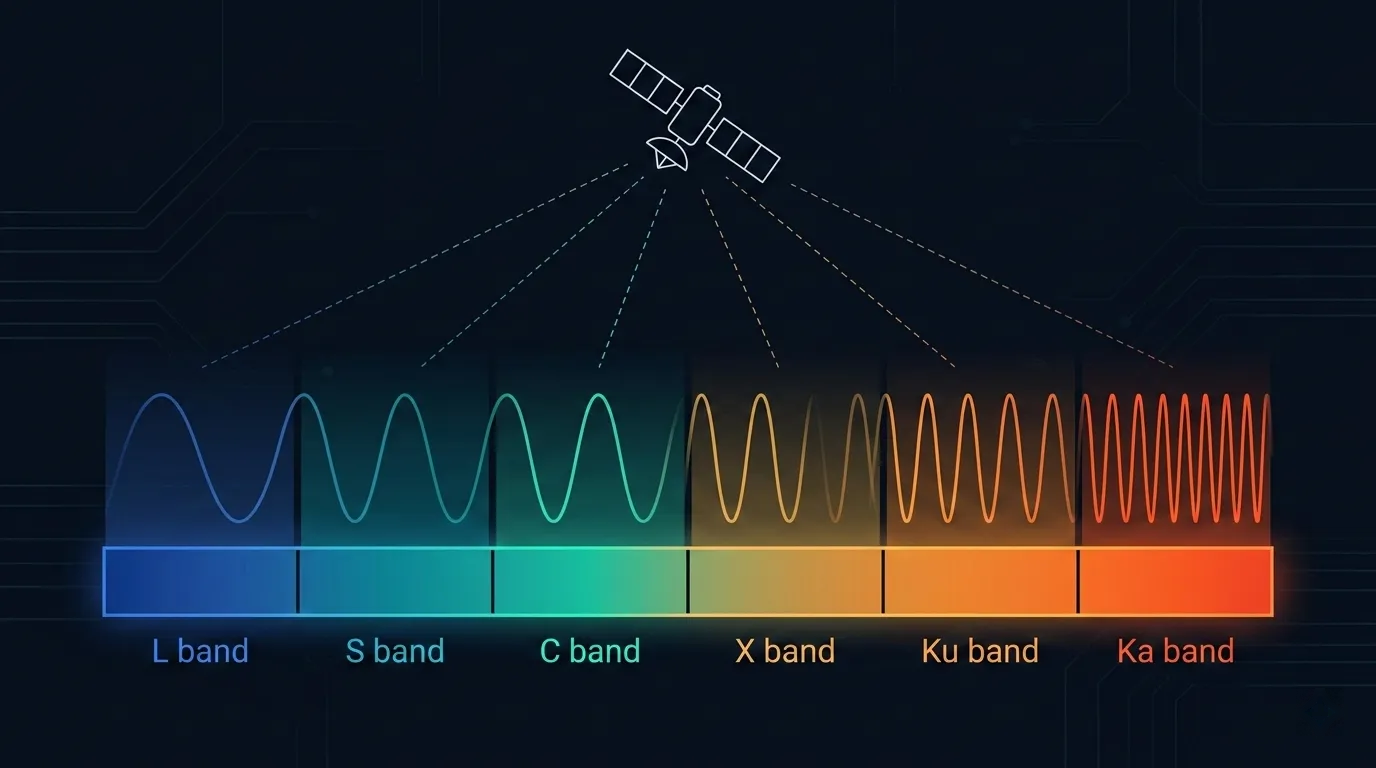
Satellite Frequency Bands: L, S, C, X, Ku and Ka
Understand L, S, C, X, Ku and Ka labels, ITU allocations, uplink/downlink direction, propagation, antenna scaling, and a defensible selection workflow.
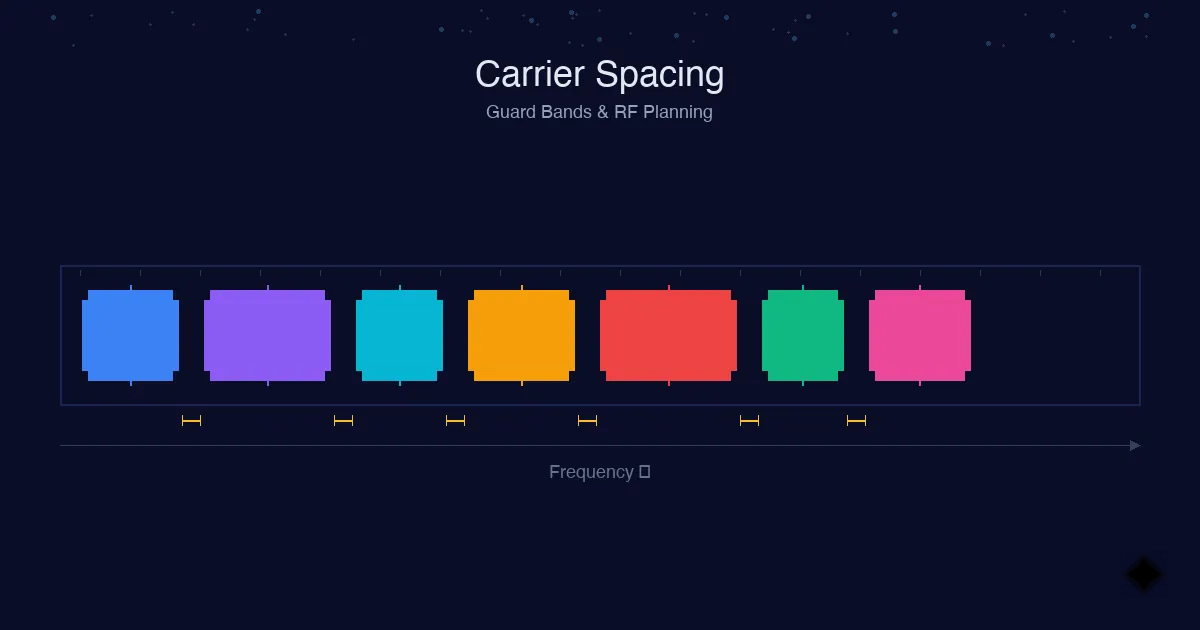
Satellite Carrier Spacing Explained: Why Guard Bands Matter in RF Planning
Engineering guide to satellite carrier spacing covering guard bands, RF planning trade-offs, spectral efficiency, and adjacent carrier interference.