
Satellite Backhaul Explained: Architecture, Use Cases, and Design Trade-offs
Technical guide to satellite backhaul covering architecture components, cellular and enterprise use cases, performance trade-offs, and multi-orbit design considerations.
Backhaul is the intermediate transport link that connects local access networks to the core network and the broader internet. In terrestrial networks, backhaul typically runs over fiber, microwave radio, or copper — technologies that assume fixed infrastructure corridors between cell towers, branch offices, and central switching sites. When those corridors do not exist, satellite provides the backhaul path.
Satellite backhaul matters because it extends connectivity to locations where terrestrial infrastructure is economically unviable, physically impossible, or too slow to deploy. Cellular operators use satellite to backhaul remote tower sites that fiber will never reach. Enterprises use satellite to connect branch offices in regions with no reliable terrestrial links. Mining, oil and gas, and emergency response operations depend on satellite backhaul to bridge the gap between isolated field sites and corporate or public networks.
This article is an engineering reference for satellite backhaul. It covers where backhaul fits in the network hierarchy, the major use cases, architecture components from gateway to remote terminal, performance trade-offs across orbit types, and design considerations for band selection, redundancy, and regulatory compliance.
For foundational satellite concepts, see How Satellite Internet Works. For the full system view from space segment to user terminal, see End-to-End Architecture.
Satellite Backhaul Overview
Understanding backhaul requires distinguishing it from related network segments. The backbone (or core network) is the high-capacity transport infrastructure that interconnects major network nodes — think intercontinental fiber, IXPs, and Tier 1 carrier peering points. The last mile (or access network) is the final link between the local network and end users — the Wi-Fi access point, the Ethernet drop, the LTE air interface from a cell tower to a handset. Backhaul sits between these two: it transports aggregated traffic from the access network back to the core.
In a cellular network, the backhaul link connects a base station (eNodeB or gNB) to the mobile operator's core network. In an enterprise network, the backhaul link connects a branch office router to the corporate WAN or SD-WAN hub. In a rural ISP deployment, the backhaul link connects a local distribution point to the ISP's upstream peering.
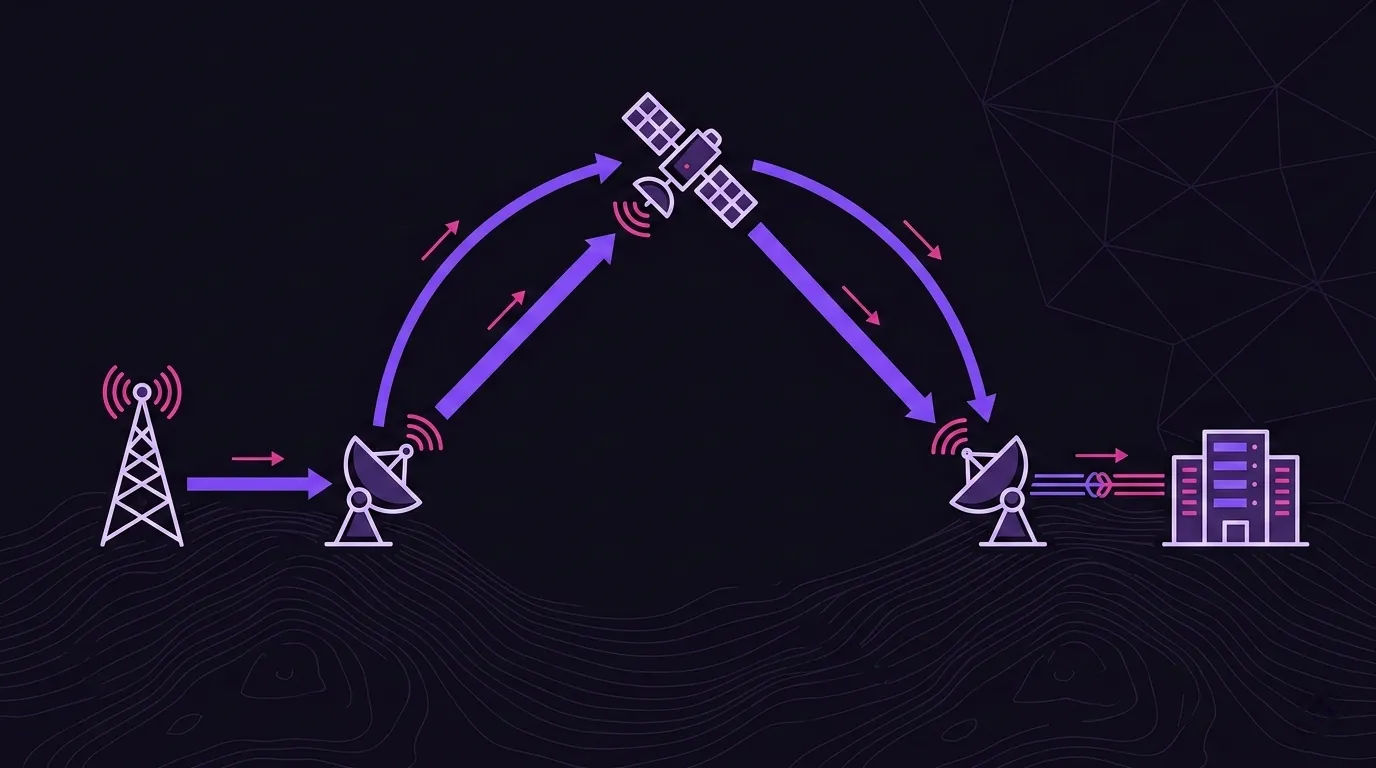
When satellite provides this backhaul function, the satellite link replaces or supplements what would otherwise be a fiber, microwave, or leased-line connection. The remote site has a satellite terminal (VSAT or similar) that transmits aggregated local traffic to a satellite. The satellite relays it to a ground gateway (teleport), which hands the traffic off to terrestrial fiber and the internet or corporate network.
Key backhaul terminology:
- Backhaul: The transport link connecting a local access network (cell site, branch office, distribution point) to the core network.
- Gateway / Teleport: The ground station that terminates the satellite link and interconnects with terrestrial fiber infrastructure.
- PoP (Point of Presence): A network interconnection point where the satellite operator peers with ISPs, cloud providers, or enterprise WANs.
- CIR (Committed Information Rate): The minimum guaranteed bandwidth in a satellite service contract — critical for backhaul SLAs.
- MIR (Maximum Information Rate): The peak burst bandwidth available when network capacity permits.
- ACM (Adaptive Coding and Modulation): A technique that dynamically adjusts modulation and coding to maintain link availability under varying conditions.
Common Backhaul Use Cases
Cellular Tower Backhaul
Mobile network operators (MNOs) face a persistent challenge: cellular coverage targets set by regulators and competitive pressure require tower deployments in locations where fiber backhaul does not exist and microwave line-of-sight is not available. Rural communities, highway corridors, island populations, and border regions all need cellular service — but the business case for running fiber to a tower serving a few hundred subscribers rarely closes.
Satellite backhaul solves this by providing a deployable transport link to any tower site with sky visibility. A VSAT terminal at the cell tower aggregates all subscriber traffic and transits it over satellite to the operator's core network via a gateway teleport. The tower operates identically to a fiber-backhauled site from the subscriber's perspective — calls connect, data flows, handovers work — but with the latency and throughput characteristics of the satellite link.
For 2G and 3G services, GEO satellite backhaul is well-proven. Voice calls tolerate the 600 ms round-trip delay with echo cancellation, and low-bandwidth data services (SMS, basic browsing) work within typical GEO throughput constraints. For 4G LTE and especially 5G NR, the latency and throughput requirements tighten considerably. LTE expects backhaul latency under 50 ms for optimal performance (though it functions at higher latencies with degraded throughput), and 5G NR use cases like URLLC (Ultra-Reliable Low-Latency Communication) assume single-digit millisecond latency that no satellite link — including LEO — can deliver.
MEO and LEO constellations have changed the cellular backhaul equation. With round-trip times of 120–150 ms (MEO) or 30–60 ms (LEO), these orbits can support 4G LTE backhaul with acceptable performance degradation. Several MNOs in Africa, Southeast Asia, and Latin America now use LEO or MEO satellite backhaul to extend 4G coverage to rural tower sites, with GEO as a fallback for guaranteed availability.
Enterprise Branch Connectivity
Enterprises with distributed operations — retail chains, banking networks, logistics hubs, government agencies — need reliable WAN connectivity to every branch. In developed markets, most branches connect over MPLS, broadband internet, or dedicated fiber. But organizations operating in emerging markets, remote regions, or across geographically dispersed territories frequently encounter branches where terrestrial connectivity is unreliable, slow, or nonexistent.
Satellite backhaul provides branch connectivity with predictable performance and global reach. A VSAT terminal at the branch connects to the enterprise WAN through a satellite link terminating at a teleport with direct peering into the corporate MPLS network or SD-WAN fabric. The branch runs the same applications — ERP, CRM, VoIP, video conferencing — as any other site on the WAN.
The key challenge is matching application requirements to satellite link characteristics. Transactional applications (point-of-sale, database queries, email) work well over GEO satellite backhaul because they are latency-tolerant. Real-time applications (VoIP, video conferencing) require WAN optimization techniques — TCP acceleration, local caching, protocol optimization — to perform acceptably over GEO links, or a MEO/LEO backhaul link for native low latency.
Mining, Oil and Gas, and Emergency Communications
Resource extraction operations are among the most demanding satellite backhaul users. Mining sites, oil platforms, pipeline monitoring stations, and exploration camps are located in some of the most remote environments on earth — deep desert, offshore continental shelf, Arctic tundra, dense jungle — where terrestrial infrastructure is absent and may never arrive.
These sites require backhaul for operational technology (OT) traffic (SCADA, telemetry, remote equipment monitoring), enterprise IT traffic (ERP, email, file sharing), safety and emergency communications, and workforce welfare (internet access, VoIP for worker calls home). Bandwidth requirements range from a few hundred kilobits per second for a pipeline monitoring station to 50+ Mbps for a large mining camp with hundreds of workers and high-resolution video surveillance.
Emergency and disaster response operations present a different backhaul requirement: rapid deployment. When terrestrial infrastructure is destroyed by earthquake, hurricane, or conflict, satellite backhaul restores connectivity to emergency coordination centers, field hospitals, and temporary shelters. Deployable satellite terminals — flyaway kits, vehicle-mounted systems, inflatable antennas — provide backhaul within hours of arrival, before any terrestrial repair work begins.
Rural ISP Backhaul
In many countries, rural internet service providers use satellite as their upstream backhaul link. The ISP deploys local distribution infrastructure — Wi-Fi hotspots, fixed wireless access points, or small cell networks — to serve a village or rural community. All subscriber traffic aggregates at a central point and is backhauled over satellite to the ISP's PoP in the nearest city with internet exchange access.
This model is common across sub-Saharan Africa, Southeast Asia, the Pacific Islands, and rural Latin America. The ISP adds value by providing local distribution, customer support, and billing services, while satellite provides the long-haul transport that would otherwise require hundreds of kilometers of fiber.
Architecture Components
Ground Gateway and PoP
The ground gateway (teleport) is where the satellite link meets terrestrial infrastructure. A backhaul-grade teleport includes large-aperture antennas (typically 7–13 m for GEO), redundant RF chains, satellite modems, and network routing equipment. The teleport connects via high-capacity fiber to one or more Points of Presence (PoPs) where the satellite operator peers with ISPs, cloud providers, content delivery networks, and enterprise WANs.
Gateway placement directly affects backhaul performance. A teleport located near major internet exchanges and cloud on-ramps minimizes terrestrial latency and provides the shortest path from the satellite link to content and application servers. Satellite operators strategically position gateways to optimize the total end-to-end path — including both the satellite hop and the terrestrial tail.
For a detailed treatment of gateway and teleport architecture, see Satellite Gateways, Teleports, and PoPs.
Terrestrial Integration
Satellite backhaul does not operate in isolation — it must integrate seamlessly with the customer's terrestrial network. At the remote site, the satellite modem presents a standard Ethernet or IP interface to the local router. The router treats the satellite link as another WAN interface, applying routing policies, access control lists, and QoS markings as it would for any transport link.
At the gateway/PoP end, the satellite operator provides a handoff — typically a VLAN on a shared Ethernet interface or a dedicated physical port — that connects into the customer's MPLS PE router, SD-WAN hub, or internet gateway. For enterprise customers, the handoff often includes a GRE or IPsec tunnel to maintain end-to-end encryption and network segmentation.
MPLS/VPN over Satellite
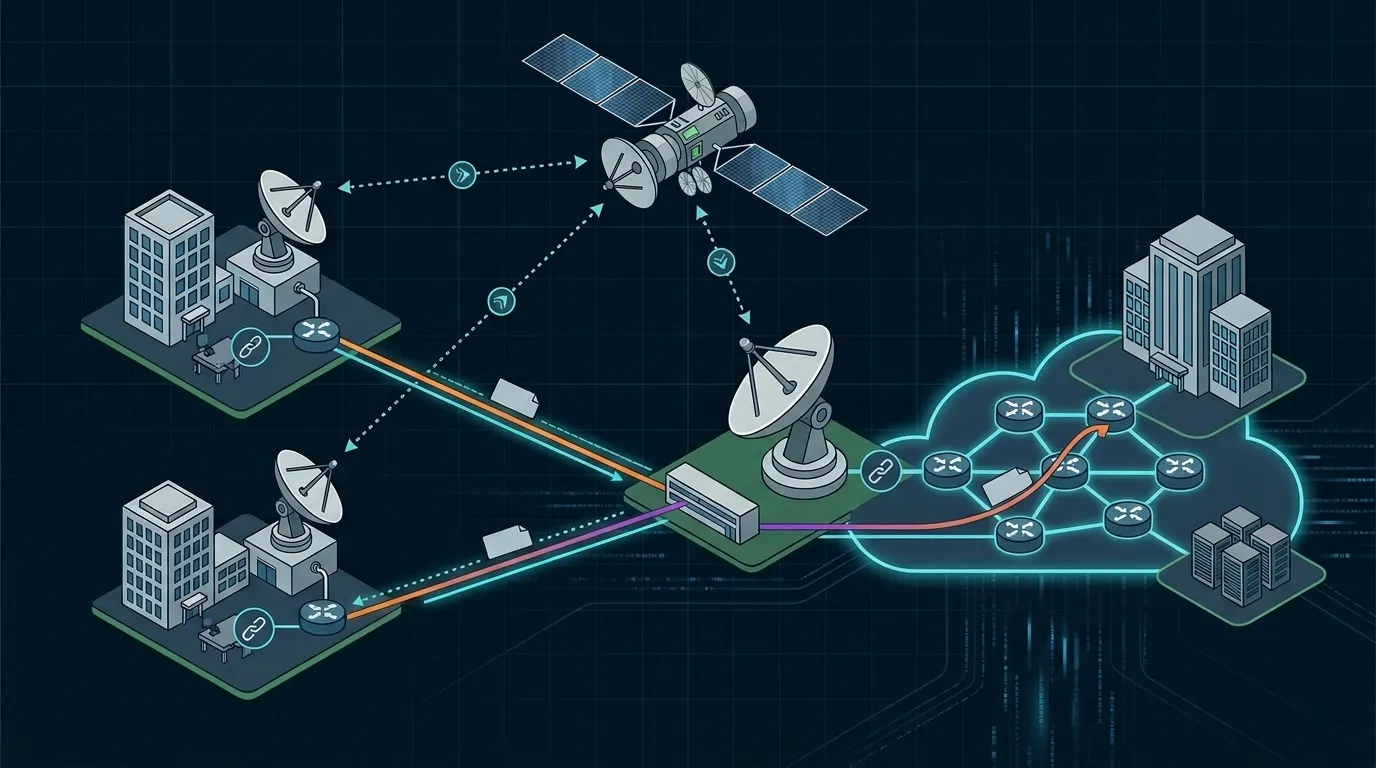
Many enterprise backhaul deployments require the satellite link to carry MPLS VPN traffic. The remote branch is an MPLS CE (Customer Edge) router connected via the satellite link to a PE (Provider Edge) router at the teleport PoP. The satellite operator's network acts as the transport between CE and PE, carrying labeled traffic transparently.
The primary engineering challenge is MPLS over satellite performance. Label-switched paths assume relatively stable latency and low jitter — conditions that GEO satellite links do not naturally provide. WAN optimization appliances at both ends of the satellite link provide TCP acceleration (spoofing TCP acknowledgments to avoid round-trip-time-dependent throughput collapse), header compression, data deduplication, and caching. These optimizations can improve effective throughput by 2–5x over unoptimized satellite MPLS.
QoS and Traffic Engineering Considerations
Satellite backhaul bandwidth is expensive and finite — typically 2–50 Mbps per remote site, compared to 100 Mbps–10 Gbps for fiber-backhauled sites. Effective QoS is therefore essential to ensure critical traffic receives priority access to the limited satellite capacity.
| QoS Class | Traffic Type | Priority | Bandwidth Allocation | Latency Sensitivity |
|---|---|---|---|---|
| Real-time | VoIP, video conferencing | Highest (EF) | Strict priority queue | Very high |
| Business Critical | ERP, SCADA, POS transactions | High (AF41) | Weighted fair queue, 40% minimum | Medium |
| Standard Data | Email, web browsing, file transfer | Medium (AF21) | Weighted fair queue, 30% minimum | Low |
| Bulk / Best Effort | Software updates, backups, streaming | Low (BE) | Remaining capacity | None |
| Network Management | SNMP, routing protocols, NTP | High (CS6) | Dedicated allocation | Medium |
Traffic engineering on the satellite link includes bandwidth on demand (BoD) mechanisms that dynamically allocate capacity based on traffic load — a site with no active VoIP calls does not consume its reserved real-time queue allocation, and that capacity is redistributed to data traffic. Adaptive coding and modulation (ACM) on the satellite link continuously adjusts to RF conditions, meaning available throughput varies with weather, antenna pointing, and interference — the QoS system must respond gracefully to these throughput changes.
Performance and Trade-offs
Latency, Throughput, and Jitter
The orbit type fundamentally determines the backhaul link's latency, which in turn defines which applications and protocols perform well over the link.
| Performance Metric | GEO (36,000 km) | MEO (8,000–20,000 km) | LEO (500–1,200 km) |
|---|---|---|---|
| One-way propagation delay | ~270 ms | ~70–130 ms | ~4–15 ms |
| Typical round-trip time (RTT) | 550–650 ms | 150–280 ms | 25–60 ms |
| Typical user throughput per site | 2–50 Mbps | 10–100 Mbps | 50–300 Mbps |
| Jitter | Low (stable path) | Moderate (orbit dynamics) | Higher (frequent handovers) |
| Handover frequency | None (stationary) | Every 2–6 hours | Every 3–8 minutes |
| Rain fade impact | High (long slant path) | Moderate | Lower (short slant path) |
| Beam coverage stability | Fixed footprint | Slowly moving beams | Rapidly moving spot beams |
GEO satellite backhaul provides the most predictable performance — latency is constant, jitter is minimal, and there are no satellite handovers. This predictability simplifies QoS engineering and makes GEO suitable for applications that can tolerate high but stable latency. The trade-off is that TCP throughput collapses without optimization (the bandwidth-delay product at 600 ms RTT severely limits window-based flow control), and real-time interactive applications suffer.
MEO backhaul (O3b mPOWER, SES) offers a middle ground: latency low enough for most enterprise applications including VoIP, with throughput per beam significantly higher than GEO. MEO requires tracking antennas that follow the satellite across the sky and hand over between satellites, adding mechanical complexity and cost to the remote terminal.
LEO backhaul provides the lowest latency and highest per-user throughput, enabling cellular backhaul that approaches fiber-like application performance. The trade-offs are frequent satellite handovers (introducing brief latency spikes), the need for electronically steered or fast-tracking antennas, and less mature ground infrastructure compared to GEO networks.
For a detailed latency comparison across orbits with application impact analysis, see Satellite Latency Comparison.
Path Diversity and SLAs
Backhaul reliability is measured by link availability — the percentage of time the link meets its performance specifications. Enterprise and cellular customers typically require 99.5–99.9% availability SLAs, which translates to no more than 4.4–8.8 hours of downtime per year.
Achieving these targets requires path diversity: multiple independent paths that protect against single points of failure. Satellite backhaul path diversity strategies include:
- Dual-satellite redundancy: two terminals at the remote site pointed at different satellites, with automatic failover.
- Multi-orbit redundancy: GEO primary with LEO or MEO backup (or vice versa), providing diversity against orbit-specific failure modes.
- Hybrid satellite-terrestrial: satellite primary with microwave or cellular backup where available, or terrestrial primary with satellite backup for disaster recovery.
- Gateway diversity: the satellite operator maintains multiple geographically separated gateways, so a gateway outage does not interrupt service.
SLA structures for satellite backhaul typically specify CIR (guaranteed minimum throughput), availability percentage, mean time to restore (MTTR), and service credit schedules for underperformance. The SLA should clearly define exclusion events — rain fade beyond design margin, force majeure, scheduled maintenance — and the measurement methodology.
Cost vs Performance
Satellite backhaul cost scales with three primary factors: bandwidth (CIR in Mbps), orbit type (GEO is cheapest per Mbps for low-bandwidth links; LEO/MEO pricing is falling but remains higher per guaranteed Mbps), and terminal complexity (a fixed GEO VSAT is simpler and cheaper than a tracking MEO or LEO terminal).
For cellular backhaul, the economics must close against the revenue generated by the tower site's subscribers. A rural tower generating $2,000/month in subscriber revenue cannot justify $5,000/month in satellite backhaul — this is why GEO with modest CIR (2–5 Mbps) remains the most deployed cellular backhaul solution in emerging markets, despite its latency limitations.
For enterprise backhaul, the comparison is against the alternative: leased lines (where available), microwave (where line-of-sight exists), or no connectivity at all. Satellite backhaul is rarely the cheapest transport option, but it is often the only option — and the business value of connecting an otherwise disconnected site typically exceeds the satellite cost.
Design Considerations
Band Selection
The choice of frequency band affects every aspect of the backhaul link — throughput, rain fade resilience, terminal size, and regulatory complexity.
Ku-band is the workhorse of satellite backhaul. It offers a good balance between available bandwidth (typically 36–72 MHz transponders), rain fade resilience (moderate — manageable with appropriate link margin in most climates), and terminal size (0.9–1.8 m antennas for typical backhaul applications). Ku-band is the most widely deployed band for VSAT backhaul globally, with mature ecosystem of modems, terminals, and service providers.
Best for: General-purpose enterprise and cellular backhaul in temperate and tropical climates where moderate bandwidth (2–20 Mbps CIR) meets requirements.
Ka-band provides higher throughput per terminal due to wider available bandwidth and more concentrated spot beams. High-throughput satellites (HTS) operating in Ka-band can deliver 50–200+ Mbps per beam, enabling high-capacity backhaul for data-intensive sites. The trade-off is significantly higher rain fade — Ka-band links in tropical regions may require 6–10 dB of additional margin compared to Ku-band, which translates to larger antennas or reduced availability.
Best for: High-bandwidth backhaul in dry or temperate climates, large mining/energy sites, and cellular backhaul requiring 20+ Mbps CIR.
C-band offers the best rain fade resilience of any commercial satellite band — a C-band link maintains availability through the heaviest tropical downpours that would take down Ka-band and degrade Ku-band. The trade-off is lower bandwidth per transponder and larger terminal requirements (2.4–3.8 m antennas typical for backhaul). C-band spectrum is also increasingly contested by terrestrial 5G deployments, which are being allocated portions of the C-band in many countries.
Best for: Mission-critical backhaul in tropical regions (equatorial Africa, Southeast Asia, Amazon basin) where rain fade tolerance is the primary design driver.
For a detailed frequency band comparison, see Ku Band vs Ka Band Satellite. For rain fade engineering, see Rain Fade and Satellite Links.
Terminal Selection
The remote terminal is the largest single capital expense in a satellite backhaul deployment. Terminal selection depends on the orbit type, required throughput, environmental conditions, and installation constraints.
Fixed VSAT terminals for GEO backhaul range from compact 0.75 m antennas (suitable for low-bandwidth applications in strong signal areas) to 2.4 m antennas (required for high-throughput or rain-fade-critical links). Larger antennas provide more gain — and therefore higher throughput and better availability — but require stronger mounting structures, more installation effort, and higher cost.
MEO tracking terminals use motorized mounts that follow the satellite across the sky and execute handovers between satellites. These are mechanically more complex and expensive than fixed GEO terminals, but deliver lower latency and higher throughput.
LEO terminals use electronically steered phased arrays (flat panels) that track satellites without mechanical movement. These are compact and easy to install, but currently offer less gain per unit area than parabolic reflectors, limiting maximum throughput for a given terminal size.
For detailed terminal technology comparisons, see VSAT Network Architecture.
Redundancy
Backhaul link failure disconnects the entire site — every user, every application, every service behind that link goes offline. Redundancy design must therefore match the criticality of the site.
Single-link sites (one satellite terminal, one satellite) accept the risk of outage during terminal failure, satellite anomaly, or severe weather beyond link margin. This is appropriate for low-criticality sites where the cost of redundancy exceeds the business impact of occasional downtime.
Dual-path sites deploy two independent satellite terminals — potentially on different satellites, different bands, or different orbits — with automatic failover at the router level. The second link may carry traffic in active-active mode (doubling aggregate capacity) or remain in standby (minimizing airtime cost until needed).
Hybrid-path sites combine satellite backhaul with a terrestrial backup — cellular, microwave, or fiber where available. The terrestrial link may serve as primary (with satellite as disaster recovery backup) or as a lower-cost supplement that offloads bulk traffic from the satellite link.
Regulatory and Licensing Impacts
Satellite backhaul deployments must navigate frequency coordination, landing rights, and local telecommunications regulations that vary by country.
Frequency licensing requires coordination with the national spectrum authority to ensure the satellite terminal does not interfere with other services — particularly relevant for C-band deployments where terrestrial 5G shares adjacent spectrum. In many countries, satellite operators hold blanket licenses that cover all VSAT terminals in their network, simplifying the process for end users.
Landing rights — the authorization for a satellite to provide service within a country's territory — must be in place before the satellite operator can sell backhaul services. Some countries restrict foreign satellite operators, require local partnerships, or impose data sovereignty requirements that affect gateway placement.
Telecommunications licensing may require the backhaul user (MNO, ISP, enterprise) to hold specific licenses for operating satellite earth stations or providing telecommunications services over satellite. Requirements vary significantly by jurisdiction.
Future Trends
Multi-Orbit Backhaul (LEO + GEO Synergy)
The satellite industry is converging toward multi-orbit architectures that combine the strengths of different orbit types. For backhaul, this means a GEO link providing guaranteed CIR and predictable performance as the always-available baseline, augmented by LEO capacity for burst traffic, low-latency applications, and peak demand absorption.
Multi-orbit backhaul requires intelligent traffic management at the remote site — an SD-WAN controller or router that dynamically routes traffic across available satellite links based on application requirements, link quality, and cost policies. This is architecturally similar to terrestrial hybrid WAN, but with the added complexity of satellite-specific characteristics (variable latency, ACM-driven throughput changes, handover events).
Several satellite operators are building multi-orbit offerings: SES combines GEO (Astra fleet) with MEO (O3b mPOWER); Telesat is deploying LEO (Lightspeed) alongside its GEO fleet; and Eutelsat (now merged with OneWeb) can offer GEO and LEO from a single provider. These integrated offerings simplify procurement and management for backhaul customers.
Integrated 5G NTN Backhaul
3GPP Release 17 and Release 18 define Non-Terrestrial Network (NTN) standards that integrate satellite directly into the 5G architecture. For backhaul, this means standardized interfaces between the 5G Radio Access Network (RAN) and satellite transport — replacing the proprietary satellite modem with a standards-based NTN link that the 5G core network manages natively.
NTN backhaul promises simplified integration (the satellite link appears as another transport option within the 5G network management framework), dynamic resource allocation (the 5G core can request bandwidth from the satellite network in real time), and multi-access edge computing (MEC) at the satellite gateway to reduce latency for edge applications.
This is still an emerging capability — early NTN deployments are focused on direct-to-device (satellite-to-handset) connectivity rather than backhaul. But as the standards mature and satellite operators deploy 5G-native payloads, NTN backhaul will become a standard option in MNO network planning.
Frequently Asked Questions
What is the difference between satellite backhaul and satellite internet?
Satellite internet is a consumer or small-business service that provides direct internet access to an end user via a satellite terminal. Satellite backhaul is a transport service that connects a local network (cell tower, branch office, ISP node) to the core network — the end users behind the backhaul link may never know their traffic traverses a satellite. Backhaul typically involves higher SLA requirements, CIR guarantees, and enterprise-grade QoS that consumer satellite internet does not provide.
Can satellite backhaul support 4G LTE and 5G cellular networks?
Yes, with caveats. 4G LTE functions over satellite backhaul with GEO (latency degrades throughput but calls and data work), MEO (good performance for most applications), or LEO (near-fiber-equivalent performance). 5G NR eMBB (enhanced Mobile Broadband) use cases work over MEO and LEO backhaul. 5G URLLC (Ultra-Reliable Low-Latency Communication) use cases requiring sub-10 ms latency cannot be served by any satellite backhaul — these remain terrestrial-only.
How much bandwidth does a typical backhaul site need?
Requirements vary dramatically by use case. A rural 2G/3G cell tower may need 2–5 Mbps CIR. A 4G LTE tower serving a small town needs 10–30 Mbps. An enterprise branch with 50 employees running ERP, email, and VoIP needs 5–15 Mbps CIR. A large mining camp with 500 workers needs 30–100 Mbps. The right bandwidth depends on the number of users, application mix, and QoS requirements — not on the transport technology.
What availability (uptime) can satellite backhaul achieve?
Well-designed single-link satellite backhaul achieves 99.5–99.7% availability in most climates, accounting for rain fade, equipment maintenance, and satellite anomalies. Dual-path or hybrid architectures with automatic failover can achieve 99.9–99.99% availability. The achievable availability depends on frequency band (C-band > Ku-band > Ka-band for rain resilience), link margin, geographic location (tropical regions have more rain fade), and redundancy architecture.
Is WAN optimization necessary for satellite backhaul?
For GEO backhaul — almost always yes. The 600 ms round-trip time causes TCP throughput collapse (due to bandwidth-delay product limitations), chatty protocol inefficiency (protocols that require multiple round trips per transaction), and poor interactive application performance. WAN optimization appliances provide TCP acceleration, application-layer optimization, caching, deduplication, and compression that can improve effective throughput 2–5x. For LEO and MEO backhaul, WAN optimization is less critical but still beneficial for maximizing efficient use of expensive satellite bandwidth.
How does rain fade affect satellite backhaul reliability?
Rain fade attenuates the satellite signal as it passes through precipitation. The impact scales with frequency: Ka-band (26.5–40 GHz) is most affected, Ku-band (12–18 GHz) is moderately affected, and C-band (4–8 GHz) is minimally affected. A properly engineered link includes rain fade margin — extra link budget to maintain the connection through expected precipitation levels for the site's climate zone. In tropical regions, this margin can consume 6–10 dB at Ka-band, requiring larger antennas or accepting reduced availability. For detailed rain fade engineering, see Rain Fade and Satellite Links.
Can I use satellite backhaul for real-time SCADA and telemetry?
Yes — SCADA and industrial telemetry are well-suited to satellite backhaul because they are low-bandwidth (typically kilobits to low megabits per second) and tolerant of moderate latency. Even GEO satellite backhaul at 600 ms RTT works for polling-based SCADA protocols. Event-driven telemetry with time-critical alarms benefits from lower-latency MEO or LEO links, but GEO is acceptable for most industrial monitoring applications.
What is the typical deployment timeline for satellite backhaul?
A single-site VSAT backhaul deployment — from contract signing to live traffic — typically takes 4–8 weeks, including terminal procurement, site survey, installation, and commissioning. Rapid-deploy terminals (flyaway kits, vehicle-mounted systems) can be operational within hours for emergency backhaul. Multi-site rollouts for cellular operators or enterprise WANs can be planned at 5–20 sites per month depending on logistics and installation crew availability.
Key Takeaways
- Satellite backhaul provides the transport link between local access networks (cell towers, branch offices, ISP nodes) and the core network, serving locations where terrestrial backhaul infrastructure does not exist.
- GEO satellite backhaul offers predictable performance and the lowest cost per Mbps for modest bandwidth requirements, but high latency (600 ms RTT) limits real-time application performance without WAN optimization.
- MEO and LEO backhaul provide lower latency (150–280 ms and 25–60 ms respectively), enabling 4G/5G cellular backhaul and latency-sensitive enterprise applications — but at higher terminal complexity and cost.
- QoS engineering is essential: satellite bandwidth is expensive and limited, so strict traffic classification and prioritization ensures critical traffic (voice, SCADA, transactions) receives guaranteed capacity.
- Band selection (C, Ku, Ka) trades off rain fade resilience, terminal size, and available throughput — choose based on climate zone, bandwidth requirement, and reliability target.
- Redundancy design (dual-satellite, multi-orbit, hybrid satellite-terrestrial) should match site criticality, with automatic failover for sites where backhaul outage halts operations.
- Multi-orbit backhaul (LEO + GEO) and 5G NTN integration are reshaping the satellite backhaul landscape, offering more flexible and higher-performance transport options.
Related Articles
Author

Organizational byline for SATCOM Index technical content. A named technical reviewer appears separately only when identity, scope, and permission are verified.
Categories
More Posts

Hybrid Satellite Networks: Multi-Orbit (LEO + GEO) Architecture and Design Considerations
Engineering guide to hybrid satellite network architecture—combining LEO and GEO orbits for latency, redundancy, and throughput optimization in enterprise and carrier deployments.

Enterprise Satellite Internet: Use Cases, Architecture, and Vendor Selection
Comprehensive guide to enterprise satellite internet covering use cases, hybrid WAN architecture, performance SLAs, vendor selection criteria, and procurement best practices.
MPLS over Satellite: How Enterprise WANs Extend Private Connectivity to Remote Sites
Engineering guide to MPLS over satellite — architecture, use cases, QoS, latency trade-offs, and when private WAN beats internet VPN for remote connectivity.