
Satellite G/T Explained | Why Antenna Gain-to-Noise Temperature Matters in SATCOM
Engineering guide to satellite G/T covering definition, formula, system noise temperature, receive chain design, VSAT and maritime examples, and comparison with EIRP, antenna gain, and C/N.
Every satellite link depends on the receiver's ability to pull a weak signal out of noise. G/T — Gain-to-Noise Temperature ratio — is the single figure of merit that quantifies how well a receive station does this job. It is the receive-side counterpart to EIRP on the transmit side, and together these two numbers determine whether a satellite link closes with adequate margin.
You will find G/T on every terminal datasheet, in every link budget spreadsheet, in satellite operator access plans, and in ITU coordination filings. Whether you are specifying a remote VSAT, evaluating a maritime terminal, or comparing LEO flat-panel antennas, G/T tells you how sensitive the receive system is — in a single number that accounts for both the antenna's ability to collect signal and the entire receive chain's contribution to noise.
Despite its importance, G/T is frequently misunderstood. Engineers confuse antenna gain with G/T, overlook noise contributions from the feed and cabling, or forget that environmental conditions change system noise temperature in real time. This article provides a complete engineering treatment: the definition, the formula, worked examples, environmental effects, and the common mistakes that lead to errors in real designs.
What Is G/T?
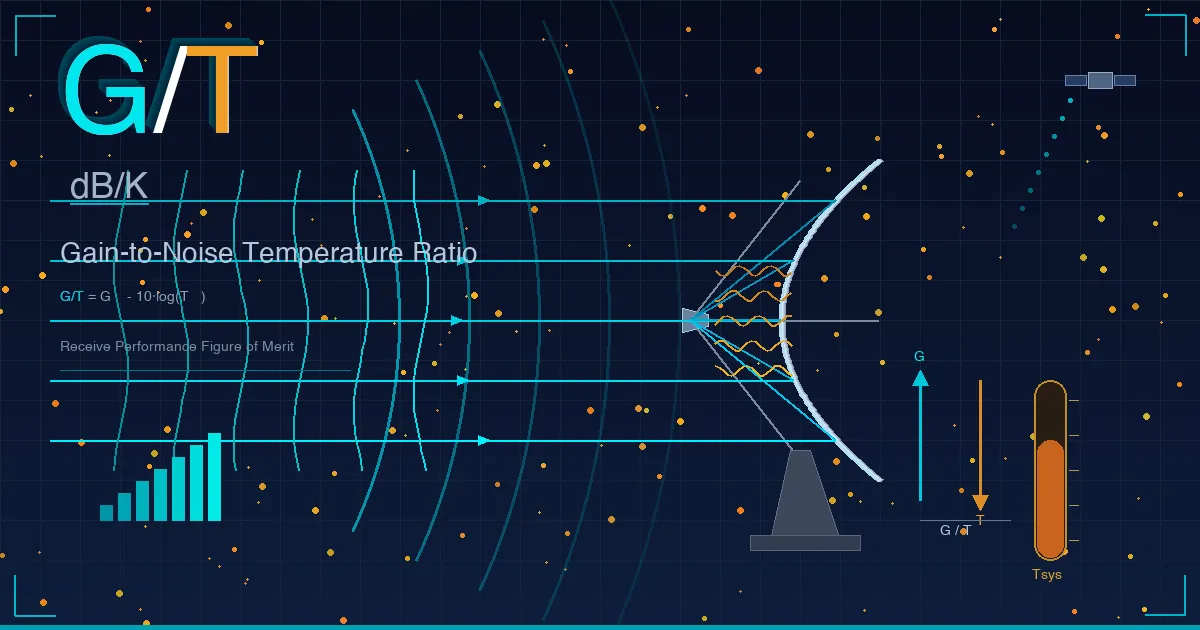
G/T stands for Gain-to-Noise Temperature ratio. It is defined as the ratio of a receive antenna's gain to the total system noise temperature of the receive chain, expressed in dB/K (decibels per kelvin).
Where EIRP answers "how loud is the transmitter?", G/T answers "how sensitive is the receiver?" A higher G/T means the receive station can detect weaker signals, support higher data rates, or operate with greater fade margin — all without changing anything on the transmit side.
The reason engineers use G/T rather than quoting antenna gain and noise figure separately is the same reason EIRP exists: it collapses two interdependent parameters into one figure of merit that can be directly compared across different terminal designs. A 2.4 m dish with a noisy LNB might have the same G/T as a 1.8 m dish with an ultra-low-noise LNB — and from a link budget perspective, those two systems perform identically on receive.
For a detailed look at the antenna designs that produce the gain component of G/T — parabolic reflectors, flat panels, and phased arrays — see the satellite antenna types guide.
Breaking Down the Formula
The G/T formula in logarithmic form is:
G/T (dB/K) = Gr (dBi) − 10·log₁₀(Tsys)Where:
- Gr — Receive antenna gain in dBi (decibels relative to an isotropic radiator) at the operating frequency, in the direction of the satellite.
- Tsys — Total system noise temperature in kelvins, representing all noise sources in the receive chain.
System Noise Temperature
System noise temperature is the sum of all noise contributions referred to the antenna output:
Tsys = Ta + TLNB + Tline- Ta — Antenna noise temperature (K), which includes sky noise, ground noise pickup from sidelobes, and atmospheric absorption. Typically 30–60 K for a well-pointed dish at Ku-band in clear sky, rising to 100–290 K in heavy rain or at low elevation angles.
- TLNB — LNB (or LNA) equivalent noise temperature (K), converted from the noise figure:
TLNB = 290 × (10^(NF/10) − 1). A 0.7 dB noise figure LNB corresponds to approximately 50 K. - Tline — Noise contribution from losses between the antenna feed and the LNB input (feed horn, OMT, waveguide). Typically 5–20 K for a well-designed feed assembly.
Worked Example
A 1.2 m Ku-band receive terminal:
| Parameter | Value | Source |
|---|---|---|
| Antenna gain at 12.5 GHz | 42.0 dBi | Calculated from 1.2 m dish, 65% efficiency |
| Antenna noise temperature (Ta) | 45 K | Clear sky, 30° elevation |
| LNB noise temperature (TLNB) | 55 K | 0.8 dB noise figure |
| Feed/waveguide loss contribution (Tline) | 10 K | Short waveguide run |
| Total Tsys | 110 K | Ta + TLNB + Tline |
G/T = 42.0 − 10·log₁₀(110)
G/T = 42.0 − 20.4
G/T = 21.6 dB/K
This 21.6 dB/K value goes directly into the link budget as the receive station's figure of merit.
What Affects G/T?
Several factors determine — and can degrade — the G/T of a SATCOM receive station:
Dish Size and Antenna Gain
Antenna gain is the numerator of G/T. Gain is proportional to the square of the dish diameter and the square of the operating frequency. Doubling the dish diameter adds approximately 6 dB of gain and therefore approximately 6 dB of G/T, assuming system noise temperature stays constant.
Frequency Band
Moving from Ku-band to Ka-band on the same dish increases antenna gain by roughly 4–5 dB due to the shorter wavelength. However, Ka-band also increases atmospheric noise and rain-induced noise, partially offsetting the gain improvement in the G/T calculation. For more on frequency band trade-offs, see the frequency bands guide.
LNB and Receive Chain Noise Figure
The LNB noise figure directly sets the TLNB component of system noise temperature. Reducing LNB noise figure from 1.2 dB to 0.5 dB lowers TLNB from approximately 90 K to 35 K — a significant improvement that can add 1–2 dB to the system G/T without touching the antenna.
Antenna Pointing Errors
An antenna's rated gain is measured at bore-sight. Pointing errors reduce the effective gain. For a 1.2 m Ku-band dish with a 1.5° 3-dB beamwidth, a 0.3° pointing error reduces gain by roughly 1 dB — which is a direct 1 dB reduction in G/T.
Sky Noise and Environmental Noise
The antenna noise temperature Ta is not a fixed number. It changes with:
- Elevation angle — Lower elevation angles increase ground noise pickup through sidelobes and increase the atmospheric path length, raising Ta.
- Rain — Rain along the signal path absorbs energy and re-radiates thermal noise into the antenna. During heavy rain at Ka-band, Ta can rise from 40 K to over 200 K, dramatically reducing G/T.
- Sun interference — When the sun passes behind the satellite (sun transit), the antenna noise temperature can spike by hundreds of kelvins for several minutes.
These environmental effects mean that a terminal's operational G/T is always lower than its clear-sky, bore-sight specification.
G/T in Different SATCOM Environments
G/T requirements vary dramatically across terminal types and operating environments:
| Terminal Type | Band | Typical Dish Size | Typical G/T (dB/K) | Key Challenge |
|---|---|---|---|---|
| Fixed VSAT | Ku | 1.2–2.4 m | 19–27 | Pointing accuracy, rain margin |
| Fixed VSAT | Ka | 0.75–1.8 m | 17–26 | Rain-induced noise increase |
| Maritime stabilized | Ku | 1.0–2.4 m | 16–25 | Platform motion, scan loss |
| Aero terminal | Ku/Ka | 30–45 cm equiv. | 8–14 | Size constraints, scan loss |
| LEO flat-panel | Ku/Ka | 30–60 cm equiv. | 6–16 | Wide scan angles, beam tracking |
| Gateway earth station | Ka | 7–13 m | 35–42 | Uptime requirements, diversity |
Fixed VSAT terminals achieve the highest G/T for their size because the dish is pointed once and does not move, allowing precise bore-sight alignment and a clean noise environment.
Maritime terminals lose 1–3 dB of G/T compared to equivalent fixed terminals due to the stabilization platform's residual pointing error and the radome's insertion loss. For more on terminal RF chains, see satellite terminal architecture.
Aero and LEO flat-panel terminals use electronically steered arrays that suffer scan loss at wide angles — the effective aperture decreases as the beam steers away from broadside, reducing gain and G/T. A flat panel that achieves 14 dB/K at broadside might deliver only 8 dB/K when scanning to 60° from zenith.
Why G/T Matters in Link Budgets
In the standard satellite link budget equation, the received carrier-to-noise ratio is:
C/N (dB) = EIRP (dBW) + G/T (dB/K) − k (dBW/K/Hz) − B (dBHz) − Lp (dB)Where k is Boltzmann's constant (−228.6 dBW/K/Hz), B is the noise bandwidth, and Lp is the path loss (including free-space loss and atmospheric attenuation).
G/T appears as a direct additive term. Every dB of G/T improvement translates directly into 1 dB of C/N improvement — which in turn enables higher-order modulation through adaptive coding and modulation (ACM), increasing throughput without additional spectrum.
The Design Trade-off
Improving G/T means either increasing antenna gain (larger dish, higher cost, more wind loading, harder to install) or reducing system noise temperature (better LNB, more expensive feed assembly). Terminal designers balance these factors against cost, size, and weight constraints:
- Cost-sensitive remote VSAT: Use a 1.2 m dish with a standard 0.7 dB NF LNB — adequate G/T for the satellite's downlink EIRP.
- Bandwidth-hungry gateway: Use a 9 m dish with a cryogenically cooled LNA — maximum G/T to support hundreds of MHz of throughput per polarization.
- Size-constrained aero terminal: Accept lower G/T and compensate with higher satellite EIRP (HTS spot beams) and more aggressive ACM.
G/T vs Other Common Metrics
G/T is one of several system-level figures of merit in satellite engineering. The table below clarifies how they differ:
| Metric | Definition | Units | Direction | What It Tells You |
|---|---|---|---|---|
| G/T | Receive antenna gain minus system noise temperature | dB/K | Receive | How sensitive the receive station is |
| Antenna Gain (Gr) | Directive gain of the receive antenna alone | dBi | Either | How much the antenna concentrates energy |
| EIRP | Transmit power + antenna gain − feed losses | dBW | Transmit | How strong the transmitted signal is |
| C/N | Carrier power to noise power ratio at the demodulator | dB | System | Overall link quality after both ends combine |
| Eb/N0 | Energy per bit to noise spectral density ratio | dB | System | Bit-level performance for a given modulation/coding |
G/T vs Antenna Gain
Antenna gain alone does not determine receive performance — a 50 dBi gateway antenna with a noisy receive chain (high Tsys) could have lower G/T than a 42 dBi VSAT with an ultra-low-noise LNB. G/T accounts for the complete receive system; gain does not.
G/T vs EIRP
EIRP characterizes the transmit side; G/T characterizes the receive side. A complete link budget requires both: the transmitter's EIRP sets how much power arrives at the receiver, and the receiver's G/T determines how effectively that power is converted into usable signal above the noise floor.
G/T vs C/N
C/N is the result of combining EIRP, G/T, path loss, and bandwidth. G/T is a property of the receive station alone, while C/N depends on the entire end-to-end link. You can improve C/N by increasing either EIRP or G/T (or reducing path loss or bandwidth).
G/T vs Eb/N0
Eb/N0 normalizes C/N to a per-bit basis, accounting for the data rate and coding scheme. G/T feeds into the C/N calculation, which is then converted to Eb/N0 for comparison against the demodulator's threshold.
Practical Examples
Example 1: 1.2 m vs 1.8 m Ku-band Receive Dish
Compare the G/T of two fixed VSAT receive terminals using the same LNB:
| Parameter | 1.2 m Dish | 1.8 m Dish |
|---|---|---|
| Antenna gain at 12.5 GHz | 42.0 dBi | 45.5 dBi |
| Antenna noise temp (Ta) | 45 K | 40 K |
| LNB noise temp (TLNB) | 55 K | 55 K |
| Feed loss contribution (Tline) | 10 K | 10 K |
| Tsys | 110 K | 105 K |
| 10·log₁₀(Tsys) | 20.4 dB | 20.2 dB |
G/T (1.2 m) = 42.0 − 20.4 = 21.6 dB/K
G/T (1.8 m) = 45.5 − 20.2 = 25.3 dB/K
Difference = 3.7 dB
The 1.8 m dish delivers 3.7 dB higher G/T. Most of this improvement comes from the 3.5 dB gain increase (dish area ratio: (1.8/1.2)² = 2.25 → 3.5 dB). The slightly lower antenna noise temperature on the larger dish (narrower beamwidth picks up less ground noise) adds another 0.2 dB.
In a link budget, this 3.7 dB G/T advantage translates to 3.7 dB more C/N — enough to move from QPSK 3/4 to 8PSK 2/3 under ACM, increasing throughput by roughly 30%.
Example 2: Ku-band vs Ka-band Receive on the Same 1.2 m Dish
How does frequency band affect G/T on identical hardware (except for the feed and LNB)?
| Parameter | Ku-band (12.5 GHz) | Ka-band (20.0 GHz) |
|---|---|---|
| Antenna gain | 42.0 dBi | 46.1 dBi |
| Antenna noise temp (Ta) | 45 K | 70 K |
| LNB noise temp (TLNB) | 55 K | 100 K |
| Feed loss contribution (Tline) | 10 K | 15 K |
| Tsys | 110 K | 185 K |
| 10·log₁₀(Tsys) | 20.4 dB | 22.7 dB |
G/T (Ku) = 42.0 − 20.4 = 21.6 dB/K
G/T (Ka) = 46.1 − 22.7 = 23.4 dB/K
Difference = 1.8 dB advantage for Ka-band (clear sky)
Ka-band gains 4.1 dB in antenna gain but loses 2.3 dB to higher system noise temperature, yielding a net 1.8 dB G/T advantage in clear sky. However, during a moderate rain event at Ka-band, Ta can rise to 200 K and atmospheric attenuation adds several dB of additional path loss — quickly eroding the clear-sky advantage. This is why Ka-band systems require more aggressive rain fade margin and benefit heavily from site diversity.
Common Mistakes
-
Focusing only on antenna gain. A large dish with a noisy LNB can have lower G/T than a smaller dish with a premium low-noise receive chain. Always evaluate gain and noise temperature together.
-
Ignoring system noise temperature. Quoting antenna gain as if it were G/T overstates receive performance. The noise temperature denominator is just as important as the gain numerator.
-
Confusing antenna noise temperature with system noise temperature. Antenna noise temperature (Ta) is only one component of Tsys. The LNB, feed losses, and cable losses all contribute additional noise that must be included.
-
Not accounting for rain-induced noise. Rain raises antenna noise temperature significantly, especially at Ka-band. A terminal specified at 23 dB/K in clear sky might operate at only 18 dB/K during a rain event — a 5 dB degradation that stacks on top of rain attenuation.
-
Misreading terminal spec sheets. Manufacturers often quote peak bore-sight G/T under ideal conditions. Operational G/T — accounting for pointing errors, radome losses, and typical elevation angles — can be 2–4 dB lower.
-
Ignoring scan loss on phased arrays. Electronically steered flat-panel antennas lose effective aperture as the beam steers away from broadside. A phased array specified at 14 dB/K at zenith may deliver only 8 dB/K at 60° scan angle — a 6 dB penalty that must be included in the link budget for low-elevation passes.
Frequently Asked Questions
What does G/T measure? G/T measures the overall sensitivity of a satellite receive station. It combines the antenna's ability to collect signal (gain) with the receive chain's noise performance (system noise temperature) into a single figure of merit expressed in dB/K. Higher G/T means the station can detect weaker signals or achieve higher data rates on the same link.
What is a typical G/T for a VSAT terminal? For fixed Ku-band VSAT terminals, G/T ranges from about 19 dB/K (1.2 m dish) to 27 dB/K (2.4 m dish). Ka-band terminals of the same size achieve similar or slightly higher G/T in clear sky, but their G/T degrades more in rain. Maritime and aero terminals typically have 3–6 dB lower G/T than equivalent fixed terminals due to radome losses, pointing errors, and size constraints.
How does rain affect G/T? Rain raises the antenna noise temperature by absorbing signal energy and re-radiating thermal noise into the antenna. At Ka-band, heavy rain can increase Ta from 40–70 K to over 200 K, reducing G/T by 3–5 dB. This G/T degradation is in addition to the rain attenuation on the signal path, making the total link impact even larger.
What is the difference between G/T and C/N? G/T is a property of the receive station alone — it does not depend on the transmitted signal, the path loss, or the bandwidth. C/N (carrier-to-noise ratio) is the end-to-end result that depends on the transmitter's EIRP, the path loss, the receiver's G/T, and the noise bandwidth. G/T is an input to the C/N calculation; C/N is the output.
Can I improve G/T without changing the antenna? Yes. Upgrading to a lower noise figure LNB is the most cost-effective way to improve G/T on an existing installation. Reducing LNB noise figure from 1.2 dB to 0.5 dB can improve G/T by 1–2 dB. Minimizing cable losses between the feed and LNB, improving the feed horn design, and ensuring proper polarization alignment also help.
Why is G/T expressed in dB/K instead of just dB? The denominator of G/T is noise temperature in kelvins, so the ratio has units of 1/K (per kelvin). When expressed in logarithmic form, this becomes dB/K. The unit reminds engineers that G/T is not a pure power ratio — it incorporates the noise environment as well as the antenna performance.
How does satellite G/T compare to ground terminal G/T? Satellite receive antennas (used for the uplink) typically have lower G/T than large gateway earth stations but higher G/T than small user terminals. A GEO satellite receive antenna might have a G/T of 5–10 dB/K per beam, while a 9 m gateway has 38–42 dB/K and a 1.2 m VSAT has 19–22 dB/K.
Does G/T change with frequency? Yes. Both the gain and noise temperature components are frequency-dependent. Antenna gain increases with frequency (for a given dish size), but atmospheric noise, LNB noise temperature, and rain-induced noise also tend to increase at higher frequencies. The net effect on G/T depends on the specific system design and operating conditions.
Key Takeaways
- G/T is the receive-side figure of merit that tells you how sensitive a satellite terminal is — the higher the G/T, the better the station can pull signal out of noise.
- The formula is G/T = Gr − 10·log₁₀(Tsys). It combines antenna gain and total system noise temperature into one number that feeds directly into the link budget.
- System noise temperature includes everything: antenna noise, LNB noise, and feed/cable losses. Ignoring any component overstates performance.
- Environmental conditions degrade G/T in real time. Rain, low elevation angles, and sun transit all raise antenna noise temperature, reducing G/T below the clear-sky specification.
- Upgrading the LNB is often the cheapest G/T improvement. A lower noise figure LNB can add 1–2 dB of G/T without changing the antenna or its installation.
- G/T and EIRP together determine link performance. The transmitter's EIRP and the receiver's G/T are the two fundamental figures of merit in every satellite link budget.
Related Articles
- Satellite Link Budget Calculation — Complete guide to link budget analysis where G/T determines the receive-side performance
- Satellite EIRP Explained — The transmit-side counterpart to G/T, covering effective isotropic radiated power
- Satellite Antenna Types Guide — Dish, flat-panel, and phased-array designs that determine the gain component of G/T
- Satellite Terminal Architecture — LNB, modem, and RF chain components that set system noise temperature
- Rain Fade in Satellite Communications — How rain degrades G/T by raising antenna noise temperature
- Adaptive Coding and Modulation in Satellite Systems — How ACM responds to C/N changes driven by G/T variations
- HTS Spot Beams and Beamforming Explained — How high-throughput satellites use concentrated EIRP to compensate for lower terminal G/T
Author

Organizational byline for SATCOM Index technical content. A named technical reviewer appears separately only when identity, scope, and permission are verified.
Categories
More Posts

Satellite Glossary: S-Z
Satellite communication terminology and definitions from S to Z.
Satellite Frequency Bands: L, S, C, X, Ku and Ka
Understand L, S, C, X, Ku and Ka labels, ITU allocations, uplink/downlink direction, propagation, antenna scaling, and a defensible selection workflow.

Hybrid Satellite Networks: Multi-Orbit (LEO + GEO) Architecture and Design Considerations
Engineering guide to hybrid satellite network architecture—combining LEO and GEO orbits for latency, redundancy, and throughput optimization in enterprise and carrier deployments.