

4 Types of Satellite Antennas: Parabolic to Phased Array
Compare parabolic dishes (41 dBi at 1.2 m), phased arrays, flat panels, and stabilized maritime antennas — with gain, size, and VSAT selection guidance.
The antenna is the single most visible component in any satellite communications system, and its type determines virtually every downstream engineering decision — from link budget margin and tracking architecture to installation complexity, operational cost, and environmental survivability. Choosing the wrong antenna type for a given application can mean the difference between a reliable, high-throughput link and one that suffers chronic outages, excessive maintenance, or prohibitive cost.
This article provides a comprehensive engineering reference covering the four major satellite antenna categories: parabolic dish antennas, electronically steered phased arrays, flat panel antennas, and gyro-stabilized maritime antennas. It then examines how each type integrates into a complete VSAT system and concludes with a practical selection guide. The intended audience is RF engineers, SATCOM integrators, solution architects, and procurement professionals evaluating antenna options for fixed, mobile, or maritime deployments.
Key terms used in this article — For complete definitions, see the Glossary A–F and Glossary G–L.
- Gain: The measure of an antenna's ability to concentrate RF energy in a specific direction, expressed in dBi.
- Beamwidth: The angular width of the antenna's main lobe, typically measured at the half-power (−3 dB) points.
- G/T: Antenna gain-to-noise-temperature ratio — the primary figure of merit for receive performance.
- EIRP: Effective Isotropic Radiated Power — the product of transmit power and antenna gain.
- Aperture efficiency: The ratio of the antenna's effective aperture to its physical aperture area.
For background on how antenna parameters fit into an end-to-end link analysis, see Satellite Link Budget Calculation. For a comparison of how frequency band choice interacts with antenna sizing, see Ku-Band vs Ka-Band Satellite.
Parabolic Dish Antennas
Parabolic dish antennas have been the workhorse of satellite communications since the earliest Intelsat systems in the 1960s. Their fundamental operating principle is geometric optics: an incoming plane wave from the satellite reflects off the parabolic surface and converges at the focal point, where a feed horn collects the concentrated energy. On transmit, the process reverses — the feed illuminates the reflector, which collimates the energy into a narrow beam directed toward the satellite.
Gain and Size Relationship
The gain of a parabolic antenna is governed by the aperture equation:
G = η × (π × D / λ)²
where D is the dish diameter, λ is the wavelength, and η is the aperture efficiency (typically 0.55–0.70 for well-designed feeds). This relationship has a critical implication: gain increases with the square of diameter. Doubling the dish diameter quadruples the gain (+6 dB), but also quadruples the wind loading and roughly doubles the mounting structure cost.
At Ku-band (12–14 GHz, λ ≈ 22 mm), a 1.2 m dish achieves approximately 41 dBi gain, while a 2.4 m dish reaches approximately 47 dBi. At Ka-band (20–30 GHz, λ ≈ 12 mm), the same physical apertures deliver roughly 5–6 dB higher gain due to the shorter wavelength.
Feed Configurations
Three feed configurations dominate commercial satellite antennas:
Prime focus feeds position the feed horn at the focal point directly in front of the reflector. This is the simplest and most cost-effective configuration, commonly used for receive-only C-band and Ku-band dishes in the 1.8–4.5 m range. The feed and its support struts partially block the aperture, reducing efficiency by 5–10%.
Offset feed configurations use an asymmetric section of a larger paraboloid so that the feed sits below the reflector's lower edge. This eliminates aperture blockage entirely, increasing efficiency to 65–75%. Offset feeds dominate the consumer and small VSAT market (0.6–1.8 m) and are standard for DTH reception and interactive VSAT terminals.
Cassegrain feeds use a convex hyperbolic subreflector at the focal point to redirect energy back through a hole in the center of the main reflector, where the feed horn is mounted at or behind the dish surface. This configuration shortens the overall feed assembly length, simplifies waveguide routing for high-power transmit applications, and is the standard for large gateway and teleport antennas (3.8–13 m).
Typical Deployments
Parabolic dishes are deployed across virtually every fixed satellite application:
- Gateway and teleport stations: 7–13 m Cassegrain antennas providing high-EIRP uplinks and sensitive G/T for bulk traffic aggregation. See Satellite Gateways, Teleports, and PoPs for detailed architecture.
- Fixed VSAT terminals: 0.75–2.4 m offset-feed antennas for enterprise connectivity, cellular backhaul, and maritime shore stations. See VSAT Network Architecture for system-level context.
- Transportable terminals: 1.0–1.8 m flyaway or driveaway antennas for emergency response, military, and broadcast uplink applications.
Parabolic antenna quick specs — A well-designed 1.2 m offset Ku-band VSAT antenna typically delivers 41–42 dBi gain, 0.8° half-power beamwidth, 21–23 dB/K G/T, and weighs 25–40 kg including mount. Wind survival is typically rated to 200 km/h (stowed) and operational performance is maintained up to 72 km/h sustained wind.
Phased Array Antennas
Phased array antennas represent the most significant architectural shift in satellite terminals since the transition from C-band to Ku-band. Instead of a single large reflector with a feed, a phased array consists of hundreds to thousands of small radiating elements, each with individually controlled phase and (in active arrays) amplitude. By adjusting the phase relationships across the element grid, the antenna can electronically steer its beam in any direction within its scan volume — with no moving parts.
Beamforming Fundamentals
Each element in a phased array radiates a low-gain pattern. When all elements radiate coherently with appropriate phase offsets, their individual contributions add constructively in the desired direction and destructively elsewhere, forming a narrow beam. The array gain is approximately:
G_array ≈ G_element × N × η_array
where N is the number of elements and η_array accounts for element coupling, quantization losses, and scan-dependent effects. A 1,000-element active array at Ka-band with properly designed elements can achieve 35–38 dBi broadside gain.
The beam is steered by applying a linear phase gradient across the aperture. For a one-dimensional scan to angle θ from broadside, the inter-element phase shift is:
Δφ = (2π × d × sin θ) / λ
where d is the element spacing (typically λ/2 to avoid grating lobes). Two-dimensional steering extends this to both azimuth and elevation.
Electronic vs Mechanical Steering
Purely electronic steering offers several fundamental advantages over mechanical pointing:
- Speed: Beam repositioning in microseconds rather than seconds, enabling rapid satellite handover for LEO tracking.
- Reliability: No motors, gears, or bearings to wear out. Mean time between failures (MTBF) can exceed 100,000 hours.
- Profile: Flat or conformal form factor suitable for aeronautical, vehicular, and shipboard installations where wind loading and drag matter.
- Multi-beam capability: Advanced arrays can form multiple simultaneous beams, enabling connections to two or more satellites concurrently — critical for LEO constellation handover without service interruption.
However, electronic steering comes with inherent limitations. As the beam scans away from broadside, the effective aperture projected toward the satellite shrinks as cos(θ), causing gain to roll off. At 60° scan angle, gain is reduced by approximately 6 dB compared to broadside, and the beam broadens correspondingly. Most commercial phased arrays specify a usable scan volume of ±60° from broadside, with full performance guaranteed only within ±45°.
LEO Constellation Tracking
Phased arrays are uniquely suited to LEO satellite tracking because LEO satellites traverse the visible sky in 5–10 minutes, requiring continuous beam re-pointing at angular rates up to 2°/second. A mechanically steered dish can track a single LEO satellite but cannot perform the instantaneous "make-before-break" handover to the next satellite that phased arrays enable. This capability is essential for uninterrupted service with constellations like SpaceX Starlink, Amazon Kuiper, and OneWeb.
Flat Panel Antennas
Flat panel antennas occupy a design space between traditional parabolic dishes and full phased arrays. The term encompasses several distinct technologies — from mechanically steered flat-plate slot arrays to hybrid electro-mechanical designs — but all share the characteristic of a thin, planar form factor that is fundamentally different from the curved reflector of a parabolic dish.
Design Principles
Most flat panel satellite antennas use one of three underlying architectures:
Microstrip patch arrays consist of printed metallic patches on a dielectric substrate, fed by a corporate or series feed network. They are lightweight and inexpensive to manufacture but suffer from relatively narrow bandwidth (typically 3–5%) and moderate efficiency (50–60%).
Slot arrays use slots cut into a waveguide or cavity structure as radiating elements. They offer higher efficiency (65–75%) and wider bandwidth than patch arrays, and can be manufactured as single machined or cast pieces for mechanical robustness.
Meta-surface antennas (as pioneered by Kymeta) use a tunable surface of sub-wavelength elements to create a holographic diffraction pattern that steers the beam. This approach eliminates active RF components at each element, potentially reducing cost and power consumption compared to active phased arrays.
Performance Trade-offs
Flat panel antennas face inherent trade-offs compared to parabolic dishes of equivalent gain:
| Parameter | 0.75 m Parabolic Dish (Ku) | Equivalent Flat Panel (Ku) |
|---|---|---|
| Gain | ~38 dBi | 33–36 dBi |
| Aperture efficiency | 60–70% | 40–55% |
| Profile height | 60–80 cm | 5–15 cm |
| Weight | 15–25 kg | 8–15 kg |
| Wind loading | High (sail area) | Low (flush mount) |
| Tracking method | Motorized mount | Electronic or hybrid |
The lower aperture efficiency of flat panels means that for a given gain requirement, a flat panel must have a larger physical area than a parabolic dish. However, the dramatically lower profile and reduced wind loading often make flat panels the only viable option for aeronautical, vehicular, and certain maritime installations where a protruding dish is impractical.
Choose a flat panel when:
- Low profile is mandatory (aircraft, vehicles, low-visibility installations)
- LEO or MEO tracking is required with frequent satellite handovers
- Rapid deployment or portable operation is needed
- Wind loading and aerodynamic drag are critical constraints
- The application tolerates moderate throughput (flat panels typically support 10–100 Mbps rather than 200+ Mbps)
Choose a parabolic dish when:
- Maximum gain per dollar is the primary requirement
- GEO-only operation with a fixed pointing direction
- High-throughput gateway or teleport applications requiring 45+ dBi gain
- Long-term fixed installation where profile height is not a concern
- Budget is constrained — parabolic dishes cost 30–60% less than equivalent-gain flat panels
- The application requires both transmit and receive with high EIRP
Commercial Flat Panel Systems
Several flat panel antenna systems are deployed or in late-stage development:
- Starlink terminals use a phased array flat panel with ~1,200 elements, achieving approximately 33–34 dBi gain at Ku-band with ±60° electronic steering. Designed exclusively for the Starlink LEO constellation.
- Kymeta u8 uses a meta-surface holographic antenna with hybrid electro-mechanical steering, supporting multi-orbit (GEO, MEO, LEO) operation across Ku-band.
- ThinKom ThinSat uses a variable-inclination continuous transverse stub (VICTS) architecture, achieving high aperture efficiency (>60%) in a thin profile for aeronautical and land-mobile applications at Ku and Ka bands.
Stabilized Maritime Antennas
Maritime satellite antennas must maintain precise pointing at a satellite while the vessel pitches, rolls, heaves, and yaws through sea states that can impose angular rates exceeding 30°/second and accelerations above 1 g. This requirement makes maritime antenna systems among the most mechanically complex and expensive components in any shipboard communications installation.
Gyro-Stabilized Pedestal Design
The standard approach for maritime VSAT antennas uses a gyro-stabilized pedestal that isolates the antenna from vessel motion. Two configurations are common:
Three-axis pedestals (azimuth, elevation, cross-elevation) can compensate for all vessel rotations and are the industry standard for antennas up to approximately 1.5 m. The azimuth axis provides 360° continuous rotation, the elevation axis covers 0–90° (or −5° to +90° for polar coverage), and the cross-elevation axis provides ±30° to correct for vessel roll when the antenna is near the horizon.
Four-axis pedestals add a polarization axis that maintains the correct polarization alignment as the antenna tracks across the sky. This is critical for linear-polarized Ku-band operation, where a polarization misalignment of just 5° can cause several dB of cross-polarization interference to adjacent satellites. Many three-axis systems handle polarization correction through a motorized feed rotation mechanism instead.
The pedestal's inertial measurement unit (IMU) — typically combining fiber-optic or MEMS gyroscopes with accelerometers — senses vessel motion and drives the servo motors to keep the antenna pointed at the satellite. Modern systems achieve pointing accuracy of ±0.1° RMS in sea state 5 (significant wave height 2.5–4.0 m) and can maintain lock up to sea state 7.
Radome Protection
All maritime VSAT antennas are enclosed in a radome — a weatherproof enclosure that protects the antenna and pedestal from wind, salt spray, rain, ice, and UV radiation. The radome must be transparent to RF energy with minimal insertion loss (typically <0.5 dB) while withstanding sustained winds up to 180 km/h, green water loading (solid waves breaking over the installation), and continuous salt fog exposure.
Radome materials are typically multi-layer fiberglass or composite sandwich construction, with an outer gelcoat for UV protection and an inner RF-transparent layer designed to minimize reflection and absorption. The radome's RF performance is frequency-dependent — a radome optimized for Ku-band may introduce unacceptable loss at Ka-band, so multi-band installations may require separate radomes or broadband radome designs.
Blockage and Mounting
Antenna placement on a vessel is a critical engineering decision. The ideal location provides an unobstructed 360° view of the sky above the minimum elevation angle (typically 5–10°). In practice, masts, funnels, cranes, and other superstructure create blockage zones where the antenna temporarily loses line-of-sight to the satellite.
A proper blockage analysis maps the vessel's superstructure profile as seen from the proposed antenna mounting location and identifies the azimuth and elevation sectors that are obscured. The analysis then overlays the satellite arc visibility for the vessel's operating routes to determine whether any critical satellite access is blocked. For vessels operating on routes where a single GEO satellite provides coverage, even a 10° blockage zone in the wrong direction can cause periodic service outages of several minutes each time the vessel heading passes through the blocked sector.
For detailed information on maritime satellite connectivity planning, see Maritime Satellite Internet.
VSAT Systems and Antenna Integration
The antenna is only one component of a complete VSAT terminal. A functioning terminal also requires a block upconverter (BUC) for transmit, a low-noise block downconverter (LNB) for receive, a satellite modem for baseband processing, and cabling and power infrastructure to connect everything. The integration approach varies significantly by antenna type.
Integration by Antenna Type
Parabolic dish VSAT terminals use a conventional RF chain: the BUC and LNB mount directly at the feed, connected to the modem indoors via coaxial cable (IFL — inter-facility link). This separation allows flexible modem selection and easy component replacement. The antenna, BUC, and LNB are collectively called the outdoor unit (ODU), while the modem is the indoor unit (IDU).
Phased array terminals integrate the RF front-end (transmit and receive amplifiers, phase shifters, and often the frequency conversion) directly into the antenna assembly. The connection to the indoor modem is typically via Ethernet or a proprietary digital interface rather than analog IFL cables. This tight integration improves RF performance but means the antenna and RF electronics are a single replaceable unit — if the BUC equivalent fails, the entire antenna assembly must be serviced.
Maritime stabilized terminals follow the parabolic integration model (BUC and LNB at the feed, coaxial IFL to below-decks modem) but add the stabilization pedestal, antenna control unit (ACU), and IMU as additional components. The ACU is typically a separate rack-mounted unit that interfaces between the ship's gyrocompass, the IMU, the pedestal servo motors, and the modem's signal quality feedback for closed-loop tracking.
System Integration Comparison
| Component | Parabolic VSAT | Phased Array | Maritime Stabilized |
|---|---|---|---|
| BUC location | Feed-mounted | Integrated in array | Feed-mounted |
| LNB location | Feed-mounted | Integrated in array | Feed-mounted |
| Modem connection | Coaxial IFL | Ethernet / digital | Coaxial IFL |
| Tracking | Fixed or motorized | Electronic | Gyro-stabilized |
| Field-replaceable units | BUC, LNB, feed, modem | Antenna assembly, modem | BUC, LNB, feed, ACU, modem |
| Typical power consumption | 40–120 W | 80–200 W | 100–300 W |
| Installation complexity | Low–moderate | Low (self-contained) | High (pedestal, radome, cabling) |
Mounting and Environmental Considerations
Antenna mounting requirements vary by type and application:
- Fixed VSAT: Concrete pad or roof mount with clear line-of-sight to the satellite arc. Non-penetrating roof mounts with ballast are standard for commercial buildings. Foundation design must account for wind loading — a 2.4 m dish in a 150 km/h wind zone generates over 2,000 N of lateral force.
- Maritime: Dedicated mounting platform on the vessel's superstructure, typically on the monkey island (above the bridge) or on a dedicated mast. Structural reinforcement of the mounting area is usually required. Vibration isolation mounts are recommended for vessels with significant engine-induced vibration.
- Vehicle-mounted: Low-profile flat panel or small stabilized dish on the roof, with cable routing through the vehicle body to the interior modem. Magnetic mounts are used for temporary installations; through-bolt or bonded mounts for permanent installations.
For a broader view of how the antenna and terminal fit into the overall satellite network, see End-to-End Architecture and Terminals.
Antenna Selection Guide
Selecting the right antenna type requires balancing multiple factors against the specific application requirements. The following decision table maps common use cases to recommended antenna types.
| Use Case | Recommended Antenna | Key Reason |
|---|---|---|
| Fixed enterprise VSAT (GEO) | Parabolic dish (0.9–2.4 m) | Best gain/cost ratio, proven reliability |
| Cellular backhaul (GEO) | Parabolic dish (1.2–1.8 m) | High throughput, fixed installation |
| Gateway / teleport | Large parabolic (3.8–13 m) | Maximum gain and EIRP required |
| LEO broadband (consumer) | Flat panel phased array | Electronic tracking, low profile |
| LEO broadband (enterprise) | Phased array or large flat panel | Multi-beam for seamless handover |
| Maritime VSAT (GEO) | Stabilized parabolic (0.6–2.5 m) | Proven sea performance, high gain |
| Maritime VSAT (LEO/multi-orbit) | Stabilized flat panel or phased array | Electronic tracking for LEO, hybrid for multi-orbit |
| Aeronautical | Flat panel (VICTS or phased array) | Low profile mandatory, drag constraints |
| Land mobile (vehicle) | Small flat panel or low-profile stabilized | Low profile, on-the-move operation |
| Military / tactical | Transportable parabolic or phased array | Depends on mobility vs throughput priority |
Key Decision Factors
When evaluating antenna types, prioritize these factors in order:
- Target orbit (GEO, MEO, LEO): GEO allows fixed pointing; LEO requires tracking. This single factor often determines whether a parabolic dish is viable.
- Frequency band: Ka-band antennas are physically smaller for equivalent gain but more affected by rain fade. Dual-band requirements may constrain antenna choices.
- Platform environment: Fixed site, maritime, aeronautical, or land-mobile. Each environment imposes distinct constraints on profile, stabilization, and environmental hardening.
- Throughput requirement: Higher throughput demands higher gain, which favors larger parabolic dishes unless profile constraints intervene.
- Budget: Parabolic dishes remain 2–5× less expensive than equivalent-performance phased arrays or flat panels for most GEO applications.
Frequently Asked Questions
What is the main advantage of a phased array over a parabolic dish? Electronic beam steering with no moving parts. This enables tracking of fast-moving LEO satellites, eliminates mechanical wear, reduces the antenna profile, and allows multi-beam operation for seamless satellite handovers. The trade-off is higher cost, greater power consumption, and lower aperture efficiency compared to an equivalent-diameter parabolic dish.
Can a flat panel antenna match the gain of a parabolic dish? Not for the same physical size. Flat panels have lower aperture efficiency (40–55%) compared to parabolic dishes (60–75%), so a flat panel must be physically larger to achieve equivalent gain. However, for applications where profile height and wind loading matter more than absolute gain, flat panels offer a compelling engineering trade-off.
Why do maritime antennas need gyro stabilization? A GEO satellite at 36,000 km altitude occupies a very small angular position in the sky. A typical Ku-band VSAT antenna has a beamwidth of 1.5–3°, meaning the antenna must maintain pointing accuracy within a fraction of a degree. Ship motion in even moderate seas can produce roll angles exceeding ±15° and roll rates above 10°/second — far exceeding the antenna's beamwidth. Without stabilization, the antenna would lose the satellite signal within seconds of any significant wave encounter.
What size dish do I need for a VSAT installation? This depends on the satellite, transponder plan, desired data rate, and availability target. As a rough guide: 0.75–0.98 m for basic broadband (1–5 Mbps), 1.2 m for medium throughput (5–20 Mbps), and 1.8–2.4 m for high throughput (20–100+ Mbps) on GEO Ku-band HTS services. Ka-band services can achieve similar throughput with smaller dishes due to higher frequency gain. A proper link budget calculation is essential for accurate sizing.
How does rain fade affect antenna selection? Rain fade affects the link budget, which in turn affects the required antenna gain and thus size. In tropical regions with heavy rain, larger antennas or higher-power BUCs may be needed to maintain the same availability target. Ka-band links are particularly sensitive — a system designed for 99.5% availability in Southeast Asia may need a 1.8 m Ka-band dish where a 1.2 m dish would suffice in an arid region. See Rain Fade and Satellite Links for a complete treatment.
Can one antenna work with both GEO and LEO satellites? Some flat panel and phased array antennas are designed for multi-orbit operation. The Kymeta u8 and certain ThinKom models support GEO, MEO, and LEO tracking. However, no single antenna design is optimal for all orbits — GEO favors high gain (large aperture, narrow beam), while LEO tracking favors wide scan volume and fast steering. Multi-orbit antennas typically compromise on peak gain to achieve the required scan range.
What is the typical lifespan of a satellite antenna? Parabolic dishes have essentially unlimited mechanical life if properly maintained — the reflector surface does not wear out. Pedestal bearings and servo motors on tracking or maritime antennas typically require overhaul at 5–8 year intervals. Phased array electronics have a typical MTBF of 50,000–100,000 hours (6–12 years of continuous operation), though graceful degradation means performance declines gradually as individual elements fail rather than catastrophically.
Key Takeaways
- Parabolic dishes remain the most cost-effective and highest-performing antenna type for fixed GEO satellite applications, offering the best gain-per-dollar ratio and proven reliability over decades of deployment.
- Phased arrays are essential for LEO constellation tracking and any application requiring electronic beam steering, multi-beam operation, or a flat form factor — but at significantly higher cost and power consumption.
- Flat panel antennas bridge the gap between dishes and full phased arrays, offering low-profile installation for aeronautical, vehicular, and space-constrained maritime applications at moderate performance levels.
- Maritime stabilized antennas combine a parabolic or flat panel radiating element with a gyro-stabilized pedestal to maintain satellite pointing through vessel motion — adding mechanical complexity but enabling reliable connectivity at sea.
- Antenna selection should be driven first by the target orbit (GEO vs LEO), then by platform constraints (fixed, maritime, aero, mobile), and finally by the throughput and budget requirements.
- Every antenna decision should be validated with a complete link budget analysis that accounts for the antenna's gain, noise temperature, and scan-angle performance in the intended operating environment.
Related Articles
- Maritime Satellite Internet: Connectivity Solutions for Vessels
- Ku-Band vs Ka-Band Satellite: Frequency Comparison Guide
- Rain Fade in Satellite Communications
- Satellite Communication End-to-End Architecture
- VSAT Network Architecture
- Satellite Gateways, Teleports, and PoPs
- Satellite Link Budget Calculation
- Terminals and Remote Sites
Author

Organizational byline for SATCOM Index technical content. A named technical reviewer appears separately only when identity, scope, and permission are verified.
Categories
More Posts
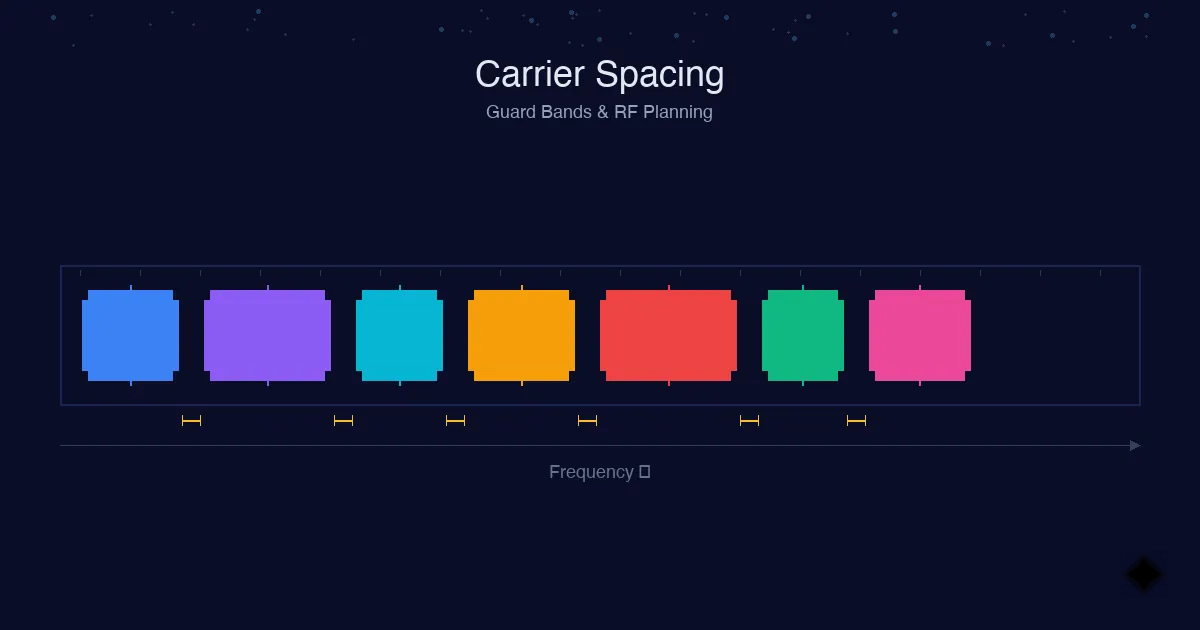
Satellite Carrier Spacing Explained: Why Guard Bands Matter in RF Planning
Engineering guide to satellite carrier spacing covering guard bands, RF planning trade-offs, spectral efficiency, and adjacent carrier interference.
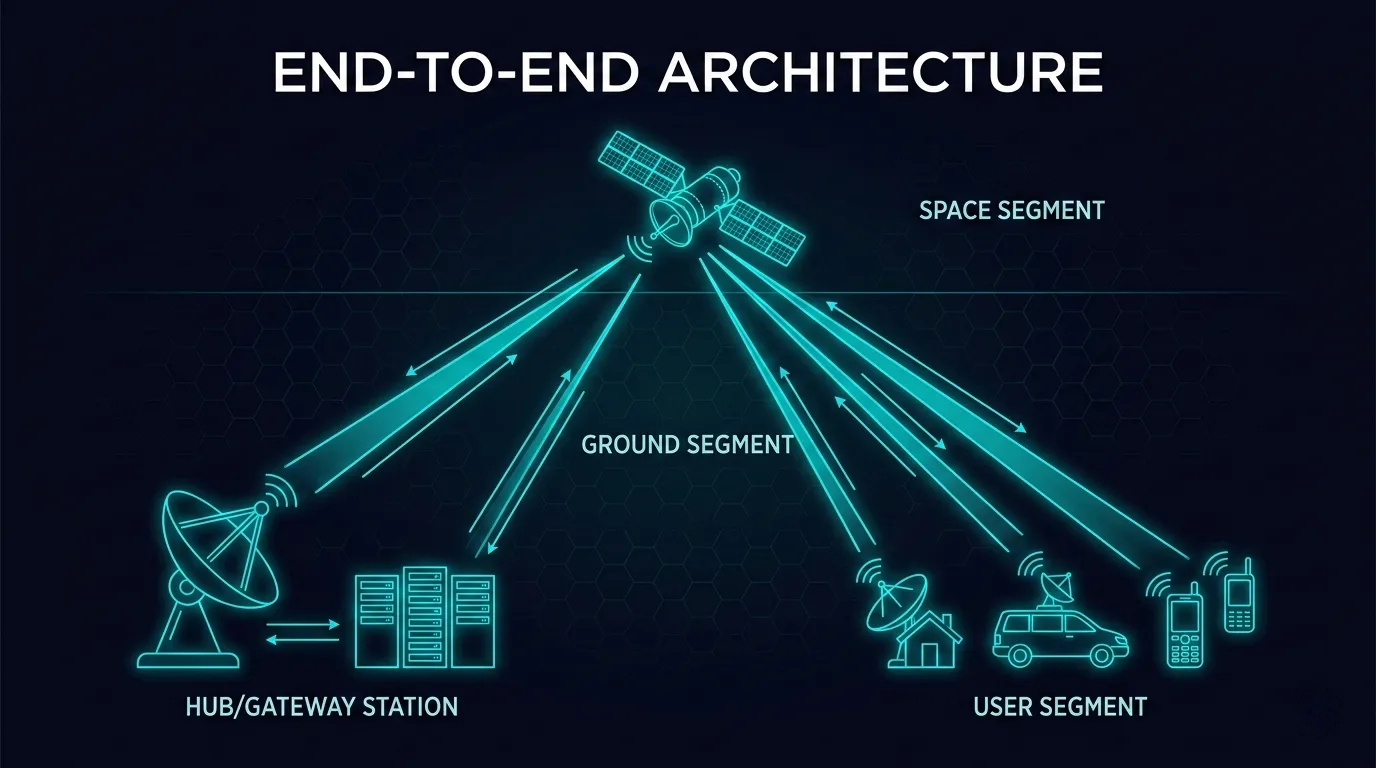
End-to-End Architecture
Complete overview of satellite communication system architecture from space segment to user terminals.

How to Evaluate a Satellite Internet Provider: SLA, Coverage, CIR, Support, and Hidden Costs
Use this practical checklist to evaluate a satellite internet provider, including coverage, SLA, CIR vs shared bandwidth, support model, terminal options, and deployment risks.