
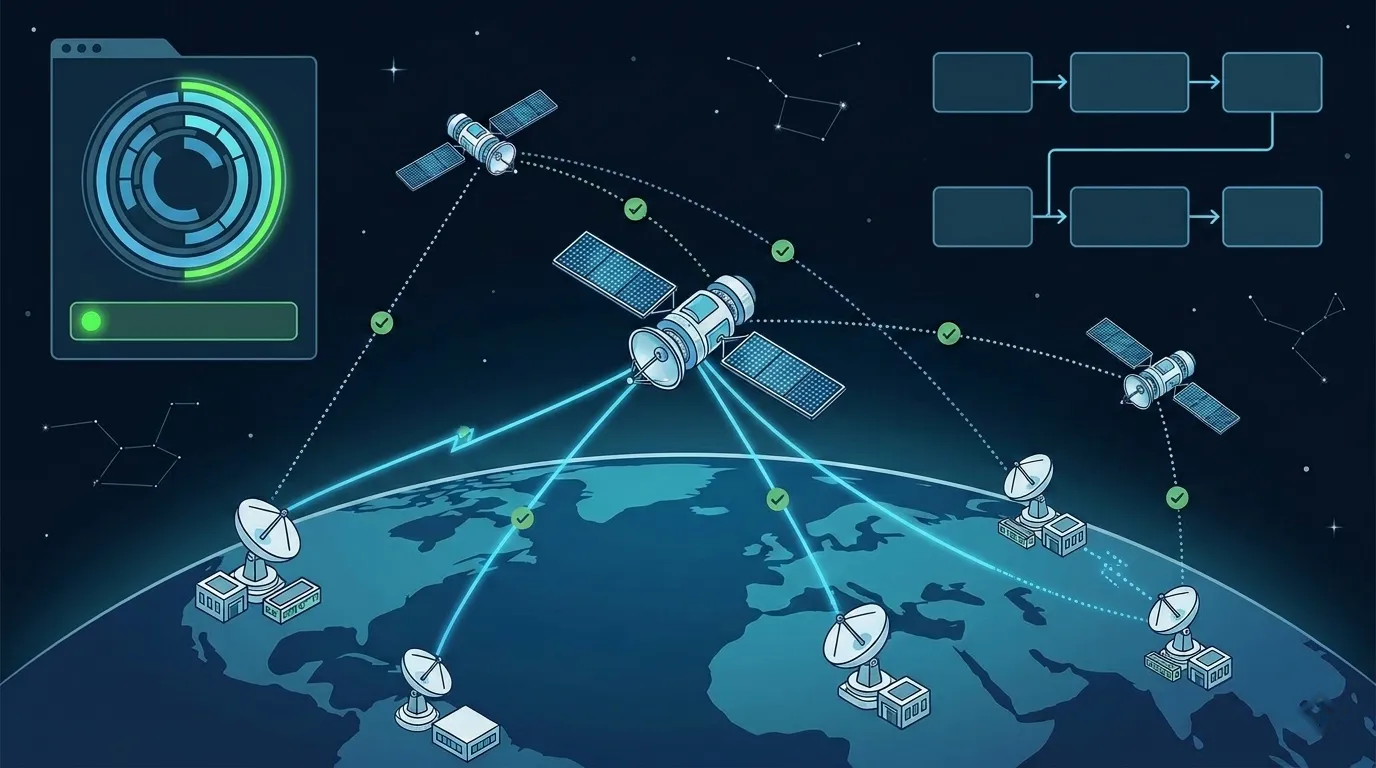
Satellite Link Availability Explained: How Engineers Design 99.9% and 99.99% Satellite Networks
Engineering guide to satellite link availability covering uptime targets, rain fade impact, fade margin design, redundancy strategies, and practical design checklists for 99.5% to 99.99% satellite networks.
Availability is the single most important metric in satellite communications network design. It determines how much fade margin must be reserved, which redundancy strategies are deployed, how large the ground antennas need to be, and ultimately how much the network costs. Every additional "nine" of availability — from 99.9% to 99.99% — requires exponentially more engineering effort and capital investment, yet certain applications demand nothing less.
This article provides a systematic engineering treatment of satellite link availability — from defining what availability means and how it is measured, through the factors that degrade it, to the design techniques that improve it. It covers uptime targets by service type, rain fade and climate impact, link budget fade margin sizing, redundancy strategies with availability formulas, cost-versus-reliability trade-offs, and a practical design checklist for network engineers. It is written for satellite network designers, system engineers, procurement managers, and anyone who needs to specify, design, or evaluate satellite network availability.
Key terms used in this article — For complete definitions, see the Glossary A–F and Glossary M–R.
- Availability: The percentage of time a satellite link meets its minimum performance specification over a defined measurement period (typically one year).
- Fade margin: Extra link budget headroom reserved to maintain service during atmospheric attenuation events such as rain fade.
- MTBF (Mean Time Between Failures): The average operating time between equipment failures, expressed in hours.
- MTTR (Mean Time To Repair): The average time required to restore service after a failure, expressed in hours.
- Site diversity: Deployment of geographically separated ground stations to mitigate localized weather impairments.
- ACM (Adaptive Coding and Modulation): Technique that dynamically adjusts modulation and coding rate to match current link conditions.
For background on how fade margin fits into a complete link analysis, see Satellite Link Budget Calculation. For a detailed treatment of rain fade physics and mitigation techniques, see Rain Fade in Satellite Communications.
What Is Satellite Link Availability
Link availability is the percentage of time that a satellite communication link operates at or above its specified minimum performance threshold. That threshold is typically defined as a minimum data rate, a maximum bit error rate (BER), or a minimum Es/No (energy per symbol to noise density ratio) at the receiving modem.
A link that meets its performance specification 99.9% of the time has an availability of 99.9% and a corresponding unavailability of 0.1%. The unavailability percentage directly converts to an outage budget — the total time per year that the link may be below specification.
The following table converts common availability targets to annual downtime budgets:
| Availability | Unavailability | Downtime per Year | Downtime per Month |
|---|---|---|---|
| 99.0% | 1.0% | 87.6 hours | 7.3 hours |
| 99.5% | 0.5% | 43.8 hours | 3.65 hours |
| 99.7% | 0.3% | 26.3 hours | 2.19 hours |
| 99.9% | 0.1% | 8.76 hours | 43.8 minutes |
| 99.95% | 0.05% | 4.38 hours | 21.9 minutes |
| 99.99% | 0.01% | 52.6 minutes | 4.38 minutes |
It is critical to distinguish between link availability and service availability. Link availability measures the RF link performance between the satellite and the ground terminal. Service availability encompasses the entire end-to-end path — including terrestrial backhaul, gateway infrastructure, network core, and application servers. Service availability is always lower than link availability because it includes additional failure modes beyond the satellite link itself. When evaluating SLAs, always clarify which definition applies.
Typical Availability Targets in SATCOM
Different satellite applications require different availability levels, driven by the consequences of outage and the willingness to pay for higher reliability.
| Service Type | Typical Availability Target | Outage Budget (per year) | Rationale |
|---|---|---|---|
| Consumer broadband | 99.0–99.5% | 44–88 hours | Cost-sensitive; temporary outages are tolerable for residential internet users |
| Enterprise VSAT networks | 99.7–99.9% | 8.8–26.3 hours | Business-critical applications require predictable connectivity with bounded outage |
| Maritime connectivity | 99.5–99.9% | 8.8–43.8 hours | Wide range: crew welfare tolerates lower availability; bridge operations require higher |
| Aviation connectivity | 99.5–99.9% | 8.8–43.8 hours | Passenger internet vs. safety-of-flight communications have different tiers |
| Government / defense | 99.9–99.95% | 4.4–8.8 hours | Mission-critical communications demand high reliability with defined restoration times |
| Mission-critical infrastructure | 99.95–99.99% | 0.9–4.4 hours | SCADA, banking, emergency services — outages have safety or financial consequences |
| Broadcast contribution | 99.99%+ | < 52.6 minutes | Live video feeds cannot tolerate visible interruption; contractual penalties for outage |
Consumer broadband services operate at 99.0–99.5% because the cost of higher availability — larger antennas, more fade margin, site diversity — would make the service uneconomical for residential pricing. Enterprise networks at 99.7–99.9% balance reliability against cost, typically using ACM and moderate fade margins. Mission-critical applications at 99.95–99.99% require redundant paths, site diversity, and often multi-orbit architectures — infrastructure investments that are justified only when the cost of downtime exceeds the cost of prevention.
For VSAT network topology considerations that affect availability, see VSAT Network Architecture.
Factors Affecting Availability
Satellite link availability is degraded by multiple independent and correlated factors. A comprehensive availability analysis must account for all of them.
Rain Fade and Atmospheric Attenuation
Rain fade is the dominant cause of satellite link outage at Ku-band and above. Raindrops absorb and scatter electromagnetic energy along the propagation path, reducing the received signal strength below the modem's demodulation threshold. The severity depends on rainfall rate, frequency band, elevation angle, and geographic location. Ka-band links experience 5–10× the rain attenuation of Ku-band for the same rainfall event. For a complete engineering treatment, see Rain Fade in Satellite Communications.
Atmospheric gases (oxygen and water vapor) produce predictable, always-present attenuation that is accounted for in the clear-sky link budget. While gas absorption alone rarely causes outage, it reduces the available margin for rain fade events.
Equipment Failure
Ground terminal and gateway equipment — modems, BUCs, LNBs, routers, power supplies — all have finite reliability characterized by MTBF and MTTR. Equipment availability is calculated as:
A_equipment = MTBF / (MTBF + MTTR)
A modem with an MTBF of 100,000 hours and an MTTR of 4 hours has an equipment availability of 99.996%. While individual component reliability is high, a terminal with multiple components in series (modem + BUC + LNB + router + cabling) has a combined availability that is the product of individual availabilities — lower than any single component.
Interference
Adjacent satellite interference (ASI), terrestrial interference, and cross-polarization interference can degrade the carrier-to-interference ratio (C/I) and trigger modem unlock. Interference events are typically intermittent and unpredictable, making them difficult to budget in availability calculations. For interference types and mitigation, see SATCOM Interference.
Gateway and Backbone Outages
The satellite link is only one segment of the end-to-end path. Gateway failures — equipment outage, fiber backhaul cuts, power failures — affect all terminals served by that gateway. Gateway availability directly limits service availability regardless of individual link quality.
Power and Site Reliability
Remote terminal sites often rely on unreliable power sources — grid power in developing regions, generator power at temporary installations, solar at unmanned sites. Power system availability can be the weakest link in the chain, particularly for sites without redundant power (UPS + generator backup).
Rain Fade and Climate Impact
Rain fade is the primary weather-driven availability impairment, and its severity varies enormously with geographic location and frequency band.
Tropical regions (Southeast Asia, West Africa, Central/South America) experience the highest rainfall rates and the most intense convective storms. ITU rain zones N, P, and Q have rainfall rates at 0.01% exceedance (corresponding to 99.99% availability) exceeding 100–180 mm/hr — producing devastating Ka-band attenuation of 20–40 dB on a single path. Achieving 99.9% availability at Ka-band in these regions without site diversity is often impractical.
Temperate regions (Europe, eastern North America, Japan) have moderate rainfall with less intense peak events. ITU zones E–K produce 99.9% exceedance rain rates of 15–40 mm/hr, resulting in manageable Ka-band attenuation of 5–15 dB that can typically be handled with ACM and UPC.
Arid regions (Middle East, North Africa, central Australia) experience minimal rainfall, making high availability at both Ku-band and Ka-band relatively straightforward to achieve with modest fade margins.
The frequency band has a dramatic effect on achievable availability for a given fade margin budget:
| Fade Margin | Ku-band (12 GHz) Temperate | Ku-band (12 GHz) Tropical | Ka-band (30 GHz) Temperate | Ka-band (30 GHz) Tropical |
|---|---|---|---|---|
| 3 dB | 99.9% | 99.5% | 99.5% | 99.0% |
| 6 dB | 99.95% | 99.7% | 99.7% | 99.3% |
| 10 dB | 99.99% | 99.9% | 99.9% | 99.5% |
| 15 dB | 99.99%+ | 99.95% | 99.95% | 99.7% |
| 20 dB | 99.99%+ | 99.99% | 99.99% | 99.9% |
These values are representative and depend on specific ITU rain zone, elevation angle, and polarization. The message is clear: the same fade margin budget delivers vastly different availability depending on band and climate. A 10 dB margin at Ku-band in a temperate region achieves 99.99%; the same margin at Ka-band in the tropics delivers only 99.5%.
For frequency band characteristics and selection guidance, see Satellite Frequency Bands Explained. For detailed Ku vs Ka comparison, see Ku-Band vs Ka-Band Satellite.
Link Budget and Fade Margin
Fade margin is the difference between the clear-sky received signal level and the minimum signal level required for the modem to maintain lock (demodulation threshold). It represents the headroom available to absorb atmospheric attenuation before the link enters outage.
The fundamental design relationship is:
Required fade margin (dB) = Rain attenuation at target availability + atmospheric gas attenuation + scintillation margin
Rain attenuation is calculated using the ITU-R P.618 methodology, which takes as inputs the operating frequency, polarization, elevation angle, terminal latitude/longitude, and the target availability percentage. The output is the total path attenuation in dB that will be exceeded for the complementary percentage of time.
Conservative vs. Aggressive Design
Conservative design allocates fade margin purely as static link budget headroom — the BUC transmits at a fixed power level, and the modem operates at a fixed modcod. If the margin is exceeded, the link fails. This approach is simple but spectrally inefficient, because the margin is wasted during clear-sky conditions.
Aggressive design uses ACM and UPC to dynamically reclaim fade margin. During clear sky, the link operates at a high-order modcod (e.g., 16APSK 3/4) for maximum throughput. During rain, ACM falls back to a more robust modcod (e.g., QPSK 1/2), and UPC increases transmit power. The effective fade margin is the sum of ACM dynamic range plus UPC headroom — often 15–20 dB on modern platforms.
The trade-off is throughput degradation during rain. An ACM-based link maintains availability (the modem stays locked) but delivers reduced throughput at lower modcods. For applications that require guaranteed minimum throughput — not just link availability — the effective fade margin for throughput availability is smaller than for link availability.
For a complete link budget methodology including fade margin calculation, see Satellite Link Budget Calculation.
Redundancy Strategies
When single-path fade margin and ACM are insufficient to meet the availability target, engineers deploy redundancy — multiple independent paths whose failures are uncorrelated. The mathematics of parallel redundancy provide dramatic availability improvements.
Parallel Availability Formula
For two independent paths with individual availabilities A₁ and A₂, the combined availability of a system that requires only one path to be operational is:
A_combined = 1 − [(1 − A₁) × (1 − A₂)]
If both paths have 99.5% availability individually (each down 43.8 hours/year), the combined system achieves:
A_combined = 1 − [(0.005) × (0.005)] = 1 − 0.000025 = 99.9975% (13.1 minutes/year downtime)
This transforms two modest 99.5% links into a system exceeding 99.99%. The key requirement is independence — the two paths must fail independently, which means geographic separation for weather-related outages.
Site Diversity
Site diversity is the most effective redundancy strategy for weather-driven outages. Two ground terminals (or gateways) separated by 300 km or more experience nearly independent rain events. When one site fades, traffic is switched to the clear-sky site. Site diversity provides an effective availability gain of 10–15 dB at Ka-band — far exceeding what any single-site technique can achieve.
The cost is significant: each diversity site requires a complete installation (antenna, RF chain, baseband equipment, fiber backhaul). For remote terminals, site diversity is impractical, but for gateway diversity — where the operator controls both sites — it is standard practice for Ka-band HTS networks.
Gateway Diversity
Modern HTS operators deploy 4–8 gateway sites per satellite to serve the full coverage area. Each beam can be served by two or more gateways, with automatic failover. This provides both rain fade resilience and equipment redundancy. Gateway diversity is the primary mechanism by which Ka-band HTS systems achieve 99.9%+ service availability despite the band's high rain sensitivity.
Multi-Satellite Backup
Satellite redundancy protects against satellite equipment failure and transponder outages. An operator may pre-position backup capacity on a second satellite at a nearby orbital slot, with pre-configured terminal profiles ready for rapid switchover. This is common for broadcast and military applications where single-satellite failure is an unacceptable risk.
Multi-Orbit Architectures
Multi-orbit networks combining GEO and LEO (or MEO) satellites provide the highest availability by exploiting fundamentally different link geometries. When a GEO link fades due to rain along a low-elevation path, a LEO satellite at high elevation may have a shorter, less attenuated path through the rain cell. Multi-orbit architectures also protect against constellation-level failures in either orbit. For architecture patterns, see Hybrid Satellite Networks.
For ground infrastructure and gateway architecture, see Satellite Backhaul Explained.
Real-World Availability Trade-offs
The relationship between availability and cost follows an approximately exponential curve. Each additional "nine" of availability — from 99% to 99.9%, from 99.9% to 99.99% — requires roughly a doubling of infrastructure investment.
The Cost Curve
| Availability Target | Typical Infrastructure Required | Relative Cost |
|---|---|---|
| 99.0–99.5% | Standard terminal, basic fade margin | 1× (baseline) |
| 99.7–99.9% | Larger antenna or higher-power BUC, ACM, UPC | 1.5–2× |
| 99.9–99.95% | ACM + UPC + oversized antenna, or Ku-band instead of Ka | 2–3× |
| 99.95–99.99% | Site diversity, gateway diversity, or multi-orbit | 3–5× |
| 99.99%+ | Full site diversity + equipment redundancy + multi-orbit | 5–10× |
This cost escalation is fundamental, not a market inefficiency. Higher availability requires designing against rarer, more extreme events (the tail of the rain rate distribution) and adding redundant systems that sit idle most of the time.
When 99.5% Is Good Enough
For consumer broadband, crew welfare on vessels, and non-critical IoT/telemetry, 99.5% availability is often the economically optimal target. The 43.8 hours of annual outage typically occur during the heaviest rain events, often at night or distributed across many short events. Users tolerate this because the alternative — doubling the terminal cost for 99.9% — is not justified by the application value.
When 99.99% Is Required
Broadcast contribution feeds, banking transaction networks, SCADA for critical infrastructure (pipelines, power grids), emergency services communications, and military command links require 99.95–99.99% availability. For these applications, the cost of downtime — lost revenue, safety risk, regulatory penalties — far exceeds the cost of redundant infrastructure. The design conversation shifts from "how cheaply can we build this?" to "what is the maximum downtime we can accept, and what infrastructure achieves it?"
Design Checklist for Engineers
When planning a satellite network with specific availability targets, follow this checklist:
-
Define the availability metric precisely — Specify whether the target is link availability (RF level) or service availability (end-to-end IP level). Define the minimum performance threshold (minimum data rate, maximum BER, or minimum Es/No). Specify the measurement period (annual, monthly, or worst-month).
-
Identify the climate zone and rain statistics — Determine the ITU rain zone for each terminal location using ITU-R P.837. Extract the rainfall rate at the exceedance percentage corresponding to your availability target. For networks spanning multiple climate zones, design to the worst-case location or define per-site availability budgets.
-
Calculate the required fade margin — Using ITU-R P.618, compute the total rain attenuation for your frequency, polarization, and elevation angle at the target availability. Add atmospheric gas attenuation (ITU-R P.676) and scintillation margin (ITU-R P.618). The sum is your minimum required fade margin.
-
Size the ACM and UPC dynamic range — Determine how much of the fade margin will be provided dynamically by ACM modcod fallback and UPC power increase, versus static link budget headroom. Verify that the modem platform supports sufficient ACM range and that the BUC has adequate power headroom.
-
Evaluate equipment availability — Calculate the series availability of all terminal components (modem, BUC, LNB, router, power supply, cabling) using MTBF and MTTR values. If equipment availability limits the overall target, plan for spares, hot-standby configurations, or redundant components.
-
Assess gateway and backbone availability — Include gateway equipment reliability, fiber backhaul availability, and power system availability in the end-to-end calculation. Identify single points of failure and determine if gateway diversity or backbone redundancy is required.
-
Design redundancy where needed — If single-path availability is insufficient, apply parallel redundancy (site diversity, gateway diversity, multi-satellite, or multi-orbit). Use the parallel availability formula to verify that the combined system meets the target: A_combined = 1 − [(1 − A₁) × (1 − A₂)].
-
Budget for power system reliability — For remote sites, specify UPS autonomy, generator backup, and fuel logistics. Power system downtime often exceeds satellite link downtime at remote locations. Solar-powered sites need battery sizing for multi-day cloud cover.
-
Define monitoring and restoration procedures — Specify how outages will be detected (modem telemetry, SNMP traps, weather radar correlation) and how quickly they will be resolved. MTTR assumptions in the availability calculation must match actual operational capabilities — staffing levels, spare parts logistics, and travel time to remote sites.
-
Validate with historical data — Where possible, compare your theoretical availability prediction against historical performance data from existing terminals in similar locations and climate zones. Theoretical models are only as good as their input assumptions; real-world data provides ground truth.
Frequently Asked Questions
What does 99.9% availability mean in hours per year?
An availability of 99.9% means the link may be below its minimum performance specification for 0.1% of the year — equivalent to 8.76 hours (8 hours and 46 minutes) of total outage annually. This outage budget is typically consumed by rain fade events distributed across the wet season, with individual events lasting minutes to hours depending on rain type (convective vs. stratiform).
Why does heavy rain affect satellite links?
Raindrops absorb and scatter electromagnetic energy along the signal path between the satellite and the ground terminal. The attenuation increases with frequency — Ka-band (30 GHz) experiences 5–10× more attenuation than Ku-band (12 GHz) for the same rainfall rate. When attenuation exceeds the link's fade margin, the received signal drops below the modem's demodulation threshold and the link enters outage. For detailed physics, see Rain Fade in Satellite Communications.
How do operators achieve 99.99% uptime?
Achieving 99.99% availability (less than 52.6 minutes of annual downtime) requires combining multiple techniques: aggressive ACM with wide dynamic range (15–20 dB), UPC for uplink compensation, and most critically — redundancy. Site diversity (multiple geographically separated terminals or gateways), gateway diversity, or multi-orbit architectures provide independent paths that fail at different times. The parallel availability formula shows that two independent 99.5% paths combine to exceed 99.99%.
Is LEO more reliable than GEO?
Not inherently. LEO satellites provide higher elevation angles (shorter rain paths) and lower latency, which can improve weather-related availability. However, LEO constellations introduce unique availability challenges: frequent handovers between satellites, potential coverage gaps, and higher complexity in terminal tracking. GEO provides continuous coverage from a single satellite with no handovers. The most reliable architectures combine GEO and LEO in a multi-orbit approach, using each orbit's strengths to compensate for the other's weaknesses. See Hybrid Satellite Networks.
What is the difference between link availability and service availability?
Link availability measures only the RF satellite link — whether the modem can demodulate the signal above the minimum threshold. Service availability measures the entire end-to-end path from user application to destination, including terrestrial backhaul, gateway infrastructure, network core, and application servers. Service availability is always lower than link availability because it includes additional failure modes. A satellite link at 99.9% availability connected through a gateway with 99.95% availability and a backbone with 99.99% availability yields a service availability of approximately 99.9% × 99.95% × 99.99% ≈ 99.84%.
How does frequency band affect satellite availability?
Lower frequency bands achieve higher availability for the same fade margin because they experience less rain attenuation. C-band (4–8 GHz) is nearly immune to rain fade and can deliver 99.99%+ availability with minimal margin. Ku-band (12–18 GHz) experiences moderate rain fade and typically achieves 99.5–99.9% with ACM. Ka-band (26.5–40 GHz) experiences severe rain fade and requires ACM + UPC + site diversity for 99.9%+ in tropical regions. For a comprehensive band comparison, see Satellite Frequency Bands Explained.
Can ACM improve satellite link availability?
Yes. ACM (Adaptive Coding and Modulation) directly improves link availability by allowing the modem to fall back to more robust modulation and coding schemes during rain fade events. A DVB-S2X modem with full ACM support provides 15–20 dB of dynamic range — meaning it can absorb 15–20 dB of rain attenuation before losing lock. The trade-off is throughput: at the lowest modcods (e.g., QPSK 1/4), the link delivers a fraction of its clear-sky capacity. ACM improves link availability but may not improve throughput availability.
What is MTBF and how does it affect satellite availability?
MTBF (Mean Time Between Failures) is the statistical average operating time between equipment failures. Combined with MTTR (Mean Time To Repair), it determines equipment availability: A = MTBF / (MTBF + MTTR). A typical satellite modem has an MTBF of 80,000–150,000 hours. With a 4-hour MTTR (assuming on-site spare), equipment availability exceeds 99.99%. Equipment failure is rarely the limiting factor in satellite availability — rain fade typically dominates. However, for remote unmanned sites where MTTR may be days or weeks (due to logistics), equipment availability can become the bottleneck.
Key Takeaways
- Availability is the defining design parameter in satellite communications — every element of network design (fade margin, antenna size, redundancy, frequency band selection) flows from the availability target.
- Each additional "nine" roughly doubles cost — the exponential relationship between availability and investment means that the first question in any design is "what availability does the application actually require?"
- Rain fade dominates the availability budget at Ku-band and above — geographic location and frequency band determine how much fade margin is needed, and whether single-site solutions are viable.
- ACM and UPC provide 15–20 dB of dynamic fade margin on modern platforms, enabling 99.7–99.9% availability at Ka-band in temperate regions without site diversity.
- Parallel redundancy transforms availability — two independent 99.5% paths combine to exceed 99.99% using the formula A_combined = 1 − [(1 − A₁) × (1 − A₂)].
- Distinguish link availability from service availability — the end-to-end path includes gateway, backhaul, and core network elements that each contribute additional unavailability.
Related Articles
- Rain Fade in Satellite Communications — Rain attenuation physics, ITU methodology, and six mitigation techniques
- Satellite Link Budget Calculation — Complete link budget methodology including fade margin sizing
- Satellite Frequency Bands Explained — Frequency band characteristics and selection guidance
- Ku-Band vs Ka-Band Satellite — Band comparison with dB-level rain fade data
- Hybrid Satellite Networks — Multi-orbit architectures for enhanced availability
- Satellite Backhaul Explained — Ground infrastructure and backbone connectivity
- VSAT Network Architecture — Network topology and design patterns
- SATCOM Interference — Interference types, detection, and coordination
- Satellite Gateways, Teleports, and PoPs — Gateway diversity and ground infrastructure design
Author

Organizational byline for SATCOM Index technical content. A named technical reviewer appears separately only when identity, scope, and permission are verified.
Categories
More Posts
Remote Site Network Monitoring Over Satellite | Practical Operations Guide
Practical guide to monitoring remote sites over satellite — architecture, KPIs, alerting design, troubleshooting, and bandwidth-efficient strategies for NOC teams managing VSAT networks.
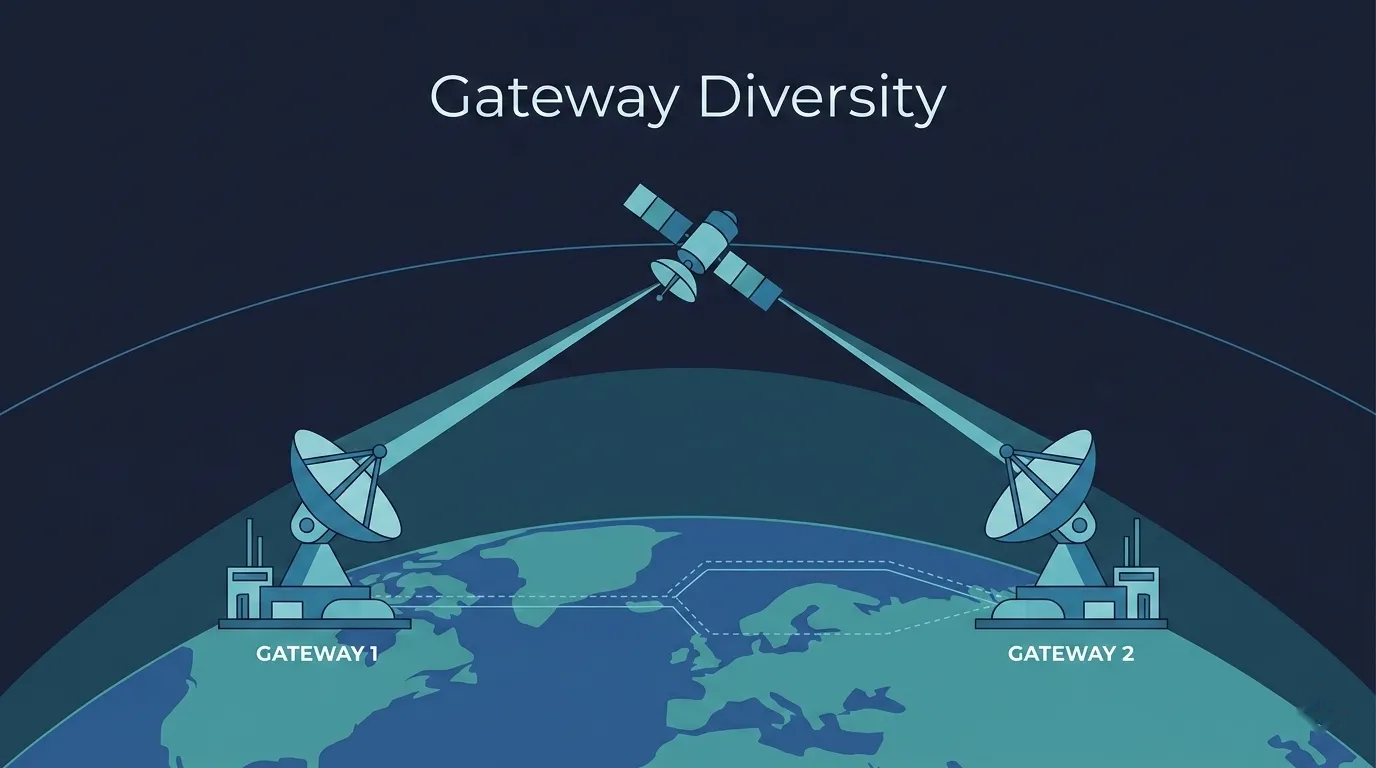
Satellite Gateway Diversity Explained: Improving Availability with Redundant Ground Stations
Engineering guide to satellite gateway diversity covering site redundancy, rain fade mitigation, failover mechanisms, and design considerations for high-availability satellite ground networks.

Hybrid Satellite Networks: Multi-Orbit (LEO + GEO) Architecture and Design Considerations
Engineering guide to hybrid satellite network architecture—combining LEO and GEO orbits for latency, redundancy, and throughput optimization in enterprise and carrier deployments.