

Satellite Service Providers: Roles and Shortlist Guide
Map operator, reseller, integrator and field-service roles, then shortlist satellite offers using current ownership, coverage, contract and support evidence.
What changed: Rebuilt the page around provider roles, current corporate relationships, contracting boundaries, and evidence-based shortlisting; removed the stale provider table, fixed GEO/LEO service assumptions, and deleted unsupported coverage, latency, SLA, licensing, support, and industry recommendations.
A satellite service provider is not one uniform type of company. The seller may own a satellite network, resell another network's plan, combine several networks into a managed service, install the terminal, or perform several of those roles at once. The name on a proposal therefore does not reveal who controls capacity, holds the customer contract, measures the SLA, carries the regulatory obligation, or dispatches field support.
Use this guide to identify those roles, understand current company relationships, and build a defensible longlist. For detailed RFP scoring and contract review, continue to How to Evaluate a Satellite Internet Provider.
Scope note: Organization fact check updated 26 August 2026 against the primary sources listed on this page. The company snapshot is non-exhaustive and is not a market ranking, provider endorsement, coverage claim, or named expert approval. Recheck ownership, legal entity, service availability, authorization, plan, hardware, and contract immediately before procurement.
Provider Evaluation Checklist | VSAT vs Starlink | End-to-End Architecture
Quick Answer
Do not start by asking which satellite provider is “best.” Start with a purchasable service at an exact location or route:
candidate offer = contracting entity
                + upstream network(s)
                + service plan and capacity policy
                + terminal and installation
                + licensed operating scope
                + gateway / terrestrial handoff
                + monitoring and support chain
                + SLA boundary and remedies
                + full commercial terms
A recognizable operator name can sit upstream of a local reseller. A managed provider may combine satellite and terrestrial paths. A local partner may be the party responsible for import, installation, or support but not capacity. None of those structures is automatically good or bad; the risk is leaving the structure undocumented.
The Satellite-Service Roles
ETSI TS 101 545-1 and Report ITU-R S.2278-0 describe multiple system, control, management, and service functions. Commercial organizations can bundle those functions differently.
| Role | What the role may control | What a buyer must identify |
|---|---|---|
| Satellite or network operator | Space segment, beams, gateways, network platform, or wholesale capacity | Exact network, beam, path, available service, restoration options, and whether the buyer contracts directly or through a partner |
| Retail service provider | Plan, billing, terminal bundle, customer support, and service terms | Contracting legal entity, upstream dependencies, measurement boundary, escalation authority, and remedies |
| Managed-service provider or integrator | Multi-network design, SD-WAN, security, private handoff, monitoring, and lifecycle operations | Which components it operates, which it subcontracts, and whether one party accepts end-to-end responsibility |
| Reseller or distributor | Access to a named upstream service, hardware, activation, and first-line support | Current authorization, territory, plan equivalence, renewal path, support escalation, and whether upstream terms pass through |
| Installer or field-service partner | Site survey, mounting, cabling, commissioning, maintenance, and spares | Qualifications, geographic reach, response commitment, test records, and responsibility after acceptance |
| Customer or customer-appointed carrier | LAN/WAN, power, security policy, traffic engineering, terrestrial tail, and application operation | The demarcation point and every customer-owned dependency excluded from the provider SLA |
One company may occupy several rows. Conversely, five logos in a proposal may represent only one underlying satellite network and one failure domain.
What Provider Labels Do Not Prove
Common labels are useful for discovery but unsafe for award decisions:
- “Operator” does not prove direct sale. The service may be available only through a partner in the required country, vertical, or contract size.
- “Global” does not prove service at a coordinate or along a route. Beam geometry, gateway reach, capacity, terminal authorization, plan restrictions, and national approvals can all narrow the usable scope.
- “GEO provider” does not prove CIR, dedicated bandwidth, or an SLA. Those are properties of the quoted service and contract, not the orbit.
- “LEO provider” does not prove best-effort service or the absence of an SLA. For example, Starlink publishes an uptime SLA for eligible Priority-plan and terminal configurations; eligibility, calculation, exclusions, and remedy still have to match the order.
- “Managed service” does not prove end-to-end accountability. Ask which organization can change capacity, routing, gateway, terminal, and support policy, and which one owes the contractual remedy.
- “24/7 support” does not prove 24/7 restoration. Record response, diagnosis, dispatch, spares, access, and resolution commitments separately.
Orbit influences propagation and coverage mechanics, but actual user experience also depends on satellite hops, gateways, terrestrial routing, congestion, traffic policy, terminal state, and the application endpoint. Compare measured end-to-end performance rather than assigning one latency number to an entire provider category.
Current Company-Name Snapshot
Provider lists age quickly because acquisitions, mergers, brands, reseller relationships, and product scopes change. The following snapshot only prevents obvious double counting; it does not establish service availability or capability.
| Names a buyer may encounter | Verified corporate context | Procurement consequence |
|---|---|---|
| SES and Intelsat | SES announced completion of its Intelsat acquisition on 17 July 2025 | Do not count two familiar names as independent parent-company competition without confirming distinct contracting entities, offers, upstream resources, and commercial independence |
| Eutelsat and OneWeb | Eutelsat said on 4 September 2025 that it operated as one company after the OneWeb merger; the LEO constellation continues under the OneWeb name | Treat brand, constellation, seller, partner, plan, terminal, and contractual entity as separate fields |
| Viasat and Inmarsat | Viasat completed its Inmarsat acquisition on 31 May 2023 | Legacy brand or product references do not by themselves identify the current contracting entity, support path, or service terms |
| Starlink | Current plan descriptions, specifications, SLA, and availability are published separately | Record the service address or route, country, plan, hardware, data treatment, SLA eligibility, seller, and order-date terms instead of comparing only the brand |
This table is deliberately not a directory of “major providers.” A useful shortlist must include providers that can produce evidence for the buyer's actual geography, legal scope, service boundary, and operating model. A long global list without that evidence creates false choice.
Map Each Candidate Offer
Before comparing price or orbit, ask the bidder to draw the service path and assign an accountable organization to each segment:
application / customer WAN
        ↕
customer-provider handoff and service edge
        ↕
terrestrial backhaul / internet / private network
        ↕
gateway, hub, or provider PoP
        ↕
satellite network and any inter-satellite path
        ↕
user terminal, RF chain, installation, and site infrastructure
The diagram must show both directions. Add control and management paths, DNS and security dependencies, monitoring probes, power, and any backup path. The architecture guide explains the relevant end-to-end boundaries; the ground-segment guide covers gateway, hub, teleport, PoP, NCC, and NMC distinctions.
For every block, record:
- asset owner and operational controller;
- party named in the customer contract;
- upstream supplier or subcontractor;
- measurement and log source;
- support and escalation owner;
- planned restoration or alternate path;
- SLA inclusion, exclusion, and remedy;
- applicable license, authorization, approval, or customer obligation.
This exposes two common errors: buying “redundant” offers that share the same upstream failure domain, and expecting a reseller to remedy a fault outside its contractual control.
Build the Longlist with Mandatory Gates
Apply pass/fail gates before assigning weighted scores. A low price should not compensate for an unusable location or unauthorized operation.
1. Geography and Operating Mode
Provide exact coordinates, expected activation date, fixed or mobile status, and full routes for vessels, vehicles, or aircraft. Ask for site- or route-specific availability, terminal visibility constraints, and the basis date of the evidence. A public coverage map is a discovery tool, not acceptance evidence.
For a plan-led service, verify the address and mode in the current ordering system and legal terms. Starlink, for example, separates its availability map, plan descriptions, specifications, and eligible Priority SLA; one document does not replace the others.
2. Regulatory and Authorization Chain
Require the bidder to identify the legal entity responsible for each jurisdiction and operating mode. Depending on the case, evidence may involve the service authorization, spectrum or earth-station licensing, terminal type approval, landing or market-access requirements, equipment import, maritime or aeronautical operation, and local partner authority.
Do not ask only, “Are you licensed?” Ask for the applicable instrument, holder, scope, expiry or status, covered equipment and service, and customer obligations. The responsible regulator or qualified local counsel—not a generic provider list—must confirm the final position.
3. Defined Service, Not Headline Speed
Record the forward and return directions separately. Capture expected or committed rates, CIR and MIR definitions where offered, contention or data precedence, quotas, throttling or network-management policy, public or private addressing, handoff, and upgrade rules.
Do not translate “Priority,” “business,” “enterprise,” “dedicated,” or “unlimited” into engineering guarantees. Quote the operative definition and its measurement boundary.
4. Operational Ownership
Identify who monitors the terminal, RF path, gateway, backhaul, service edge, and customer handoff. Request support hours, severity definitions, response and restoration objectives, field-dispatch coverage, spare-parts plan, escalation authority, maintenance windows, and customer-visible evidence.
A bidder can use subcontractors and still deliver a strong service, but the RACI and remedy must survive every handoff.
5. Contract and Exit Path
Compare the same scope and time horizon. Include terminals, mounts, spares, shipping, customs, installation, licensing work, capacity or plan charges, overage, support, maintenance, power, taxes, price changes, upgrades, suspension, relocation, early termination, removal, and data or configuration handover.
The seller should also state what happens if an upstream agreement, satellite, gateway, national authorization, product plan, or hardware model changes during the term.
Minimum Evidence Pack
Use this table to turn a provider claim into auditable evidence.
| Claim | Request before shortlisting | Pass condition |
|---|---|---|
| “Coverage is available” | Exact site or route result, plan, terminal, evidence date, constraints, and activation dependency | All required locations and modes are supported or exceptions are explicitly accepted |
| “Operation is legal” | Jurisdiction-by-jurisdiction responsibility matrix and applicable authorization evidence | Responsible entity, scope, status, and customer obligations are clear |
| “Performance meets the need” | Forward/return definitions, test endpoint, busy-period distribution, loss, jitter, latency, and traffic-policy evidence | Measurement method and acceptance thresholds match the application requirement |
| “Capacity is guaranteed” | Exact CIR/MIR or precedence definition, interval, load condition, exclusions, and enforcement method | Contract language and measurable remedy support the claim |
| “The service has an SLA” | Target, boundary, calculation period, outage threshold, exclusions, maintenance, evidence, claim process, and credit or termination right | The SLA covers the failure and impact the buyer actually cares about |
| “Support is local and 24/7” | NOC and field-service locations, staffing model, escalation tree, dispatch limits, access assumptions, and spare locations | Response and restoration chain is feasible for every site or route |
| “The design is resilient” | Both path diagrams, gateway and terrestrial dependencies, power, DNS, security, management, and failover test | Required failure cases do not share an unaccepted common cause |
| “The quote is lower cost” | Same-scope implementation and recurring cash flows, taxes, changes, exit costs, and assumptions | TCO comparison uses the same currency date, term, quantity, and service boundary |
Only candidates that pass the mandatory gates should proceed to a weighted evaluation. The detailed provider evaluation framework covers SLA, CIR, support, security, TCO, red flags, and a reusable comparison matrix.
Validate Before Award
A pilot is useful only when it represents the deployment risk. Do not prescribe one or two easy sites by default. Select sites, routes, weather conditions, traffic loads, power states, support cases, and failure scenarios that challenge the proposal.
Agree the acceptance plan before ordering. It should define:
- configuration, firmware, plan, policy, and test endpoints;
- measurement tools, clocks, sampling, duration, and raw-data retention;
- forward and return throughput under stated traffic and load;
- latency, jitter, loss, session continuity, and application behavior;
- installation, obstruction, environmental, power, and restart tests;
- fault detection, ticket handling, escalation, dispatch, and restoration evidence;
- primary-to-backup and backup-to-primary behavior where diversity is claimed;
- pass/fail thresholds, exceptions, retest rights, and the consequence of failure.
A hybrid GEO, MEO, LEO, cellular, or terrestrial design is not automatically “best of both worlds.” It creates value only if routing policy works, degraded capacity is sufficient, failure domains are acceptably independent, and one operational model can support the combined system.
Common Shortlisting Mistakes
- Counting brands under the same corporate group as independent competition.
- Counting resellers of the same underlying plan as network diversity.
- Treating operator footprint, a colored country map, or “global” marketing as an installable service.
- Assuming GEO means committed capacity or LEO means no contractual SLA.
- Comparing one offer's MIR with another offer's CIR or expected speed.
- Accepting a percentage SLA without its measurement point, exclusions, outage threshold, and remedy.
- Assuming the bidder owns the NOC, gateway, capacity, field team, or license because it uses those nouns.
- Choosing a fixed number of proposals instead of obtaining enough qualified, materially independent offers for the market and requirement.
- Signing a long term before testing the hardest representative conditions and the support process.
FAQ
Who are the largest or best satellite service providers?
Company scale does not establish fit, and this page does not rank providers. The defensible answer depends on the exact site or route, operating mode, authorization, service plan, terminal, capacity policy, handoff, support chain, contract, and evidence date. Use the corporate snapshot to avoid obsolete names and double counting, then test qualified offers against one requirement.
Is a satellite operator the same as a satellite service provider?
Not necessarily. An operator may sell wholesale capacity, managed services, direct retail offers, or some combination. A service provider may own no spacecraft but still contract, integrate, monitor, and support the customer service. Document functions and accountability rather than inferring them from the company category.
Is it safer to buy direct or through a reseller?
Neither route is universally safer. Direct purchase may shorten some escalation paths. An authorized partner may add essential local licensing, installation, language, billing, integration, or field support. Compare authorization, term equivalence, support escalation, commercial continuity, and end-to-end accountability.
How many provider proposals should I request?
There is no universal minimum. Seek enough qualified and materially independent offers to test price and design alternatives. In a constrained country, route, frequency, terminal, or security environment, three logos may still represent one network—or only one bidder may pass mandatory gates.
Should I shortlist GEO or LEO providers first?
Shortlist services, not orbit labels. Translate application needs into measurable latency, availability, capacity, security, mobility, and support requirements. Then determine which offered GEO, MEO, LEO, or hybrid paths satisfy those requirements at the actual location and date.
How do I verify a provider's coverage?
Combine current address- or route-level service availability, the offered plan and terminal, technical path or link evidence where applicable, capacity confirmation, obstruction and installation assessment, authorization status, and a witnessed acceptance test. A marketing footprint alone is insufficient.
Related Guides
- How to Evaluate a Satellite Internet Provider — detailed RFP, SLA, CIR, support, TCO, and proposal scoring
- VSAT vs Starlink — plan- and contract-level comparison without treating VSAT as one service
- VSAT Network Architecture — terminal, payload, gateway, control, management, and service-edge roles
- End-to-End Architecture — system boundaries, interfaces, owners, and acceptance evidence
- Ground Segment — gateway, teleport, hub, PoP, NCC, NMC, and terrestrial handoff distinctions
Author

Organizational byline for SATCOM Index technical content. A named technical reviewer appears separately only when identity, scope, and permission are verified.
Categories
More Posts

Satellite Link Budget Calculation with Example
Calculate a satellite link budget step by step: EIRP, antenna gain, FSPL, G/T, C/N0, C/N, uplink/downlink combination, rain loss, and link margin.

How Satellite Internet Works: Architecture, Latency, and Real-World Operation
Learn how satellite internet works, including GEO vs LEO satellites, ground stations, latency, and how data travels through space networks.
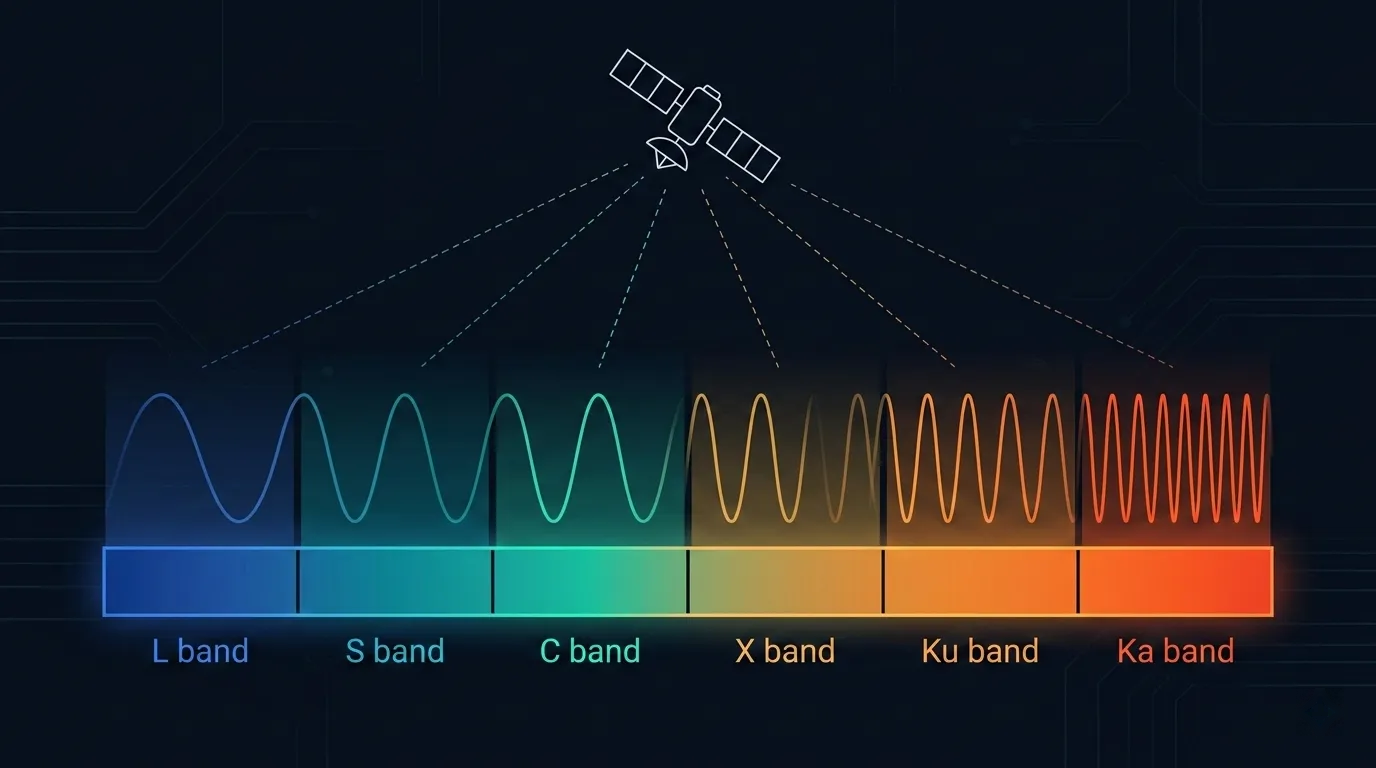
Satellite Frequency Bands: L, S, C, X, Ku and Ka
Understand L, S, C, X, Ku and Ka labels, ITU allocations, uplink/downlink direction, propagation, antenna scaling, and a defensible selection workflow.