
Satellite Beam Handover Explained: How Terminals Switch Between Beams and Satellites
Engineering guide to satellite beam handover covering intra-beam, inter-beam, and inter-satellite handover types, GEO and LEO switching mechanisms, terminal tracking, latency impact, and network resource allocation.
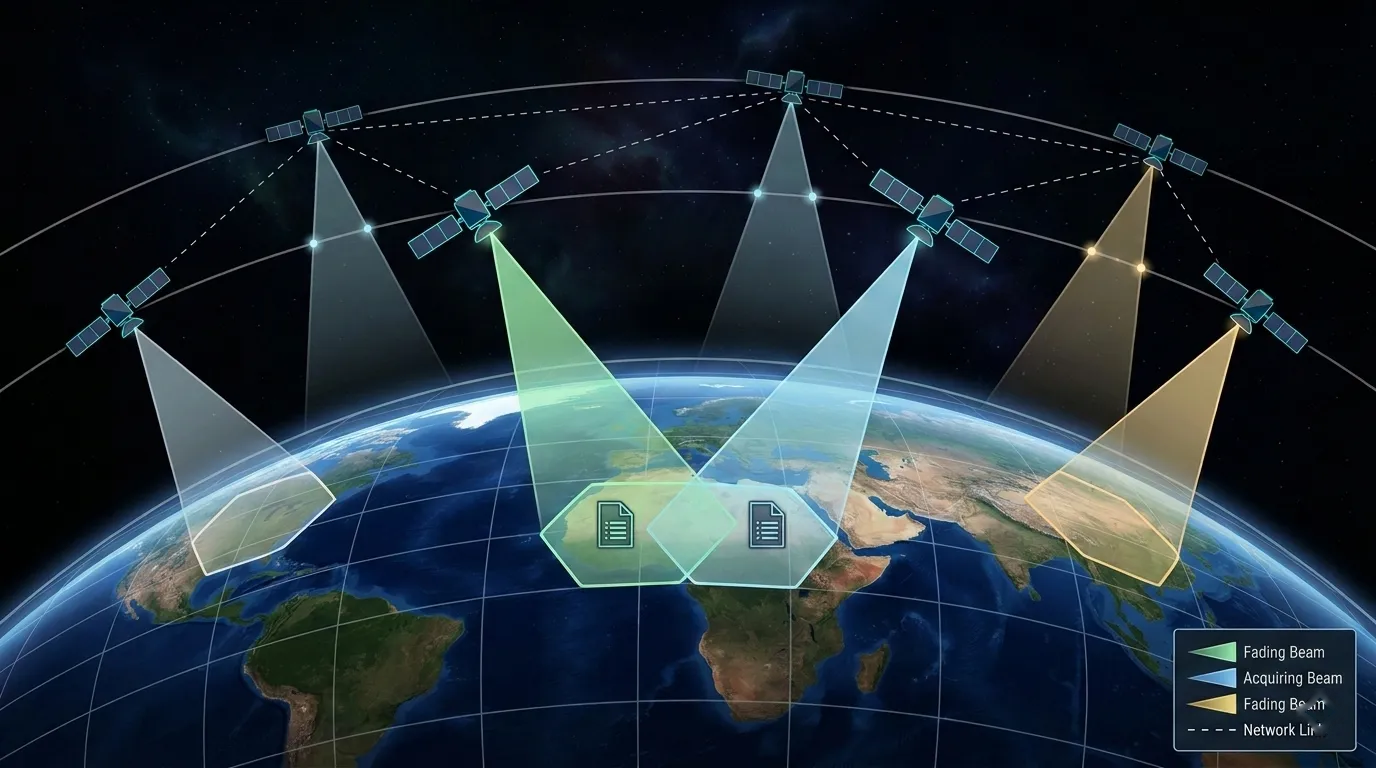
Modern satellite networks no longer rely on a single wide beam covering an entire continent. High-throughput satellites (HTS) divide their coverage into dozens or hundreds of narrow spot beams, and low-Earth-orbit (LEO) constellations use thousands of fast-moving spacecraft that rise and set every few minutes. In both architectures, a terminal must transition between beams—and sometimes between satellites—to maintain an uninterrupted data session. This transition is beam handover.
Beam handover is the satellite equivalent of cellular handoff. When a mobile phone crosses from one cell tower's coverage into the next, the network reassigns the call to the new tower without dropping it. Satellite networks face the same challenge, but the geometry is more complex: the beams may be fixed while the terminal moves (GEO HTS), or the beams themselves may sweep across the ground as the satellite orbits (LEO). In either case, the network must coordinate frequency assignments, timing, power levels, and routing to ensure continuity.
This article is an engineering deep-dive into beam handover: the types of handover, how they differ between GEO and LEO networks, what the terminal must do physically to track and switch, and how well-designed systems minimize latency and packet loss during transitions.
Key terms used in this article: beam handover (switching a terminal from one beam to another), make-before-break (establishing the new link before releasing the old one), phased array (electronically steered antenna with no moving parts), dwell time (how long a LEO satellite remains above a terminal's minimum elevation), ephemeris (predicted orbital position data), co-channel interference (unwanted signal from a beam using the same frequency), dual-illuminate (briefly transmitting to a terminal from two beams simultaneously during handover).
What Is Beam Handover
Beam handover is the process of transferring a terminal's active communication session from one beam to another—or from one satellite to another—without terminating the session. The network reassigns the terminal to a new beam that provides better geometry, stronger signal, or is the only beam currently covering the terminal's location.
In traditional single wide-beam GEO satellites, handover essentially did not exist. A single beam covered an entire ocean region or continent, and every terminal within that footprint communicated through the same beam for the life of the session. The only scenario requiring a "handover" was switching between satellites when a terminal physically moved beyond the orbital arc's coverage—a rare event that was typically handled manually.
The shift to multi-beam HTS and LEO constellations has made handover a routine, automated operation. An HTS may divide a continent into 200 spot beams, each only 200–600 km across. A ship crossing the Atlantic traverses dozens of beam boundaries. A LEO satellite passes overhead in 5–10 minutes, and the terminal must switch to the next satellite in the constellation before the current one sets below the horizon. Handover is no longer exceptional—it is a continuous background process that the network must execute reliably thousands of times per day across its terminal population.
It is important to distinguish beam handover from frequency handover. Frequency handover changes the carrier frequency or channel assignment within the same beam—typically for interference mitigation or load balancing—without changing the beam itself. Beam handover changes the beam (and potentially the satellite), which may or may not also involve a frequency change depending on the frequency reuse plan.
Types of Handover
Satellite beam handover falls into three categories based on what changes during the transition. Each type has different triggers, complexity, and impact on service continuity.
Intra-Beam Handover
Intra-beam handover reassigns a terminal to a different carrier, time slot, or channel within the same beam. The terminal does not change beams—it changes its resource allocation within the current beam. This type of handover is triggered by load balancing (redistributing terminals across carriers to equalize utilization), interference mitigation (moving a terminal away from a degraded carrier), or adaptive coding and modulation changes that require a different carrier configuration.
Intra-beam handover is the simplest form. The terminal remains within the same beam's coverage, the antenna pointing does not change, and the propagation path is identical. The transition involves re-tuning the modem to a new frequency or time-slot assignment, which modern DVB-S2X terminals accomplish in a few milliseconds.
Inter-Beam Handover
Inter-beam handover transfers a terminal from one spot beam to an adjacent beam on the same satellite. This is the most common handover type in GEO HTS networks and occurs when a mobile terminal—on a ship, aircraft, or vehicle—crosses a beam boundary as it moves across the satellite's coverage area.
The inter-beam transition requires the network to assign the terminal a new frequency/polarization combination (since adjacent beams use different colors in the reuse plan), update routing tables so that traffic destined for the terminal is directed to the correct beam, and potentially adjust the terminal's transmit power and timing to account for the slightly different geometry of the new beam. The satellite's spot beam and beamforming architecture determines how sharply beam boundaries are defined and how much overlap exists between adjacent beams—a factor that directly affects handover difficulty.
Inter-Satellite Handover
Inter-satellite handover transfers a terminal from one satellite to a different satellite entirely. This is the defining handover challenge for LEO constellations, where each satellite is visible for only 5–10 minutes before it drops below the minimum elevation angle and the next satellite in the constellation must take over.
Inter-satellite handover is the most complex type. The terminal must physically repoint its antenna to a different part of the sky (or electronically steer its phased-array beam), acquire the new satellite's signal, synchronize timing and frequency, authenticate, and receive a new resource allocation—all before the old satellite's link degrades below usability. The propagation delay, Doppler shift, and signal geometry all change discontinuously. In hybrid multi-orbit networks, inter-satellite handover may also involve switching between satellites in different orbital shells (e.g., from a LEO satellite to a MEO or GEO satellite as a fallback).
Comparison Table
| Parameter | Intra-Beam | Inter-Beam | Inter-Satellite |
|---|---|---|---|
| What changes | Carrier/channel within same beam | Beam on same satellite | Entire satellite |
| Trigger | Load balancing, interference | Terminal crosses beam boundary | Satellite sets below horizon |
| Frequency change | Usually yes (new carrier) | Yes (different reuse color) | Yes (new satellite, new beam) |
| Antenna repointing | No | No (same satellite) | Yes (different sky position) |
| Typical interruption | < 5 ms | 10–50 ms | 20–200 ms |
| Complexity | Low | Medium | High |
| Occurrence in GEO | Common | Mobile terminals only | Rare |
| Occurrence in LEO | Common | Less relevant (beams move) | Every 5–10 minutes |
Beam Handover in GEO Networks
In geostationary HTS networks, the satellite's spot beams are fixed—they illuminate the same geographic areas continuously throughout the satellite's 15+ year operational life. Beam handover is triggered only when a mobile terminal physically crosses the boundary between two adjacent spot beams. Fixed terminals (VSAT sites, gateway stations) remain in their assigned beam permanently and never require beam handover.
Handover frequency. Because GEO spot beams are typically 200–600 km in diameter, beam handover in GEO networks is relatively infrequent even for mobile terminals. A maritime vessel traveling at 15 knots (28 km/h) crosses a 400 km beam footprint in approximately 14 hours. An aircraft at 900 km/h crosses the same beam in under 30 minutes. For most GEO HTS deployments, inter-beam handover occurs a few times per day for maritime terminals and every 20–40 minutes for aeronautical terminals.
Beam overlap zones. Well-designed HTS beam maps include deliberate overlap between adjacent beams—typically 10–20% of the beam diameter. Within the overlap zone, the terminal can receive usable signal from both the old and new beams simultaneously. The network management system monitors the terminal's signal quality in both beams and triggers handover when the new beam's signal strength exceeds a threshold or the old beam's signal drops below a threshold. The overlap zone provides a transition window that makes beam handover smoother than an abrupt boundary.
Beam hopping complication. Some advanced GEO HTS satellites use beam hopping—time-sharing the satellite's transmit power across beams in a scheduled pattern. In a beam-hopping system, a beam may not be continuously illuminated; it receives power only during its allocated time slots. Handover in a beam-hopping environment requires coordination with the hopping schedule: the terminal must be assigned time slots in the new beam's hopping frame, which adds a scheduling constraint beyond the simple signal-strength-based trigger used in continuously illuminated systems.
Beam Handover in LEO Constellations
LEO satellite constellations present a fundamentally different handover environment. Unlike GEO, where beams are fixed and only mobile terminals trigger handover, in LEO the beams move with the satellite across the ground at approximately 7 km/s. Every terminal—fixed or mobile—experiences continuous handover as satellites rise, pass overhead, and set.
Orbital mechanics and dwell time. A LEO satellite at 550 km altitude is visible to a terminal for approximately 5–10 minutes per pass, depending on the minimum elevation angle (typically 25–40°). The satellite's spot beams sweep across the ground during this window. As the satellite approaches the horizon, the slant range increases, the propagation delay grows, and the link budget degrades. The terminal must switch to a new satellite—one that is rising on the opposite horizon or passing through a more favorable geometry—before the current satellite's link becomes unusable.
Handover rate. A LEO terminal may execute 6–12 inter-satellite handovers per hour during continuous operation. Each handover requires acquiring the new satellite, synchronizing, and transferring the session—all within a few hundred milliseconds. This handover rate is 10–100× higher than in GEO networks and places extreme demands on both the terminal hardware and the network control system.
Ephemeris-based predictive handover. Because LEO satellite orbits are deterministic (governed by well-known Keplerian mechanics with perturbation corrections), handover timing can be predicted minutes or hours in advance. The network computes the exact time each satellite will rise and set at each terminal location, the optimal handover moment based on link budget crossover, and the target satellite for each transition. This predictive handover eliminates the need for reactive signal-quality-based triggering (as used in GEO) and allows the terminal to begin acquiring the next satellite before the current handover instant, reducing transition time. For more on multi-orbit coordination, see Hybrid Satellite Networks.
Inter-plane handover. LEO constellations are organized into multiple orbital planes. Within a plane, satellites follow each other in a continuous stream, and intra-plane handover (switching from one satellite to the next in the same plane) is geometrically smooth. Inter-plane handover—switching between satellites in different orbital planes—involves a larger angular change in the sky and different Doppler characteristics, making it more challenging. Constellation design (inclination, number of planes, phasing between planes) directly affects how often inter-plane handover occurs and how difficult it is.
Terminal Tracking and Mobility
The terminal's antenna must physically or electronically point at the satellite to maintain a viable link. During handover, the antenna must transition from tracking one satellite or beam to acquiring and tracking the next. The antenna technology determines how quickly and reliably this transition occurs.
Mechanically steered antennas. Traditional VSAT terminals and maritime stabilized antennas use a parabolic dish mounted on a two-axis or three-axis pedestal. The dish physically rotates to track the satellite. For GEO terminals, mechanical tracking is straightforward—the satellite appears stationary, and the antenna makes only slow corrections for platform motion (ship roll, pitch, yaw). For LEO terminals, mechanical tracking must slew the dish across the sky to follow the satellite's rapid arc, then quickly repoint to the next satellite at handover. Mechanical slew rates of 5–10°/s are typical, which may introduce a 2–5 second gap during inter-satellite handover if the new satellite is on the opposite side of the sky. This gap is unacceptable for continuous broadband service.
Electronically steered phased arrays. Phased-array antennas steer their beam by adjusting the phase of each element electronically, with no mechanical movement. Beam switching takes microseconds to milliseconds—orders of magnitude faster than mechanical steering. A phased array can simultaneously track the current satellite and acquire the next satellite (using a second beam or rapid beam switching), enabling true make-before-break handover. This is why phased arrays have become the dominant antenna technology for LEO broadband terminals (e.g., Starlink user terminals). For a comprehensive comparison, see Satellite Antenna Types Guide.
Hybrid designs. Some antenna systems combine a mechanically steered platform with an electronically steered element. The mechanical system provides coarse pointing over a wide angular range, while the electronic element handles fine tracking and rapid beam switching during handover. This hybrid approach can achieve phased-array-like handover performance at lower cost than a full electronically steered array, though at the expense of a larger physical form factor.
Multi-panel phased arrays. Because a single flat phased array has a limited field of view (typically ±60° from boresight), some terminal designs use two or more phased-array panels oriented in different directions to provide hemispherical sky coverage. During handover, the terminal can track the departing satellite on one panel while simultaneously acquiring the arriving satellite on another panel, providing seamless make-before-break transitions with no coverage gap.
Latency and Packet Loss During Handover
The critical performance metric for beam handover is how much it disrupts the user's data session. Disruption manifests as increased latency (additional delay during the transition) and packet loss (data that fails to arrive during the switching interval).
Make-before-break vs break-before-make. The two fundamental handover strategies are:
-
Make-before-break (MBB): The terminal establishes a link with the new beam or satellite before releasing the old one. During the transition, the terminal is briefly connected to both. MBB eliminates packet loss during handover because there is no interval without connectivity. The cost is increased complexity (the terminal and network must manage two simultaneous links) and potential co-channel interference during the dual-illuminate period.
-
Break-before-make (BBM): The terminal drops the old link before establishing the new one. There is a brief interval—typically 20–200 ms—during which the terminal has no active link. Any packets in transit during this interval are lost or must be buffered and retransmitted. BBM is simpler to implement but degrades performance for latency-sensitive applications.
Typical handover interruption times. Well-designed satellite systems achieve handover interruptions of:
- Intra-beam handover: < 5 ms (modem retune only)
- GEO inter-beam handover: 10–50 ms (MBB) or 50–200 ms (BBM)
- LEO inter-satellite handover: 20–100 ms (MBB with phased array) or 200–500 ms (BBM with mechanical antenna)
For comparison, cellular LTE handover typically takes 30–50 ms. A well-implemented satellite MBB handover is comparable to terrestrial cellular performance.
Impact on applications. A 50 ms handover interruption is imperceptible for web browsing and file downloads. TCP handles the brief gap through retransmission, with the only effect being a momentary throughput dip. VoIP tolerates up to 150 ms of jitter without perceptible quality degradation. Real-time applications like video conferencing may experience a brief freeze or audio glitch during BBM handover but recover immediately. The applications most sensitive to handover are high-frequency financial trading (where even 1 ms matters) and real-time control systems—neither of which typically operates over satellite for exactly this reason. See Satellite Latency Comparison for a broader analysis of delay budgets.
Mitigation strategies. Networks employ several techniques to minimize handover impact:
- Predictive buffering. The network buffers downstream packets for a terminal approaching a handover boundary, then replays them immediately after the new link is established—ensuring no data is lost even during BBM handover.
- Dual-illuminate. During MBB handover, both the old and new beams transmit to the terminal simultaneously for a brief overlap period. The terminal receives data from both and selects the better signal.
- Seamless mobility protocols. Higher-layer protocols like Mobile IP or GPRS Tunneling Protocol (GTP) maintain session continuity at the network layer, hiding the physical-layer beam transition from the application.
- Aggressive forward error correction. Increasing FEC redundancy around the handover instant allows the terminal to recover data even if some symbols are lost during the transition.
Network Control and Resource Allocation
Beam handover is not just a terminal-side operation—it requires coordinated action by the network control center (NCC) or satellite operations center that manages beam resources, routing, and terminal assignments.
Resource allocation. When a terminal transitions from Beam A to Beam B, the NCC must release the terminal's allocated resources in Beam A (frequency slot, time slots, power budget) and assign equivalent resources in Beam B. If Beam B is fully loaded, the NCC must either preempt lower-priority traffic, queue the handover until resources become available, or gracefully degrade the terminal's allocation. This resource management is analogous to admission control in cellular networks.
Routing updates. In a bent-pipe HTS architecture, each beam is typically backhauled through a specific gateway earth station. If the old and new beams are served by different gateways, the handover also requires updating the routing path in the terrestrial network—redirecting the terminal's traffic from one gateway to another. This gateway-level rerouting adds latency to the handover process and is a significant source of complexity in large HTS networks.
Signaling overhead. Each handover generates control-plane signaling: handover request, resource allocation, authentication, link establishment confirmation, and resource release on the old beam. In a LEO constellation with thousands of terminals each executing 6–12 handovers per hour, the aggregate signaling load is substantial. Efficient signaling protocols and pre-computed handover tables (based on ephemeris predictions) are essential to prevent the control plane from becoming a bottleneck.
Beam-level load balancing. In GEO HTS networks, the NCC can influence handover decisions to balance load across beams. If a terminal is in the overlap zone between a heavily loaded beam and a lightly loaded beam, the NCC can bias the handover threshold to steer the terminal toward the less loaded beam—improving overall system efficiency. This load-aware handover is a direct analogue of load-based handoff in cellular networks.
Real-World Examples
Maritime terminals. A container ship crossing the Pacific Ocean on a GEO Ka-band HTS service traverses 15–25 spot beam boundaries over a two-week voyage. Each inter-beam handover is triggered by the vessel's navigation system reporting its position to the NCC, which compares the position against the beam map and initiates handover when the vessel enters the overlap zone. Modern maritime VSAT systems execute these handovers transparently—the crew sees no interruption in their internet, VoIP, or fleet management applications. For more on maritime satellite connectivity, see our dedicated guide.
Aeronautical terminals. An aircraft at 900 km/h crosses GEO HTS spot beams far more frequently than a ship. A transatlantic flight may traverse 8–12 beam boundaries in 7 hours. Aero terminals use compact phased-array antennas (conformal or fuselage-mounted) that handle inter-beam handover electronically without mechanical movement. The high speed also means less time in beam overlap zones, requiring faster handover execution—typically under 30 ms for airline-grade systems.
LEO broadband terminals. A Starlink user terminal executes inter-satellite handover every 5–10 minutes, 24 hours a day. The terminal's phased-array antenna electronically switches between satellites with no user-perceptible interruption. Over the course of a day, a single terminal may execute 150–250 handovers. The constellation's ground infrastructure pre-computes the handover schedule for every terminal based on orbital predictions, making each transition deterministic rather than reactive.
Ground vehicle mobility. Military and emergency-response vehicles equipped with satellite terminals on-the-move (SOTM) experience frequent beam handover as they traverse operational areas. These terminals combine stabilized mechanical platforms with electronic beam steering to maintain connectivity during vehicle motion while executing beam handovers at beam boundaries. The satellite backhaul architecture supporting these deployments must account for the terminal's mobility pattern and handover frequency.
Engineering Challenges
Despite decades of development, beam handover remains one of the most challenging aspects of satellite network engineering. Several technical problems are still areas of active research and system optimization.
Interference during dual-illuminate. Make-before-break handover requires the terminal to receive from two beams simultaneously during the transition. If both beams use the same frequency (possible when the new beam is a co-channel reuse beam separated by several cells), the dual-illuminate period creates co-channel interference. Managing this interference requires careful power control, timing, and sometimes spatial filtering at the terminal.
Timing synchronization. Each beam has its own timing reference (frame timing, symbol timing, guard intervals). When a terminal switches beams, it must rapidly synchronize to the new beam's timing structure. In LEO systems, the timing offset between the old and new satellite links can be tens of microseconds (due to different propagation delays), requiring the terminal's modem to re-acquire timing within the handover window.
Doppler compensation in LEO. A LEO satellite at 550 km altitude moves at approximately 7.5 km/s relative to the ground. This velocity produces Doppler shifts of ±25 kHz at Ka-band. During inter-satellite handover, the Doppler shift changes abruptly as the terminal switches from a setting satellite (receding, negative Doppler trending) to a rising satellite (approaching, positive Doppler trending). The terminal must pre-compensate for the new satellite's Doppler profile before the handover instant to avoid losing lock.
Beam boundary design. The shape and overlap of adjacent beams create a "handover zone" whose width determines how much time the terminal has to execute the transition. Wider overlap zones provide more handover margin but waste spectrum (the overlap area is served by two beams using different frequencies, reducing reuse efficiency). Narrower overlap zones maximize spectral efficiency but require faster handover execution and tighter position accuracy. Beam boundary design is a trade-off between handover reliability and capacity.
Handover failure recovery. When a handover fails—due to resource unavailability in the target beam, synchronization failure, or antenna pointing error—the terminal must fall back to the old beam (if still available) or initiate an emergency reconnection procedure. In LEO systems, where the old satellite may have set below the horizon, a failed handover can result in a complete service outage until the next satellite rise. Robust handover failure recovery mechanisms—including pre-allocated backup resources and multi-satellite tracking—are critical for high-availability services.
Frequently Asked Questions
Why do LEO satellites require frequent handover?
LEO satellites orbit at 500–1,200 km altitude and travel at approximately 7.5 km/s relative to the ground. Each satellite is visible to a terminal for only 5–10 minutes before it drops below the minimum usable elevation angle. The terminal must switch to the next satellite in the constellation before losing the current link. This orbital geometry forces inter-satellite handover every 5–10 minutes—roughly 150–250 times per day for a continuously operating terminal. GEO satellites, by contrast, appear stationary and do not require inter-satellite handover.
Does beam switching interrupt internet service?
In well-designed systems, beam handover is imperceptible to the user. Make-before-break handover maintains connectivity throughout the transition with zero packet loss. Even break-before-make handover typically interrupts service for only 20–200 ms—short enough that TCP recovers automatically and web browsing, video streaming, and VoIP continue without noticeable degradation. Users may occasionally notice a brief stutter during handover on latency-sensitive applications like real-time gaming.
How do maritime terminals maintain connection during beam handover?
Maritime VSAT terminals combine stabilized antenna platforms (to compensate for vessel motion) with network-level handover management. The ship's GPS position is continuously reported to the network control center, which monitors the vessel's location relative to beam boundaries. As the vessel approaches a beam edge, the NCC pre-assigns resources in the adjacent beam and executes the handover during the overlap zone. Modern maritime systems complete handover in under 50 ms with no interruption to bridge systems, crew internet, or fleet management applications.
What is make-before-break handover?
Make-before-break (MBB) is a handover strategy where the terminal establishes a connection to the new beam or satellite before releasing the existing connection. During a brief overlap period, the terminal maintains links to both the old and new beams simultaneously. This eliminates the connectivity gap that occurs in break-before-make handover, preventing packet loss and providing seamless continuity. MBB requires more complex terminal hardware (ability to process two links simultaneously) and network coordination but delivers superior user experience.
How fast is satellite beam handover?
Handover speed depends on the type and implementation. Intra-beam handover (channel reassignment within the same beam) completes in under 5 ms. GEO inter-beam handover typically takes 10–50 ms with make-before-break implementation. LEO inter-satellite handover takes 20–100 ms with phased-array antennas and make-before-break, or 200–500 ms with mechanically steered antennas using break-before-make. The fastest implementations approach terrestrial cellular handover speeds of 30–50 ms.
Do phased array antennas improve handover performance?
Yes, significantly. Phased arrays steer their beam electronically in microseconds, compared to the seconds required for mechanical dish antennas to physically repoint. A phased array can simultaneously track the current satellite and pre-acquire the next satellite using a second beam, enabling true make-before-break handover with near-zero interruption. Multi-panel phased arrays provide hemispherical coverage, eliminating the blind spots that force mechanically steered antennas into break-before-make transitions when the next satellite is on the opposite side of the sky.
How does beam handover differ from cellular handoff?
The fundamental concept is identical—transferring an active session from one coverage cell to another. The key differences are scale and geometry. Satellite beams are 200–600 km wide (vs 1–30 km for cellular cells), propagation delays are 5–600 ms (vs < 1 ms for cellular), and LEO satellite beams move at 7 km/s while cellular towers are stationary. Satellite handover must also manage Doppler shifts (significant in LEO), antenna repointing (not required in cellular), and inter-satellite routing changes. Despite these differences, satellite handover borrows many principles from cellular handoff, including overlap zones, make-before-break strategies, and predictive triggering.
Can beam handover cause data loss?
Make-before-break handover does not cause data loss because connectivity is maintained throughout the transition. Break-before-make handover can cause packet loss during the brief interruption interval (typically 20–200 ms). However, most data applications use TCP, which automatically detects and retransmits lost packets. The practical effect is a momentary throughput reduction—not permanent data loss. Real-time protocols like UDP (used for VoIP and video) may lose a few packets during BBM handover, potentially causing a brief audio click or video artifact, but modern jitter buffers and packet loss concealment algorithms minimize the perceptible impact.
Key Takeaways
-
Beam handover is the satellite equivalent of cellular handoff. It transfers a terminal's session between beams or satellites to maintain connectivity as coverage geometry changes—a routine operation in modern multi-beam HTS and LEO constellation networks.
-
Three handover types address different transitions. Intra-beam (channel reassignment), inter-beam (adjacent beam on same satellite), and inter-satellite (different satellite entirely) each have distinct complexity, latency, and trigger mechanisms.
-
LEO constellations demand continuous handover. Orbital mechanics force inter-satellite handover every 5–10 minutes, requiring predictive scheduling, phased-array antennas, and sub-100 ms transition times—a fundamentally different challenge from the infrequent handovers in GEO networks.
-
Phased-array antennas are the key enabler for seamless handover. Electronic beam steering in microseconds—compared to seconds for mechanical antennas—enables make-before-break transitions with near-zero interruption.
-
Make-before-break eliminates packet loss during handover. By maintaining dual connectivity during the transition, MBB handover achieves cellular-grade seamlessness, though at the cost of increased terminal and network complexity.
-
Network-level coordination is as important as terminal capability. Resource allocation, routing updates, signaling efficiency, and load-aware handover decisions by the network control center are critical to system-wide handover performance.
Related Articles
- Hybrid Satellite Networks — Multi-orbit architectures and inter-orbit handover strategies
- Satellite Backhaul Explained — Ground infrastructure supporting mobile terminal connectivity
- Satellite Antenna Types Guide — Mechanically steered, phased array, and hybrid antenna technologies
- Satellite Frequency Bands Explained — Frequency planning and reuse in multi-beam satellite systems
- HTS Spot Beams and Beamforming Explained — Spot beam architecture, beam hopping, and dynamic capacity allocation
- Satellite Latency Comparison — Propagation delay analysis across GEO, MEO, and LEO orbits
- Maritime Satellite Internet — Connectivity solutions for vessels traversing multiple beam coverage areas
Author

Organizational byline for SATCOM Index technical content. A named technical reviewer appears separately only when identity, scope, and permission are verified.
Categories
More Posts

Satellite Glossary: G-L
Satellite communication terminology and definitions from G to L.

How to Evaluate a Satellite Internet Provider: SLA, Coverage, CIR, Support, and Hidden Costs
Use this practical checklist to evaluate a satellite internet provider, including coverage, SLA, CIR vs shared bandwidth, support model, terminal options, and deployment risks.

Satellite Doppler Shift Explained: Why Frequency Changes in LEO Satellite Communication
Engineering guide to satellite Doppler shift covering frequency drift in LEO and GEO systems, impact on carrier tracking and demodulation, compensation techniques, and design considerations for modern constellations.