
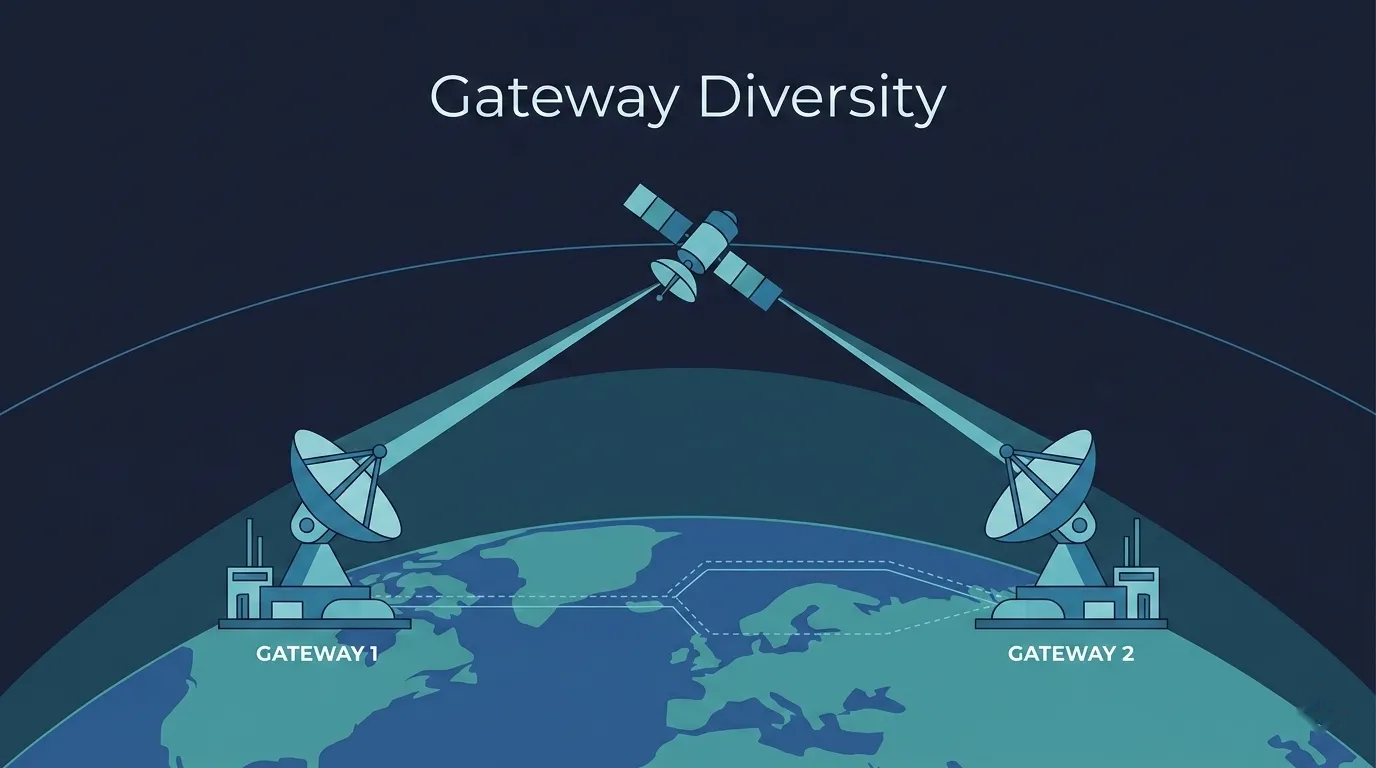
Satellite Gateway Diversity Explained: Improving Availability with Redundant Ground Stations
Engineering guide to satellite gateway diversity covering site redundancy, rain fade mitigation, failover mechanisms, and design considerations for high-availability satellite ground networks.
A satellite gateway is the ground-side anchor of every satellite link — the facility where user traffic transitions between the terrestrial network and the space segment. When a gateway fails or fades, every terminal it serves loses connectivity. For networks that promise 99.9% or higher availability, a single gateway is a single point of failure that no amount of terminal-side engineering can compensate for. Gateway diversity — the deliberate deployment of multiple, geographically separated gateway earth stations capable of serving the same satellite beams — is the primary architectural strategy that satellite operators use to eliminate this vulnerability.
This article provides a comprehensive engineering treatment of gateway diversity in satellite communications. It covers what gateway diversity is and why it is needed, the different types of diversity employed in modern networks, the impact of weather and rain fade on gateway design, network routing and failover mechanisms, engineering design considerations with quantitative trade-offs, operational challenges, and answers to frequently asked questions. It is written for satellite network engineers, system architects, procurement managers, and anyone involved in designing or evaluating high-availability satellite ground infrastructure.
Key terms used in this article — For complete definitions, see the Glossary A–F and Glossary S–Z.
- Gateway earth station: A large ground facility that connects satellite capacity to terrestrial networks, typically equipped with 7–13 m antennas and high-power amplifiers.
- Site diversity: Deployment of geographically separated ground stations so that localized weather events do not simultaneously impair all paths.
- Rain fade: Attenuation of satellite signals caused by rainfall along the propagation path, particularly severe at Ka-band and above.
- Failover: Automatic switching of traffic from a degraded or failed primary path to a backup path.
- N+P redundancy: A configuration where N active gateways are backed by P protection gateways, ready to assume traffic on failure.
For background on gateway infrastructure and ground segment architecture, see Satellite Ground Segment Architecture. For a detailed treatment of link availability engineering, see Satellite Link Availability Explained.
What Is Gateway Diversity
Gateway diversity is a network architecture strategy in which two or more gateway earth stations, separated by a sufficient geographic distance, are configured to serve the same satellite beams or coverage area. If one gateway becomes unavailable — due to rain fade, equipment failure, power outage, or any other impairment — traffic is automatically redirected to an alternate gateway that remains operational.
The concept is analogous to data center redundancy in terrestrial networking: critical services are not hosted in a single facility but distributed across multiple sites so that no single failure takes down the entire service. In satellite communications, the "data center" equivalent is the gateway earth station, and the "failure" that most commonly triggers a switchover is not equipment malfunction but rain fade — the attenuation of Ka-band and Ku-band signals by heavy rainfall along the gateway-to-satellite path.
A gateway diversity system has three essential components:
- Multiple gateway sites — Two or more fully equipped earth stations, each capable of independently handling the full traffic load of the beams they protect.
- Sufficient geographic separation — Sites must be far enough apart that heavy rain at one site does not correlate with heavy rain at the other. Typical minimum separation is 300–500 km, though the required distance depends on the local meteorology.
- Automatic traffic switching — A control system that monitors link quality at each gateway in real time and seamlessly redirects traffic to the best-performing site when degradation is detected.
Modern Ka-band HTS (High Throughput Satellite) systems such as ViaSat-3, Jupiter-3, and SES mPOWER deploy dozens of gateway sites per satellite, with systematic diversity pairing so that every beam has at least two gateway paths. This is not optional for Ka-band systems — without gateway diversity, the rain fade vulnerability of Ka-band frequencies would make the 99.5%+ availability targets required for commercial broadband service unachievable in most climate zones.
For details on how HTS systems organize spot beams and frequency reuse, see HTS, Spot Beams, and Beamforming Explained.
Why Gateway Diversity Is Needed
Three categories of threat drive the need for gateway diversity: weather-related impairments, infrastructure failures, and the architectural reality of modern HTS systems.
Weather and Rain Fade
Rain fade is the dominant availability threat at Ka-band (26.5–40 GHz) and a significant factor at Ku-band (12–18 GHz). A gateway antenna operating at Ka-band with a 30° elevation angle in a tropical climate zone (ITU rain zone N or P) can experience 15–30 dB of rain attenuation during intense convective storms. No practical amount of fade margin or adaptive coding can absorb this level of attenuation on a single path. For a thorough treatment of rain attenuation physics, see Rain Fade in Satellite Communications.
The critical insight is that heavy rain events are localized. A severe thunderstorm producing 100+ mm/hr rainfall rarely extends beyond a 30–50 km radius. Two gateways separated by 400 km will almost never experience simultaneous heavy rain. This geographic decorrelation is what makes site diversity so effective — it converts a correlated, weather-driven outage into two independent events whose simultaneous probability is vanishingly small.
Infrastructure Failures
Beyond weather, gateways are vulnerable to equipment failures (amplifier, modem, antenna drive), power outages (grid failure, generator malfunction), fiber backhaul cuts (construction damage, natural disaster), and facility-level events (fire, flooding, security incidents). While each individual failure mode has low probability, the aggregate risk across all modes is non-trivial — particularly for unattended or semi-attended facilities in remote locations.
Gateway diversity provides protection against all of these failure modes simultaneously. When the cause of outage is localized to a single site — regardless of whether that cause is rain, a failed power supply, or a severed fiber — the diverse gateway absorbs the traffic.
HTS Architecture Requirements
Modern HTS satellites generate hundreds of narrow spot beams, each requiring a dedicated feeder link between the satellite and a gateway. A single gateway site can typically support 8–20 beams depending on the available spectrum and antenna count. A satellite with 200 spot beams therefore needs 10–25 gateway sites just for capacity — and each of those sites needs a diversity partner, doubling the total to 20–50 gateways. Gateway diversity in HTS systems is therefore both a reliability requirement and an architectural necessity.
For details on frequency bands and their rain fade characteristics, see Ku-Band vs Ka-Band Satellite.
Types of Diversity
Diversity in satellite communications takes several forms, each addressing different failure modes and operating at different architectural levels.
Gateway Diversity
Gateway diversity is the deployment of two or more gateway earth stations that can serve the same satellite beams. When the primary gateway degrades, traffic is switched to the protection gateway. This is the most common and cost-effective form of diversity for commercial satellite networks.
Gateway diversity configurations follow standard redundancy models:
| Configuration | Description | Use Case |
|---|---|---|
| 1+1 | One active gateway, one standby | Single-beam protection, broadcast contribution |
| N+1 | N active gateways share one standby | Cost-efficient protection for multi-beam systems |
| N+P | N active gateways with P standby (P > 1) | Higher reliability for large HTS deployments |
| Active-active | All gateways carry traffic, with capacity to absorb each other's load | Maximum utilization, used in advanced HTS systems |
In a 1+1 hot-standby configuration, the protection gateway continuously tracks the satellite and maintains synchronization so that switchover takes less than one second. In an N+1 scheme, the standby gateway must reconfigure its RF chain and modem pool to assume the beam assignments of the failed primary, which may take 10–30 seconds.
Site Diversity
Site diversity is the broader principle of separating any ground infrastructure — not just gateways — across multiple geographic locations. For remote VSAT terminals, site diversity means deploying a second terminal at a different location to serve the same user community. This is practical only for high-value fixed installations (e.g., oil platforms, mining sites) where the cost of a second terminal is justified by the availability requirement.
The effectiveness of site diversity depends on the decorrelation distance — the minimum separation required to ensure that rain events at the two sites are statistically independent. This distance varies by climate:
| Climate Zone | Decorrelation Distance | Rain Characteristics |
|---|---|---|
| Tropical | 300–500 km | Intense convective cells, short duration, highly localized |
| Temperate | 200–400 km | Frontal systems with moderate spatial extent |
| Arid | 100–200 km | Rare rainfall, minimal diversity benefit needed |
Satellite Diversity
Satellite diversity uses two or more satellites — typically at different orbital positions — to provide independent paths between the ground and space. If one satellite experiences a transponder failure, eclipse-related power reduction, or orbital anomaly, traffic is redirected to the backup satellite.
Satellite diversity also provides weather resilience when the diverse satellites have sufficiently different look angles from the ground station, creating propagation paths through different atmospheric volumes. This form of diversity is primarily used for mission-critical government and broadcast applications.
Orbit Diversity
Orbit diversity extends the concept across different orbital regimes — combining GEO, MEO, and LEO satellites to maximize path independence. A GEO link at 35° elevation fading due to rain may be supplemented by a LEO satellite passing overhead at 70° elevation, where the shorter slant path through the rain cell produces significantly less attenuation.
Multi-orbit architectures represent the highest level of diversity investment and are increasingly deployed for defense, maritime safety, and aviation connectivity where continuous service is non-negotiable. For architecture patterns, see Hybrid Satellite Networks.
Weather and Rain Fade Impact
Rain fade is the primary driver of gateway diversity design. Understanding its characteristics is essential for sizing diversity systems correctly.
Ka-Band Vulnerability
Ka-band feeder links between gateways and satellites operate at 27.5–31.0 GHz (uplink) and 17.7–21.2 GHz (downlink). At these frequencies, rain attenuation follows an approximately power-law relationship with rainfall rate, and the specific attenuation (dB/km) is 5–10× higher than at Ku-band for the same rain rate.
A single Ka-band gateway in a tropical region (ITU rain zone N) faces the following rain attenuation at 30 GHz, 30° elevation:
| Availability Target | Rain Rate Exceeded | Path Attenuation | Practical with Single Site? |
|---|---|---|---|
| 99.0% | 35 mm/hr | 8 dB | Yes — ACM handles this |
| 99.5% | 55 mm/hr | 14 dB | Marginal — requires large fade margin |
| 99.9% | 95 mm/hr | 25 dB | No — exceeds practical fade margin |
| 99.99% | 150 mm/hr | 40+ dB | Impossible without diversity |
These numbers demonstrate why Ka-band HTS systems universally deploy gateway diversity. At 99.9% availability, a single tropical gateway faces 25 dB of rain attenuation — far beyond what any combination of ACM and UPC can absorb. With a diverse gateway 400 km away, the probability of simultaneous 25 dB fade at both sites drops to less than 0.001%, effectively solving the problem.
Diversity Gain
The diversity gain is the reduction in effective rain attenuation achieved by selecting the better of two diverse paths at any given time. It is typically expressed in dB and depends on the separation distance, correlation of rain events, and frequency band.
Measured diversity gains for Ka-band gateway pairs in various regions:
| Separation Distance | Temperate Climate | Tropical Climate |
|---|---|---|
| 100 km | 5–8 dB | 8–12 dB |
| 200 km | 8–12 dB | 12–18 dB |
| 400 km | 12–18 dB | 18–25 dB |
| 600+ km | 15–20 dB | 20–30 dB |
Tropical climates show higher diversity gain because their rain events are more localized (intense convective cells vs. broad frontal systems). This is fortunate, since tropical regions also produce the highest single-site attenuation — diversity is both more needed and more effective in the tropics.
For adaptive techniques that complement diversity, see Adaptive Coding and Modulation in Satellite Systems.
Network Routing and Failover
Gateway diversity is only as effective as the switching mechanism that redirects traffic when a gateway degrades. The routing and failover architecture determines how quickly and transparently the network responds to impairments.
Failover Triggers
Modern gateway diversity systems monitor multiple parameters to detect degradation and trigger switchover:
- Es/No (energy per symbol to noise density) — The most direct indicator of link quality. When Es/No at the gateway receiver drops below a threshold (typically 1–2 dB above modem lock threshold), a switch is initiated.
- BER (bit error rate) — Rising BER indicates increasing link stress, even before modem unlock.
- Rain rate measurement — On-site weather stations and rain gauges provide predictive input; if measured rain rate is rising rapidly, a preemptive switch may be triggered before link degradation occurs.
- Equipment alarms — SNMP traps and hardware fault indicators trigger immediate switchover on equipment failure.
- Beacon monitoring — Dedicated satellite beacon signals provide a continuous, traffic-independent measure of path attenuation.
Switching Mechanisms
Gateway failover operates through several mechanisms depending on the network architecture:
Beam switching — The satellite's on-board processor or ground-based beam management system reassigns a beam's feeder link from the primary gateway to the diverse gateway. This is the standard approach in modern HTS systems, where the satellite can dynamically route any user beam to any gateway. Switching time: 0.5–5 seconds.
IP-layer rerouting — For networks where the gateway serves as an IP routing point, traffic is rerouted at Layer 3 through the terrestrial backbone to the diverse gateway, which then uplinks to the satellite. This approach requires both gateways to be connected via a high-capacity terrestrial network. Switching time: 1–10 seconds.
Make-before-break — Advanced systems establish the diverse path before tearing down the primary path, ensuring zero packet loss during switchover. This requires the satellite to briefly support simultaneous feeder links from both gateways.
Transparent vs. Non-Transparent Switching
Transparent switching maintains TCP sessions and application-layer connections across the switchover event. The user experiences no interruption beyond a brief increase in latency or jitter during the transition. This requires careful coordination of modem synchronization, encryption state, and IP addressing.
Non-transparent switching causes a brief link outage (typically 2–15 seconds) during which TCP sessions may time out and need to be re-established. This is acceptable for most data applications but unacceptable for real-time services such as voice and live video.
Engineering Design Considerations
Designing a gateway diversity system requires balancing multiple engineering constraints and cost factors. The following considerations guide the design process.
Geographic Separation
The minimum separation between diverse gateway sites is determined by the decorrelation distance for the target climate zone. As a practical guideline:
- Minimum 300 km separation for tropical regions to ensure rain event independence
- Minimum 200 km separation for temperate regions
- Sites should NOT be on the same river system or flood plain to avoid correlated flooding events
- Separate power grid regions are preferred to avoid correlated grid outages
Excessive separation (beyond 800–1,000 km) introduces challenges: longer terrestrial fiber paths with higher latency and more potential failure points, different satellite look angles that may require separate antenna pointing, and increased operational complexity for maintenance teams.
Terrestrial Interconnection
Diverse gateways must be interconnected by high-capacity, low-latency terrestrial links — typically leased dark fiber or DWDM circuits. The interconnection serves two purposes:
- Traffic routing — User traffic arriving at one gateway can be routed to the diverse gateway for uplinking when the primary gateway fades.
- Synchronization — Gateway systems must maintain timing and state synchronization for seamless switchover.
The terrestrial interconnection must itself be resilient. A single fiber path between diverse gateways creates a new single point of failure. Best practice is to provision physically diverse fiber routes between gateway sites, ideally from different carriers.
Availability Modeling
The combined availability of a gateway diversity pair is calculated using the parallel redundancy formula:
A_diversity = 1 − [(1 − A_gw1) × (1 − A_gw2)]
This formula assumes independent failures. For weather-related outages, independence is ensured by sufficient geographic separation. For example, two gateways each with 99.5% weather availability (43.8 hours annual outage) combine to:
A_diversity = 1 − [(0.005) × (0.005)] = 99.9975% (13.1 minutes annual outage)
However, common-mode failures — satellite transponder outage, network core failure, software bugs affecting both sites — are not mitigated by gateway diversity and must be addressed separately.
Design Comparison Table
| Design Parameter | Single Gateway | 1+1 Gateway Diversity | N+P Active-Active |
|---|---|---|---|
| Weather availability (Ka, tropical) | 99.0–99.5% | 99.99%+ | 99.99%+ |
| Equipment availability | 99.95% | 99.9999% | 99.9999% |
| Failover time | N/A | 0.5–5 seconds | Sub-second |
| Terrestrial backhaul | Single path | Dual path required | Mesh required |
| Capital cost | 1× | 1.8–2.2× | 2.5–3.5× |
| Operational complexity | Low | Medium | High |
| Spectrum efficiency | Baseline | Same (standby idle) | Higher (all active) |
| Suitable for | Ku-band, arid climates | Ka-band commercial | Large HTS constellations |
Operational Challenges
Deploying and maintaining gateway diversity introduces several operational challenges beyond the initial capital investment.
Cost and Capital Expenditure
Each diversity gateway requires a complete installation: land acquisition or lease, antenna (typically 7–13 m), RF electronics (HPA, LNA, up/down converters), baseband equipment (modems, routers, encryption), power infrastructure (grid connection, UPS, generator), facility construction (building, HVAC, security), and high-capacity fiber connectivity. The cost of a fully equipped Ka-band gateway site ranges from $5–15 million depending on scale and location, making diversity an investment that is justified only for networks where the revenue impact of downtime exceeds the infrastructure cost.
Regulatory and Licensing
Each gateway site requires separate regulatory approvals: earth station licenses, frequency coordination with adjacent satellite operators, environmental permits, and building permits. The licensing process can take 6–18 months per site and varies significantly by jurisdiction. In some countries, obtaining multiple gateway licenses in different geographic regions adds substantial complexity.
Maintenance and Staffing
Diverse gateway sites multiply the maintenance burden — antenna inspections, equipment testing, generator servicing, facility upkeep, and security must be performed at each site. Remote or semi-attended sites require periodic physical visits and reliable remote monitoring systems. Operators must maintain trained staff or service contracts that can respond to failures at any site within the MTTR assumption used in the availability calculation.
Synchronization and Software
Maintaining synchronization between diverse gateways — beam assignments, encryption keys, routing tables, firmware versions, configuration files — requires robust management systems. A software update applied to one gateway but not its diversity partner could create incompatibilities that prevent seamless failover. Configuration management and change control processes must treat the diversity pair as a single logical entity.
Frequently Asked Questions
What is satellite gateway diversity?
Gateway diversity is a network architecture in which two or more gateway earth stations, separated by hundreds of kilometers, are configured to serve the same satellite beams. When one gateway is impaired — by rain fade, equipment failure, or any other cause — traffic is automatically switched to an operational gateway. This eliminates the single point of failure that a standalone gateway represents and is the primary technique for achieving 99.9%+ availability at Ka-band frequencies.
How far apart should diverse gateway sites be?
The required separation depends on the local climate and the correlation distance of rain events. In tropical regions with intense convective storms, a minimum of 300–500 km is recommended to ensure rain events are statistically independent. In temperate regions with broader frontal weather systems, 200–400 km is typically sufficient. Arid regions require the least separation (100–200 km) but also benefit least from diversity since rain fade is already minimal.
How does gateway diversity mitigate rain fade?
Heavy rain events are geographically localized — a severe thunderstorm producing 100+ mm/hr rainfall rarely extends beyond a 30–50 km radius. When two gateways are separated by 400 km, the probability that both experience heavy rain simultaneously is extremely low. The diversity system continuously monitors link quality at both sites and routes traffic through whichever gateway has the clearest path to the satellite. This effectively converts a single-site availability of 99.0–99.5% into a combined availability exceeding 99.99%. For rain fade engineering details, see Rain Fade in Satellite Communications.
How fast is the failover between diverse gateways?
Failover speed depends on the switching mechanism. Modern HTS systems using on-board or ground-based beam switching achieve failover in 0.5–5 seconds. Advanced make-before-break implementations can achieve sub-second switching with zero packet loss. IP-layer rerouting through the terrestrial backbone typically takes 1–10 seconds. For real-time applications such as voice and video, transparent sub-second switching is essential; for data applications, 5–10 second failover is generally acceptable.
Why is gateway diversity especially important for Ka-band systems?
Ka-band frequencies (26.5–40 GHz) experience 5–10× more rain attenuation than Ku-band (12–18 GHz) for the same rainfall event. In tropical climates, a single Ka-band gateway can face 25–40 dB of rain attenuation at 99.9% availability — far exceeding what adaptive coding and modulation (ACM) or uplink power control (UPC) can compensate for. Without gateway diversity, achieving commercial-grade availability at Ka-band would be impractical in most climate zones. For band comparison details, see Ku-Band vs Ka-Band Satellite.
What is the difference between gateway diversity and site diversity?
Gateway diversity specifically refers to redundancy among gateway earth stations — the large, operator-controlled facilities that connect satellite capacity to the terrestrial network. Site diversity is a broader term that applies to any geographically separated ground infrastructure, including remote VSAT terminals. In practice, gateway diversity is far more common because the operator controls both sites and can justify the investment across thousands of terminals served. Terminal-level site diversity is typically reserved for high-value fixed installations such as oil platforms or military bases.
Does gateway diversity protect against satellite failures?
No. Gateway diversity protects against ground-side failures — rain fade at the gateway, equipment malfunction, power outages, and fiber backhaul cuts. It does not protect against satellite transponder failures, satellite power subsystem issues, or orbital anomalies. Protection against satellite-level failures requires satellite diversity (backup capacity on a different satellite) or orbit diversity (multi-orbit architectures combining GEO, MEO, and LEO). For multi-orbit architectures, see Hybrid Satellite Networks.
How do HTS operators manage dozens of gateway sites?
Large HTS systems deploy centralized network management platforms that monitor all gateway sites in real time — tracking link quality, equipment health, power status, and weather conditions. Automated beam management systems handle traffic switching between diverse gateway pairs without manual intervention. Configuration management systems ensure that firmware, routing tables, and encryption keys remain synchronized across all sites. Operators typically establish regional maintenance hubs with trained staff and spare parts to minimize MTTR at any gateway within their coverage area.
Key Takeaways
- Gateway diversity is essential for Ka-band availability — single-site Ka-band gateways cannot achieve 99.9%+ availability in most climate zones due to severe rain attenuation; geographic diversity is the only practical solution.
- 300–500 km separation ensures rain decorrelation — diverse gateways must be far enough apart that heavy rain events at one site do not correlate with events at the other, with tropical regions requiring the greatest separation.
- Two 99.5% gateways combine to exceed 99.99% — the parallel availability formula (A = 1 − [(1−A₁)(1−A₂)]) transforms modest individual availability into exceptional combined availability.
- Failover must be automatic and fast — modern systems achieve 0.5–5 second switching through beam reassignment or IP rerouting, with advanced implementations offering sub-second make-before-break transitions.
- Diversity addresses weather and equipment failures simultaneously — any localized impairment (rain, power outage, equipment failure, fiber cut) triggers failover to the operational site.
- HTS architecture makes diversity mandatory — modern Ka-band HTS satellites require 20–50 gateway sites to serve hundreds of spot beams, with systematic diversity pairing built into the network design.
- Common-mode failures require separate protection — satellite transponder failures, network core outages, and software bugs affect both diverse sites equally and must be mitigated through satellite diversity, multi-orbit architectures, or robust software practices.
Related Articles
- Satellite Link Availability Explained — Availability engineering from 99.5% to 99.99% with fade margin and redundancy design
- Rain Fade in Satellite Communications — Rain attenuation physics, ITU methodology, and mitigation techniques
- Satellite Ground Segment Architecture — Ground infrastructure components and design patterns
- Satellite Backhaul Explained — Terrestrial backbone connectivity and gateway integration
- Ku-Band vs Ka-Band Satellite — Frequency band comparison with rain fade sensitivity data
- HTS, Spot Beams, and Beamforming Explained — HTS architecture, spot beam design, and frequency reuse
- Adaptive Coding and Modulation in Satellite Systems — ACM dynamic range and fade compensation techniques
- Satellite Frequency Bands Explained — Complete guide to satellite frequency allocations and characteristics
Author

Organizational byline for SATCOM Index technical content. A named technical reviewer appears separately only when identity, scope, and permission are verified.
Categories
More Posts
4 Types of Satellite Antennas: Parabolic to Phased Array
Compare parabolic dishes (41 dBi at 1.2 m), phased arrays, flat panels, and stabilized maritime antennas — with gain, size, and VSAT selection guidance.
CIR vs MIR Explained: Understanding Guaranteed and Burst Bandwidth in Satellite Services
Learn the difference between CIR and MIR in satellite services, why guaranteed bandwidth matters for enterprise procurement, and how to evaluate satellite service plans.
Satellite Terminal Architecture Explained: Antennas, Modems, and RF Components
Engineering guide to satellite terminal architecture covering VSAT terminal components, satellite modem architecture, RF signal chain design, and ground terminal system integration.