
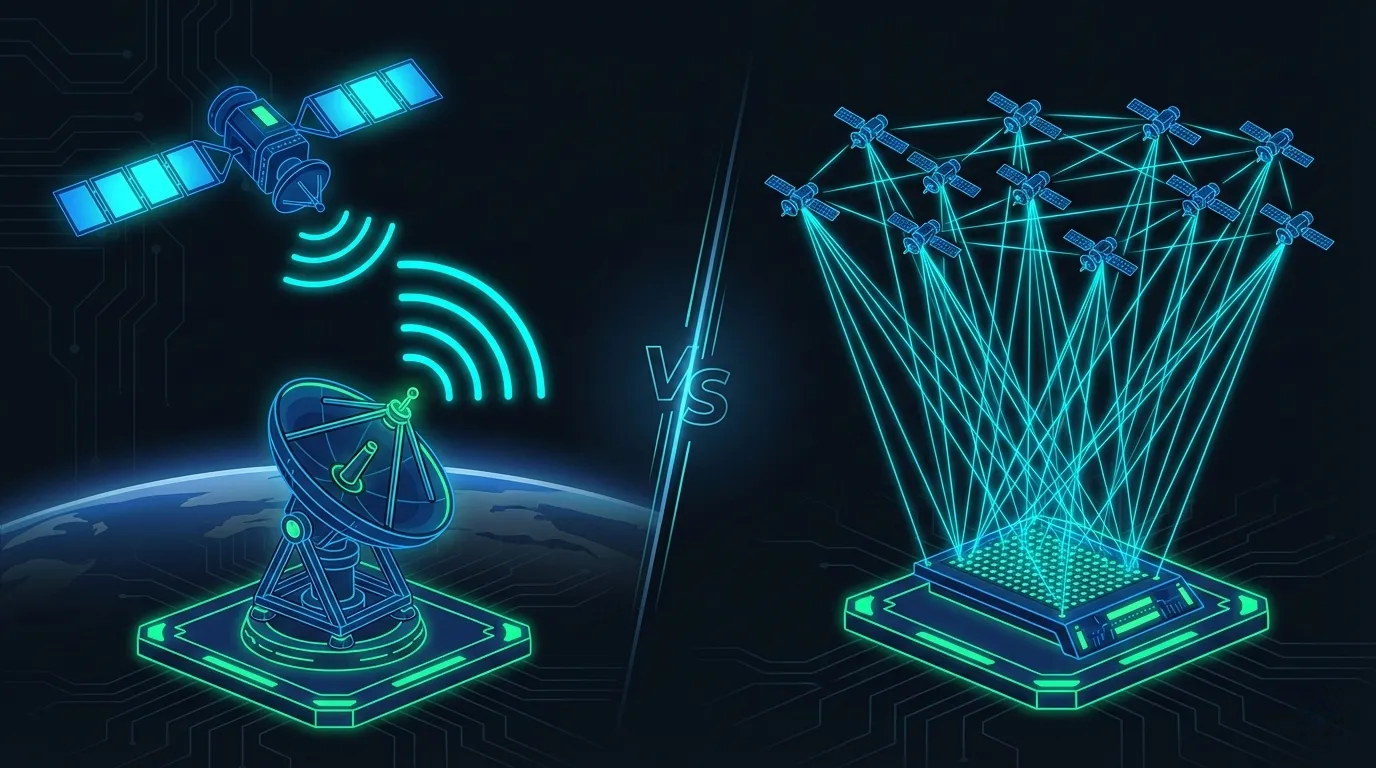
VSAT vs Starlink: Engineering and Service Comparison
Compare VSAT and Starlink with current latency, priority-data and SLA evidence, plus a checklist for coverage, operations, security, cost, and hybrid design.
What changed: Rebuilt the comparison around plan- and contract-level evidence; corrected the claims that VSAT always means GEO/CIR and that Starlink has no SLA; removed unsupported prices, equipment ranges, constellation counts, lifetimes, deployment times, and universal industry recommendations.
VSAT vs Starlink is not a clean technology-versus-technology comparison. VSAT describes a class of small-aperture earth terminals and the networks that use them; it does not by itself specify an orbit, topology, bandwidth commitment, or service-level agreement. Starlink is a particular managed satellite-internet service whose plans, hardware, performance targets, coverage, and legal terms can change by location and date.
The defensible question is therefore: Which purchasable service meets the requirement at the exact site, on the selected plan and hardware, under the offered contract? This guide provides that comparison method and a dated Starlink evidence snapshot.
Scope note: Organization fact check updated 26 August 2026 against the primary references listed on this page. This is not a named expert approval or a recommendation to buy either service. Starlink terms must be rechecked for the service address and order date; a VSAT bid must be checked against its operator, satellite, gateway, terminal, license, and contract.
VSAT Network Architecture | Satellite Latency Comparison | Ground-Segment Acceptance
Quick Verdict
There is no universal winner.
- Shortlist Starlink when the address and operating mode are authorized, the available plan meets the traffic requirement, low latency matters, and a shared managed service with plan-based data precedence is acceptable.
- Shortlist a managed VSAT service when a supplier can contract the required coverage, service handoff, traffic commitment, support model, security boundary, and remedies. Do not award it merely because the proposal says “CIR” or “SLA.”
- Shortlist both only when two links reduce the failure modes that matter and the site can prove policy, failover, degraded capacity, and common-cause independence.
- Reject either option when licensing, physical visibility, power, environmental limits, application tests, support, or contract evidence fails a mandatory requirement.
The old shortcuts are unsafe:
| Shortcut | Why it fails | Correct comparison |
|---|---|---|
| “VSAT means GEO” | VSAT networks can use different topologies and satellite architectures | Identify the actual orbit, payload, gateway path, and number of satellite hops |
| “VSAT includes CIR and an SLA” | Those are commercial terms, not properties of an antenna class | Read the committed rate, measurement interval, exclusions, and credit schedule |
| “Starlink has no SLA” | Eligible Local and Global Priority configurations now have a published uptime SLA | Verify the selected plan, terminal eligibility, billing-period calculation, and remedy |
| “Priority data is CIR” | Starlink describes Priority as network precedence and still states that speeds are not guaranteed | Treat precedence, expected speed, availability, and contractual uptime as separate fields |
| “Two satellite links are redundant” | They can still share power, LAN, routing, DNS, security, mounting, weather, or regulatory failure modes | Draw both paths and test each claimed failure case |
Define the Two Offers Before Comparing Them
What “VSAT” Means Here
Report ITU-R S.2278-0 describes star, mesh, hybrid, and point-to-point VSAT networks. ETSI TS 101 545-1 also covers transparent, regenerative, and NGSO reference architectures and separates user, control, and management roles.
For this comparison, a “VSAT offer” means a quoted service using a specified terminal and satellite access network. Record at least:
- satellite system, orbit, beams, gateways, and path in each direction;
- terminal, antenna or tracking method, RF chain, and environmental configuration;
- forward and return rates, access method, contention, CIR/MIR definitions, and traffic policy;
- terrestrial handoff, addressing, routing, security, and performance measurement point;
- license responsibilities, installation, monitoring, support, maintenance, and restoration;
- SLA objectives, exclusions, maintenance windows, evidence source, claim process, and credits.
A VSAT proposal can be shared or dedicated, public or private, best-effort or committed. The label proves none of those properties.
What “Starlink” Means Here
A Starlink comparison must name the country or service address, plan, data type, hardware, fixed or in-motion use, land or ocean area, and contract version. Residential, Priority, Roam, and other plan families do not have interchangeable rights or performance treatment.
Starlink's current plan descriptions say availability depends on network availability and regulatory approvals. They also say stated speeds and uninterrupted use are not guaranteed, while Priority data receives network precedence over lower-priority data. Those statements must remain attached to any speed table.
Current Starlink Performance Snapshot
The following values reproduce the English Starlink Specifications accessed on 26 August 2026. They are Starlink's expected service ranges, not measurements by SatCom Index and not guarantees for every address.
| Fixed plan class | Service availability in specification | Expected download | Expected upload | Expected latency |
|---|---|---|---|---|
| Standard | at least 99% | 25–100 Mbps | 5–10 Mbps | 25–60 ms |
| Priority | at least 99% | 40–220 Mbps | 8–25 Mbps | 25–60 ms |
Starlink states that actual performance varies with location, time of day, congestion, and the precedence assigned to the plan's data. It also identifies remote regions where latency can be higher. Before procurement, replace this table with the values displayed for the service address and preserve a dated copy of the applicable order, specification, fair-use policy, and SLA.
Three different ideas must not be merged:
- Expected performance is a published planning range.
- Priority data receives network precedence; it is not a fixed per-site information rate.
- The Priority SLA is a contractual uptime commitment for eligible configurations, not a throughput guarantee.
Latency: Compare the Complete Path
Orbit strongly affects propagation delay, but the application sees the complete path through radio links, gateways or inter-satellite routing, terrestrial transport, queues, security appliances, and the destination.
RFC 2488 gives approximately 250 ms propagation over a geosynchronous satellite channel and discusses roughly 500 ms of round-trip waiting in its GSO example. Those are reference values for a geosynchronous path, not a promise for every VSAT service. A double-satellite-hop route, congested queue, distant terrestrial destination, or tunnel can add more delay. A non-GEO VSAT offer requires a different path model.
For Starlink, use the current plan specification and site measurement rather than deriving end-to-end latency from a nominal satellite altitude. The current fixed-plan snapshot above gives 25–60 ms, but Starlink explicitly qualifies that range by location, load, and plan.
Measure both candidates with the same method:
- endpoint and protocol;
- packet size and direction;
- wired test point, excluding local Wi-Fi unless Wi-Fi is part of the service;
- local time, sample interval, and busy-hour window;
- median, p95, p99, maximum, loss, outage, and recovery;
- application transaction time, not only ICMP RTT.
For interactive workloads, test the real application. A lower median RTT can still fail the requirement if tail latency, packet loss, handover behavior, DNS, VPN reconvergence, or upstream routing is unacceptable.
Throughput, Contention, and Data Policy
Do not compare a Starlink expected download range with a VSAT CIR as though they are the same metric.
For a VSAT bid, define:
- CIR and MIR separately for forward and return directions;
- whether CIR is dedicated capacity, statistical commitment, or policy-floor terminology;
- contention pool and oversubscription boundary;
- measurement interval, protocol overhead, burst allowance, and busy-hour condition;
- QoS classes, queue limits, discard behavior, and capacity during failover;
- remedy when the measured commitment is missed.
For Starlink, capture:
- plan and data type;
- included Priority-data block, if applicable;
- treatment after the Priority allocation is exhausted;
- expected plan performance for the address;
- public-addressing and routing options required by the application;
- current fair-use and network-management terms.
The Starlink Fair Use Policy says Priority data receives higher network precedence and that customers who exhaust their Priority allocation can receive lower-priority data under the applicable plan terms. That is a traffic-treatment rule, not a reserved channel.
SLA and Availability: Read the Measurement Rule
“Has an SLA” is not enough. Compare the exact service objective, calculation, exclusions, remedy, and evidence source.
Starlink's current Priority Plan SLA states a 99.9% uptime commitment per complete billing period for eligible Local Priority and Global Priority configurations. It counts outages lasting longer than one minute and describes a 20% credit of applicable recurring line and data fees when the threshold is missed. Hardware and plan eligibility conditions apply.
The arithmetic behind 99.9% is:
counted outage allowance = billing-period minutes × (1 - 0.999)

30 days: 43,200 × 0.001 = 43.20 minutes
31 days: 44,640 × 0.001 = 44.64 minutes
This calculation does not change Starlink's outage definition, exclusions, eligibility, or claim process. It only translates the percentage into time.
Apply the same discipline to a VSAT SLA:
| Contract field | Question to answer |
|---|---|
| Measurement boundary | Terminal LAN, modem, hub, provider edge, or end application? |
| Service objective | Availability, latency, loss, jitter, CIR, response, or restoration? |
| Time basis | Calendar month, billing period, rolling window, or annual value? |
| Outage definition | What threshold starts and stops an outage? Are short events counted? |
| Exclusions | Planned maintenance, weather, power, obstruction, customer equipment, licensing, or force majeure? |
| Evidence | Provider telemetry, customer probes, trouble ticket, or jointly agreed records? |
| Remedy | Credit, percentage cap, termination right, or no contractual remedy? |
A VSAT supplier may offer a stronger, weaker, or simply different SLA. The answer comes from the quote and contract, not from the word VSAT.
Coverage, Licensing, and Mobility
Coverage is a pass/fail gate before speed, latency, or price.
For Starlink, verify the exact address or operating area on the current availability map, then confirm plan availability, hardware eligibility, fixed or in-motion authorization, land or open-water use, travel limits, and local regulatory approval. A global coverage image is not operating authority.
For a VSAT service, verify satellite and beam coverage, elevation and blockage, link budget at the site, gateway and terrestrial reachability, spectrum and terminal authorization, cross-border or mobility permissions, and the operator's installation and commissioning requirements.
For maritime or mobile use, repeat the check across the full route. A plan that works at one port or country does not prove open-water, regional, or in-motion rights elsewhere.
Installation and Site Engineering
Starlink markets simple setup, but “plug it in” is not a complete enterprise acceptance test. The selected kit still needs an approved mount, clear field of view, suitable cable routing, power, grounding or surge design where required, environmental compliance, safe access, and verification under the site's real obstructions and operating modes. Starlink's obstruction guidance recommends a clear view of the sky and warns that obstructions can cause interruptions.
VSAT installation requirements depend on the terminal, satellite operator, jurisdiction, mount, frequency plan, and site. They can include surveying, structural work, pointing and polarization tests, transmit authorization, commissioning, and as-built documentation. Do not apply one generic installation time or hardware-price range to every bid.
Use the same acceptance evidence for both where applicable:
- approved equipment and mount;
- field-of-view or look-angle survey;
- cable, grounding, power, and environmental inspection;
- activation and regulatory evidence;
- wired baseline performance;
- application and VPN tests;
- outage, power-loss, reboot, and failover recovery;
- monitoring, alerting, inventory, and support handover.
Security and Network Handoff
Neither “VSAT” nor “Starlink” proves a private or secure application network. Document:
- customer handoff and ownership boundary;
- public, shared, or private addressing behavior;
- inbound reachability and NAT assumptions;
- IPv4/IPv6 routing and failover behavior;
- encryption and overlay VPN endpoints;
- identity, DNS, logging, monitoring, and time sources;
- remote-management access and change control;
- data residency, lawful-access, and sector requirements;
- incident escalation and evidence retention.
If a VSAT offer includes a private carrier network, compare that managed service with the Starlink-plus-overlay design needed to provide the same application boundary. Comparing a managed private WAN with raw internet access is not an equivalent comparison.
Cost: Build a Same-Scope Total-Cost Model
Prices differ by country, plan, reseller, taxes, hardware, data allocation, and date, so this page does not publish a universal dollar range.
Use a common time horizon and include:
TCO = terminal and accessories
    + survey, mount, installation, and commissioning
    + monthly access and data
    + priority data, overage, or capacity upgrades
    + licensing, tax, shipping, and customs
    + router, firewall, VPN, SD-WAN, and monitoring
    + power, spares, maintenance, field visits, and replacement
    + support and managed-service charges
    + suspension, relocation, termination, and contract-risk costs
Normalize the result against usable service: cost per site-month that passes the application test and contractual requirement. A low hardware price does not compensate for an ineligible plan, and an expensive managed service does not prove better availability.
When a Hybrid Design Is Defensible
A VSAT-plus-Starlink design can improve service when the two paths have sufficiently independent failure modes and the network has explicit steering and recovery policy. Dual-WAN or SD-WAN is an implementation mechanism, not proof of resilience.
Map common-cause risks before calling the design redundant:
- shared mains power, battery, generator, or grounding;
- shared roof, mast, sky blockage, weather exposure, cable route, or equipment room;
- shared router, firewall, switch, DNS, identity, VPN concentrator, or cloud edge;
- shared terrestrial destination, internet exchange, carrier, or application dependency;
- shared configuration error, software update, monitoring gap, or support process;
- regulatory suspension, import restriction, or operating-area limitation;
- insufficient backup-link capacity for the traffic marked critical.
Then test policy under load:
- Define traffic classes and the preferred path for each.
- Define health checks that represent application reachability, not merely an active Ethernet port.
- Set failover and failback thresholds that avoid route flapping.
- Measure session survival, DNS and VPN recovery, packet loss, and degraded capacity.
- Prove that monitoring distinguishes a radio failure from a gateway, terrestrial, security, or application failure.
- Repeat after firmware, plan, topology, or security changes.
See Hybrid Satellite Network Design for the broader multi-orbit failure analysis.
Decision Worksheet
Set mandatory gates before scoring preferences. A high throughput score cannot override a licensing failure.
| Requirement | Evidence and test | Gate or weight | VSAT bid | Starlink offer |
|---|---|---|---|---|
| Authorized coverage | Address/route, license, plan, beam, and hardware proof | Pass/fail | ||
| Application performance | Busy-hour p50/p95/p99 latency, loss, and transaction test | |||
| Capacity | Both directions, contention/data policy, degraded state | |||
| Availability and remedy | Calculation, exclusions, evidence, and credit | |||
| Security and handoff | Routing, addressing, encryption, logs, and ownership | |||
| Operations | Monitoring, support, spares, field access, and restoration | |||
| Environmental fit | Mount, power, obstruction, weather, motion, and safety | Pass/fail | ||
| Same-scope TCO | Dated quote over the selected term and traffic model | |||
| Diversity value | Failure-domain map and witnessed failover result |
Record the evidence date beside every score. Product pages and quotes can change before deployment.
Scenario Guidance Without a Default Winner
Fixed Branch or Remote Office
Test whether the address-specific Starlink plan meets busy-hour applications and support requirements. Compare it with a VSAT quote only after the quote defines both-direction rates, contention, latency path, handoff, and SLA. If the site depends on inbound reachability or private routing, design that boundary explicitly.
Industrial and Operational Technology
Do not infer safety or determinism from either access label. Separate safety functions from business connectivity, classify traffic, validate cybersecurity and hazardous-area requirements, and obtain the responsible engineering and regulatory approvals. A contractual CIR or Priority plan is not a safety case.
Maritime and Other In-Motion Use
Check the entire operating route, approved plan and terminal, open-water or land rights, blockage zones, mounting, power, motion qualification, data treatment, and support. See Maritime Satellite Internet for the route-level checklist.
Emergency and Temporary Sites
Pre-positioning is useful only if the kit, subscription, activation, power, mounting, local authorization, transport, and trained operator are available when needed. Rehearse activation and failover before the incident. See Enterprise Satellite Internet for continuity planning.
Frequently Asked Questions
Is Starlink faster than VSAT?
That question lacks a plan and a VSAT quote. Starlink publishes expected ranges by plan; a VSAT service can be configured with many different forward and return commitments. Compare both directions during the same busy-hour window and include data-priority or contention rules.
Does Starlink have an SLA?
Eligible Local Priority and Global Priority configurations currently have a published 99.9% uptime SLA with defined outage counting and credit terms. Residential expected performance is not the same thing, and plan or terminal eligibility must be checked in the current contract.
Does VSAT guarantee bandwidth?
Not automatically. Some managed VSAT offers include a CIR or dedicated capacity; others use shared capacity or best-effort terms. Require a definition, measurement method, busy-hour condition, and remedy.
Which has lower latency?
A current Starlink fixed plan is expected to have much lower latency than a conventional single-hop GEO access path. But VSAT is not synonymous with GEO, and the application result depends on the complete route. Test the actual endpoints and tail latency.
Is Starlink always cheaper?
No universal answer is defensible. Compare dated, local, same-scope TCO including hardware, data, installation, licenses, networking, support, power, maintenance, replacements, taxes, and contract risk.
Can I use Starlink and VSAT together?
Yes, if both services are authorized and the network can prove traffic policy, capacity, failure independence, and recovery. Two active subscriptions without a tested failover design do not establish availability.
Is VSAT obsolete?
No. VSAT is a broad earth-station and network category, not one legacy product. The procurement question is whether a specific VSAT or Starlink offer meets the current requirement better than the alternatives.
Final Decision Rule
Choose the offer that passes every mandatory coverage, regulatory, environmental, security, and application gate, then scores best on measured performance, contractual remedy, operations, and same-scope cost. Preserve the plan, specification, quote, and test evidence used for the decision.
Do not rely on the labels “VSAT,” “LEO,” “Priority,” “CIR,” or “SLA” without their definitions. Recheck Starlink's address-level availability and current legal documents before ordering, and require the same dated evidence from the VSAT provider.
Research Methodology | Technical Review Scope | End-to-End Architecture
Author

Organizational byline for SATCOM Index technical content. A named technical reviewer appears separately only when identity, scope, and permission are verified.
Categories
More Posts

SCPC vs TDMA: Satellite Access Methods Compared
SCPC vs TDMA satellite access methods compared: dedicated vs shared carriers, bandwidth efficiency, contention, cost, and why TDMA needs ranging while SCPC doesn't.

Satellite Doppler Shift Explained: Why Frequency Changes in LEO Satellite Communication
Engineering guide to satellite Doppler shift covering frequency drift in LEO and GEO systems, impact on carrier tracking and demodulation, compensation techniques, and design considerations for modern constellations.

Satellite Polarization Explained: Linear vs Circular Polarization in SATCOM
Engineering guide to satellite polarization covering linear and circular polarization, cross-polarization interference, antenna alignment, polarization reuse in HTS, and Ku/Ka band polarization schemes.