
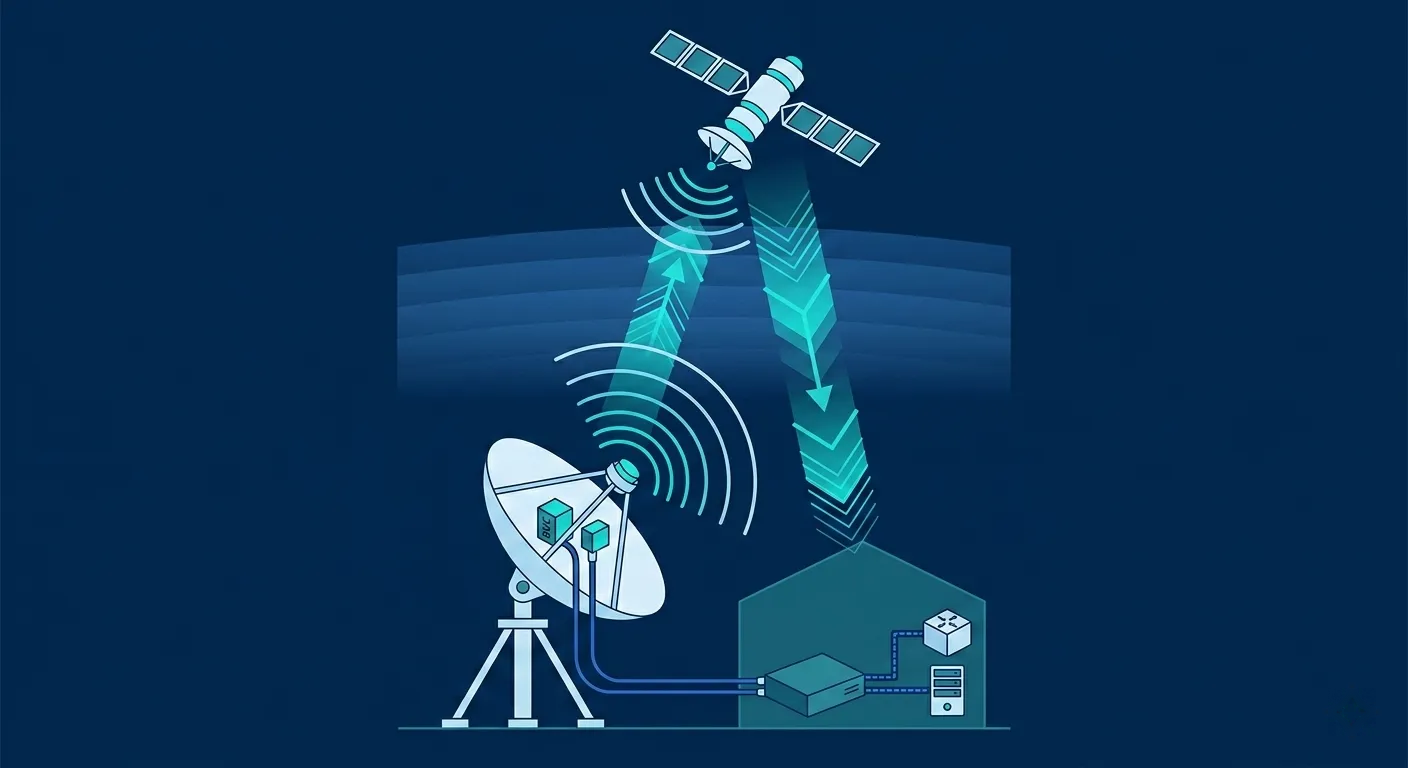
Satellite Terminal Architecture Explained: Antennas, Modems, and RF Components
Engineering guide to satellite terminal architecture covering VSAT terminal components, satellite modem architecture, RF signal chain design, and ground terminal system integration.
Introduction
The satellite terminal is the point where terrestrial networks meet space-based infrastructure. Every bit of traffic that traverses a satellite link—enterprise WAN data, maritime safety communications, broadcast video feeds, IoT telemetry—originates or terminates at a terminal. The terminal's architecture directly determines the achievable throughput, latency, availability, and cost of the satellite service.
While the Terminals & Remotes reference page covers terminal categories, installation procedures, and maintenance guidelines, this article provides the engineering architecture treatment: how the components inside a terminal interconnect, how the RF signal chain is designed from baseband to space, what engineering trade-offs drive terminal design decisions, and how terminals integrate into modern network architectures. The goal is to give satellite engineers and system designers a component-level understanding of terminal architecture that informs equipment selection, system design, and troubleshooting.
This article assumes familiarity with basic satellite link budget concepts and frequency band characteristics.
What Is a Satellite Terminal
A satellite terminal (also called an earth station, ground terminal, or VSAT) is the ground-based equipment assembly that originates and terminates user traffic over a satellite communication link. It performs the fundamental functions of modulating user data onto an RF carrier for uplink transmission and demodulating the received downlink carrier back into user data.
In a typical satellite network, the terminal is the remote-side equipment—the user-facing endpoint deployed at the customer premise, vessel, aircraft, or field location. The hub or gateway station at the network operations center performs the complementary function, aggregating traffic from hundreds or thousands of remote terminals. While hub stations share the same fundamental RF architecture, they operate at much higher power levels and use larger antennas, as described in Satellite Ground Segment Architecture.
The terminal occupies a critical position in the end-to-end satellite architecture: it is the single point where the quality of every upstream and downstream component—antenna gain, BUC power, modem performance, cable losses—combines to determine the link performance that the user actually experiences.
Key Components of a Satellite Terminal
A satellite terminal comprises five major subsystems: the antenna, the block upconverter (BUC), the low-noise block downconverter (LNB), the satellite modem, and the network interface equipment. Each subsystem has distinct engineering parameters that affect overall terminal performance.
Antenna System
The antenna is the terminal's interface to the satellite. Its primary function is to concentrate transmitted RF energy into a narrow beam directed at the target satellite and to collect the weak downlink signal from the satellite while rejecting signals from adjacent satellites and terrestrial sources.
For VSAT terminals, the dominant antenna type is the parabolic reflector with a prime-focus or offset-feed configuration. The antenna's key parameters are gain (directly proportional to the aperture area and frequency), half-power beamwidth (HPBW ≈ 70λ/D degrees), and sidelobe performance (must comply with the ITU 29–25log(θ) off-axis envelope to prevent adjacent satellite interference).
Antenna sizing is driven by link budget requirements: larger apertures provide higher gain and narrower beams, improving both signal strength and interference isolation. However, larger antennas increase cost, wind loading, and installation complexity. The engineering trade-off between antenna size and other terminal parameters (BUC power, modem coding efficiency) is a core terminal design decision.
For a comprehensive treatment of antenna types—parabolic, flat panel, phased array, and maritime stabilized—see the Satellite Antenna Types Guide.
Block Upconverter (BUC)
The block upconverter (BUC) converts the modem's modulated output from L-band (typically 950–1450 MHz) to the satellite uplink frequency band (Ku-band: 14.0–14.5 GHz, Ka-band: 29.5–30.0 GHz, C-band: 5.925–6.425 GHz). The BUC also provides the final stage of RF power amplification before the signal reaches the antenna feed.
Key BUC engineering parameters:
| Parameter | Typical Range | Engineering Significance |
|---|---|---|
| Output power | 1W – 40W+ | Determines maximum uplink EIRP; sized to link budget |
| Frequency band | C / Ku / Ka | Must match satellite uplink allocation |
| 1 dB compression point (P1dB) | Rated output – 1 dB | Maximum linear output power; operating point set 1–3 dB below P1dB |
| Phase noise | –80 to –95 dBc/Hz @ 10 kHz | Affects modulation accuracy for higher-order MODCODs |
| Spurious emissions | –50 to –60 dBc | Must meet ITU off-axis emission limits |
| DC power consumption | 20W – 200W+ | Drives power system sizing for remote/solar sites |
BUC power selection is governed by the uplink EIRP requirement from the link budget. For a terminal with antenna gain G_ant (dBi) and required EIRP (dBW), the BUC power must satisfy:
P_BUC (dBW) ≥ EIRP (dBW) – G_ant (dBi) + L_feed (dB) + L_IFL (dB)where L_feed is the feed loss and L_IFL is the inter-facility link (cable) loss between the modem and BUC. A 2W BUC with a 1.2 m Ku-band antenna (gain ≈ 42 dBi) produces approximately 45 dBW EIRP—sufficient for most VSAT return channels. Higher-power BUCs (8W–25W) are used for high-throughput outbound carriers or in challenging rain fade environments.
BUCs are typically mounted directly on the antenna feed assembly (integrated outdoor unit) to minimize feed loss, or separately on the antenna mount (split configuration) for higher-power units that require forced-air cooling.
Low-Noise Block Downconverter (LNB)
The low-noise block downconverter (LNB) performs the inverse function of the BUC on the receive path: it amplifies the extremely weak satellite downlink signal and converts it from the satellite frequency band to L-band for transmission to the indoor modem over coaxial cable.
Key LNB engineering parameters:
| Parameter | Typical Range | Engineering Significance |
|---|---|---|
| Noise figure | 0.3 – 1.5 dB | Directly sets the receive system noise temperature; lower is better |
| Gain | 50 – 65 dB | Must provide sufficient signal level at the modem input |
| LO frequency stability | ±5 kHz to ±25 kHz | Affects carrier acquisition and narrow-band operation |
| Phase noise | –75 to –90 dBc/Hz @ 10 kHz | Critical for higher-order modulation reception |
| Output P1dB | 0 to +5 dBm | Sets maximum multi-carrier handling capacity |
The LNB's noise figure is the single most critical parameter because it dominates the terminal's receive system noise temperature. The system noise temperature T_sys is:
T_sys = T_ant + T_LNB = T_ant + (F – 1) × 290 Kwhere F is the LNB noise factor (linear) and T_ant is the antenna noise temperature. A 0.7 dB noise figure LNB contributes approximately 51 K of noise temperature; increasing to 1.5 dB raises the contribution to 120 K—a degradation that directly reduces the downlink C/N by approximately 1 dB.
LNB types include universal LNBs (consumer/low-cost, with switchable LO frequencies for wide-band coverage), PLL-stabilized LNBs (±5 kHz stability, required for narrowband SCPC carriers and high-order modulation), and multi-output LNBs (multiple independent outputs for redundant or multi-modem configurations).
Satellite Modem
The satellite modem is the terminal's digital signal processing core. It performs modulation, coding, encapsulation, and baseband processing on the transmit side, and demodulation, decoding, and de-encapsulation on the receive side. Modern satellite modems implement the DVB-S2/S2X standard, supporting a wide range of modulations and code rates.
Modem architecture functional blocks:
-
Forward channel receiver — Receives the hub-originated DVB-S2/S2X carrier (TDM or continuous), performs demodulation, LDPC/BCH decoding, and outputs user IP packets. Supports adaptive coding and modulation (ACM) with dynamic MODCOD selection based on real-time link conditions.
-
Return channel transmitter — Accepts user IP packets, performs encapsulation (typically DVB-RCS2 or proprietary MF-TDMA/SCPC), applies LDPC coding and modulation, and outputs the L-band carrier to the BUC. Return channel access schemes include MF-TDMA (shared bandwidth, bursty traffic), SCPC (dedicated carrier, constant bit rate), and dynamic SCPC (carrier activated on demand).
-
Baseband processor — Handles IP packet classification, QoS queuing, header compression, payload compression, WAN optimization (TCP acceleration, HTTP prefetch), and encryption (AES-256 for secure links).
-
Management processor — Controls modem configuration, monitors link performance (Eb/N₀, BER, MODCOD), manages ACM feedback, handles over-the-air software updates, and provides SNMP/web management interfaces.
The modem's processing capability—maximum symbol rate, supported MODCODs, number of simultaneous carriers—determines the terminal's maximum throughput capacity. High-end modems support symbol rates up to 500 Msps with DVB-S2X, enabling single-carrier throughputs exceeding 500 Mbps. The relationship between modulation, coding, and throughput is detailed in the Satellite Modulation and Coding Guide.
Network Interface Equipment
The network interface connects the satellite modem to the user's local network. At its simplest, this is an Ethernet port on the modem itself. In more complex deployments, dedicated network interface equipment provides additional functionality.
Network interface functions:
- Ethernet switching — Multiple LAN ports for connecting user devices, with VLAN tagging for traffic separation between services (data, voice, video, management).
- IP routing — Layer 3 routing between the satellite WAN interface and local LAN segments, with static routes, OSPF, or BGP for multi-path configurations.
- Traffic classification and QoS — Deep packet inspection and traffic marking (DSCP) to prioritize latency-sensitive traffic (VoIP, video conferencing) over bulk transfers. This maps to the satellite QoS framework described in QoS Over Satellite.
- Voice gateway — FXS/FXO ports or SIP proxy functionality for analog or IP voice services, with jitter buffers and echo cancellation optimized for satellite delay.
- WAN optimization — TCP acceleration, HTTP object caching, and application-layer optimization to mitigate the throughput impact of satellite latency.
RF Signal Flow
Understanding the complete RF signal path through a satellite terminal—from user data to satellite and back—is essential for system engineering, troubleshooting, and performance optimization.
Transmit Path (Uplink)
The transmit signal flow from user data to satellite proceeds through these stages:
-
User data ingress — IP packets arrive at the modem's Ethernet interface from the local network. The modem classifies and queues packets according to QoS policy.
-
Baseband processing — The modem encapsulates IP packets into the satellite protocol frame (DVB-RCS2 burst or SCPC frame), applies forward error correction (LDPC + BCH coding), and performs digital modulation (QPSK, 8PSK, 16APSK, or 32APSK depending on the selected MODCOD).
-
L-band output — The modem's digital-to-analog converter and upconverter produce the modulated carrier at L-band (950–1450 MHz), typically at a power level of –25 to –15 dBm.
-
IFL transmission — The L-band signal travels over coaxial cable (the inter-facility link, IFL) from the indoor modem to the outdoor BUC. IFL cable loss is typically 5–15 dB depending on cable type and length (up to 100 m for standard RG-6; longer runs require low-loss cable or fiber IFL).
-
BUC upconversion and amplification — The BUC converts the L-band signal to the satellite uplink frequency (e.g., 14.0–14.5 GHz for Ku-band) and amplifies it to the rated output power. For a 4W BUC, the output is approximately +36 dBm (4W).
-
Feed and antenna radiation — The amplified RF signal passes through the feed horn (with typical insertion loss of 0.2–0.5 dB) into the antenna reflector, which focuses the energy into a narrow beam directed at the satellite. The antenna adds gain (e.g., 42 dBi for a 1.2 m Ku-band dish), producing the uplink EIRP.
-
Free-space propagation — The signal travels approximately 36,000 km to a GEO satellite (or 550–1,200 km for LEO), experiencing free-space path loss of approximately 207 dB at Ku-band GEO, plus atmospheric attenuation.
Receive Path (Downlink)
The receive signal flow from satellite to user data reverses the process:
-
Antenna reception — The antenna collects the satellite's downlink signal. At Ku-band GEO, the received power at the antenna feed is extremely low—typically –120 to –130 dBm.
-
LNB amplification and downconversion — The LNB's low-noise amplifier (LNA) boosts the signal by 50–65 dB while adding minimal noise (0.3–1.5 dB noise figure). The mixer and local oscillator convert the signal from the satellite frequency to L-band.
-
IFL transmission — The L-band signal travels over coaxial cable to the indoor modem. The LNB's high gain ensures adequate signal level despite cable losses.
-
Modem demodulation and decoding — The modem's tuner selects the desired carrier, the demodulator recovers the symbol stream, and the LDPC/BCH decoder corrects transmission errors. The modem reports the received Eb/N₀ and selects the appropriate MODCOD under ACM operation.
-
User data egress — Decoded IP packets are de-encapsulated from the satellite protocol frame and forwarded to the user network through the Ethernet interface.
Signal Level Budget
At each stage of the RF chain, signal levels must be maintained within the operating range of the next component. A typical Ku-band VSAT transmit chain: modem output –20 dBm → IFL loss –10 dB → BUC input –30 dBm → BUC gain +66 dB → BUC output +36 dBm (4W) → feed loss –0.3 dB → antenna gain +42 dBi → EIRP +77.7 dBm (≈ +47.7 dBW). On receive: satellite signal at feed –125 dBm → LNB gain +60 dB → LNB output –65 dBm → IFL loss –10 dB → modem input –75 dBm.
Types of Satellite Terminals
Terminal architecture varies significantly based on the deployment environment and application requirements.
VSAT Terminals
VSAT (Very Small Aperture Terminal) is the most common terminal architecture for enterprise and consumer satellite services. The traditional VSAT uses a split-mount design: the outdoor unit (ODU) comprises the antenna, BUC, and LNB mounted on a pole or non-penetrating roof mount; the indoor unit (IDU) comprises the modem and network interface equipment, connected by the IFL coaxial cable.
Modern VSAT architectures increasingly use all-outdoor designs where the modem is integrated into the antenna assembly, eliminating the IFL cable and simplifying installation. The all-outdoor modem connects to the user network via a single Ethernet cable (often with PoE for power). This reduces cable losses and installation time but limits access to the modem for troubleshooting.
Typical VSAT specifications: 0.74–2.4 m antenna, 1–8W BUC, 0.7–1.0 dB NF LNB, throughput up to 200 Mbps forward / 50 Mbps return per terminal.
Flat Panel Terminals
Flat panel terminals use electronically steered antenna (ESA) technology or hybrid mechanical/electronic steering to replace the traditional parabolic reflector. The antenna consists of an array of radiating elements with phase shifters that electronically steer the beam without mechanical movement.
Flat panel architectures enable low-profile installations (typically 5–10 cm height vs. 50–100 cm for a parabolic dish), making them suitable for vehicle-mount, aeronautical, and aesthetically constrained environments. The trade-offs include lower aperture efficiency (typically 50–70% vs. 65–80% for parabolic), higher cost, higher power consumption (active phase shifters), and scan loss at wide steering angles.
Flat panel terminals are particularly important for LEO constellation tracking, where the antenna must continuously steer across large angular ranges to follow fast-moving satellites and execute beam handovers between satellites.
Maritime Terminals
Maritime satellite terminals operate on moving platforms and require stabilized antenna systems to maintain pointing accuracy during vessel motion (roll, pitch, yaw, and heading changes).
The maritime terminal architecture adds several components beyond a standard VSAT:
- Stabilized pedestal — A three- or four-axis gimbal platform with rate sensors (fiber-optic or MEMS gyroscopes) that isolates the antenna from vessel motion, maintaining pointing accuracy within 0.2–0.5° RMS.
- Antenna control unit (ACU) — Processor that receives vessel motion data from the ship's gyrocompass and inertial sensors, computes the required antenna pointing corrections, and drives the pedestal motors. The ACU also implements satellite acquisition (initial pointing using vessel GPS position and satellite orbital data) and tracking (closed-loop pointing using satellite beacon signal strength).
- Radome — A fiberglass or composite dome that protects the antenna from wind, rain, and salt spray while allowing RF transmission with minimal loss (typically 0.5–1.5 dB insertion loss).
- Transmit inhibit — Mandatory safety circuit that mutes the BUC when antenna pointing error exceeds the threshold, preventing adjacent satellite interference during heavy seas or tracking loss.
- Auto-beam switching — In multi-beam or multi-satellite networks, the ACU manages handover between satellite beams as the vessel transits coverage boundaries.
Maritime terminal engineering is further detailed in Maritime Satellite Internet.
Mobile and Portable Terminals
Flyaway terminals are transportable systems designed for rapid deployment in the field—typically by military, government, disaster response, and broadcast teams. They feature segmented antennas (0.75–2.4 m) that pack into transport cases, with integrated BUC/LNB feeds and ruggedized modems. Setup time ranges from 15 minutes for small auto-pointing systems to 45 minutes for larger manually pointed dishes.
Communications-on-the-move (COTM) terminals operate while the platform is in motion—mounted on vehicles, aircraft, or UAVs. COTM architectures require continuous tracking (mechanical or electronic beam steering) and compact, low-profile antenna designs. The combination of motion, limited antenna aperture, and power constraints makes COTM the most challenging terminal design environment.
Terminal Design Considerations
Terminal architecture decisions are driven by a set of interconnected engineering constraints. Optimizing one parameter typically involves trade-offs with others.
Power Budget
Terminal power consumption is dominated by the BUC, which accounts for 50–80% of total DC power draw. A 16W Ku-band BUC with 15% DC-to-RF efficiency requires approximately 107W of DC input. For grid-powered sites, this is straightforward. For remote sites relying on solar power or batteries, the BUC sizing directly determines the solar panel area and battery capacity—and therefore the total system cost and logistics complexity.
Design strategies for power-constrained deployments include using lower-power BUCs with proportionally larger antennas (maintaining the same EIRP), employing burst-mode transmission (MF-TDMA) that reduces the duty cycle, and using power-efficient GaN BUC technology.
Antenna Sizing vs. Link Margin
Antenna size affects both the uplink EIRP (transmit gain) and the downlink G/T (receive gain relative to system noise temperature). The link budget establishes the minimum required antenna size for a given BUC power and target availability. Key factors include:
- Frequency band — Higher frequencies (Ka-band) provide more gain per unit aperture than lower frequencies (C-band), enabling smaller antennas for equivalent link performance.
- Orbital spacing — The antenna beamwidth must be narrow enough to discriminate between the target satellite and adjacent satellites. For 2° GEO spacing at Ku-band, a minimum aperture of approximately 1.0–1.2 m is typically required to meet the 29–25log(θ) sidelobe envelope.
- Rain fade margin — Terminals in tropical or high-rainfall regions require additional link margin to maintain availability during precipitation events. This margin can be provided by a larger antenna, higher BUC power, or more robust MODCODs via adaptive coding and modulation.
- Regulatory compliance — Satellite operators and regulatory authorities specify minimum antenna sizes for each frequency band and orbital position to ensure interference compliance.
Environmental Hardening
Terminals deployed in harsh environments must be designed for the expected conditions:
| Environmental Factor | Design Response |
|---|---|
| Temperature (–40°C to +60°C) | Extended-temperature-rated components, heaters for cold-start, thermal management for BUC |
| Humidity / salt spray | IP66/IP67-rated enclosures, conformal coating on PCBs, marine-grade connectors |
| Wind loading | Antenna wind survival rating (typically 200 km/h stow, 120 km/h operational), ballast for NPR mounts |
| Ice / snow | Radome or antenna cover, de-icing heaters, sloped reflector design for snow shedding |
| Solar radiation | UV-resistant materials, thermal paint, shaded equipment enclosures |
| Vibration / shock | Mil-spec ruggedization for mobile platforms, vibration-dampened modem mounts |
Redundancy
For high-availability applications (maritime safety, enterprise SLAs, military communications), terminal redundancy architectures include:
- 1+1 modem redundancy — Two modems with automatic switchover on failure, maintaining service continuity. Switchover time is typically 30–60 seconds for re-acquisition.
- Redundant BUC/LNB — Waveguide switches allow automatic failover to a standby BUC or LNB. Critical for remote sites where maintenance access is limited.
- Dual-band / multi-band — Terminals equipped with multiple feed systems (e.g., Ku + Ka) that can switch bands to avoid frequency-specific interference or rain fade.
- Multi-WAN failover — The terminal acts as one WAN link alongside terrestrial (fiber, cellular) connections, with SD-WAN or router-based failover.
Terminal Integration with Networks
Modern satellite terminals must integrate seamlessly into terrestrial network architectures.
IP Routing and Bridging
Satellite modems operate in either bridging mode (Layer 2, transparent to IP—the modem forwards Ethernet frames between the satellite and LAN interfaces) or routing mode (Layer 3, the modem acts as an IP router with its own routing table). Routing mode is more common in enterprise deployments, supporting NAT, DHCP, static routes, and dynamic routing protocols (OSPF, BGP).
VLAN and Traffic Separation
Enterprise terminals often carry multiple services over a single satellite link: corporate data, VoIP, video surveillance, and management traffic. VLAN tagging (802.1Q) on the modem's LAN interface separates these traffic types, enabling per-service QoS treatment and security isolation. The modem maps VLANs to satellite-side traffic classes for differentiated handling over the satellite link.
QoS and Traffic Shaping
Satellite links have finite bandwidth and inherent latency, making QoS essential. The terminal's QoS implementation typically includes:
- Traffic classification — Identifying traffic by protocol, port, DSCP marking, or application signature.
- Priority queuing — Strict priority for real-time traffic (VoIP, video), weighted fair queuing for data classes.
- Rate limiting — Committed and peak information rates (CIR/PIR) per traffic class or per VLAN.
- Header compression — RTP and TCP header compression to improve bandwidth efficiency for voice and interactive applications.
The satellite QoS framework and its integration with terrestrial QoS mechanisms are detailed in QoS Over Satellite Traffic Shaping.
SD-WAN Integration
Increasingly, satellite terminals are deployed as one WAN transport within an SD-WAN architecture. The SD-WAN controller treats the satellite link as one of multiple paths (alongside MPLS, broadband, LTE), applying application-aware routing policies that direct latency-sensitive traffic to terrestrial links and bulk/backup traffic to the satellite. The terminal's modem or a co-located SD-WAN edge appliance provides the integration point, reporting link quality metrics (latency, jitter, packet loss) to the SD-WAN controller.
Network Management
Terminal management uses a combination of:
- SNMP — Standard MIBs for modem and network interface monitoring; traps for alarm notification.
- Web interface — Browser-based configuration and monitoring for local management.
- Centralized NMS — The hub's network management system provides remote configuration, firmware updates, performance monitoring, and fault management for all terminals in the network. Typical metrics tracked include Eb/N₀, transmit power, MODCOD, throughput, and packet error rate.
Future Trends
Electronically Steered Antennas (ESAs)
Phased array and ESA technology is transitioning from military and aerospace applications to commercial satellite terminals. ESAs eliminate mechanical pointing systems entirely, using thousands of radiating elements with individual phase and amplitude control to steer the beam electronically. Benefits include instantaneous beam steering (microseconds vs. seconds for mechanical systems), no moving parts (higher reliability, lower maintenance), and flat form factors suitable for vehicle and building integration.
Current ESA limitations include higher cost per unit area, lower aperture efficiency compared to parabolic reflectors, higher DC power consumption, and thermal management challenges. As manufacturing costs decrease with volume production—driven by LEO constellation demand—ESAs are expected to become the dominant terminal antenna technology for mobile and multi-orbit applications.
Software-Defined Modems
Next-generation modems are moving toward software-defined architectures where the physical layer processing (modulation, coding, waveform) is implemented in reconfigurable FPGA or software rather than fixed-function ASICs. This enables:
- Support for multiple waveforms (DVB-S2X, proprietary LEO protocols) on a single hardware platform.
- Over-the-air capability upgrades without hardware replacement.
- Dynamic switching between GEO and LEO networks using different protocols.
Multi-Orbit Terminal Architectures
The emergence of LEO constellations alongside existing GEO networks creates demand for terminals that can operate on multiple orbits—either simultaneously or with switchover capability. Multi-orbit terminal architectures combine:
- ESA or multi-feed antennas capable of tracking LEO satellites while maintaining a GEO connection.
- Multi-waveform modems supporting both GEO (DVB-S2X) and LEO (proprietary) protocols.
- Intelligent traffic steering that routes latency-sensitive traffic via LEO and bulk traffic via GEO.
The beam handover mechanisms required for LEO operation—where satellites cross the sky in minutes rather than remaining stationary—represent a fundamental architectural shift from traditional GEO terminal design.
Frequently Asked Questions
What components are inside a VSAT terminal? A VSAT terminal consists of five main components: the antenna (parabolic reflector with feed horn), the block upconverter (BUC) that converts L-band signals to the satellite uplink frequency and amplifies them, the low-noise block downconverter (LNB) that amplifies and converts the satellite downlink signal to L-band, the satellite modem that performs modulation/demodulation and IP processing, and the network interface equipment that connects to the user's local network.
What does a satellite modem do? A satellite modem performs the digital signal processing that converts user IP data into satellite RF signals and back. On transmit, it encapsulates IP packets, applies forward error correction (LDPC/BCH coding), and modulates the carrier (QPSK to 32APSK). On receive, it demodulates the carrier, decodes the error correction, and extracts the user data. Modern modems also implement adaptive coding and modulation (ACM), QoS, WAN optimization, and network management functions.
How does a satellite terminal connect to a network? A satellite terminal connects to the user's local network through Ethernet interfaces on the modem or dedicated network interface equipment. The modem can operate in bridging mode (Layer 2, transparent) or routing mode (Layer 3, with NAT, DHCP, and routing protocols). Enterprise terminals support VLAN tagging for traffic separation, QoS marking for traffic prioritization, and can integrate with SD-WAN architectures as one of multiple WAN transports.
What is the difference between a BUC and an LNB? The BUC and LNB perform complementary functions on opposite signal paths. The BUC (Block Upconverter) handles the transmit path: it converts the modem's L-band output up to the satellite uplink frequency and amplifies it to the required transmit power (1W–40W+). The LNB (Low-Noise Block downconverter) handles the receive path: it amplifies the extremely weak satellite downlink signal with minimal noise addition and converts it down to L-band for the modem. Both are mounted on the antenna outdoors.
How does RF signal flow through a satellite terminal? On transmit: user data enters the modem via Ethernet → the modem modulates and encodes the data onto an L-band carrier → the signal travels over coaxial cable (IFL) to the outdoor BUC → the BUC upconverts to the satellite frequency and amplifies → the signal passes through the feed horn into the antenna → the antenna radiates toward the satellite. On receive: the antenna collects the satellite signal → the LNB amplifies and downconverts to L-band → the signal travels over the IFL to the modem → the modem demodulates and decodes → user data is delivered via Ethernet.
What determines satellite terminal antenna size? Antenna size is determined by the link budget requirements: the required EIRP (transmit) and G/T (receive) to close the link with adequate margin at the target availability. Key factors include the operating frequency band (higher frequencies allow smaller antennas for equivalent gain), orbital spacing (narrower beams needed for closer satellite spacing), rain fade margin requirements, the BUC power available (larger antenna can compensate for lower BUC power), and regulatory minimum antenna size requirements for the specific satellite network.
What is a flat panel satellite terminal? A flat panel terminal uses an electronically steered antenna (ESA) or phased array instead of a traditional parabolic dish. The antenna consists of an array of small radiating elements with electronic phase shifters that steer the beam without mechanical movement. Flat panels are thin (5–10 cm), low-profile, and can track fast-moving LEO satellites, but currently have lower aperture efficiency and higher cost than parabolic antennas. They are increasingly used for vehicle-mounted, aeronautical, and LEO constellation applications.
How do maritime satellite terminals maintain connectivity? Maritime terminals use stabilized antenna systems with three- or four-axis gimbal pedestals and rate sensors (gyroscopes) that compensate for vessel roll, pitch, and yaw. An antenna control unit (ACU) continuously adjusts antenna pointing using vessel motion data and satellite beacon tracking. A radome protects the antenna from wind and salt spray. A mandatory transmit inhibit circuit mutes the uplink if pointing accuracy degrades beyond the threshold, preventing interference to adjacent satellites. Auto-beam switching handles transitions between satellite coverage areas as the vessel moves.
Key Takeaways
- Terminal architecture determines link performance — The antenna, BUC, LNB, modem, and network interface form an integrated system where each component's specifications must be matched to achieve the required link budget and service quality.
- The BUC and LNB are the critical RF components — BUC power determines uplink EIRP and is the dominant power consumer; LNB noise figure sets the receive system noise temperature and directly affects downlink C/N.
- RF signal chain engineering requires end-to-end level planning — Signal levels, losses, and gains must be carefully managed from the modem output through the IFL, BUC, feed, and antenna to maintain proper operating points at each stage.
- Terminal type is driven by deployment environment — Fixed VSAT, flat panel, maritime stabilized, and mobile/COTM architectures each address specific physical and operational constraints with distinct engineering trade-offs.
- Network integration is as important as RF design — Modern terminals must support VLANs, QoS, SD-WAN integration, and centralized management to function as seamless elements of enterprise and carrier network architectures.
- ESA and multi-orbit architectures represent the future — Electronically steered antennas, software-defined modems, and multi-orbit terminal designs are reshaping terminal architecture to support LEO constellations and hybrid GEO+LEO networks.
Related Articles
- Satellite Antenna Types Guide — Deep-dive into parabolic, phased array, flat panel, and maritime antenna engineering
- Satellite Modulation and Coding Guide — DVB-S2/S2X modulation, coding, and MODCOD selection
- Satellite Frequency Bands Explained — C-band, Ku-band, Ka-band characteristics and applications
- Satellite Beam Handover Explained — Beam switching and handover for multi-orbit terminals
- VSAT Network Architecture — Hub-spoke and mesh VSAT network topologies
- QoS Over Satellite Traffic Shaping — Traffic classification, prioritization, and shaping over satellite
- Satellite Link Budget Calculation — Link budget fundamentals for terminal sizing
- Terminals & Remotes — Practical reference for terminal categories, installation, and maintenance
Author

Organizational byline for SATCOM Index technical content. A named technical reviewer appears separately only when identity, scope, and permission are verified.
Categories
More Posts
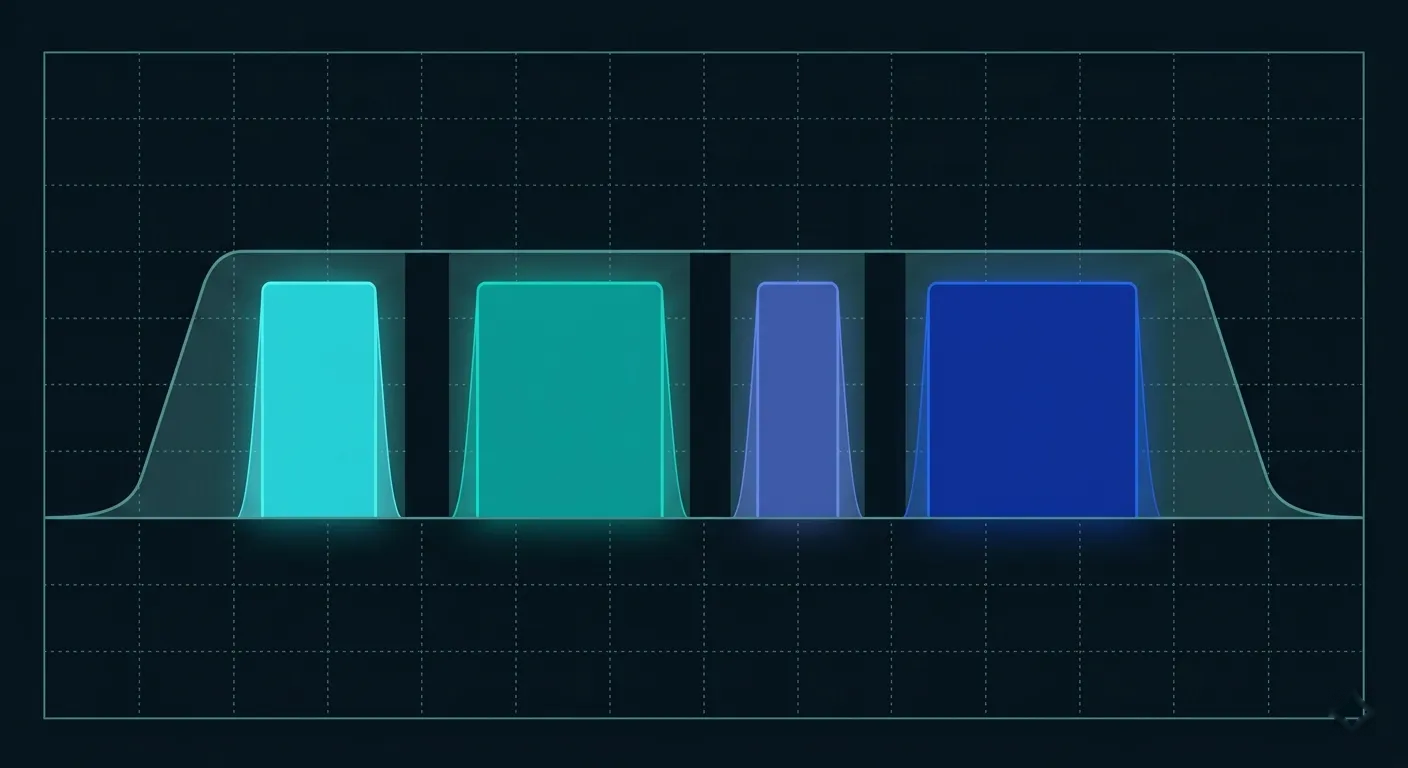
Satellite Transponder Bandwidth and Carrier Planning
Distinguish transponder output bandwidth, carrier span, occupied bandwidth, assigned spectrum, power loading, throughput, and operator acceptance evidence.
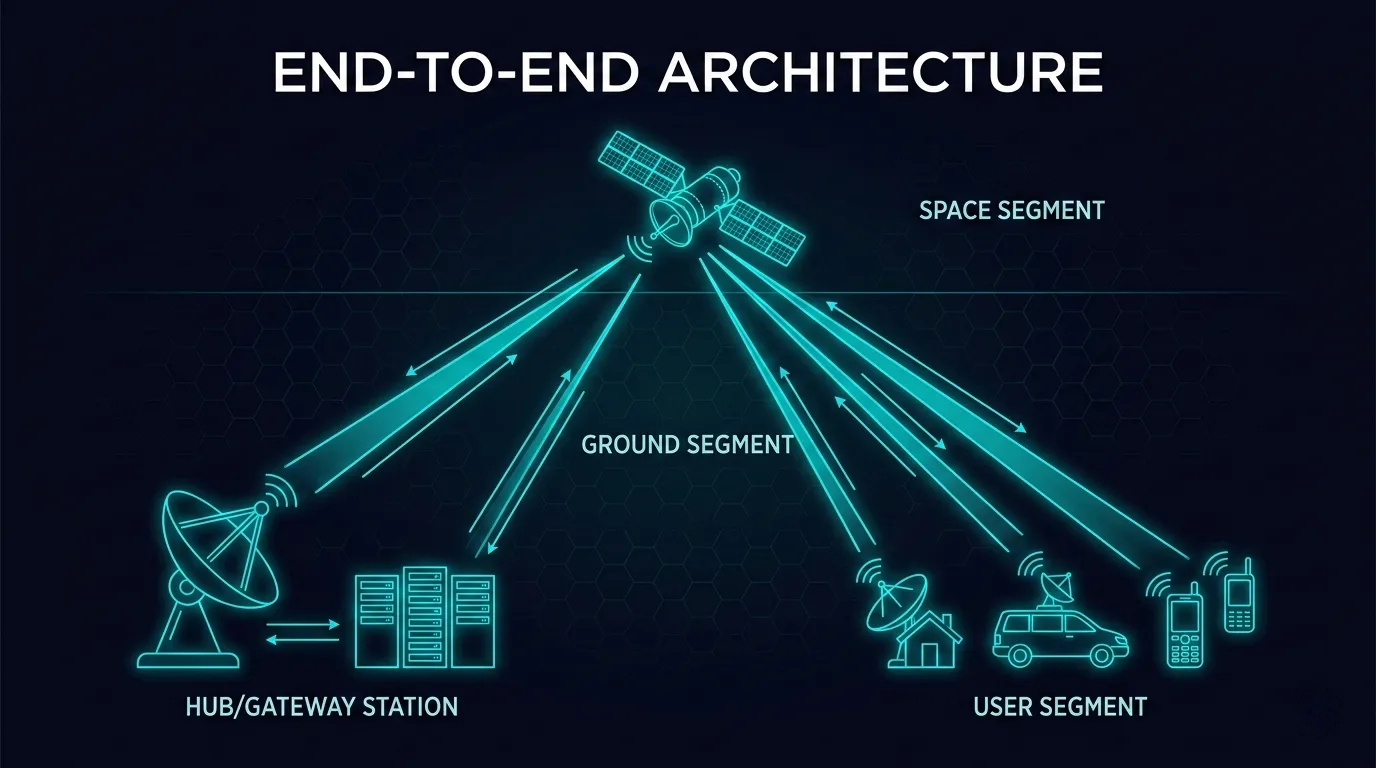
End-to-End Architecture
Complete overview of satellite communication system architecture from space segment to user terminals.
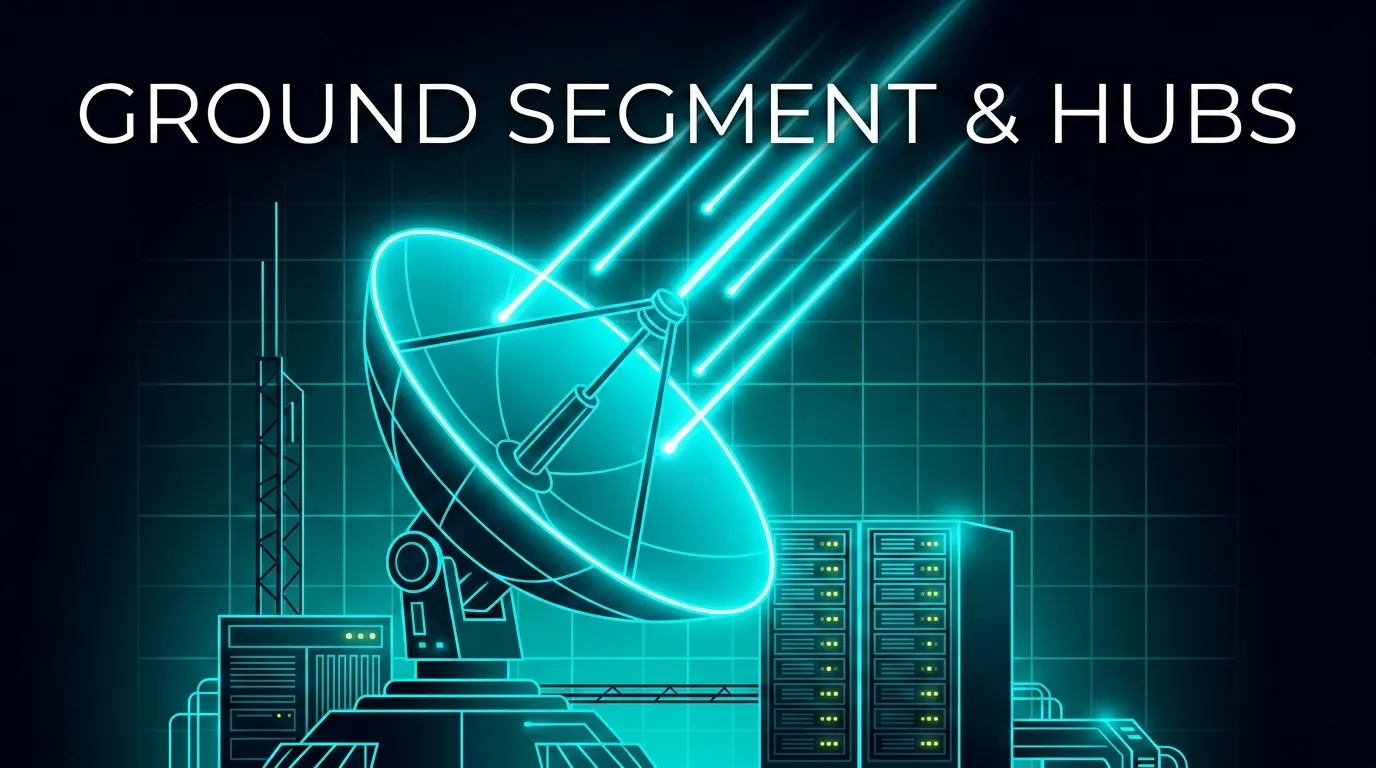
Ground Segment & Hubs
Gateway stations, hub infrastructure, and teleport facilities for satellite networks.