

Satellite Modulation and Coding Explained: QPSK, 8PSK, ACM, and Throughput Trade-offs
Technical guide to QPSK, 8PSK, ACM, and DVB-S2 modulation—learn how modulation and coding affect satellite throughput and link availability.
Introduction
Every satellite link is defined by three competing variables: spectrum (how much bandwidth you occupy on the transponder), power (the EIRP you need from your earth station to close the link), and throughput (how many bits per second you actually deliver to the user). The modulation and coding scheme you choose sits at the exact center of this three-way tension.
Pick a modulation that is too conservative—say, BPSK at rate 1/2—and you consume twice the bandwidth you need for a given data rate, driving up your transponder lease cost. Push too aggressively toward 32APSK at rate 9/10 and your link collapses the moment a rain event knocks 3 dB off your margin. The art of satellite link design is finding the optimal operating point on the modulation-coding continuum for each specific deployment scenario.
Understanding that continuum requires fluency in three interrelated concepts: the modulation scheme (how many bits each transmitted symbol carries), the forward error correction (FEC) code rate (how much redundancy protects those bits), and the adaptive control mechanism (how the system responds when channel conditions change). These three elements—modulation, coding, and adaptation—are inseparable in modern VSAT and broadcast systems built on DVB-S2 and DVB-S2X.
This article covers each layer in depth: from the basic physics of BPSK through the advanced MODCOD tables of DVB-S2X, with engineering-level treatment of Adaptive Coding and Modulation (ACM) and the throughput-versus-availability trade-offs that every SATCOM architect must navigate.
For context on how these choices flow into an overall link calculation, see the companion article on Satellite Link Budget Calculation.
Basic Modulation Schemes
The I/Q Plane and Constellation Diagrams
A digital modulator maps groups of input bits onto symbols, where each symbol is a specific combination of in-phase (I) and quadrature (Q) signal components. Plotting all possible I/Q states produces the constellation diagram—a two-dimensional map of the symbol space.
The fundamental trade-off is simple: more symbol states mean more bits per symbol, but the states are spaced closer together on the I/Q plane. Closer spacing means less noise margin before one symbol is mistaken for a neighbor—the decision boundary shrinks. Higher-order modulations therefore require a higher signal-to-noise ratio (SNR) at the receiver to maintain an acceptable bit error rate.
BPSK — Binary Phase Shift Keying
BPSK uses two symbol states, 180° apart on the I axis. Each symbol carries 1 bit. With only two states, the noise margin is the largest of any PSK scheme—approximately equal to the full signal amplitude. BPSK is the most robust modulation available and is used for:
- Satellite telemetry and beacon carriers (must survive the worst channel conditions)
- Deep-space communications (extreme path loss, minimal link margin)
- Spread-spectrum and navigation signals (GPS L1 C/A uses BPSK)
Spectral efficiency: 1 bit/s/Hz (before FEC overhead). In commercial VSAT, BPSK is rarely used for traffic carriers because the bandwidth cost is prohibitive.
QPSK — Quadrature Phase Shift Keying
QPSK doubles BPSK's spectral efficiency by using four states arranged at 90° intervals on the I/Q plane. Each symbol carries 2 bits. The noise margin is reduced (the I and Q components are each at ±0.707 of full amplitude), but QPSK remains highly robust—it requires only about 3 dB more Eb/No than BPSK for equivalent BER, and is remarkably tolerant of phase noise and nonlinear amplification.
QPSK is the dominant workhorse of GEO VSAT. Most enterprise and maritime VSAT networks use QPSK for the outbound (forward) carrier because it closes the link under adverse conditions while delivering acceptable spectral efficiency. DVB-S2 supports QPSK at code rates from 1/4 to 9/10.
8PSK — 8-Phase Shift Keying
8PSK places eight states equally spaced around a single circle (45° separation). Each symbol carries 3 bits. To maintain the same BER as QPSK, the receiver needs roughly 3 dB more Eb/No because the constellation points are closer together.
In DVB-S2, 8PSK is the first step up from QPSK in the MODCOD table. It yields a meaningful capacity gain for links with adequate margin—on a 36 MHz transponder running at 8PSK 3/4 versus QPSK 3/4, throughput increases by 50% (3 vs. 2 bits/symbol). 8PSK is amplitude-constant (all symbols at the same power level), so it is tolerant of HPA nonlinearity—a key advantage over APSK.
16APSK and 32APSK — Amplitude and Phase Shift Keying
At spectral efficiencies beyond 8PSK, phase-only modulation becomes geometrically constrained—you can only fit so many equally spaced points on a circle before the noise margin becomes unusable. APSK solves this by using multiple concentric rings, each with its own radius and phase points.
16APSK uses 4+12 ring geometry (4 points on inner ring, 12 on outer). Each symbol carries 4 bits. It requires tighter HPA linearity than 8PSK because the ratio between inner and outer ring amplitudes must be preserved at the receiver. DVB-S2 specifies 16APSK at code rates from 2/3 to 9/10.
32APSK uses 4+12+16 geometry and carries 5 bits/symbol. It demands the highest linearity, the smallest HPA output back-off (OBO), and the highest Eb/No of all standard DVB-S2 MODCODs. 32APSK is used in high-throughput satellite (HTS) spot beams where the C/I environment is tightly controlled and the available EIRP is high.
DVB-S2X extends this further with 64APSK, 128APSK, and 256APSK for extremely favorable link conditions.
Comparison Table
| Modulation | Bits/Symbol | Spectral Efficiency (raw) | Typical Eb/No (BER 10⁻⁷) | Primary Use Case |
|---|---|---|---|---|
| BPSK | 1 | 1 bit/s/Hz | ~7.5 dB | Telemetry, beacons |
| QPSK | 2 | 2 bit/s/Hz | ~10.5 dB | GEO VSAT, broadcast |
| 8PSK | 3 | 3 bit/s/Hz | ~13.5 dB | DVB-S2 mid-tier |
| 16APSK | 4 | 4 bit/s/Hz | ~16.5 dB | HTS spot beams |
| 32APSK | 5 | 5 bit/s/Hz | ~19.5 dB | HTS / clear sky |
Eb/No values are approximate; actual thresholds depend on FEC code rate and specific LDPC implementation.
Coding in Satellite Systems
What FEC Accomplishes
Forward error correction adds structured redundancy to the transmitted bitstream so that the receiver can detect and correct errors without requesting retransmission. In a one-way satellite broadcast link, ARQ (automatic repeat request) is impossible; FEC is the only mechanism available. Even in two-way VSAT links, the round-trip latency (240–280 ms for GEO) makes ARQ economically unacceptable for the forward link.
FEC trades raw throughput capacity for link robustness: a lower code rate protects more aggressively but consumes more bandwidth per useful bit.
Legacy and Modern FEC
Reed-Solomon (RS) was the standard outer code for DVB-S and DVB-DSNG. An RS(204,188) code adds 16 parity bytes per 188-byte MPEG-TS packet, correcting up to 8 byte errors. RS is effective against burst errors but cannot approach the Shannon limit.
Turbo codes (Parallel Concatenated Convolutional Codes) are used in military SATCOM and some commercial systems. They approach the Shannon limit within 1–2 dB but have high decoder complexity.
LDPC (Low-Density Parity-Check) is the FEC of choice in DVB-S2 and S2X. LDPC codes with a BCH outer code achieve performance within 0.7–1.1 dB of the Shannon limit at practical block lengths (64,800 bits for "normal" frames, 16,200 bits for "short" frames). LDPC decoders use iterative belief-propagation and are efficiently implementable in silicon.
Code Rate Explained
Code rate r = k/n where k is the number of information bits and n is the total transmitted bits. Examples:
- r = 1/2: For every information bit, one redundancy bit is added. Bandwidth is doubled relative to uncoded transmission; maximum coding gain, lowest throughput.
- r = 3/4: Three information bits for every four transmitted bits. 33% overhead.
- r = 9/10: Ten percent overhead; near-uncoded throughput but minimal protection.
Coding Gain and the Shannon Limit
Coding gain is the reduction in required Eb/No that FEC provides at a target BER, compared to uncoded BPSK. A well-designed rate-3/4 LDPC code in DVB-S2 delivers roughly 8–9 dB of coding gain—meaning the receiver needs 8–9 dB less signal power to achieve BER 10⁻⁷ than it would without FEC.
The Shannon limit defines the theoretical minimum Eb/No required to transmit error-free at a given spectral efficiency. DVB-S2's LDPC+BCH combination typically operates within 1 dB of this limit, which is a remarkable achievement compared to the 3–5 dB gap typical of legacy Viterbi-decoded convolutional codes.
Combined MODCOD Notation
In DVB-S2 terminology, modulation and code rate are always specified together as a MODCOD: "QPSK 3/4", "8PSK 2/3", "16APSK 5/6". The MODCOD fully determines the spectral efficiency:
Spectral efficiency (bits/s/Hz) = bits/symbol × code rate
For example: 8PSK 3/4 = 3 × 0.75 = 2.25 bits/s/Hz; QPSK 3/4 = 2 × 0.75 = 1.5 bits/s/Hz
Code Rate Summary
| Code Rate | Bandwidth Overhead | Approximate Coding Gain (vs. uncoded) | Typical Application |
|---|---|---|---|
| 1/4 | 300% | Very high (~11 dB) | Ultra-low SNR, mobile |
| 1/2 | 100% | High (~9 dB) | Low SNR, small antennas |
| 3/4 | 33% | Good (~7 dB) | Standard VSAT |
| 9/10 | 11% | Low (~4 dB) | Clear-sky HTS |
DVB-S2 and DVB-S2X Overview
Standards Evolution
The satellite broadcasting and broadband industry has converged on the DVB family of standards as the universal forward-link waveform:
- DVB-S (1994): First-generation digital satellite standard. QPSK with concatenated Reed-Solomon + Viterbi FEC. Defined the MPEG-2 TS delivery model for broadcast TV.
- DVB-S2 (2003, ETSI EN 302 307-1): Major revision. Introduced LDPC+BCH FEC, 8PSK/16APSK/32APSK support, ACM capability, and generic stream encapsulation (GSE). Achieved approximately 30% throughput improvement over DVB-S for the same power and bandwidth.
- DVB-S2X (2014, ETSI EN 302 307-2): Extension standard. Added finer-granularity MODCODs, ultra-low SNR operation, very high throughput (VHT) channel bonding, and higher-order APSK for HTS.
DVB-S2 Key Technical Features
DVB-S2's most significant architectural improvements over its predecessor:
- LDPC + BCH concatenation: Outer BCH code protects against residual LDPC errors; together they achieve quasi-error-free (QEF) operation (BER < 10⁻⁷) within ~1 dB of Shannon.
- Physical layer framing: Fixed-length Physical Layer Frames (PLFRAMEs) carry the MODCOD identifier in the header, allowing per-frame MODCOD switching for ACM.
- Four modulation orders: QPSK, 8PSK, 16APSK, 32APSK with 28 standardized MODCOD combinations.
- Rolloff factors: Three options (0.35, 0.25, 0.20) allowing tighter spectral shaping.
- Generic Stream Encapsulation (GSE): Direct IP packet encapsulation without MPEG-TS overhead.
DVB-S2X Additions
DVB-S2X is backward-compatible with DVB-S2 and extends it significantly:
- Finer MODCOD granularity: Over 80 MODCODs vs. 28 in DVB-S2, with 0.5 dB steps between operating points. This fine granularity is critical for ACM systems—tighter steps mean ACM switches less dramatically in response to fading.
- Very low SNR operation (down to −10 dB Es/No): Enabled by new low-order MODCODs (BPSK, BPSK-S, QPSK at very low rates), targeting mobile terminals and maritime scenarios.
- Wideband option: Channel bandwidths up to 500 MHz (vs. 72 MHz in DVB-S2) for HTS feeder links and gateway uplinks.
- Higher-order APSK: 64APSK, 128APSK, 256APSK for high C/I spot beam environments.
- Channel bonding: Multiple carriers bonded for >1 Gbps aggregate throughput on a single terminal.
Typical Deployment Profiles
| Deployment | Standard | Typical MODCOD |
|---|---|---|
| Broadcast DTH downlink | DVB-S2 | QPSK 3/4 or 8PSK 2/3 |
| HTS spot beam broadband | DVB-S2X | 16APSK 3/4 to 32APSK 5/6 |
| Enterprise VSAT two-way | DVB-S2 + ACM | QPSK 1/2 to 8PSK 3/4 (adaptive) |
| Maritime broadband | DVB-S2X | QPSK 1/2 to 16APSK 2/3 (ACM) |
For the role of satellite backhaul in HTS gateway architectures, the MODCOD choices at the feeder link level often determine the entire capacity equation for the spot beam fleet.
Adaptive Coding and Modulation (ACM)
How ACM Works
Adaptive Coding and Modulation is the mechanism by which a DVB-S2 or DVB-S2X hub dynamically adjusts the MODCOD used for each terminal based on real-time channel conditions at that terminal.
The control loop operates as follows:
- The receive terminal (RCST in DVB-RCS terminology, or simply the VSAT modem) continuously measures the Es/No (energy per symbol to noise power spectral density ratio) of the received downlink signal.
- The terminal reports this measurement back to the hub over the return channel, typically every 100–200 ms.
- The hub's ACM controller compares the reported Es/No against the minimum Es/No threshold table for each available MODCOD.
- The hub selects the highest-throughput MODCOD whose threshold is at least met by the terminal's reported Es/No (plus a configured guard margin).
- The selected MODCOD is signaled to the terminal in the Physical Layer Frame header of the next outgoing frame.
The entire round-trip—measurement, reporting, selection, signaling—completes within one to two frame periods (frames are 33 ms for normal frames). The terminal is effectively always operating at the most efficient MODCOD sustainable for its current link quality.
ACM vs. CCM vs. VCM
Three operating modes exist in DVB-S2:
- CCM (Constant Coding and Modulation): Single MODCOD for all frames and all terminals. Used for broadcast where all receivers must decode the same signal. Link must be designed for the worst-case terminal or worst-case weather condition—significant margin is "wasted" during clear-sky operation.
- VCM (Variable Coding and Modulation): Different MODCODs assigned to different logical channels (e.g., different service tiers) within the same multiplex, but the MODCOD for each channel is fixed, not adaptive. Used for multi-service multiplexes where different services have different power/robustness needs.
- ACM (Adaptive Coding and Modulation): Per-terminal, per-frame MODCOD selection based on real-time SNR feedback. Requires a return path and a unicast or multicast delivery model. Maximizes aggregate throughput across a mixed population of terminals.
ACM and Rain Fade Mitigation
The primary operational motivation for ACM in commercial VSAT is rain fade mitigation. When precipitation attenuates the downlink signal at a terminal, the received Es/No drops. Without ACM, the terminal's MODCOD threshold may no longer be met, causing the decoder to lose synchronization—a complete outage.
With ACM, the hub detects the degrading Es/No via return-channel feedback and steps down to a more robust MODCOD (e.g., from 16APSK 3/4 to QPSK 1/2) before the threshold is crossed. The terminal remains connected with reduced throughput rather than experiencing an outage. When the fade clears, ACM steps back up through the MODCOD table to recover full throughput.
This connects directly to the rain fade challenge on Ka-band systems—for more on the propagation physics, see Rain Fade in Satellite Communications.
ACM Trade-offs
ACM is not without costs:
- Throughput variability: A terminal's throughput fluctuates with weather. This is incompatible with constant bit rate (CBR) services (uncompressed video, synchronous TDM circuits) unless buffers and shaping are applied.
- Capacity planning complexity: Aggregate hub capacity depends on the current MODCOD distribution across all terminals—a fleet-wide rain event can temporarily reduce hub throughput significantly.
- Return channel dependency: ACM requires a low-latency return path. If the return link is impaired, ACM feedback stops and the hub must fall back to a conservative default MODCOD.
- Frame scheduling complexity: The hub scheduler must assign MODCOD per terminal per frame, requiring sophisticated real-time MODCOD tracking and frame packing logic.
Throughput vs. Availability Trade-offs
Link Margin and Design Availability
Every satellite link is designed to a availability target—the percentage of time the link must meet or exceed a minimum performance threshold (typically BER ≤ 10⁻⁷ or a specified throughput floor). Common targets:
- 99.5% availability: ~44 hours of outage per year. Typical for enterprise broadband.
- 99.9% availability: ~8.7 hours of outage per year. Required for mission-critical enterprise links.
- 99.99% availability: ~52 minutes of outage per year. Financial or government grade.
The gap between the clear-sky Es/No and the minimum MODCOD threshold is the link margin. Link margin must cover rain attenuation, atmospheric losses, pointing errors, and equipment aging—all at the specified availability percentile.
MODCOD and Availability
Choosing a more robust (lower-order) MODCOD for the CCM operating point directly determines what margin is available against fading. Consider a Ka-band link with a 3 dB clear-sky margin above the QPSK 3/4 threshold (Es/No = 5.2 dB). A rain event causing 4 dB of attenuation would cause an outage. If the designer instead uses QPSK 1/2 (Es/No threshold = 1.0 dB), the link closes with 7 dB of rain margin—at the cost of 25% less throughput at all times.
With ACM, the link can operate at QPSK 3/4 (or higher) in clear sky and step down through intermediate MODCODs as the fade develops, maintaining availability while recovering most of the throughput during benign conditions.
Spectral Efficiency and the bits/s/Hz Metric
Spectral efficiency in satellite systems is expressed as bits/s/Hz—how many bits are delivered per hertz of occupied transponder bandwidth per second. This is the true measure of transponder utilization:
Throughput (bps) = Spectral Efficiency (bits/s/Hz) × Symbol Rate (Bd) × Bandwidth (Hz) / Symbol Rate
For a 36 MHz transponder with 0.25 rolloff (occupied BW ≈ 45 MHz, symbol rate ≈ 36 Mbaud):
| MODCOD | Spectral Efficiency | Throughput (36 Mbaud) |
|---|---|---|
| QPSK 1/2 | 0.99 bits/s/Hz | ~35.7 Mbps |
| QPSK 3/4 | 1.49 bits/s/Hz | ~53.6 Mbps |
| 8PSK 2/3 | 1.98 bits/s/Hz | ~71.3 Mbps |
| 16APSK 3/4 | 2.97 bits/s/Hz | ~106.9 Mbps |
| 32APSK 4/5 | 3.96 bits/s/Hz | ~142.6 Mbps |
Uplink Power Control (AUPC)
Automatic Uplink Power Control (AUPC) is an alternative or complement to ACM for fade mitigation. When downlink rain attenuation is detected (via a beacon receiver or signal quality monitor), the uplink EIRP is increased to compensate. AUPC is most applicable for:
- Uplink fade compensation on the hub transmit path
- Maintaining constant MODCOD (CCM) when hardware power reserves exist
- Complement to ACM in two-way links
AUPC has limits—it is constrained by the HPA's maximum power and the transponder's saturation point—and cannot compensate for deep fades exceeding 6–8 dB.
Availability and MODCOD Headroom
| Availability Target | Ka-Band Rain Margin (Tropical) | Ka-Band Rain Margin (Temperate) | Committed MODCOD Impact |
|---|---|---|---|
| 99.5% | ~5–7 dB | ~3–4 dB | QPSK 3/4 to 8PSK 2/3 |
| 99.9% | ~8–12 dB | ~5–7 dB | QPSK 1/2 to QPSK 3/4 |
| 99.99% | ~15–20 dB | ~8–12 dB | BPSK or QPSK 1/4 |
These margins directly constrain the maximum committed MODCOD and therefore the committed information rate (CIR) a service provider can guarantee.
For how antenna size and gain feed into these link margin calculations, see Satellite Antenna Types Guide.
Practical Design Considerations
When to Use Conservative MODCODs
Stick with QPSK 1/2 or QPSK 3/4 as the baseline MODCOD when:
- Tropical deployments: Locations above 15° latitude with heavy convective rainfall (Nigeria, Indonesia, Brazil) see rain attenuation events of 15–25 dB on Ka-band. Significant rain margin is non-negotiable.
- Maritime terminals: Small-aperture antennas (0.45–0.6 m VSAT dishes on vessels) have lower gain, reducing clear-sky margin. Combined with vessel motion affecting pointing, only robust MODCODs are reliable. See Maritime Satellite Internet for deployment context.
- High-availability SLAs (≥99.9%): The committed rain margin required to achieve five-nines availability on Ka-band in mid-latitudes essentially mandates QPSK with moderate code rate as the CCM floor.
- Small antennas in CCM mode: A 0.75 m Ka-band VSAT with 12 dBW EIRP may barely close a QPSK 3/4 link in clear sky—any modulation step-up is impossible.
When to Push for Higher-Order Modulation
16APSK and above are appropriate when:
- Large HTS spot beams with high EIRP: Modern high-throughput satellites deliver 60–70 dBW EIRP in spot beams. A 1.2 m terminal at 20° elevation may have 15 dB or more of clear-sky margin over the 16APSK threshold.
- C/I-controlled environment: On-axis terminals in the center of a well-isolated spot beam see minimal co-channel interference. High C/I allows high-order APSK to operate at coded margins rather than interference margins.
- Cost-per-bit optimization: On HTS capacity priced per MHz or per GB, maximizing spectral efficiency directly reduces the cost per delivered bit. A service provider running 16APSK 3/4 instead of QPSK 3/4 delivers 2× the data from the same transponder slice.
- ACM-enabled platforms: When ACM is available, operating at a high target MODCOD is lower risk—the system backs off gracefully during fades rather than experiencing binary link failure.
HPA Nonlinearity and Back-off
APSK is more sensitive to HPA nonlinearity than PSK because it relies on amplitude differences between ring levels. A traveling-wave tube amplifier (TWTA) operating near saturation introduces amplitude compression and AM-to-PM conversion that collapses the inter-ring amplitude ratio, increasing symbol error rate.
To maintain APSK fidelity, the HPA must operate with output power back-off (OBO):
- 16APSK: typically 2–3 dB OBO
- 32APSK: typically 3–5 dB OBO
This OBO directly reduces the available EIRP margin. When sizing link budgets for high-order APSK, the HPA back-off must be explicitly included in the EIRP calculation. For power-limited uplinks (particularly small maritime and enterprise terminals), this back-off requirement may be the binding constraint preventing use of 16APSK or above.
Enterprise SLA Implications
Enterprise service providers build their SLAs around a committed information rate (CIR)—the minimum guaranteed throughput under specified availability conditions. The CIR is computed assuming the link operates at a conservatively chosen MODCOD with sufficient rain margin to meet the availability target. Any throughput above the CIR (during clear sky or when ACM is operating at higher MODCODs) is typically uncontrolled "burst" capacity.
When negotiating satellite bandwidth contracts, understanding the MODCOD baseline used to derive the CIR is essential. A provider quoting 50 Mbps CIR on a 36 MHz transponder at QPSK 3/4 is making different assumptions than one quoting 50 Mbps CIR at 16APSK 3/4—the latter has far less rain margin baked in.
Frequently Asked Questions
What is the difference between QPSK and 8PSK in satellite links?
QPSK encodes 2 bits per symbol using four phase states; 8PSK encodes 3 bits per symbol using eight phase states. The 50% increase in bits per symbol raises spectral efficiency proportionally, but requires approximately 3 dB higher Es/No to maintain equivalent BER. QPSK is the standard choice for links with limited margin (small antennas, high rain attenuation risk, or low available EIRP). 8PSK is used when there is sufficient clear-sky margin to absorb the additional SNR requirement while still meeting the availability target.
Why does higher-order modulation require more power?
Higher-order modulation packs more symbol states into the same I/Q plane, reducing the minimum Euclidean distance between neighboring constellation points. A smaller minimum distance means noise perturbations are more likely to push a received symbol across a decision boundary into an adjacent state, causing an error. To maintain the same error probability (BER), the SNR must be higher—which requires either more transmit power, a larger receive antenna (gain), or a lower noise figure. The relationship is approximately logarithmic: each doubling of modulation order requires roughly 3–4 dB additional SNR.
How does ACM differ from VCM?
VCM (Variable Coding and Modulation) assigns different fixed MODCODs to different services or multiplexes within a carrier, but does not adapt those assignments in real time based on link quality. It is a static, configuration-time assignment. ACM (Adaptive Coding and Modulation) dynamically changes the MODCOD on a per-frame, per-terminal basis in response to real-time Es/No measurements from the terminal. ACM requires a return channel and active hub control logic; VCM does not.
What MODCOD does DVB-S2 use for broadcast TV?
Standard-definition and high-definition DTH (Direct-to-Home) broadcast typically uses QPSK 3/4 or 8PSK 2/3, providing a good balance of robustness and spectral efficiency for the large number of home receivers that may have small antennas (0.6–0.9 m) in varying weather conditions. Some high-capacity HD multiplexes use 8PSK 3/4. Ultra-HD/4K broadcasts on HTS platforms may use 16APSK at mid-range code rates. CCM mode is always used for broadcast (ACM requires per-terminal addressing incompatible with mass broadcast).
Can ACM work over LEO satellite links?
ACM as defined in DVB-S2 was designed for GEO links with stable, slowly varying channel conditions. On LEO links, the channel changes rapidly due to Doppler shift, elevation angle variation, and handovers between satellites. Some LEO broadband systems (notably Starlink's consumer service) use proprietary adaptive modulation schemes, but they differ significantly from DVB-S2 ACM in implementation—faster adaptation rates, different feedback mechanisms, and coordination across handover boundaries. Standardized DVB-S2 ACM is not typically deployed on LEO broadband systems.
What is spectral efficiency in satellite communication?
Spectral efficiency measures how many bits of information are transmitted per second for each hertz of bandwidth occupied: the unit is bits/s/Hz. A higher spectral efficiency means more data throughput from the same bandwidth allocation. In satellite, this is constrained by the Shannon limit for the available SNR. Higher-order modulation and higher code rates both increase spectral efficiency, but require higher SNR. The practical range in DVB-S2 spans from approximately 0.5 bits/s/Hz (QPSK 1/4) to 4.5 bits/s/Hz (32APSK 9/10).
How does FEC code rate affect throughput in a fixed bandwidth transponder?
In a fixed transponder bandwidth, the symbol rate (baud) is fixed by the occupied bandwidth and rolloff factor. Throughput (bps) equals the symbol rate multiplied by bits per symbol (determined by modulation) multiplied by the code rate. Reducing the code rate from 3/4 to 1/2 on a QPSK carrier reduces throughput by 33% (1.5 bits/s/Hz vs. 1.0 bits/s/Hz) while consuming the same bandwidth. Conversely, raising the code rate from 1/2 to 3/4 increases throughput by 50% with the same bandwidth—but requires ~2 dB more Es/No to maintain the same BER.
Summary and Key Takeaways
Modulation and coding are not independent configuration choices—they are two sides of a single design decision that determines spectral efficiency, power requirement, and link availability simultaneously. The key engineering principles:
-
Modulation order determines symbol efficiency: Each step up from BPSK to QPSK to 8PSK to 16APSK to 32APSK adds one bit per symbol at the cost of roughly 3–4 dB in required Es/No.
-
FEC code rate trades throughput for margin: Lower code rates provide more coding gain and link robustness at the expense of bandwidth efficiency. DVB-S2's LDPC+BCH FEC operates within ~1 dB of the Shannon limit across the full MODCOD table.
-
ACM is the standard approach for maximizing throughput while preserving availability: By adapting the MODCOD per terminal in real time, ACM allows links to operate at peak efficiency in clear sky while gracefully degrading (rather than failing) during rain events.
-
DVB-S2X enables fine-grained MODCOD for HTS and very-low-SNR scenarios: The extended MODCOD table with 0.5 dB granularity allows ACM to step down finely rather than coarsely, minimizing throughput loss during partial fades.
-
Always design for the worst-case link margin, then let ACM recover throughput in clear sky: The committed information rate (CIR) should be based on a conservative MODCOD that the link can sustain at the required availability percentile. ACM throughput above CIR is bonus capacity, not a design guarantee.
Related Articles
- Satellite Link Budget Calculation — How to compute the end-to-end power budget that determines your available link margin
- VSAT Network Architecture — How VSAT hubs and terminals are organized and how the forward link fits into the overall topology
- Rain Fade in Satellite Communications — Propagation physics behind the attenuation that ACM is designed to mitigate
- Satellite Backhaul Explained — How HTS gateway feeder links use high-order modulation to concentrate capacity
- Satellite Antenna Types Guide — How antenna aperture and gain affect the link margin available for higher-order modulation
Author

Organizational byline for SATCOM Index technical content. A named technical reviewer appears separately only when identity, scope, and permission are verified.
Categories
More Posts
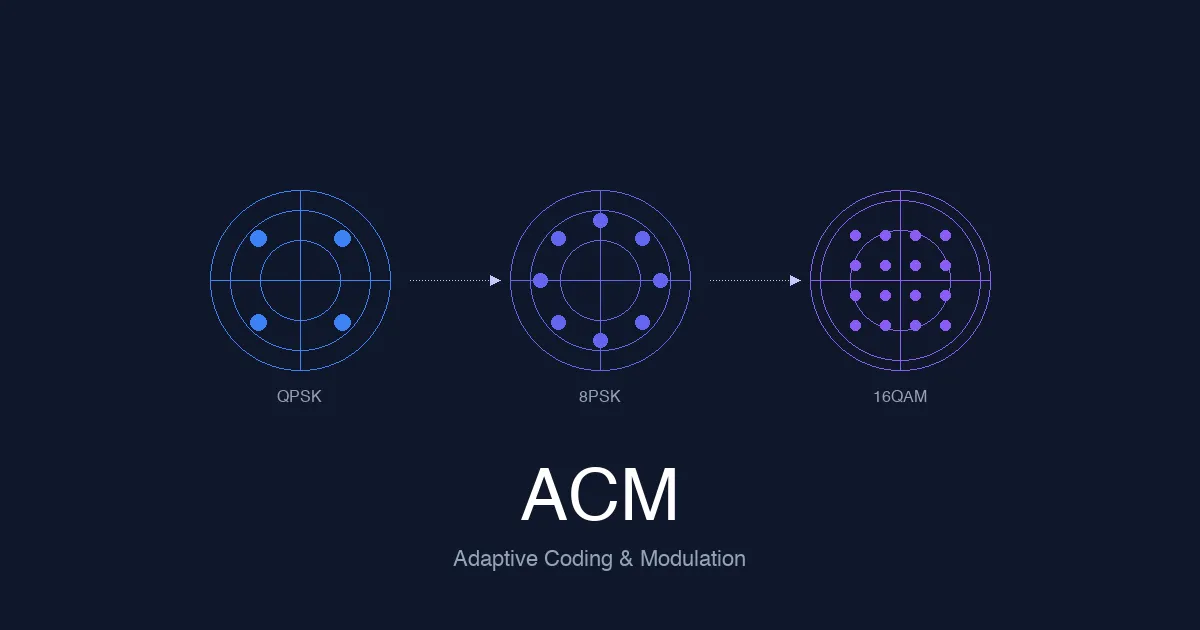
Adaptive Coding and Modulation (ACM) Explained: How Satellite Networks Maintain Link Quality
Engineering guide to adaptive coding and modulation in satellite systems covering signal quality measurement, MODCOD selection algorithms, DVB-S2/S2X ACM capabilities, rain fade response, and ACM design for HTS and LEO networks.
C/N, C/N0, Eb/N0 and Es/N0 Explained
Learn how C/N, C/N0, Eb/N0, and Es/N0 relate, choose the correct bandwidth and bit rate, and reproduce a DVB-S2 conversion without reference-plane errors.
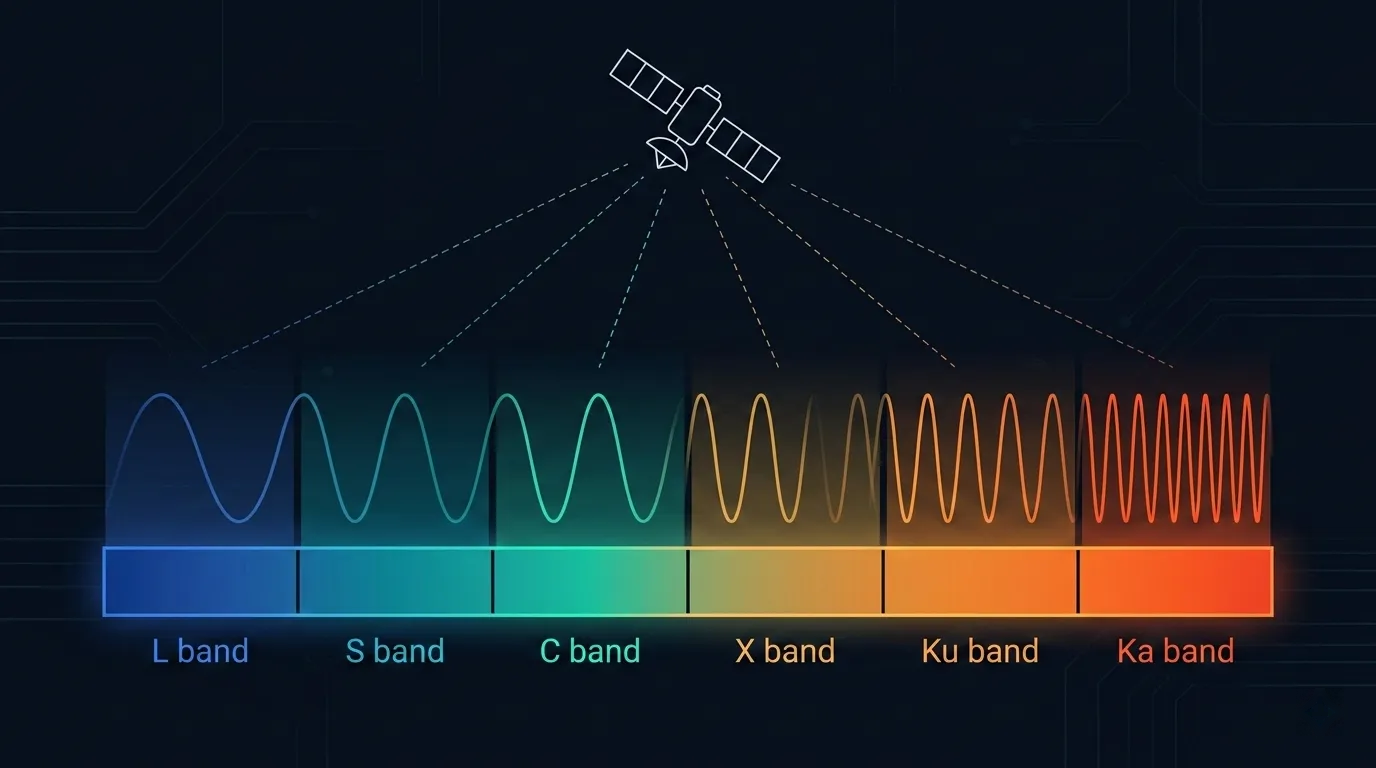
Satellite Frequency Bands: L, S, C, X, Ku and Ka
Understand L, S, C, X, Ku and Ka labels, ITU allocations, uplink/downlink direction, propagation, antenna scaling, and a defensible selection workflow.