
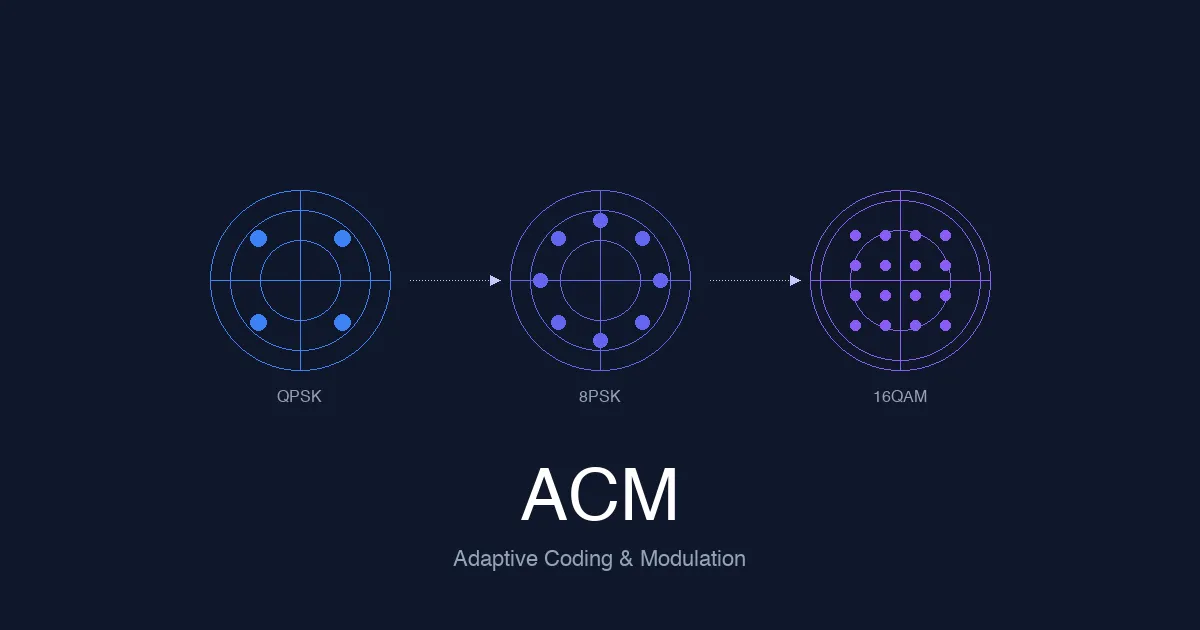
Adaptive Coding and Modulation (ACM) Explained: How Satellite Networks Maintain Link Quality
Engineering guide to adaptive coding and modulation in satellite systems covering signal quality measurement, MODCOD selection algorithms, DVB-S2/S2X ACM capabilities, rain fade response, and ACM design for HTS and LEO networks.
Satellite links operate under continuously varying conditions. Rain attenuates the signal, antenna mispointing reduces received power, interference raises the noise floor, and—in LEO systems—the changing geometry of each satellite pass alters the link budget from one second to the next. A fixed transmission configuration must be sized for the worst case, which means the link wastes most of its capacity under the clear-sky conditions that prevail 95–99% of the time.
Adaptive Coding and Modulation (ACM) solves this problem by measuring the actual signal quality at the receiver and dynamically selecting the most efficient combination of modulation order and forward error correction (FEC) code rate that the link can support at that moment. When conditions are good, ACM uses high-order modulation and light FEC for maximum throughput. When conditions degrade, it shifts to lower-order modulation and stronger FEC to maintain the connection. The result is a link that delivers 2–4× the average throughput of a fixed configuration while maintaining the same availability target.
This article provides an engineering-level treatment of how ACM works internally—signal quality measurement, MODCOD selection algorithms, hysteresis and guard margins, DVB-S2 vs DVB-S2X ACM capability differences, and ACM behavior during rain fade events. For MODCOD fundamentals and modulation/coding tables, see our Satellite Modulation and Coding Guide.
Key terms used in this article: ACM (Adaptive Coding and Modulation — closed-loop system that dynamically selects modulation and coding based on real-time link quality), CCM (Constant Coding and Modulation — fixed modulation and coding regardless of conditions), VCM (Variable Coding and Modulation — operator-assigned modulation and coding that can differ per stream but does not adapt to real-time measurements), MODCOD (Modulation and Coding combination — a specific pairing of modulation scheme and FEC code rate), Es/No (Energy per symbol to noise density ratio — the standard signal quality metric for DVB-S2/S2X), FEC (Forward Error Correction), LDPC (Low-Density Parity-Check — the primary FEC code in DVB-S2/S2X), ACM loop (the closed-loop feedback cycle of measurement, reporting, selection, and transmission adjustment), hysteresis (different Es/No thresholds for stepping up vs stepping down MODCOD to prevent rapid oscillation), AUPC (Automatic Uplink Power Control — terminal transmit power adjustment to compensate for uplink fades), DVB-S2 / DVB-S2X (Digital Video Broadcasting satellite standards defining the air interface).
What Is Adaptive Coding and Modulation
Adaptive Coding and Modulation (ACM) is a closed-loop system that measures the signal quality of a satellite link in real time and dynamically selects the optimal combination of modulation order and FEC code rate—called a MODCOD—to maximize throughput while maintaining quasi-error-free (QEF) operation. The receiver continuously measures Es/No (energy per symbol to noise density ratio), reports it back to the transmitter, and the transmitter adjusts the MODCOD on a frame-by-frame basis.
ACM is best understood by contrasting it with the two alternative modes:
-
CCM (Constant Coding and Modulation): The MODCOD is fixed and never changes. The link is designed for worst-case conditions—typically the deepest rain fade at the target availability. Under clear-sky conditions (which prevail most of the time), the link operates far below its capacity potential. CCM is simple and requires no feedback channel, but wastes capacity.
-
VCM (Variable Coding and Modulation): Different data streams within the same carrier can use different MODCODs, but the assignment is static or operator-configured—it does not respond to real-time signal quality measurements. VCM is useful for broadcast scenarios where different content streams have different protection requirements.
The key insight behind ACM is that worst-case conditions occur only a small fraction of the time. A link designed for 99.5% availability at Ka-band may experience rain fades exceeding 6 dB for only 0.5% of the year. ACM uses efficient high-order MODCODs during the remaining 99.5% and falls back to robust lower-order MODCODs only when needed, dramatically increasing average throughput without sacrificing availability. For detailed MODCOD tables and spectral efficiency values, see our modulation and coding guide.
Why ACM Is Important in Satellite Systems
Satellite link conditions vary due to multiple factors, each capable of degrading the received signal quality by several decibels:
Weather. Rain fade is the dominant impairment at Ku-band and Ka-band. At Ka-band (20/30 GHz), rain attenuation during heavy storms can exceed 10–15 dB. At Ku-band (12/14 GHz), typical fades range from 3–6 dB during moderate to heavy rainfall. These fades are location-dependent, time-varying, and highly statistical. For a comprehensive treatment, see our rain fade article.
Antenna mispointing. On fixed VSAT terminals, mispointing typically contributes 0.5–1.0 dB of pointing loss. On mobile platforms—maritime, aeronautical, and land-mobile—pointing errors can be significantly larger and more dynamic, especially in rough seas or during aircraft maneuvers. Each dB of pointing loss directly reduces the received Es/No.
Interference. Adjacent satellite interference (ASI), cross-polarization interference, and terrestrial interference raise the effective noise floor, reducing the carrier-to-noise ratio. Interference levels can vary over time as traffic patterns change on neighboring satellites. For more on interference sources, see our interference article.
Distance variation. In LEO systems, the satellite's elevation angle changes continuously during each pass, producing 3–6 dB of path loss variation as the satellite moves from low elevation (long slant range) to high elevation (short slant range) and back. Even in GEO systems, terminals at the edge of the satellite's coverage footprint receive weaker signals than those at beam center.
Without ACM, the link must be designed for the worst combination of all these impairments. Consider a Ka-band link designed for 99.5% availability with CCM: it might be constrained to QPSK 1/2 (spectral efficiency ~1.0 bit/s/Hz) to survive deep fades. With ACM, the same link operates at 16APSK 3/4 (spectral efficiency ~3.0 bit/s/Hz) during clear sky—95% or more of the time—and falls back to QPSK 1/2 only during the deepest fades. The result is a 3× increase in average throughput for the same bandwidth, antenna size, and power.
How ACM Works
ACM operates as a continuous closed-loop feedback system. The loop has four stages: signal quality measurement, quality reporting, MODCOD selection, and dynamic transmission adjustment.
Signal Quality Measurement
The receiver continuously measures the received signal quality, expressed as Es/No (energy per symbol to noise density ratio) in DVB-S2/S2X systems. This measurement is derived from the demodulator's internal signal processing—typically from pilot-based or data-aided estimation within each physical layer frame.
Measurement accuracy is critical. An error of ±0.5 dB in Es/No estimation can cause the system to select the wrong MODCOD—either too aggressive (causing errors) or too conservative (wasting throughput). Modern DVB-S2X demodulators achieve measurement accuracy of ±0.3 dB or better under stable conditions.
The measurement averaging interval is a key design parameter. Too short an averaging window (< 50 ms) produces noisy estimates that cause unnecessary MODCOD switching. Too long a window (> 1 s) makes the system slow to respond to rapid fades. Typical implementations use 100–500 ms averaging, with shorter intervals for LEO systems where conditions change faster due to satellite geometry dynamics.
MODCOD Selection
The hub or gateway maps the measured Es/No to a MODCOD from the available table. Each MODCOD has a defined Es/No threshold—the minimum signal quality needed for quasi-error-free operation (packet error rate < 10⁻⁷ after LDPC/BCH decoding).
The selection process includes two important mechanisms:
Guard margin. The system adds a margin (typically 0.5–1.5 dB) above the theoretical Es/No threshold before selecting a MODCOD. This margin accounts for measurement uncertainty, fast signal fluctuations within the averaging window, and implementation losses. Without adequate guard margin, the system would frequently select MODCODs that are marginally too aggressive, causing intermittent errors.
Hysteresis. The Es/No threshold for stepping up to a higher MODCOD is set higher than the threshold for stepping down to a lower one. For example, if the step-down threshold for 8PSK 3/4 is 10.0 dB and hysteresis is 1.0 dB, the step-up threshold is 11.0 dB. This prevents rapid oscillation between adjacent MODCODs when the Es/No hovers near a boundary—a condition that would cause throughput instability and increase the signaling overhead.
Dynamic Transmission Adjustment
Once the MODCOD is selected, the transmission is adjusted:
Forward link (hub → terminals): In DVB-S2/S2X, each physical layer frame carries its MODCOD identifier in the frame header (PLHEADER). The hub can change MODCOD on a per-frame basis, with different frames within the same carrier using different MODCODs for different destination terminals. The receiver reads the PLHEADER, determines the MODCOD, and configures its demodulator and decoder accordingly.
Return link (terminals → hub): The hub sends a MODCOD command to the terminal through the forward link signaling channel (typically in the terminal burst time plan or a dedicated control message). The terminal adjusts its next transmission accordingly. This adds additional latency to the ACM loop because the command must traverse the satellite link.
| ACM Loop Step | Typical Duration |
|---|---|
| Es/No measurement and averaging | 100–500 ms |
| Quality report transmission (return link) | 50–150 ms (including satellite delay) |
| MODCOD selection at hub | 1–10 ms |
| MODCOD command transmission (forward link) | 50–150 ms (including satellite delay) |
| Terminal applies new MODCOD | 1–10 ms |
| Total ACM loop latency | 200–600 ms |
For GEO systems, the satellite propagation delay (~250 ms one way) dominates the loop timing, limiting the ACM response to events occurring over hundreds of milliseconds or longer. For LEO systems with lower propagation delay, the loop can be faster, but the measurement averaging interval becomes the limiting factor.
ACM in DVB-S2 and DVB-S2X
The DVB-S2 and DVB-S2X standards define the MODCOD tables and frame structures that ACM operates within. The differences between these two standards have significant implications for ACM performance.
DVB-S2 defines 28 MODCODs spanning four modulation schemes: QPSK, 8PSK, 16APSK, and 32APSK. The Es/No operating range extends from approximately -2.35 dB (QPSK 1/4) to 16.05 dB (32APSK 9/10), providing about 18 dB of dynamic range. The spacing between adjacent MODCODs varies from 0.5 to 1.5 dB, with larger gaps at some operating points.
DVB-S2X dramatically expands the MODCOD table to 116+ combinations. It extends the modulation range to include 64APSK, 128APSK, and 256APSK at the high end, and adds Very Low SNR (VL-SNR) MODCODs that operate down to -10 dB Es/No at the low end. The spacing between adjacent MODCODs is finer—typically 0.2–0.5 dB in the most commonly used operating ranges.
| Parameter | DVB-S2 | DVB-S2X |
|---|---|---|
| Number of MODCODs | 28 | 116+ |
| Modulation range | QPSK to 32APSK | QPSK to 256APSK |
| Es/No operating range | -2.35 to 16.05 dB | -10 to ~20 dB |
| Typical ACM dynamic range | ~18 dB | ~30 dB |
| MODCOD granularity | 0.5–1.5 dB steps | 0.2–0.5 dB steps |
| Key additions | — | VL-SNR MODCODs, 64/128/256APSK, finer steps |
Why the S2X improvements matter for ACM: finer MODCOD steps mean less throughput is wasted from the guard margin between adjacent MODCODs. With DVB-S2's coarser steps, the system might be forced to use a MODCOD that is 1.5 dB below the link's actual capability. With DVB-S2X, the nearest MODCOD is typically within 0.3 dB of the optimum, recovering that lost spectral efficiency. Over a fleet of thousands of terminals, this improvement adds up to significant additional capacity.
The VL-SNR MODCODs in DVB-S2X are particularly valuable for mobile and LEO scenarios where the link may temporarily operate at very low Es/No—conditions where DVB-S2 would lose connectivity entirely. By maintaining a data connection (even at very low throughput) through deep fades, VL-SNR MODCODs improve link availability and enable continuous service.
Benefits of ACM
ACM delivers measurable improvements across several dimensions of satellite link performance:
Higher average throughput. The most significant benefit. For a Ka-band link in a moderate rain region (ITU-R rain zone K), ACM typically provides 2–4× the average throughput compared to CCM for the same link and availability target. The exact gain depends on the rain statistics, frequency band, and terminal size. Higher-frequency bands (Ka, Q/V) and wetter climates see larger ACM gains because the difference between clear-sky and worst-case conditions is greater.
Improved link availability. ACM can maintain connectivity during fades that would break a CCM link operating at the same average throughput. By dynamically dropping to more robust MODCODs, ACM extends the link's effective dynamic range. A DVB-S2X system with VL-SNR MODCODs can tolerate fades exceeding 25 dB—well beyond what any fixed MODCOD could survive while still providing useful clear-sky throughput.
Efficient spectrum usage. Under clear-sky conditions, ACM operates closer to the Shannon capacity limit by using high-order modulation and light coding. This means more bits per hertz of bandwidth—critical in the congested satellite spectrum environment where bandwidth is expensive and limited.
Reduced over-provisioning. Because ACM optimizes throughput under typical conditions rather than worst-case, system designers can use smaller antennas, lower-power amplifiers, or narrower bandwidth allocations than a CCM system would require for the same average performance. This reduces terminal cost and opens satellite broadband to price-sensitive markets.
Per-terminal optimization. In a multi-terminal system, each terminal experiences different conditions based on its location, weather, antenna quality, and local interference. ACM adapts independently for each terminal—a terminal in the desert operates at high-order MODCODs almost continuously, while a terminal in a tropical rain zone drops to lower MODCODs during storms. Both receive the best throughput their individual conditions allow, simultaneously, on the same carrier.
ACM and Rain Fade
Rain fade is the primary impairment that ACM is designed to mitigate. Understanding how ACM behaves during a rain event—not rain fade in general, which is covered in our rain fade article—is essential for system design and capacity planning.
Timeline of an ACM Response to Rain Fade
Consider a Ka-band terminal normally operating at 16APSK 3/4 under clear sky (Es/No = 12 dB):
-
Clear sky (Es/No = 12 dB): Operating at 16APSK 3/4, spectral efficiency ~3.0 bit/s/Hz. Full throughput.
-
Rain onset, 3 dB fade (Es/No = 9 dB): ACM steps down to 8PSK 2/3, spectral efficiency ~2.0 bit/s/Hz. Throughput drops to ~67% of clear sky.
-
Moderate rain, 6 dB fade (Es/No = 6 dB): ACM steps down to QPSK 3/4, spectral efficiency ~1.5 bit/s/Hz. Throughput at ~50%.
-
Heavy rain, 10 dB fade (Es/No = 2 dB): ACM steps down to QPSK 1/3, spectral efficiency ~0.66 bit/s/Hz. Throughput at ~22%. Link maintained.
-
Recovery: As rain subsides, Es/No climbs back up. ACM steps up through the MODCODs in reverse order, but with hysteresis—each step-up occurs at an Es/No 0.5–1.0 dB higher than the step-down threshold. Full throughput is restored within 1–2 ACM loop cycles after Es/No recovers to clear-sky levels.
ACM Dynamic Range vs Fade Depth
ACM can only compensate for fades within its dynamic range. If the fade exceeds the range between the highest and lowest available MODCODs, the link drops regardless of ACM. For a DVB-S2 system with ~18 dB dynamic range, a 20 dB fade causes link loss. For DVB-S2X with VL-SNR MODCODs providing ~30 dB dynamic range, the same fade is survivable.
System design must ensure that the fade depth statistics for the target location and availability align with the ACM dynamic range. For Ka-band systems in tropical regions where rain fades can exceed 20 dB, DVB-S2X VL-SNR capability or site diversity may be required.
ACM and AUPC Interaction
On the return link (terminal → satellite), Automatic Uplink Power Control (AUPC) works in combination with ACM. AUPC increases the terminal's transmit power during uplink fades, up to the high-power amplifier's (HPA) maximum output. This compensates for uplink attenuation without changing the MODCOD.
The sequence during a fade event is:
- Mild fade: AUPC increases transmit power to compensate. MODCOD unchanged. No throughput impact.
- AUPC saturated: When the HPA reaches maximum power, AUPC can no longer compensate further. Any additional fade causes Es/No to drop.
- ACM engages: As Es/No drops below the current MODCOD's threshold, ACM steps down to a more robust MODCOD. Throughput decreases but connectivity is maintained.
This layered approach—AUPC first, then ACM—maximizes the fade depth that can be tolerated while minimizing throughput impact. AUPC handles mild fades transparently (no throughput loss), while ACM handles deeper fades with graceful throughput degradation.
Engineering Trade-offs
ACM introduces several engineering trade-offs that must be understood for proper system design and capacity planning.
Throughput variability. ACM means throughput is not constant—it varies with weather and link conditions. Service level agreements must distinguish between Committed Information Rate (CIR), which must be guaranteed under worst-case conditions (sized for the lowest MODCOD at the target availability), and Maximum Information Rate (MIR) or Excess Information Rate (EIR), which benefit from clear-sky MODCODs. Network planning must model the statistical throughput distribution, not just the peak or worst case.
Return channel dependency. Forward-link ACM requires the return channel to carry signal quality reports from terminals to the hub. If the return link fails—due to its own rain fade, equipment failure, or interference—the hub cannot receive Es/No reports and ACM cannot adapt. The system falls back to a conservative default MODCOD until the return link is restored. System design must consider this dependency and size the default fallback MODCOD appropriately.
Guard margin tuning. The guard margin between the measured Es/No and the MODCOD threshold is a key design parameter. Too much margin means the system consistently operates one MODCOD below what the link could support, wasting throughput. Too little margin means the system occasionally selects MODCODs that are too aggressive, causing packet errors and retransmissions. Typical values are 0.5–1.0 dB for GEO systems (where conditions change slowly) and 1.0–2.0 dB for LEO systems (where faster dynamics require more margin for measurement latency).
Capacity planning complexity. ACM makes capacity planning fundamentally probabilistic. The throughput a terminal delivers depends on weather statistics at that location, not just link geometry. Accurate capacity planning requires Monte Carlo simulation using ITU-R rain models (P.618, P.837, P.838) or measured rain rate data for each terminal location. For a network of hundreds or thousands of terminals across multiple climate zones, this is computationally intensive but essential for accurate service dimensioning.
Latency of adaptation. The ACM loop latency (200–600 ms for GEO) means the system cannot respond to impairments that change faster than the loop. Scintillation—rapid signal fluctuations caused by tropospheric turbulence—has time scales of 0.1–1 seconds, often faster than the ACM loop can follow. For scintillation, the link relies on FEC margin within the selected MODCOD rather than MODCOD switching. Similarly, fast-changing interference events may not be mitigated by ACM.
ACM in Modern Networks
ACM in HTS Networks
High-throughput satellite (HTS) systems using multiple spot beams introduce additional complexity for ACM. Each spot beam covers a different geographic area and may experience different weather conditions simultaneously. ACM operates independently per beam—terminals in a beam experiencing rain use lower MODCODs while terminals in clear beams use higher ones.
For an HTS satellite with 100+ beams, the aggregate capacity depends on the statistical weather correlation across all beams. If 5% of beams experience rain at any given time, the capacity reduction is localized—the other 95% of beams operate at full capacity. This statistical multiplexing is one reason HTS systems with ACM can offer higher committed capacity than non-HTS systems. For more on HTS beam architecture, see our HTS spot beams guide.
During beam handover, a terminal moving from one spot beam to another may experience a MODCOD change—the new beam may have different co-channel interference levels, different rain conditions, or a different position within the beam pattern (center vs edge). The ACM system must re-measure and re-adapt after the handover, which temporarily adds uncertainty to the throughput until the new MODCOD stabilizes.
ACM in LEO Networks
LEO satellite systems present unique challenges for ACM because the signal quality varies even in clear sky. As the satellite moves across the sky during a pass, the slant range changes—shortest at high elevation, longest near the horizon. This produces 3–6 dB of Es/No variation over a single pass, purely from geometry, independent of weather.
ACM in LEO must track these geometry-driven Es/No changes in addition to weather-driven changes. The combined dynamics require:
- Shorter measurement averaging: 50–200 ms instead of 200–500 ms, to track faster Es/No changes.
- Faster ACM loop: Target total loop latency < 200 ms, achievable because LEO propagation delay is 2–10 ms instead of GEO's 250 ms.
- Wider guard margins: 1.0–2.0 dB to accommodate faster signal dynamics and the higher measurement uncertainty from shorter averaging windows.
ACM must also operate simultaneously with Doppler compensation—both systems adapting in parallel without interfering. The Doppler correction adjusts the carrier frequency, while ACM adjusts the MODCOD. These are independent adaptations, but both rely on the receiver's ability to maintain demodulator lock, and excessive Doppler tracking loop bandwidth can degrade Es/No measurement accuracy.
Frequently Asked Questions
What is adaptive coding and modulation in satellite communications?
Adaptive coding and modulation (ACM) is a closed-loop technique that dynamically adjusts the modulation scheme and forward error correction code rate of a satellite transmission based on real-time signal quality measurements at the receiver. The receiver measures the link's Es/No, reports it to the transmitter, and the transmitter selects the most efficient MODCOD that the current link conditions can support. Under good conditions, ACM uses high-order modulation (16APSK, 32APSK) with light coding for maximum throughput. Under degraded conditions, it falls back to lower-order modulation (QPSK) with stronger coding to maintain connectivity.
How does ACM improve satellite link performance?
ACM improves performance primarily by increasing average throughput. A satellite link designed with CCM (fixed modulation and coding) must use a conservative MODCOD that works under worst-case conditions—typically deep rain fades that occur less than 1% of the time. ACM allows the link to use efficient high-order MODCODs during the 99%+ of clear-sky time and only falls back to robust MODCODs during actual fades. For Ka-band links in typical rain regions, this produces 2–4× higher average throughput compared to CCM for the same link and availability target.
What is the difference between ACM, CCM, and VCM?
CCM uses a fixed MODCOD regardless of conditions—simple but wasteful. VCM allows different MODCODs for different data streams but does not adapt to real-time conditions—useful for broadcast with different content priorities. ACM dynamically adapts the MODCOD based on continuous signal quality feedback—optimal for unicast and interactive services where throughput should be maximized per terminal. ACM requires a return channel for quality reporting; CCM and VCM do not.
How quickly does ACM respond to rain fade?
The ACM response time is determined by the ACM loop latency—typically 200–600 ms for GEO systems. This includes Es/No measurement averaging (100–500 ms), report transmission over the satellite link (~250 ms round trip for GEO), MODCOD selection (< 10 ms), and command delivery. For most rain fade events, which develop over seconds to minutes, this response time is adequate. ACM cannot respond to sub-second impairments like scintillation—these rely on FEC margin within the current MODCOD rather than MODCOD switching.
What is ACM dynamic range and why does it matter?
ACM dynamic range is the difference in Es/No between the highest-efficiency and lowest-efficiency MODCODs available in the system. DVB-S2 provides approximately 18 dB of dynamic range; DVB-S2X with VL-SNR MODCODs extends this to approximately 30 dB. The dynamic range determines the deepest fade the system can tolerate while maintaining connectivity. If a rain fade exceeds the ACM dynamic range, the link drops regardless of ACM capability. System design must ensure the dynamic range covers the fade statistics at the target availability for the terminal's location and frequency band.
How does ACM interact with Automatic Uplink Power Control (AUPC)?
On the return link, AUPC and ACM work as a two-layer defense against fades. AUPC responds first by increasing the terminal's transmit power to compensate for uplink attenuation, up to the HPA's maximum output. This maintains the Es/No at the hub without changing the MODCOD, so throughput is unaffected. When the HPA is saturated and can no longer compensate, any additional fade causes Es/No to drop, and ACM steps the MODCOD down. The combination extends the total tolerable fade depth beyond what either technique could handle alone—AUPC provides 3–6 dB of transparent compensation, and ACM provides an additional 18–30 dB of graceful degradation.
Does ACM affect committed information rate (CIR) guarantees?
Yes. CIR in an ACM-based system must be sized for the MODCOD that applies under worst-case conditions at the target availability. If the CIR guarantee is 99.5%, the CIR throughput is determined by the MODCOD that the link can sustain 99.5% of the time—which will be lower than the clear-sky throughput. Additional throughput available under better conditions is classified as MIR or EIR, which is not guaranteed. This distinction is critical for SLA design: operators must clearly communicate that ACM provides variable throughput above the CIR floor, not constant peak throughput.
Is ACM used in LEO satellite systems like Starlink?
LEO broadband systems use adaptive modulation and coding techniques, though the specific implementations are proprietary and may not follow DVB-S2X exactly. The principle is the same: adapt the transmission parameters to the varying link conditions. LEO ACM must handle geometry-driven Es/No variation (3–6 dB over a satellite pass) in addition to weather-driven variation. The lower propagation delay in LEO (2–10 ms vs 250 ms for GEO) enables faster ACM loops, which partially compensates for the faster-changing link conditions. However, the rapid satellite motion also means the ACM system must coordinate with Doppler compensation and beam handover—both happening simultaneously during each pass.
Key Takeaways
-
ACM delivers 2–4× average throughput improvement over CCM by using efficient MODCODs during clear-sky conditions (95–99% of the time) and falling back to robust MODCODs only during actual impairments.
-
The ACM loop operates in 200–600 ms for GEO systems, sufficient for rain fade events (which develop over seconds) but too slow for sub-second impairments like scintillation, which rely on FEC margin instead.
-
DVB-S2X significantly improves ACM performance over DVB-S2 through finer MODCOD granularity (0.2–0.5 dB steps vs 0.5–1.5 dB), extended dynamic range (~30 dB vs ~18 dB), and VL-SNR MODCODs for deep-fade survival.
-
Guard margin and hysteresis are critical tuning parameters that balance throughput efficiency against MODCOD stability—too aggressive causes errors, too conservative wastes capacity.
-
ACM and AUPC work as complementary layers on the return link: AUPC compensates mild fades transparently (no throughput loss), while ACM handles deeper fades with graceful throughput degradation.
-
ACM transforms capacity planning from deterministic to probabilistic, requiring Monte Carlo simulation with ITU-R rain models to accurately dimension throughput guarantees across terminal locations and weather statistics.
Related Articles
- Satellite Modulation and Coding Guide — DVB-S2/S2X MODCOD tables, spectral efficiency, and waveform design fundamentals
- Rain Fade in Satellite Communications — Atmospheric impairments, rain attenuation statistics, and mitigation techniques
- Satellite Link Budget Calculation — End-to-end link budget analysis including margin allocation for ACM
- Satellite Frequency Bands Explained — Frequency planning and band characteristics affecting ACM dynamic range
- HTS Spot Beams and Beamforming Explained — Multi-beam architecture and per-beam ACM operation
- Satellite Beam Handover Explained — Handover procedures and MODCOD re-adaptation during beam transitions
- Satellite Doppler Shift Explained — Frequency compensation in LEO systems operating alongside ACM
- QoS over Satellite — Traffic shaping and quality of service in ACM-based variable-throughput links
Author

Organizational byline for SATCOM Index technical content. A named technical reviewer appears separately only when identity, scope, and permission are verified.
Categories
More Posts
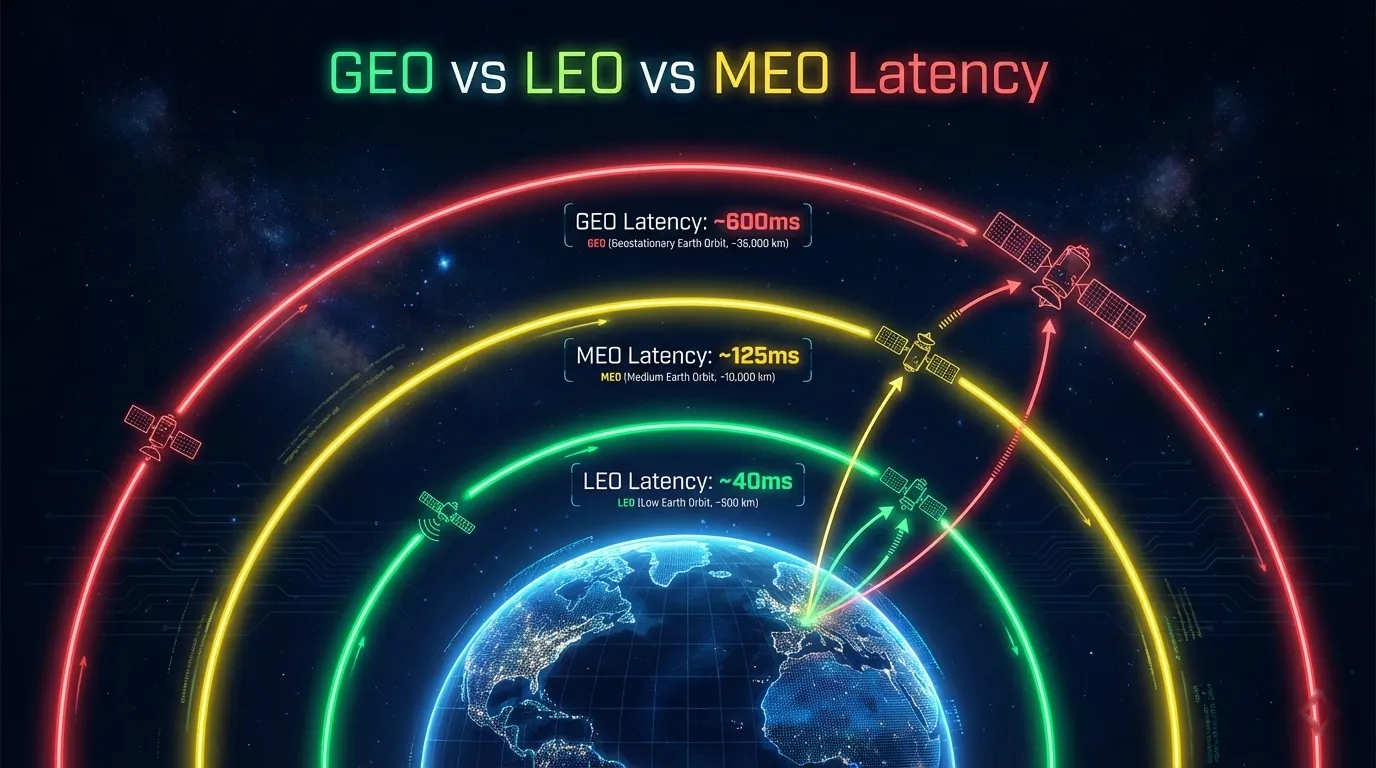
Satellite Latency: GEO vs MEO vs LEO
Calculate satellite latency from path length, then compare GEO, MEO, and LEO propagation floors with service RTT, application limits, and test results.
BER, FER, and Packet Loss Explained: How Satellite Link Errors Affect Real Network Performance
Engineering guide to bit error rate, frame error rate, and packet loss in satellite communication covering RF-to-IP error propagation, FEC recovery, ACM interaction, and practical troubleshooting.

Satellite Interference Explained: Causes, Types, and Mitigation in SATCOM Systems
Engineering guide to satellite interference covering adjacent satellite interference, cross-polarization, co-channel, and terrestrial interference types with detection and mitigation techniques.