

How Satellite Internet Works: Architecture, Latency, and Real-World Operation
Learn how satellite internet works, including GEO vs LEO satellites, ground stations, latency, and how data travels through space networks.
Satellite internet is a method of delivering broadband connectivity by relaying data between user terminals on the ground and satellites orbiting Earth. Understanding how satellite internet works is essential for engineers, procurement teams, and decision-makers evaluating connectivity solutions for locations where terrestrial infrastructure — fiber, cable, or cellular — is unavailable, unreliable, or prohibitively expensive to deploy.
Satellite internet serves a critical role across some of the world's most challenging connectivity environments: remote Indonesian archipelagos separated by hundreds of kilometers of open water, oil and gas platforms operating 200 km offshore in the Arabian Gulf, commercial shipping vessels transiting global trade routes, and disaster response operations where terrestrial networks have been destroyed. In each scenario, satellite provides the only viable path to reliable broadband connectivity.
This article explains the complete technical architecture of how satellite internet works, from the physics of signal propagation to the practical differences between orbital types, and examines why this technology continues to evolve as a foundational layer of global communications infrastructure.
Basic Architecture of Satellite Internet
Every satellite internet system consists of four interconnected segments that work together to deliver end-to-end connectivity.
User Terminal
The user terminal is the equipment at the customer's location that transmits and receives satellite signals. For traditional VSAT systems, this is a parabolic dish antenna (typically 0.75–2.4 m diameter) mounted on a fixed structure or stabilized platform. For modern LEO systems like Starlink, the terminal is a flat electronically steered phased-array antenna that automatically tracks satellites as they move across the sky.
The terminal includes an outdoor unit (antenna and radio transceiver) and an indoor unit (modem/router) connected by cabling. The outdoor unit converts digital data into radio frequency (RF) signals for transmission and converts received RF signals back to digital data.
Satellite
The satellite serves as a relay station in orbit. It receives signals from the ground on one frequency (the uplink), amplifies and frequency-converts them, then retransmits on a different frequency (the downlink). This frequency separation prevents the satellite's powerful transmitter from interfering with its sensitive receiver.
Modern High Throughput Satellites (HTS) use multiple spot beams to reuse frequency across geographic cells, dramatically increasing total system capacity. A single HTS can deliver hundreds of gigabits per second — far exceeding traditional widebeam satellites.
Ground Station (Gateway)
The ground station — also called a gateway or teleport — is a large antenna facility (typically 7–13 m dishes) that connects the satellite network to the terrestrial internet backbone. Gateways aggregate traffic from thousands of user terminals, route it to internet exchange points via fiber connections, and manage the return path.
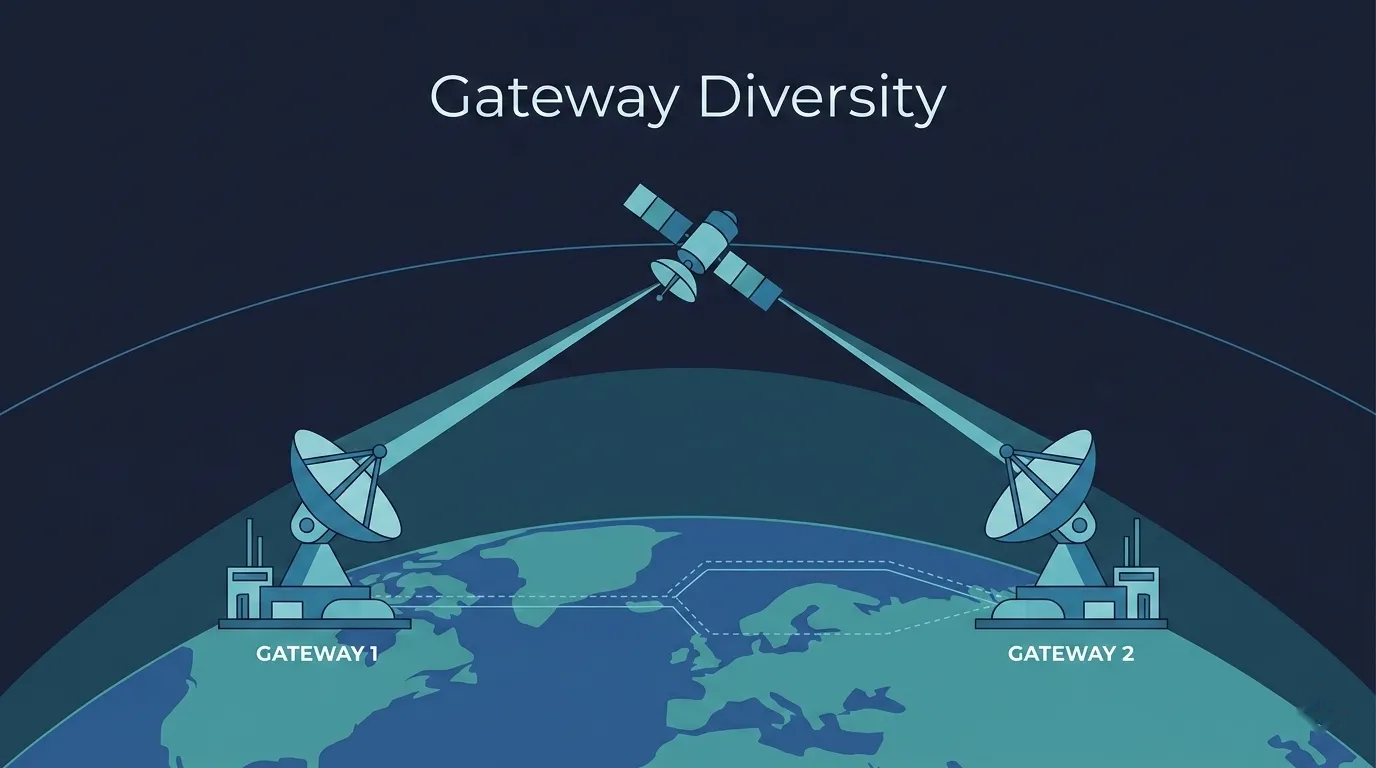
A satellite network typically has multiple gateways distributed geographically to provide redundancy and reduce the distance between gateways and the internet infrastructure they connect to.
Network Core
The network core consists of the Network Operations Center (NOC), bandwidth management systems, traffic shaping platforms, and routing infrastructure. The NOC monitors satellite health, link quality, and user traffic in real time. Bandwidth management systems allocate capacity dynamically based on demand, service tier, and contractual commitments.
The Complete Signal Path
When a user requests a webpage, the data journey follows this path:
- The user's device sends the request to the indoor modem via Ethernet or WiFi
- The modem encodes the data and sends it to the outdoor antenna unit
- The antenna transmits the signal on the uplink frequency toward the satellite
- The satellite receives the signal, frequency-converts it, and retransmits on the downlink frequency toward the gateway
- The gateway receives the signal, demodulates the data, and routes it to the internet backbone via fiber
- The web server responds, and the return data follows the reverse path: internet backbone to gateway, uplink to satellite, downlink to user terminal
In a GEO star-topology network, every packet traverses the satellite twice (user-to-satellite-to-gateway, then gateway-to-satellite-to-user), resulting in four satellite hops per round trip.
How Satellite Internet Works: GEO vs LEO
The orbital altitude of the satellite is the single most consequential design decision in any satellite internet system, directly determining latency, coverage architecture, constellation size, and terminal complexity.
GEO Satellite Internet
Geostationary Earth Orbit (GEO) satellites orbit at exactly 35,786 km above the equator. At this altitude, the satellite's orbital period matches Earth's rotation, causing it to appear stationary relative to a point on the ground. This fixed position means user terminals can point at a single location in the sky and maintain a permanent connection without any tracking mechanism.
A single GEO satellite covers approximately one-third of Earth's surface. Three well-placed GEO satellites can provide near-global coverage (excluding polar regions). Major GEO operators include SES, Intelsat, Viasat, Eutelsat, and Arabsat.
GEO satellite internet is the foundation of enterprise VSAT services, delivering dedicated bandwidth with committed information rates (CIR) and contractual service level agreements (SLAs). Traditional VSAT platforms operate on C-band (4–8 GHz), Ku-band (12–18 GHz), and Ka-band (26–40 GHz).
LEO Satellite Internet
Low Earth Orbit (LEO) satellites orbit at 300–2,000 km altitude. At these altitudes, satellites complete an orbit in approximately 90–120 minutes, moving across the sky at roughly 7.5 km/s. This means each satellite is visible from any ground location for only 4–8 minutes before handing off to the next satellite.
To provide continuous coverage, LEO systems require constellations of hundreds or thousands of satellites. SpaceX's Starlink operates over 6,000 satellites at ~550 km altitude. OneWeb (now part of Eutelsat) deploys ~648 satellites at ~1,200 km altitude. Amazon's Project Kuiper plans a 3,236-satellite constellation.
LEO terminals use electronically steered phased-array antennas that continuously track overhead satellites and manage handovers between them — a level of complexity unnecessary in GEO systems where the satellite position is fixed.
GEO vs LEO Comparison
| Characteristic | GEO | LEO |
|---|---|---|
| Orbital altitude | 35,786 km | 300–2,000 km |
| Round-trip latency | 550–650 ms | 20–60 ms |
| Satellites for global coverage | 3–4 | Hundreds to thousands |
| Satellite lifespan | 15–20 years | ~5 years |
| User terminal tracking | Fixed pointing | Electronic beam steering |
| Bandwidth model | Dedicated CIR | Typically shared |
| Coverage per satellite | ~1/3 of Earth | Narrow swath |
| Handover required | No | Yes (every few minutes) |
Step-by-Step: How Data Travels Through Satellite Internet
Understanding exactly how satellite internet works at the packet level reveals why each architectural choice affects user experience.
Step 1 — User Request. A user at a remote site clicks a link or initiates a data transfer. The application generates IP packets that travel from the device to the satellite modem via the local network.
Step 2 — Uplink Transmission. The modem encapsulates the IP packets into satellite-specific frames (typically DVB-S2X on the forward link, MF-TDMA or SCPC on the return link), applies forward error correction coding, modulates the signal, and the antenna transmits it toward the satellite on the assigned uplink frequency.
Step 3 — Satellite Relay. The satellite's receive antenna captures the uplink signal. In a traditional bent-pipe transponder, the satellite amplifies the signal, converts it to the downlink frequency, and retransmits it toward the gateway. In a regenerative (onboard processing) satellite, the satellite can demodulate, route, and re-modulate the signal — enabling satellite-to-satellite routing in LEO constellations.
Step 4 — Gateway Reception. The gateway's large antenna receives the downlink signal with high gain, demodulates it, extracts the IP packets, and forwards them to the terrestrial internet backbone via high-capacity fiber connections.
Step 5 — Internet Routing. The packets traverse the terrestrial internet to reach the destination server (web server, cloud application, etc.). The server processes the request and generates response packets.
Step 6 — Return Path. The response follows the reverse path: internet backbone to gateway, uplink to satellite, downlink to user terminal, and finally to the user's device via the local network.
The total time for this round trip determines the user-perceived latency — the delay between clicking a link and seeing the first response.
Why Satellite Internet Has Higher Latency Than Fiber
Latency in satellite internet is governed by the speed of light and the distance signals must travel. Radio waves propagate at approximately 300,000 km/s in free space.
For GEO satellite internet, the one-way distance from the ground to the satellite is 35,786 km. The signal must travel this distance four times in a star-topology round trip (user to satellite, satellite to gateway, gateway to satellite, satellite to user), covering approximately 143,144 km total. At the speed of light, this propagation alone takes roughly 477 ms. Adding processing delays at the satellite, gateway, and modem brings the total round-trip time to approximately 550–650 ms.
For LEO satellite internet at 550 km altitude, the same propagation calculation yields significantly shorter delays. With shorter distances and fewer relay hops (especially with inter-satellite laser links), observed round-trip latency ranges from 20–60 ms — comparable to terrestrial broadband.
For comparison:
| Connection Type | Typical Round-Trip Latency |
|---|---|
| Fiber optic | 10–30 ms |
| LEO satellite (Starlink) | 20–60 ms |
| GEO satellite (VSAT) | 550–650 ms |
GEO latency is intrinsic to the orbital altitude and cannot be reduced through engineering optimization — it is a fundamental physics constraint. This is why interactive applications like video conferencing and VoIP perform better over LEO than GEO, while applications tolerant of delay (file transfer, video streaming with buffering, SCADA telemetry) work well over either orbit type.
Real-World Use Cases
Understanding how satellite internet works in practice means examining the environments where it delivers critical connectivity.
Remote Islands and Archipelagos
Indonesia comprises over 17,000 islands, many with no terrestrial broadband infrastructure. Satellite internet — both GEO VSAT and increasingly Starlink — connects schools, clinics, government offices, and businesses across islands that submarine fiber cannot economically reach. The high rainfall environment favors C-band or Ku-band with adequate rain margin over Ka-band.
Desert and Arid Infrastructure
Middle Eastern countries deploy satellite internet for oil and gas infrastructure, pipeline monitoring stations, and remote construction projects across vast desert regions. The arid climate minimizes rain fade concerns, making Ka-band HTS services particularly effective. SCADA data, corporate communications, and worker welfare connectivity all travel via satellite.
Maritime Connectivity
Commercial shipping, offshore energy platforms, and cruise lines depend on satellite internet for operational communications, crew welfare, fleet management, and regulatory compliance (GMDSS safety systems). Maritime VSAT systems use stabilized antennas that compensate for vessel motion, maintaining lock on GEO satellites in rough seas. LEO services are increasingly adopted for lower-latency applications aboard vessels.
Oil and Gas Operations
Offshore platforms and remote wellheads require highly reliable satellite connectivity for SCADA/telemetry (monitoring production parameters), safety systems, VoIP communications, video surveillance, and crew internet access. These deployments typically demand enterprise-grade SLAs with 99.5%+ availability and redundant communication paths.
Emergency and Disaster Response
When earthquakes, floods, or conflicts destroy terrestrial infrastructure, satellite internet provides immediate connectivity for emergency responders, humanitarian organizations, and affected populations. Portable flyaway terminals and auto-deploy LEO terminals can establish broadband connectivity within minutes of arrival at a disaster site.
Advantages and Limitations
Advantages of Satellite Internet
- Global coverage — satellite can deliver connectivity anywhere on Earth with a clear view of the sky, independent of terrestrial infrastructure
- Rapid deployment — LEO terminals deploy in minutes; VSAT terminals in hours to days, compared to weeks or months for fiber construction
- Infrastructure independence — satellite networks operate independently of local ground infrastructure, providing resilience against terrestrial outages, natural disasters, and conflict
- Scalable coverage — adding a remote site requires only a terminal installation, not a network buildout to that location
Limitations of Satellite Internet
- Latency — GEO systems incur ~600 ms round-trip delay; LEO systems reduce this to 20–60 ms but still exceed fiber
- Weather sensitivity — rain attenuation (rain fade) degrades signal quality, particularly at higher frequencies (Ka-band). System designers compensate with link margin, adaptive coding and modulation (ACM), and site diversity
- Capacity constraints — satellite bandwidth is a shared, finite resource. Unlike terrestrial fiber (where capacity can be increased by adding wavelengths or fiber pairs), satellite capacity is limited by transponder power, spectrum allocation, and beam coverage area
- Cost — enterprise VSAT services with dedicated CIR remain more expensive per Mbps than terrestrial alternatives where available
Conclusion
How satellite internet works can be summarized as a four-segment system — user terminal, satellite, ground station, and network core — that relays data through space to bypass the limitations of terrestrial infrastructure. The choice between GEO and LEO architectures involves fundamental tradeoffs between latency, coverage simplicity, terminal complexity, and service models.
GEO satellite internet delivers proven, SLA-backed enterprise connectivity with the tradeoff of higher latency. LEO satellite internet dramatically reduces latency and simplifies terminal deployment, but operates primarily as a shared-bandwidth service with evolving enterprise capabilities. The most advanced deployments increasingly combine both architectures in hybrid configurations.
As LEO constellations continue to expand, inter-satellite laser links mature, and software-defined networking transforms bandwidth allocation, satellite internet is evolving from a last-resort connectivity option into a competitive complement — and in some scenarios, alternative — to terrestrial broadband. For the billions of people and countless industrial operations beyond the reach of fiber and cellular, understanding how satellite internet works is not an academic exercise but a practical necessity for connecting to the global digital economy.
Author

Organizational byline for SATCOM Index technical content. A named technical reviewer appears separately only when identity, scope, and permission are verified.
Categories
More Posts

Satellite Service Providers: Roles and Shortlist Guide
Map operator, reseller, integrator and field-service roles, then shortlist satellite offers using current ownership, coverage, contract and support evidence.
Satellite Gateway Diversity Explained: Improving Availability with Redundant Ground Stations
Engineering guide to satellite gateway diversity covering site redundancy, rain fade mitigation, failover mechanisms, and design considerations for high-availability satellite ground networks.

Satellite Glossary: A-F
Satellite communication terminology and definitions from A to F.