
HTS Spot Beams and Beamforming Explained: How Modern Satellites Increase Capacity
Engineering guide to HTS spot beams and beamforming covering frequency reuse, phased-array beam steering, gateway design, and capacity scaling trade-offs.
Introduction
Traditional geostationary satellites illuminate entire continents with a single wide beam. A conventional C-band or Ku-band spacecraft may carry 24–48 transponders, each delivering 36–72 MHz of bandwidth across a footprint thousands of kilometers wide. The total aggregate capacity of such a satellite is typically 2–10 Gbps—a figure that must be shared among every terminal within the coverage area.
For decades that capacity ceiling was acceptable. Satellite served niche segments—broadcast distribution, maritime safety, rural telephony—where per-user throughput demands were modest. But the explosion of broadband data consumption, enterprise cloud migration, cellular backhaul requirements, and maritime connectivity expectations has exposed a fundamental bottleneck: wide-beam satellites simply cannot scale capacity fast enough to compete with terrestrial alternatives.
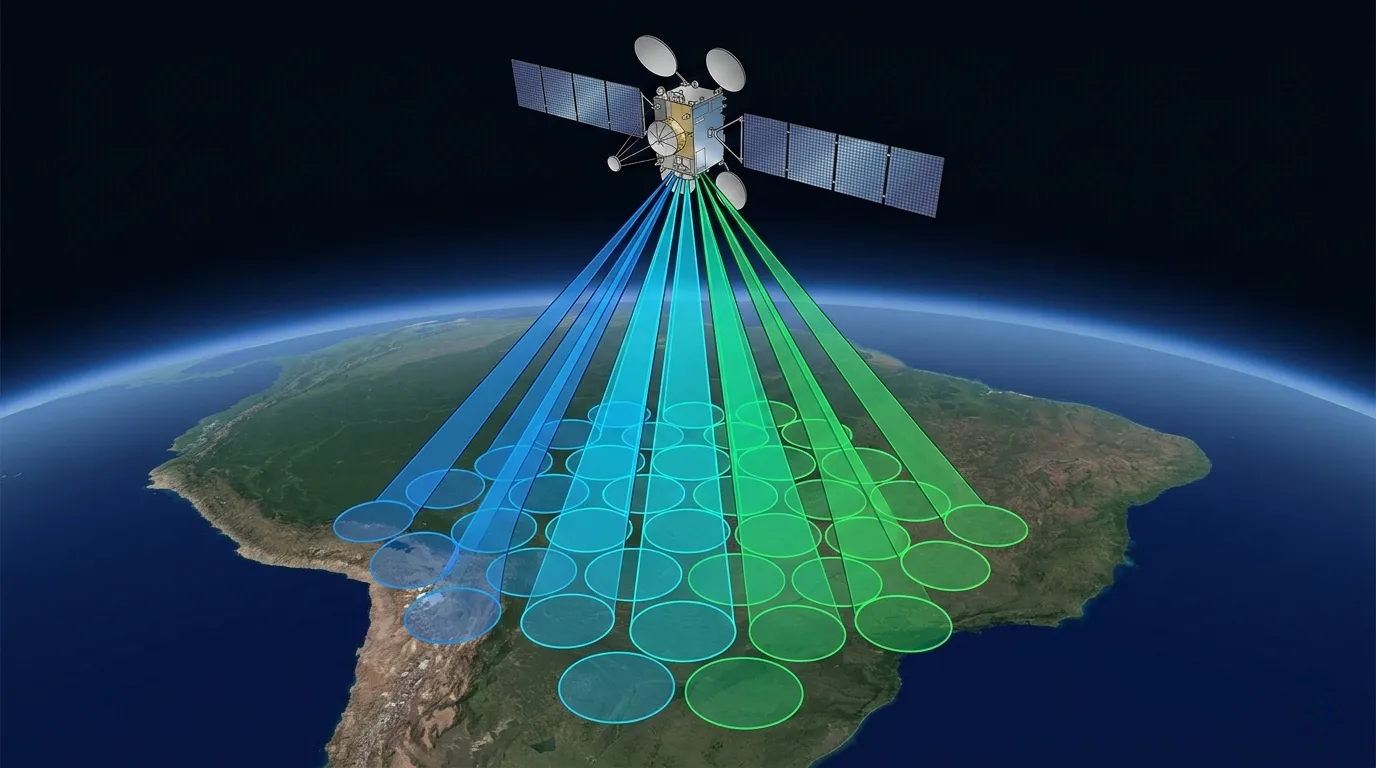
High-throughput satellites (HTS) break through this bottleneck by replacing wide beams with dozens or hundreds of narrow spot beams, each illuminating a small geographic area. Spot beams enable frequency reuse—the same spectrum is allocated simultaneously to multiple non-overlapping beams—multiplying the satellite's aggregate capacity by the number of reuse clusters. A single HTS spacecraft can deliver 100 Gbps to over 1 Tbps of total throughput, a 10–100× improvement over conventional designs.
This article explains the engineering foundations of HTS spot beams and beamforming: how spot beams are formed, how frequency reuse scales capacity, how beamforming technology steers and shapes beams dynamically, and what design trade-offs engineers face when specifying HTS-based networks.
What Is a High-Throughput Satellite (HTS)?
A high-throughput satellite is defined by its capacity advantage over conventional fixed-satellite-service (FSS) spacecraft operating in the same frequency band. There is no formal ITU threshold, but the industry consensus is that an HTS delivers at least 20 Gbps of aggregate throughput—and modern HTS platforms routinely exceed 100 Gbps, with next-generation systems targeting 1 Tbps per spacecraft.
Bent-pipe vs regenerative architectures. Most commercial HTS satellites use a bent-pipe (transparent) architecture: the satellite receives uplink signals from gateways, frequency-translates them, amplifies them, and retransmits on the user downlink—without demodulating or processing the data payload. This approach minimizes on-board complexity, reduces mass and power, and allows ground-based modems to evolve independently of the spacecraft. Regenerative (on-board processing) HTS satellites demodulate, route, and re-modulate traffic on the spacecraft, enabling beam-to-beam switching without routing through a ground gateway. Regenerative payloads are more flexible but heavier, more power-hungry, and harder to upgrade after launch.
Capacity comparison. A conventional Ku-band wide-beam satellite with 36 transponders × 54 MHz bandwidth delivers roughly 5–8 Gbps of aggregate throughput. A Ka-band HTS with 60–100 spot beams, each carrying 250–500 MHz, and a frequency reuse factor of 15–20× can deliver 100–500 Gbps from a single spacecraft. The cost per gigabit drops by an order of magnitude—which is why HTS dominates new satellite broadband deployments. For comparison with conventional VSAT Network Architecture, the topology shifts from a single shared beam to a cellular-like multi-beam structure.
The key enabler is not any single technology but the combination of spot beams, frequency reuse, and high-power multi-beam antenna systems—topics covered in detail in the following sections.
Spot Beams: From Wide Coverage to Targeted Capacity
A satellite antenna's beam width is governed by the ratio of aperture diameter to wavelength: θ ≈ 70λ/D (in degrees), where λ is the operating wavelength and D is the reflector diameter. A conventional Ku-band satellite with a 2 m reflector produces a beam roughly 1° wide, covering a footprint approximately 600 km in diameter from GEO. A wider reflector or higher frequency narrows the beam proportionally.
Wide beams vs spot beams. A wide beam covers a large geographic area—an entire ocean region or continent—with a single frequency plan. Every terminal within the beam shares the same capacity pool. A spot beam narrows the footprint to 200–600 km diameter by using a larger reflector aperture (3–5 m for Ka-band HTS) or a phased-array feed system. The narrower beam concentrates the satellite's radiated power into a smaller area, increasing the effective isotropic radiated power (EIRP) and the receive gain (G/T) per beam—both of which improve the Satellite Link Budget Calculation.
Gain advantage. Concentrating the same transmit power into a beam 1/10th the area increases the EIRP by 10 dB. This additional gain can be traded for higher-order modulation (more bits per symbol), reduced terminal aperture size, or increased fade margin. In practice, HTS spot beams achieve 5–8 dB higher EIRP than wide-beam satellites in the same orbital slot, enabling smaller user terminals (0.6–1.0 m vs 1.2–2.4 m for Ku-band wide beam) while maintaining equivalent or better link performance.
Beam map architecture. An HTS beam map divides the coverage area into a tessellated grid of spot beams—typically hexagonal cells, much like a terrestrial cellular network. Each beam is assigned a frequency channel and polarization from a reuse plan. Adjacent beams use different frequency/polarization combinations to minimize co-channel interference; beams separated by sufficient angular distance can reuse the same combination. The comparison with Ku-Band vs Ka-Band Satellite systems highlights why Ka-band's shorter wavelength enables narrower spots from the same aperture.
The number of spot beams per satellite has grown steadily: early HTS systems like ViaSat-1 (2011) used 72 Ka-band spot beams; current-generation platforms like ViaSat-3 deploy over 1,000 beams. More beams mean finer geographic granularity, more aggressive frequency reuse, and higher aggregate capacity—but also more complex antenna systems and more gateway infrastructure on the ground.
Frequency Reuse and Capacity Scaling
Frequency reuse is the mechanism that converts spot beams into a capacity multiplier. The concept is borrowed directly from cellular telephony: by assigning non-overlapping frequency channels to adjacent beams and reusing the same channels in sufficiently separated beams, the satellite reuses its total allocated spectrum many times across the coverage area.
The four-color pattern. The most common HTS frequency reuse scheme uses a four-cell reuse pattern. The satellite's total bandwidth is divided into two frequency sub-bands, and each sub-band is transmitted in two orthogonal polarizations (right-hand circular and left-hand circular, or vertical and horizontal linear). This yields four distinct frequency/polarization combinations—four "colors"—that are assigned to beams in a repeating pattern such that no two adjacent beams share the same color.
Capacity formula. The aggregate forward-link capacity of an HTS can be approximated as:
C_total = N_beams × BW_per_beam × η_spectral
Where N_beams is the number of user spot beams, BW_per_beam is the bandwidth allocated to each beam (total bandwidth divided by the reuse factor), and η_spectral is the spectral efficiency in bits/s/Hz (determined by the MODCOD used, typically 2–5 bits/s/Hz with DVB-S2X). For a satellite with 100 beams, 250 MHz per beam, and 3 bits/s/Hz average spectral efficiency, the aggregate capacity is 100 × 250 × 10⁶ × 3 = 75 Gbps.
Practical limits. Theoretical capacity scales linearly with the number of beams, but real systems face diminishing returns from three sources:
-
Co-channel interference (CCI). Adjacent-beam isolation is never perfect. Sidelobe energy from neighboring beams using the same frequency/polarization creates interference that degrades the carrier-to-interference ratio (C/I). As beams become narrower and more numerous, the isolation between co-channel beams must be maintained through careful antenna design and power control.
-
Rain fade. Ka-band spot beams—the dominant HTS frequency—are subject to significant rain attenuation. In heavy rain events, the beam serving a rain cell must operate at lower MODCODs, reducing spectral efficiency and per-beam throughput. See Rain Fade in Satellite Communications for propagation details and mitigation strategies.
-
Gateway bottleneck. Each spot beam's traffic must be backhauled to the terrestrial internet through a gateway earth station. More beams require more gateway capacity—a constraint explored in the gateway section below.
Beamforming Technology
Traditional HTS satellites form spot beams using a single large reflector illuminated by an array of feed horns—one horn per beam. Each feed horn produces a fixed spot beam pointing at a predetermined location on the ground. This single-feed-per-beam (SFPB) architecture is simple and proven but inflexible: beam positions and shapes are fixed at manufacture.
Phased-array feeds and beam steering. Modern HTS payloads increasingly use phased-array feed (PAF) systems or full direct-radiating phased arrays. In a PAF, multiple feed elements illuminate the reflector simultaneously, and the beam is formed by controlling the amplitude and phase of the signal at each element. By adjusting these weights electronically, the satellite can steer beams, reshape beam contours, and even create nulls to suppress interference—all without mechanical movement. For ground-segment antenna technology including phased arrays, see Satellite Antenna Types Guide.
Analog vs digital beamforming. Analog beamforming applies phase shifts and amplitude weights in the RF domain using passive or semi-active networks. It is simpler and lower-power but limited in flexibility—typically supporting a fixed set of beam positions with limited reconfigurability. Digital beamforming (DBF) digitizes the received signal at each antenna element and performs beam formation in digital signal processors. DBF enables fully flexible beam placement, beam hopping (time-division multiplexing of beams across different locations), and adaptive interference cancellation. The trade-off is significantly higher on-board processing power, thermal dissipation, and mass.
Dynamic beam allocation. The most advanced HTS systems combine digital beamforming with beam hopping to dynamically allocate capacity where demand exists. Rather than illuminating every beam continuously, the satellite time-shares its transmit power across beams, spending more dwell time on high-demand areas (urban centers, shipping lanes, flight corridors) and less on low-demand regions. This demand-responsive architecture can improve effective capacity utilization by 2–3× compared to fixed beam allocation, because real-world traffic demand is never uniformly distributed across a satellite's coverage area.
Flexible payloads. Next-generation HTS platforms—including SES mPOWER, Eutelsat KONNECT VHTS, and Telesat Lightspeed—feature software-defined payloads where beam size, beam position, frequency assignment, and power allocation can be reconfigured in orbit by ground command. This transforms the satellite from a fixed infrastructure asset into a programmable capacity resource that adapts to changing market conditions over its 15+ year orbital lifetime.
Gateways and Feeder Links
Every HTS spot beam requires a feeder link connecting the satellite to a terrestrial gateway earth station. The gateway aggregates user traffic from multiple beams and routes it to the internet backbone via terrestrial fiber. This feeder-link architecture is one of the most significant design challenges in HTS systems.
Why HTS needs more gateways. A conventional wide-beam satellite may operate with a single gateway handling all traffic for the entire coverage area. An HTS with 100 spot beams delivering 100 Gbps aggregate throughput requires gateway infrastructure capable of backhauling that same 100 Gbps to the terrestrial network. Since each gateway site has finite spectrum and power budget, multiple geographically distributed gateways are necessary. A typical Ka-band GEO HTS operates 8–20 gateway sites, each handling a subset of user beams. For detailed gateway architecture, see Satellite Gateways, Teleports & PoPs.
Q/V-band feeder links. To avoid consuming Ka-band user spectrum for feeder links, some next-generation HTS systems use Q-band (37.5–42.5 GHz) and V-band (47.2–51.4 GHz) for gateway uplinks and downlinks. These higher frequencies offer abundant spectrum—several GHz—sufficient to backhaul the full aggregate capacity through fewer gateway sites. The trade-off is extreme rain fade susceptibility at Q/V frequencies, requiring aggressive gateway diversity schemes.
Gateway diversity. Because Q/V-band (and even Ka-band) feeder links are vulnerable to localized rain events, HTS operators deploy redundant gateway sites separated by 50–100 km—far enough that a rain cell affecting one site is unlikely to affect the backup simultaneously. Traffic is dynamically switched between primary and diversity gateways based on real-time link quality measurements. This adds infrastructure cost but is essential for maintaining the high-availability SLAs that enterprise and government customers require. Terrestrial Satellite Backhaul Explained connectivity from each gateway to the nearest internet exchange point is equally critical.
Performance in Real Networks
Understanding HTS performance requires distinguishing between aggregate satellite capacity, per-beam capacity, and per-user throughput—three very different numbers that are frequently conflated in marketing materials.
Aggregate vs per-beam throughput. A satellite advertised as "500 Gbps" divides that capacity across all its spot beams. If 200 beams share the capacity, each beam carries approximately 2.5 Gbps of forward-link throughput. The actual per-beam rate varies based on demand allocation, beam hopping schedules, and MODCOD distribution across terminals in the beam.
Per-user throughput and oversubscription. Within each beam, capacity is shared among active users through time-division multiple access (TDMA) on the forward link and MF-TDMA or SCPC on the return link. Service plans typically oversubscribe beam capacity by 10:1 to 50:1, depending on user traffic profiles. A beam with 2.5 Gbps aggregate capacity serving 1,000 subscribers at 20:1 oversubscription offers a committed information rate (CIR) of perhaps 25 Mbps per user with burst (peak) rates of 100–200 Mbps during off-peak hours.
Latency. HTS architecture does not change the fundamental propagation delay of the orbit. A GEO HTS has the same ~600 ms round-trip time as a conventional GEO satellite. MEO HTS systems like SES O3b mPOWER reduce latency to ~120–150 ms RTT. LEO HTS constellations (Starlink, OneWeb, Kuiper) achieve 20–50 ms RTT. For a comprehensive latency comparison, see Hybrid Satellite Networks. The choice of ACM and Satellite Modulation and Coding affects throughput under varying conditions but not propagation delay.
Beam handover. Mobile terminals—on aircraft, ships, and vehicles—may transit from one spot beam to another as they move. Beam handover is analogous to cellular handoff: the network management system detects the terminal approaching a beam boundary and reassigns it to the adjacent beam. Well-designed HTS systems execute beam handover in under 100 ms with no perceptible service interruption. Maritime Satellite Internet deployments must account for frequent beam transitions as vessels traverse ocean coverage areas.
Design and Procurement Checklist
Engineers evaluating HTS spot-beam services for enterprise or government networks should address these questions before committing to a service contract:
-
How many spot beams cover your service area, and what is the per-beam committed capacity? Aggregate satellite capacity is meaningless if your sites are concentrated in a single beam with limited throughput.
-
What is the frequency reuse plan, and what co-channel interference levels have been measured? Ask the operator for C/I specifications per beam—not just theoretical EIRP values.
-
What gateway diversity architecture protects the feeder links? A single gateway failure can take offline every beam it serves. Confirm diversity site locations and switchover time.
-
Does the satellite support beam hopping or dynamic capacity allocation? Fixed-beam satellites cannot redistribute capacity to match changing demand patterns—a significant limitation for networks with time-varying traffic profiles.
-
What are the rain fade assumptions in the link budget? Confirm the availability target (99.5%, 99.7%, 99.9%) and the corresponding rain fade margin for your geographic location. Ka-band services in tropical regions require careful scrutiny.
-
What terminal antenna size and transmit power are required to close the link at your target availability? Smaller terminals may require lower MODCODs, reducing effective throughput. Ensure the terminal specification matches the SLA.
-
What is the beam handover performance for mobile terminals? For maritime, aero, or vehicular applications, confirm handover latency and packet loss during transitions.
-
How does the service plan handle oversubscription during peak demand? Understand the CIR vs peak rate structure and what happens when beam capacity is fully loaded.
Common pitfall: Comparing HTS services solely on advertised aggregate capacity (e.g., "500 Gbps satellite") without examining per-beam allocation, oversubscription ratios, and gateway redundancy. The capacity that matters is the committed throughput available to your terminals in your specific beams under your contracted SLA—not the satellite's total capacity across all beams globally. See Enterprise Satellite Internet for vendor evaluation frameworks.
Frequently Asked Questions
What is a spot beam on a satellite?
A spot beam is a focused, narrow radio-frequency beam transmitted by a satellite to cover a limited geographic area—typically 200–600 km in diameter from GEO. Unlike a wide beam that covers an entire continent or ocean region, a spot beam concentrates the satellite's transmit power and receive sensitivity into a small footprint. This concentration increases EIRP and G/T (improving link performance), and enables frequency reuse across multiple non-overlapping beams, which is the foundation of HTS capacity scaling.
How does frequency reuse increase satellite capacity?
Frequency reuse allows a satellite to use the same frequency band in multiple spot beams that are geographically separated enough to avoid mutual interference. A four-color reuse plan divides the spectrum into four frequency/polarization combinations and assigns each to non-adjacent beams. If a satellite has 80 user beams, each frequency/polarization combination is used in 20 beams simultaneously. The total usable bandwidth is effectively multiplied by the reuse factor—delivering 20× more aggregate capacity than a single wide beam using the same spectrum.
What is the difference between HTS and conventional satellites?
A conventional FSS satellite uses wide beams to cover large areas with shared capacity of 2–10 Gbps total. An HTS uses dozens to hundreds of spot beams with frequency reuse, delivering 50–1,000+ Gbps aggregate capacity. The key architectural differences are: (1) spot beams instead of wide beams, (2) frequency reuse across beams, (3) multiple gateway earth stations instead of a single hub, and (4) typically Ka-band operation for the user links. The cost per Gbps is 5–10× lower on HTS, which is why all new broadband satellite deployments use HTS architecture.
What is beamforming in satellite communication?
Beamforming is the technique of controlling the amplitude and phase of signals across multiple antenna elements to shape and steer radio-frequency beams electronically, without mechanical movement. In satellite applications, beamforming enables flexible beam placement, beam hopping (time-sharing beams across locations), interference nulling, and dynamic capacity allocation. Digital beamforming (DBF) performs these operations in the digital domain, offering maximum flexibility but requiring significant on-board processing power.
How many spot beams does a typical HTS have?
Early HTS systems (2011–2015) used 50–100 spot beams. Current-generation GEO HTS platforms deploy 200–1,000+ beams. The number depends on the satellite's coverage area, antenna design, and capacity target. More beams enable finer frequency reuse and higher aggregate capacity but require more complex antenna systems and more gateway infrastructure. LEO HTS constellations achieve global coverage through thousands of satellites, each forming a smaller number of beams that move with the spacecraft.
Why do HTS systems need multiple gateways?
Each gateway earth station has a finite capacity to backhaul traffic between the satellite and the terrestrial internet. An HTS delivering 100+ Gbps of aggregate throughput requires proportional gateway bandwidth. Since a single gateway site can typically handle 10–30 Gbps (limited by available spectrum, antenna count, and local fiber connectivity), multiple gateway sites—typically 8–20 for a GEO HTS—are distributed across the coverage area to aggregate the full satellite capacity. Gateway diversity (redundant sites) is also required for availability protection against localized rain fade events.
Can HTS spot beams be reconfigured after launch?
On legacy HTS platforms with fixed single-feed-per-beam antennas, beam positions and sizes are determined at manufacture and cannot be changed in orbit. Modern flexible-payload HTS satellites with digital beamforming and phased-array feeds can reconfigure beam positions, beam shapes, frequency assignments, and power allocation by ground command. This flexibility allows operators to adapt capacity distribution to evolving market demand, move beams to serve new regions, or respond to interference scenarios—a major commercial advantage over fixed-beam designs.
What is beam hopping and why does it matter?
Beam hopping is a time-division technique where the satellite illuminates different spot beams in a scheduled sequence rather than transmitting to all beams continuously. During each time slot, the satellite directs its full power to a subset of beams, cycling through all beams over a hopping frame (typically milliseconds). Beam hopping improves capacity utilization by allocating more time slots to high-demand beams and fewer to low-demand beams—matching satellite resources to actual traffic patterns rather than distributing capacity uniformly. This can improve effective system capacity by 2–3× compared to fixed allocation.
Key Takeaways
-
Spot beams are the foundation of HTS capacity. By narrowing coverage from continental footprints to 200–600 km cells, spot beams concentrate EIRP, improve link budgets, and enable frequency reuse.
-
Frequency reuse is the capacity multiplier. A four-color reuse pattern with 80 beams delivers 20× more aggregate capacity than a single wide beam using the same spectrum.
-
Beamforming enables flexibility. Phased-array feeds and digital beamforming allow modern HTS to steer beams, hop between coverage areas, and dynamically allocate capacity based on demand.
-
Gateways are a critical bottleneck. HTS systems require 8–20 geographically distributed gateway sites with diversity protection—a significant ground-infrastructure investment.
-
Per-beam capacity is what matters for SLAs. Aggregate satellite capacity divided across hundreds of beams, further shared among subscribers with oversubscription ratios, determines actual user experience.
-
Flexible payloads are the future. Software-defined HTS with reconfigurable beams and power allocation represent the current state of the art, enabling operators to adapt to market changes over a 15+ year satellite life.
-
Rain fade and co-channel interference are the primary limiters. Ka-band HTS performance degrades in heavy rain and under aggressive frequency reuse—proper link budget design and ACM are essential.
Related Articles
- Satellite Frequency Bands Explained — L through Ka band propagation characteristics and selection criteria
- Ku Band vs Ka Band Satellite — Why Ka band dominates HTS and when Ku remains the better choice
- Satellite Link Budget Calculation — How spot beam gain and EIRP factor into end-to-end link budgets
- Rain Fade in Satellite Communications — Ka-band rain attenuation physics and mitigation for HTS networks
- VSAT Network Architecture — Comparing conventional wide-beam VSAT with HTS spot-beam topologies
- Satellite Gateways, Teleports & PoPs — Gateway infrastructure requirements for multi-beam HTS systems
- Satellite Modulation and Coding — ACM and MODCOD selection for variable link conditions in spot beams
- Hybrid Satellite Networks — GEO HTS vs MEO and LEO HTS capacity and latency comparison
Author

Organizational byline for SATCOM Index technical content. A named technical reviewer appears separately only when identity, scope, and permission are verified.
Categories
More Posts
Satellite Diversity Explained: How Multi-Satellite and Multi-Path Design Improves Resilience
Learn how satellite diversity techniques — including satellite, gateway, site, orbit, and frequency diversity — improve network resilience for enterprise and critical infrastructure.
Satellite Latency: GEO vs MEO vs LEO
Calculate satellite latency from path length, then compare GEO, MEO, and LEO propagation floors with service RTT, application limits, and test results.
Satellite Carrier Spacing Explained: Why Guard Bands Matter in RF Planning
Engineering guide to satellite carrier spacing covering guard bands, RF planning trade-offs, spectral efficiency, and adjacent carrier interference.