
Symbol Rate and Roll-Off: DVB-S2 Bandwidth Planning
Calculate DVB-S2 and DVB-S2X bandwidth from symbol rate and roll-off, then distinguish raised-cosine span, occupied bandwidth, spacing, and throughput.
What changed: Rebuilt the guide around raised-cosine spectral support, regulatory occupied-bandwidth measurement, exact carrier-plan equations, and DVB frame efficiency; corrected the ambiguous bandwidth in Eb/N0 conversion and removed unsupported guard-band, modem-range, overhead, amplifier, and deployment claims.
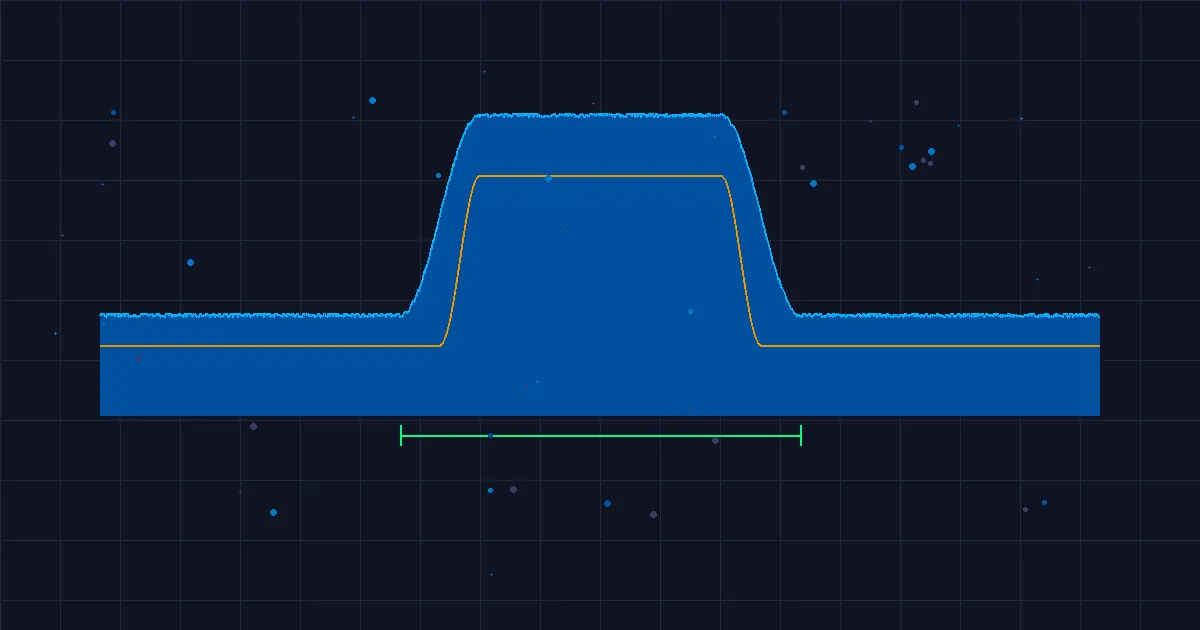
Symbol rate and roll-off determine the ideal raised-cosine frequency span of a DVB-S2 or DVB-S2X carrier. For transmitted symbol rate Rs and roll-off factor α, the familiar planning value is:
B_RC = Rs × (1 + α)That formula is useful, but calling every result “occupied bandwidth” hides important differences. Theoretical raised-cosine support, ITU occupied bandwidth, necessary bandwidth, an operator's allocated slot, receiver noise bandwidth, spectrum-analyzer RBW, and center-to-center carrier spacing are not interchangeable.
This guide defines each quantity, shows what the equation can and cannot calculate, and provides reproducible carrier-planning examples.
Scope note: Organization fact check updated 26 August 2026 against the primary standards listed on this page. Calculations were independently repeated. This is not a named expert approval, a modem specification, a satellite-operator frequency assignment, or an emission-compliance result. Use the exact waveform profile, product manual, operator mask, transponder plan, and witnessed measurement for deployment.
C/N, C/N0, Eb/N0 and Es/N0 | Carrier Spacing | Transponder Bandwidth
Quick Calculator
Use consistent units. If Rs is in Msymbol/s, B_RC is in MHz.
raised-cosine support span: B_RC = Rs × (1 + α)

symbol rate from a planning span: Rs = B_RC / (1 + α)

excess span: B_excess = B_RC - Rs = α × Rs
For Rs = 10 Msymbol/s:
| Standard family | Roll-off α | B_RC = 10(1+α) | Excess over Rs |
|---|---|---|---|
| DVB-S2 | 0.35 | 13.50 MHz | 3.50 MHz |
| DVB-S2 | 0.25 | 12.50 MHz | 2.50 MHz |
| DVB-S2 | 0.20 | 12.00 MHz | 2.00 MHz |
| DVB-S2X | 0.15 | 11.50 MHz | 1.50 MHz |
| DVB-S2X | 0.10 | 11.00 MHz | 1.00 MHz |
| DVB-S2X | 0.05 | 10.50 MHz | 0.50 MHz |
Changing from α = 0.35 to α = 0.05 reduces this planning span by 3.00 MHz. Relative to the original 13.50 MHz span, the reduction is:
(13.50 - 10.50) / 13.50 × 100 = 22.22%It does not automatically create 3 MHz of billable capacity. Edge clearances, guards, filter masks, transponder response, nonlinear distortion, frequency uncertainty, and lease increments still apply.
Symbol Rate Is Not Bit Rate
Symbol rate Rs is the number of transmitted modulation symbols per second. Its SI-compatible unit is symbol/s; baud is also used. A modulation symbol selects one constellation state.
For an M-ary modulation, each data symbol maps:
m = log2(M) coded bits per data symbolExamples are m = 2 for QPSK, 3 for 8PSK, 4 for 16APSK, and 5 for 32APSK. This mapping does not make Rs × m the user throughput. FEC redundancy, physical-layer headers, pilots, baseband headers, padding, encapsulation, packet headers, and idle or dummy frames can all reduce the useful rate.
A common screening shortcut is:
nominal FEC-input rate ≈ Rs × m × code rateIt is not an exact DVB-S2 service-throughput formula.
For example, the shortcut gives 15.000 Mbps for 10 Msymbol/s, QPSK, and nominal code rate 3/4. But ETSI EN 302 307-1 Table 13 lists spectral efficiency 1.487473 bit/symbol for QPSK 3/4 with a normal FECFRAME and no pilots:
10 Msymbol/s × 1.487473 bit/symbol = 14.87473 Mbit/sThat standard-table value still is not guaranteed IP throughput. The selected input mode, BBFRAME data-field length, pilots, padding, encapsulation, traffic mix, and platform behavior must be included.
Use this hierarchy:
| Quantity | Meaning | Evidence source |
|---|---|---|
Rs | Transmitted symbols per second | Modem/carrier configuration |
m | Coded bits mapped to each data symbol | Constellation definition |
| Code rate | FEC relationship for the selected mode | Standard and mode identifier |
| Standard spectral efficiency | Information rate per symbol-rate basis under stated frame/pilot conditions | Applicable ETSI table |
| Service or IP throughput | Payload delivered across the declared interface and interval | Platform calculation and measurement |
What Roll-Off Means
ETSI EN 302 307-1 clause 5.6 requires square-root raised-cosine baseband shaping for DVB-S2 and defines α = 0.35, 0.25, and 0.20. ETSI EN 302 307-2 V1.4.1 adds 0.15, 0.10, and 0.05 with specified signalling.
For the ideal raised-cosine model:
Nyquist frequency: f_N = Rs / 2

flat-region width: B_flat = Rs × (1 - α)

one transition width: B_transition,one-side = α × Rs

two-sided non-zero support: B_RC = Rs × (1 + α)
The positive-frequency transition runs from (1-α)Rs/2 to (1+α)Rs/2; the negative side mirrors it. At the outer theoretical edges, the response reaches zero.
In a textbook matched pair, transmit and receive root-raised-cosine filters combine to form a raised-cosine response satisfying the Nyquist zero-ISI condition at the correct sampling instants. Real performance also depends on finite filter implementation, timing recovery, group delay, phase noise, channel filtering, nonlinear devices, and equalization. The equation describes an ideal spectral model, not an end-to-end error guarantee.
An ideal α = 0 raised-cosine response has brick-wall frequency support and a sinc-shaped impulse response of unlimited duration. Practical systems approximate finite filters; the cited DVB-S2 and DVB-S2X standards do not signal α = 0 as one of these roll-off options.
Six Different “Bandwidths”
Before using a number, name its definition.
| Term | What it means | Is it automatically Rs(1+α)? |
|---|---|---|
Raised-cosine support B_RC | Ideal two-sided span over which the RC spectrum is non-zero | Yes, for this model |
| Occupied bandwidth | Power-containment bandwidth measured using a declared beta-percent method | No |
| Necessary bandwidth | Width sufficient for the stated information rate and quality under specified conditions | No |
| Allocated or leased bandwidth | Frequency slot assigned commercially or operationally | No |
Receiver noise bandwidth Bn | Bandwidth over which the receiver's noise is integrated for the declared metric | No |
| Analyzer RBW | Instrument resolution-filter setting | No |
The ITU Radio Regulations define necessary and occupied bandwidth as distinct terms. Recommendation ITU-R SM.443-4 specifies a beta-percent occupied-bandwidth measurement method and separate x-dB methods. Therefore a spectrum analyzer's “99% OBW,” a -26 dB width, and Rs(1+α) can be three different numbers for the same carrier.
Recommendation ITU-R SM.328-12 addresses emitted spectra and bandwidth terminology. Compliance, however, depends on the applicable regulation, emission designation, operator mask, reference point, instrument method, and uncertainty. The roll-off equation alone is not a compliance test.
This page uses raised-cosine support span or planning span for Rs(1+α). If a product manual or operator calls that quantity “occupied bandwidth,” preserve its definition when exchanging data.
Carrier-Plan Equations
Center Spacing for Two Carriers
Let B1 and B2 be planning spans on the same definition, and let G be the intentional gap between their edges. A screening equation for center-frequency separation is:
Δf_centers = B1/2 + B2/2 + GThis is geometry, not proof of acceptable adjacent-carrier interference. The approved G comes from the operator plan and measured or specified masks, frequency error, transponder filtering, carrier power relationship, nonlinear operation, receive selectivity, and required margin.
Equal Carriers Inside an Available Span
For N equal carriers, each with planning span B, equal internal gaps G, left edge clearance E_L, right edge clearance E_R, and available span W:
N × B + (N - 1) × G + E_L + E_R ≤ WWith B = Rs(1+α):
Rs ≤ [W - (N - 1)G - E_L - E_R] / [N(1+α)]If both edge clearances are zero, an algebraic screening limit for the integer carrier count is:
N_max = floor[(W + G) / (B + G)]Do not round symbol rate upward. Apply the modem's supported step size, operator rounding, and all edge constraints after calculation.
Worked Four-Carrier Example
Assume, only for the arithmetic:
- available span
W = 36.000 MHz; N = 4equal carriers;- roll-off
α = 0.20; - three internal gaps of
G = 0.500 MHz; - zero edge clearance.
Rs ≤ [36.000 - 3(0.500)] / [4(1.20)]
   ≤ 34.500 / 4.800
   ≤ 7.1875 Msymbol/s per carrier

B per carrier = 7.1875 × 1.20 = 8.625 MHz

total span = 4(8.625) + 3(0.500)
           = 34.500 + 1.500
           = 36.000 MHz
The example fits its assumptions exactly and leaves no edge clearance. It is not an authorization to use a 36 MHz transponder at those settings.
For detailed interference and guard decisions, use Satellite Carrier Spacing. This page supplies the geometry; the spacing guide owns the acceptance trade-off.
Fixed Symbol Rate and Fixed Bandwidth Are Different Comparisons
Fixed Symbol Rate
At Rs = 25 Msymbol/s:
α | B_RC | Reduction from α=0.35 |
|---|---|---|
| 0.35 | 33.75 MHz | 0.00 MHz |
| 0.25 | 31.25 MHz | 2.50 MHz |
| 0.20 | 30.00 MHz | 3.75 MHz |
| 0.15 | 28.75 MHz | 5.00 MHz |
| 0.10 | 27.50 MHz | 6.25 MHz |
| 0.05 | 26.25 MHz | 7.50 MHz |
The symbol rate and nominal frame information rate are unchanged; only the raised-cosine support span changes. Whether the saved span can be used depends on the full frequency and power plan.
Fixed Planning Span
If exactly 30.00 MHz is available for B_RC before any additional guard or edge requirement:
α | Rs_max = 30/(1+α) |
|---|---|
| 0.35 | 22.2222 Msymbol/s |
| 0.20 | 25.0000 Msymbol/s |
| 0.05 | 28.5714 Msymbol/s |
This comparison holds the planning span fixed. It does not prove that the modem, transponder, link budget, or service interface supports the higher rate.
Spectral Efficiency: State the Denominator
“Bits per hertz” is incomplete unless the bandwidth denominator and bit-rate numerator are declared.
If a standard supplies spectral efficiency η_Rs in bit/symbol, normalized to Rs, then the value normalized to the ideal raised-cosine support is:
η_RC = η_Rs / (1 + α) bit/s/Hz of B_RCETSI EN 302 307-2 Table 20a explicitly notes that its no-pilot spectral efficiencies use a bandwidth equal to Rs, and that values for Rs(1+roll-off) are obtained by dividing by (1+roll-off).
Do not compare:
- an ETSI
bit/symboltable value; - useful IP throughput divided by a leased MHz figure;
- a coded-bit rate divided by measured 99% occupied bandwidth;
- aggregate beam throughput divided by one carrier span;
as though they were the same metric. Record the frame length, pilots, waveform, traffic interface, bandwidth definition, and measurement interval beside every efficiency number.
Noise Bandwidth and Eb/N0
The old shortcut Eb/N0 = C/N + 10log10(BW/Rb) is valid only when BW is the same receiver noise bandwidth used to obtain that C/N, and Rb is the matching information bit rate. Writing only “BW” invites an error.
For carrier power C, single-sided noise density N0, receiver noise bandwidth Bn, information bit rate Rb, and symbol rate Rs:
C/N  = C/N0 - 10log10(Bn)

Eb/N0 = C/N0 - 10log10(Rb)

Es/N0 = C/N0 - 10log10(Rs)
For the DVB-S2 notation in ETSI EN 302 307-1 clause 3.1, C/N uses noise measured in a bandwidth equal to the symbol rate. That does not mean every modem display or spectrum-analyzer measurement uses the same convention.
B_RC, ITU occupied bandwidth, Bn, and analyzer RBW should not be substituted for one another without a definition. See C/N, C/N0, Eb/N0 and Es/N0 for conversions and reference-plane checks.
Lower Roll-Off Is Not a Standalone Upgrade
A smaller α narrows the ideal support for fixed Rs, but deployment depends on the whole signal path:
- the exact roll-off option and signalling supported by both transmitter and receiver;
- finite transmit and receive filter masks and group delay;
- modem sampling rate, equalization, timing, frequency, and phase-noise limits;
- uplink HPA, satellite input/output filtering, transponder nonlinearity, and downlink chain;
- adjacent-carrier power ratios and receive selectivity;
- operator emission mask, edge clearance, and acceptance procedure;
- any change in required back-off or link margin shown by product and operator data.
ETSI supplies modulator-output spectral masks and, for specified nonlinear test cases, reports performance under stated roll-off and optimized back-off conditions. Those results do not support a universal claim that every lower-roll-off carrier requires a fixed extra back-off, has a fixed PAPR change, or tolerates a particular guard band.
ACM also requires precise wording. A platform may change MODCOD while holding symbol rate and roll-off fixed, or it may support other controlled operating modes. Do not infer from the term ACM alone that Rs, α, or occupied allocation changes dynamically.
Measure and Commission the Actual Carrier
Declare the Measurement
Before comparing bandwidth results, record:
- measurement point and reference plane;
- center frequency, symbol rate, roll-off, MODCOD, frame length, and pilots;
- traffic state, including dummy or idle behavior;
- analyzer span, sample rate, RBW, VBW, detector, averaging, attenuation, reference level, and preamplifier state;
- occupied-bandwidth percentage or x-dB method;
- calibration status, noise-floor margin, and measurement uncertainty;
- transmitter power, HPA operating point, and transponder state where applicable.
A screenshot without these settings is not reproducible evidence.
Compare Four Results
For acceptance, keep these separate:
B_RC = Rs(1+α)calculated from configuration.- Product or standard mask at the declared reference point.
- Measured occupied or x-dB bandwidth using the stated method.
- Operator-allocated slot, edge clearance, and adjacent-carrier limit.
Passing one does not prove the others. A carrier can fit the theoretical span but fail an output mask after nonlinear amplification, or pass a power-containment measurement while violating an adjacent-channel criterion.
Carrier-Plan Acceptance Checklist
- Verify exact modem, software, waveform, roll-off signalling, frame, and pilot configuration.
- Recalculate every carrier width and center spacing with consistent units and definitions.
- Apply operator edge, grid, guard, and power constraints.
- Re-run both-direction link budgets with the approved carrier plan.
- Measure the emitted spectrum at the required reference point before and during satellite line-up.
- Check adjacent carriers and transponder edges under the approved power and traffic state.
- Retain configuration exports, calculations, analyzer data, operator approval, and rollback settings.
Common Errors
- Calling
Rs(1+α)the only occupied-bandwidth definition. It is the ideal raised-cosine support span; ITU power-containment OBW is measured differently. - Calling
Rs × m × ruser throughput. It omits standard frame and service overhead and may not match the exact FEC definition. - Using allocated bandwidth in an Eb/N0 conversion. Use the noise bandwidth attached to the reported
C/N, or convert throughC/N0. - Applying one guard-band percentage. Guard comes from the actual masks, frequency uncertainty, powers, filters, margins, and operator rules.
- Ignoring transponder and amplifier effects. The emitted spectrum after the complete path need not match an ideal baseband shape.
- Assuming low roll-off is enabled because the standard defines it. Both product endpoints and the deployed profile must support and signal it.
- Rounding the calculated symbol rate upward. Keep adequate precision, then round down to the supported and approved setting.
- Comparing spectral-efficiency numbers with different denominators. State whether the denominator is
Rs,Rs(1+α), measured OBW, allocated MHz, or another span.
Frequently Asked Questions
What is symbol rate in satellite communication?
Symbol rate is the number of transmitted modulation symbols per second. It sets the waveform time scale and, together with pulse shaping, its ideal frequency support. It is not the same as coded bit rate, information rate, or user throughput.
How do I calculate DVB-S2 carrier bandwidth?
For the ideal raised-cosine planning model, use B_RC = Rs(1+α). A 20 Msymbol/s carrier at α=0.20 has B_RC = 24 MHz. Then add the operator's required spacing and edge constraints; do not call 24 MHz a measured regulatory OBW without performing the declared measurement.
Which roll-off factors do DVB-S2 and DVB-S2X define?
ETSI EN 302 307-1 defines DVB-S2 roll-offs 0.35, 0.25, and 0.20. ETSI EN 302 307-2 V1.4.1 adds 0.15, 0.10, and 0.05 and specifies their signalling. Product and profile support must still be verified.
Is lower roll-off always better?
No. It reduces ideal support for fixed symbol rate, but the complete path must still meet filter, group-delay, phase-noise, frequency, nonlinear, adjacent-carrier, operator-mask, acquisition, and link-margin requirements. Compare accepted end-to-end results, not only the formula.
How is symbol rate related to throughput?
The constellation maps log2(M) coded bits per data symbol, and FEC determines the information fraction. Exact DVB throughput also includes physical and baseband framing, pilots, padding, encapsulation, idle behavior, and interface overhead. Use the applicable standard table and platform calculation, then measure the service interface.
Is receiver noise bandwidth equal to Rs(1+α)?
Not automatically. Receiver noise bandwidth belongs to the estimator and receive filter used for the metric. DVB-S2 defines its C/N with noise measured over a bandwidth equal to Rs; another modem or instrument may use a different convention.
What center spacing should two carriers use?
The geometric starting point is B1/2 + B2/2 + G, where both widths use the same definition and G is an intentional edge gap. The satellite operator must approve the final spacing using actual masks, powers, filters, frequency tolerances, and required interference margin.
How should occupied bandwidth be measured?
State the beta-percent or x-dB method and all instrument settings. ITU-R SM.443-4 describes measurement methods and conditions. Compare the result with the applicable emission mask and operator requirement at the declared reference point.
Final Planning Rule
Use Rs(1+α) to calculate the ideal raised-cosine support, not to erase every other bandwidth definition. Then design the carrier plan with explicit guards and edges, calculate the exact frame-dependent information rate, keep noise bandwidth separate, and verify the emitted spectrum and link margin under the approved operating condition.
Research Methodology | Technical Review Scope | DVB-S2X Explained
Author

Organizational byline for SATCOM Index technical content. A named technical reviewer appears separately only when identity, scope, and permission are verified.
Categories
Rs(1+α)?What center spacing should two carriers use?How should occupied bandwidth be measured?Final Planning RuleMore Posts

VSAT Network Architecture: Star, Mesh & Hybrid Topology
See how VSAT networks separate terminals, gateways, NCC/NMC control and satellite payloads, then compare star, mesh, hybrid and point-to-point traffic paths.

MPLS over Satellite: How Enterprise WANs Extend Private Connectivity to Remote Sites
Engineering guide to MPLS over satellite — architecture, use cases, QoS, latency trade-offs, and when private WAN beats internet VPN for remote connectivity.

DVB-S2X Explained: How Modern Satellite Networks Improve Spectral Efficiency
Engineering guide to DVB-S2X covering finer MODCODs, efficiency gains over DVB-S2, roll-off improvements, HTS and backhaul applications, and deployment trade-offs.