

High Availability Satellite Networks: Architecture, Failure Domains, and Tests
Design high availability satellite networks by defining service outcomes, separating failure domains, controlling failover, and proving recovery with end-to-end tests.
What changed: New end-to-end resilience guide covering availability boundaries, failure-domain mapping, path independence, detection and failover policy, degraded service, recovery objectives, operational readiness, and acceptance testing.
High availability satellite networks keep defined services usable through specific failures; they do not promise that every packet survives every incident. A credible design starts with business and operational outcomes, maps each dependency from the application to its destination, removes unacceptable common failure points, and proves detection, switchover, degraded operation, and recovery under controlled tests.
This guide treats availability as an end-to-end property. For RF propagation and link-margin calculations, use Satellite Link Availability Explained. For gateway weather diversity, use Satellite Gateway Diversity. For NMS and NOC functions, use Satellite Network Management System.
Scope note: This page is an architecture and verification framework, not a universal availability promise. Safety, emergency, aviation, maritime, defense, and critical-infrastructure systems require the standards, approvals, risk processes, and competent authorities applicable to their use. Tests must not create an unsafe operating condition.
Quick Design Rule
high-availability service = defined application outcome
                          + bounded failure assumptions
                          + sufficiently independent paths
                          + trustworthy health detection
                          + deterministic traffic policy
                          + tested recovery and operations
Redundant hardware alone is insufficient. Two terminals can share the same power panel. Two satellite offers can share a gateway or terrestrial handoff. Two WAN paths can converge on one firewall, DNS service, identity system, or cloud edge. A router can change routes while the application remains unavailable.
Define the Service Before the Percentage
An availability target has meaning only when the measured service is defined. Record:
- the application or transaction being protected;
- the service boundary and measurement points;
- the observation interval and calculation period;
- the minimum usable performance state;
- excluded and included maintenance;
- the maximum interruption and data-loss tolerance;
- the evidence required to declare restoration;
- the accountable service owner.
For example, “99.9% satellite availability” could mean carrier lock at the modem, IP reachability to a provider router, VPN reachability to the enterprise edge, or completion of a business transaction. Those are different services with different dependencies.
NIST SP 800-34 Rev. 1 uses business-impact analysis to determine contingency requirements and priorities. Apply the same discipline before selecting redundant paths:
| Service | Maximum interruption | Minimum degraded outcome | Data/session requirement | Local or manual fallback | Restoration evidence |
|---|---|---|---|---|---|
| Operations voice | |||||
| Telemetry and alarms | |||||
| Supervisory control | |||||
| Enterprise applications | |||||
| Vendor support | |||||
| Welfare or guest access |
The protected design should follow this table. Do not give all traffic equal priority merely because both paths can carry IP.
Map the Complete Failure Domain
Draw the service path from the user or machine to the real destination, not just from antenna to satellite:
application
  -> local LAN / OT zone
  -> router, firewall, VPN and policy
  -> terminal, antenna, RF path and satellite
  -> gateway, hub and provider core
  -> terrestrial carrier and internet/private handoff
  -> DNS, identity, cloud or data-centre edge
  -> destination service
For every component, ask what else shares its fate. Common dependencies include:
- mounting structure, horizon view, radome, cable route, equipment room, cooling, power, UPS, generator, and fuel;
- modem platform, software controller, beam, satellite, constellation, gateway, hub, provider core, and terrestrial point of presence;
- router, SD-WAN controller, firewall, VPN concentrator, address translation, DNS, identity, certificates, and cloud region;
- monitoring, time source, configuration repository, spare equipment, field access, and escalation organization.
Independence is always relative to a named event. A second antenna may protect against terminal failure but not loss of the shared power board. A different orbit may protect against one satellite or beam event but still share a provider core. A cellular path may avoid the satellite system but converge at the same shore facility.
Maintain a failure-domain register:
| Failure event | Primary affected? | Alternate affected? | Detection evidence | Traffic response | Residual exposure |
|---|---|---|---|---|---|
| Terminal or antenna fault | |||||
| Local power or cooling loss | |||||
| Rain fade at remote site | |||||
| Gateway or hub outage | |||||
| Provider-core failure | |||||
| Terrestrial handoff failure | |||||
| Security-edge or VPN failure | |||||
| DNS, identity, or application failure | |||||
| Misconfiguration or cyber incident |
Separate Availability Layers
A high-availability design usually combines several layers. Each protects a different failure set.
Terminal and RF Layer
Protection may include redundant indoor units, RF chains, antennas, feeds, power supplies, cable paths, or complete terminals. The design must state whether the standby equipment is cold, warm, hot, or active, and how configuration, software, authorization, and spares remain current.
Propagation performance is location, frequency, geometry, climate, antenna, and waveform specific. Use the current ITU-R P.618 method and the service provider's link evidence rather than copying generic fade or uptime values.
Satellite, Beam, and Gateway Layer
A second beam or satellite can reduce some space-segment and coverage risks. Gateway diversity can reduce exposure to localized propagation or facility events. Verify whether the alternate path actually uses a different gateway, hub platform, terrestrial backhaul, and control plane.
IP and Security Layer
The WAN design must preserve routing, security policy, addressing, VPN, DNS, identity, and logging. Decide whether the alternate path uses dynamic routing, SD-WAN policy, static routes, tunnels, or application-level selection. A valid alternate route that bypasses segmentation or audit controls is not a successful recovery.
Application Layer
Applications may need to reconnect after address, route, NAT, VPN, or latency changes. Stateful protocols can remain pinned to the failed path. Authentication and certificate checks can depend on services unavailable during the incident. Test a safe transaction through the alternate path; do not stop at ping or modem lock.
Operations and Support Layer
Availability also depends on monitoring, escalation, remote access, field access, spares, configuration ownership, and change control. If the only engineer, credential, or replacement part is unavailable, installed redundancy may not restore the service.
Design Health Detection as a Chain
The switching decision should use evidence from the layer that matters:
| Health layer | Example evidence | What it proves | What it does not prove |
|---|---|---|---|
| Equipment | power, temperature, process state | device is running | RF or service works |
| RF | lock, receive quality, transmit state | carrier path is usable | IP destination works |
| IP path | routed probe or forwarding check | target path forwards packets | VPN or application works |
| Security service | tunnel, authentication, certificate state | protected access is established | transaction succeeds |
| Application | safe synthetic transaction | defined service outcome works | every user workflow works |
RFC 5880 defines BFD as a mechanism for detecting faults in a bidirectional forwarding path. Its timers must be engineered for the actual path. A timer aggressive enough to react to normal delay variation, congestion, handover, or rain-related impairment can cause oscillation instead of resilience.
Use several states rather than a single up/down flag:
- healthy — service meets the required outcome;
- impaired — path remains usable but a threshold is breached;
- failed — the protected outcome cannot be delivered;
- recovering — primary evidence is improving but stability is not yet proven;
- maintenance — behavior is intentionally changed under an approved window.
Define assertion time, clearing time, hold-down, hysteresis, retry limits, and who can override the automatic decision. Feed the same state model to the NMS, ticketing workflow, and post-incident evidence.
Decide What the Alternate Path May Carry
An alternate service can have less usable capacity or different latency, data policy, addressing, and congestion treatment. Create a degraded-mode traffic matrix before activation:
| Traffic class | Admit on alternate? | Minimum service | Queue/policy | Session behavior | Owner |
|---|---|---|---|---|---|
| Safety and approved OT traffic | |||||
| Operations voice and messaging | |||||
| Monitoring, DNS, identity, and time | |||||
| Enterprise transactions | |||||
| Vendor remote support | |||||
| Video, backup, updates, and bulk transfer | |||||
| Guest or welfare traffic |
Reserve capacity for control and visibility. If monitoring, DNS, identity, VPN maintenance, or routing control is starved by user traffic, the network can lose both service and the ability to diagnose it.
Protect OT and Management Boundaries
For industrial environments, NIST SP 800-82 Rev. 3 emphasizes that security controls must respect OT performance, reliability, and safety needs. An alternate satellite path should preserve approved zones, conduits, authentication, authorization, logging, and remote-access controls.
Do not assume that failover justifies:
- direct inbound exposure of a terminal or controller;
- shared credentials or disabled multifactor controls;
- bypassing the industrial DMZ or security inspection point;
- merging enterprise, guest, vendor, and control traffic;
- permitting unrestricted vendor access because the primary path is down;
- changing protective or local control behavior without the applicable engineering authority.
Keep fast protective functions and safe autonomous behavior within their approved local design. Communications resilience should support operations without turning a WAN dependency into a new safety dependency.
Acceptance Test the Whole Service
Test under controlled conditions with owners, rollback criteria, and safety constraints.
Baseline
- record topology, configurations, software, licenses, service plan, certificates, routing, QoS, and monitoring state;
- measure representative application outcomes on the primary and alternate paths;
- confirm logs and clocks are sufficient to reconstruct the event sequence.
Failure Injection
- isolate each approved failure domain separately: primary terminal, local router path, gateway-facing route, VPN, DNS, or application dependency;
- distinguish hard failure from brownout and partial reachability;
- confirm the intended detector, not an accidental symptom, drives the response.
Switchover and Degraded Operation
- measure detection, routing decision, packet restoration, VPN recovery, and application recovery separately;
- prove critical traffic is admitted and lower-priority traffic is shaped or blocked as designed;
- verify alarms are correlated into an actionable incident rather than an uncontrolled alarm storm.
Failback
- restore the primary path in an unstable state and verify hold-down and hysteresis;
- define whether existing sessions remain on the alternate or move;
- confirm routes, NAT, VPN, DNS, QoS, monitoring, and accounting return to the expected state.
Operational Exercise
- open a real test incident and exercise customer/provider escalation;
- retrieve raw performance evidence and reason-for-outage data;
- restore a known configuration and replace a nominated spare;
- record corrective actions, owners, due dates, retest results, and sign-off.
Procurement Evidence
Require evidence for:
- exact coverage, terminal, service plan, capacity policy, gateway and terrestrial handoff;
- protected and shared failure domains;
- availability boundary, measurement point, interval, exclusions, maintenance, and remedies;
- performance behavior in normal and degraded states;
- monitoring access, telemetry retention, alarm ownership, incident timestamps, and raw evidence;
- NOC hours, severity definitions, response, escalation, restoration, dispatch, and spares;
- configuration, firmware, credential, certificate, license, and end-of-life ownership;
- change notification for satellites, beams, gateways, platforms, routes, plans, and policies;
- acceptance, recurring exercise, chronic-failure, exit, and configuration-handover rights.
If a provider cannot disclose a dependency for security or commercial reasons, record the unknown and decide whether the residual risk is acceptable. Do not silently treat an unknown as independent.
Common Failure Patterns
- Two links, one local edge: both paths terminate on the same router, firewall, power feed, or cable route.
- Different brands, shared upstream: commercial diversity hides a common satellite, gateway, carrier, or provider core.
- Carrier-only detection: the modem remains locked while the VPN, DNS, or application is unavailable.
- Unbounded timers: normal delay variation triggers repeated switching.
- No degraded policy: backup capacity is immediately consumed by updates, video, or guest traffic.
- Untested standby: subscription, authorization, software, certificates, or configuration have expired.
- Failover without failback: the alternate works, but restoration causes route, NAT, VPN, or session instability.
- SLA without evidence: headline availability has undefined boundaries, exclusions, or measurement data.
FAQ
What makes a satellite network highly available?
It delivers a defined service through named failures using independent enough paths, trustworthy detection, controlled traffic policy, and tested recovery. Redundant hardware is only one input.
Is multi-orbit automatically high availability?
No. GEO, MEO, and LEO paths can still share local power, network equipment, gateway or provider dependencies, terrestrial handoffs, security services, and operational support.
Should both satellite links be active?
Active/active, hot standby, warm standby, and cold standby each have different capacity, monitoring, cost, security, and recovery characteristics. Choose from the required outcome and prove the selected state in tests.
What should trigger failover?
Use the lowest layer that reliably represents the protected service. Carrier loss can be useful but may miss upstream failure; an application probe is stronger but depends on more components. Many designs combine layered signals and stateful policy.
How often should failover be tested?
Set the interval from outage consequence, rate of configuration and certificate change, standby state, maintenance windows, and governance requirements. Retest after material path or policy changes.
Is a 99.99% link enough for a 99.99% service?
Not necessarily. End-to-end service availability also depends on the terminal, gateway, terrestrial handoff, routing, security edge, DNS, identity, application, power, and operations.
Related Guides
- Satellite Link Availability Explained — RF link availability, fade margin, and outage calculations
- Satellite Gateway Diversity — geographically diverse gateway protection
- Satellite Diversity Explained — site, satellite, gateway, frequency, and orbit diversity
- Satellite Network Brownout — degraded-but-connected failure detection
- Satellite Network Management System — NMS, NOC, telemetry, alarm, and operational control functions
- Remote Site Network Monitoring — bandwidth-aware edge monitoring and fault isolation
- Managed Satellite Services — service boundary, RACI, evidence, and operating model
Author

Organizational byline for SATCOM Index technical content. A named technical reviewer appears separately only when identity, scope, and permission are verified.
Categories
More Posts
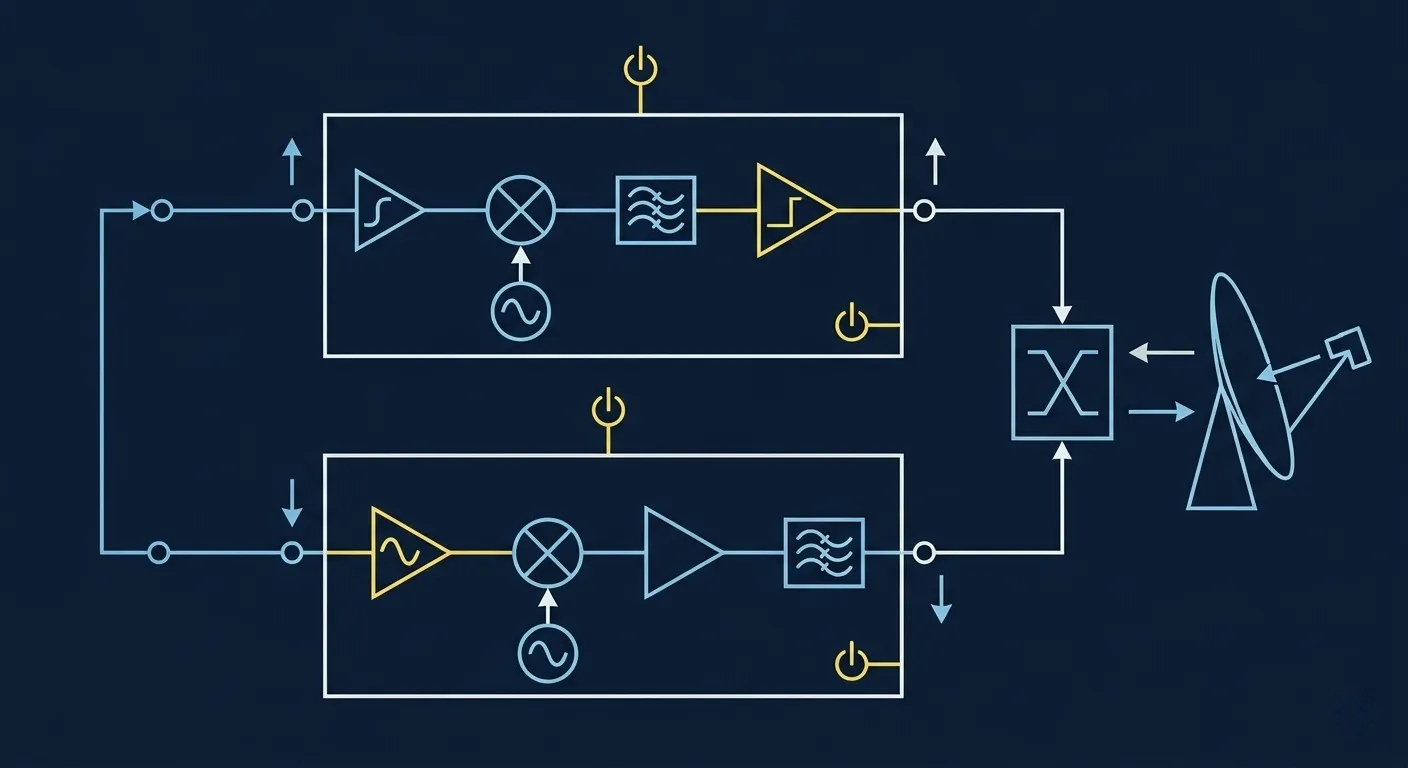
BUC vs LNB vs LNA in Satellite Systems Explained
Engineering guide comparing BUC, LNB, and LNA satellite RF components covering signal flow, selection criteria, failure modes, and practical troubleshooting.
SCADA Using Satellite Communication: Design and Acceptance Testing
Design SCADA using satellite communication with measured traffic, protocol timing, OT segmentation, outage behavior, QoS, and reproducible application tests.
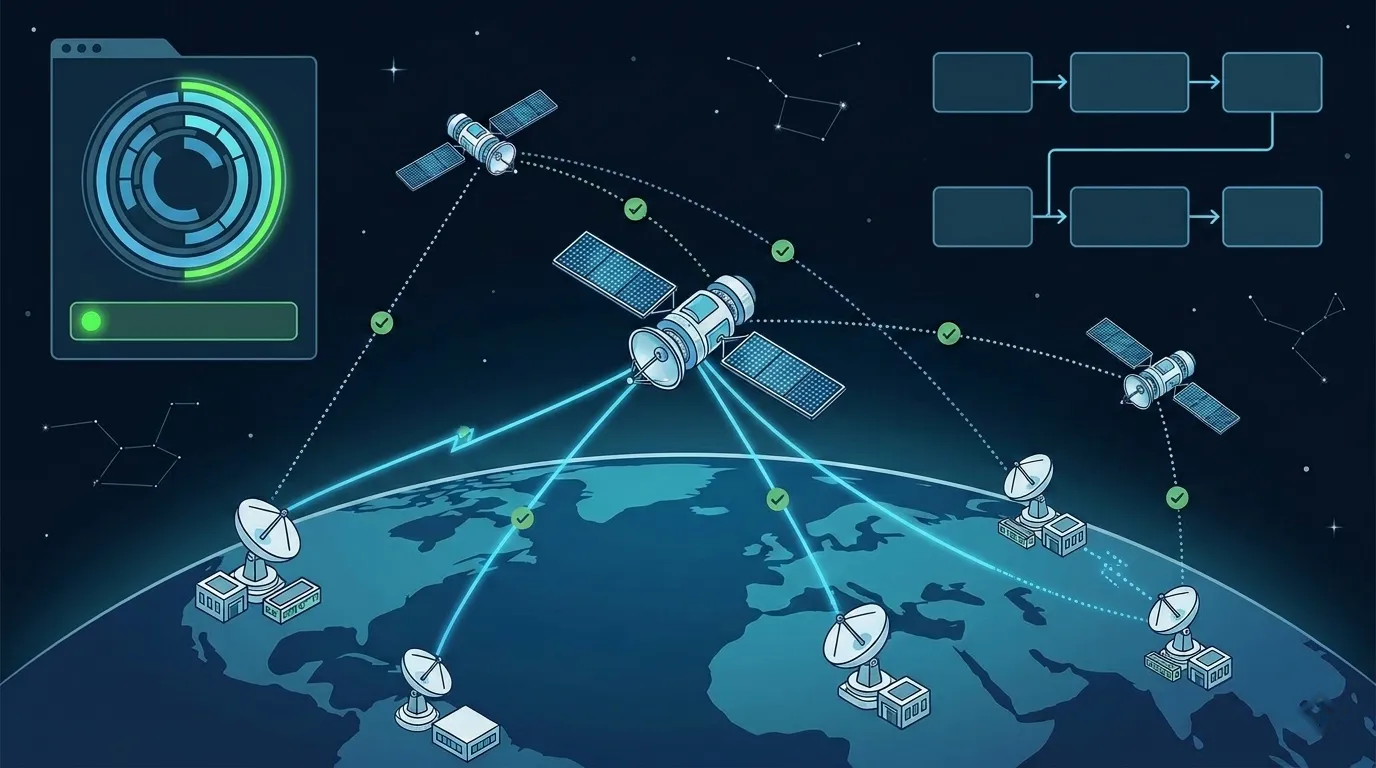
Satellite Link Availability Explained: How Engineers Design 99.9% and 99.99% Satellite Networks
Engineering guide to satellite link availability covering uptime targets, rain fade impact, fade margin design, redundancy strategies, and practical design checklists for 99.5% to 99.99% satellite networks.