
BUC vs LNB vs LNA in Satellite Systems Explained
Engineering guide comparing BUC, LNB, and LNA satellite RF components covering signal flow, selection criteria, failure modes, and practical troubleshooting.
Introduction
Every satellite communication link depends on three core RF components at the terminal: the Block Upconverter (BUC), the Low-Noise Block Downconverter (LNB), and the Low-Noise Amplifier (LNA). These devices sit between the antenna feed and the indoor modem, forming the RF front end that determines a terminal's transmit power, receive sensitivity, and overall link performance.
While the Satellite Terminal Architecture article covers these components as subsystems within the broader terminal design, this article provides a focused head-to-head comparison: what each device does, how they differ, when to choose one configuration over another, and how to troubleshoot them in the field. Whether you are sizing a new VSAT installation, diagnosing a degraded link, or selecting components for a gateway station, understanding the engineering distinctions between BUC, LNB, and LNA is essential.
This article assumes familiarity with satellite frequency bands and basic link budget concepts.
What Is a BUC
A Block Upconverter (BUC) is the transmit-side RF component that converts the modem's modulated intermediate frequency (IF) signal—typically L-band (950–1450 MHz)—up to the satellite uplink frequency band and amplifies it to the required transmit power level. The BUC is the final active component in the transmit chain before the antenna feed.
How a BUC Works
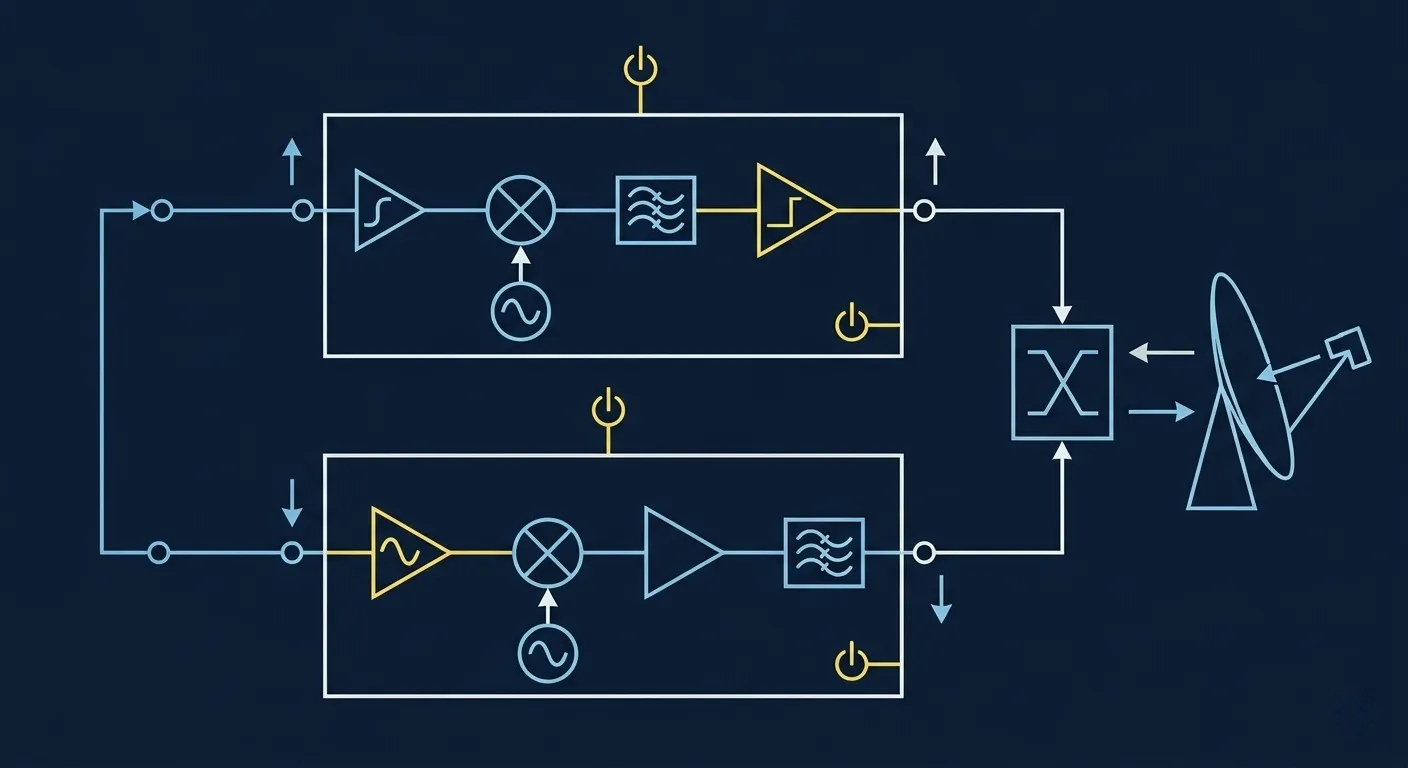
The BUC receives the L-band IF signal from the indoor modem via coaxial cable (the inter-facility link, or IFL). Internally, it mixes this IF signal with a local oscillator (LO) to produce the desired uplink RF frequency, then amplifies the resulting signal through a power amplifier (PA) stage. The output feeds directly into the antenna's transmit port.
Key BUC Parameters
| Parameter | Typical Range | Engineering Significance |
|---|---|---|
| Output power | 1 W – 80 W+ | Determines maximum uplink EIRP when combined with antenna gain |
| Frequency band | C / Ku / Ka | Must match satellite uplink allocation |
| 1 dB compression point (P1dB) | Rated output – 1 dB | Maximum linear output; operate 1–3 dB below P1dB |
| Phase noise | –80 to –95 dBc/Hz @ 10 kHz | Affects modulation accuracy for higher-order MODCODs |
| Spurious emissions | –50 to –60 dBc | Must meet ITU off-axis emission limits |
| DC power consumption | 20 W – 300 W+ | Drives power system sizing for remote/solar sites |
| Operating temperature | –40 °C to +60 °C | Critical for outdoor-mounted units |
GaN vs GaAs BUC Technology
Modern BUCs use either Gallium Arsenide (GaAs) or Gallium Nitride (GaN) semiconductor technology in their power amplifier stages:
- GaAs BUCs: Mature technology, lower cost at lower power levels (1–4 W), adequate for standard VSAT return channels. Less efficient at higher power levels, generating more heat per watt of RF output.
- GaN BUCs: Higher power density, better thermal efficiency, and wider bandwidth. GaN devices achieve the same output power in a smaller, lighter package with lower DC power consumption. Increasingly dominant for BUCs above 8 W, and essential for Ka-band high-power applications where thermal management is critical.
For terminal sizing, the required BUC power is derived from the link budget:
P_BUC (dBW) ≥ EIRP_required (dBW) – G_antenna (dBi) + L_feed (dB) + L_IFL (dB)What Is an LNB
A Low-Noise Block Downconverter (LNB) is the receive-side RF component that amplifies the weak satellite downlink signal and converts it from the satellite frequency band down to L-band IF for transmission to the indoor modem. The LNB is mounted directly at the antenna feed to minimize the noise contribution of the receive chain.
Internal Block Diagram
An LNB is actually a multi-stage device containing several functional blocks:
- Low-Noise Amplifier (LNA) — The first amplification stage, which sets the system noise figure
- Band-pass filter — Selects the desired frequency range and rejects out-of-band signals
- Mixer + Local Oscillator — Performs the frequency downconversion from satellite band to L-band IF
- IF amplifier — Provides additional gain at the intermediate frequency to drive the coaxial cable to the modem
This is a critical point: every LNB contains an LNA as its first stage. The LNA inside the LNB is what gives the LNB its "low-noise" characteristic. The distinction between a standalone LNA and an LNB is that the LNB adds frequency conversion and IF amplification.
Key LNB Parameters
| Parameter | Typical Range | Engineering Significance |
|---|---|---|
| Noise figure | 0.3 – 1.5 dB | Directly sets receive system noise temperature; lower is better for G/T |
| Gain | 50 – 65 dB | Must provide sufficient signal level at modem input |
| LO frequency stability | ±5 kHz to ±25 kHz | Affects carrier acquisition and narrow-band operation |
| Input frequency range | C / Ku / Ka band | Must match satellite downlink allocation |
| Output frequency range | 950 – 2150 MHz (L-band) | Standard IF range for coaxial cable to modem |
| Phase noise | –75 to –90 dBc/Hz @ 10 kHz | Impacts demodulation of higher-order modulation |
LNB Types
- Universal LNB: Covers both low (10.7–11.7 GHz) and high (11.7–12.75 GHz) Ku-band segments, switchable via 22 kHz tone. Common in DTH but also used in some VSAT applications.
- PLL (Phase-Locked Loop) LNB: Uses a phase-locked local oscillator for superior frequency stability (±5 kHz or better). Required for data communications and professional VSAT applications where the modem needs precise carrier frequency control.
- Multi-output LNB: Provides multiple independent IF outputs, each with its own LO and amplifier chain, enabling multiple receivers to share a single antenna feed.
- Ka-band LNB: Operates at 19.2–20.2 GHz receive band. Requires tighter manufacturing tolerances due to shorter wavelengths.
What Is an LNA
A Low-Noise Amplifier (LNA) is a standalone amplification device designed to boost an extremely weak RF signal while adding minimal noise. Unlike an LNB, a standalone LNA does not perform frequency conversion—it amplifies the signal at the original satellite frequency and passes it to a separate downconverter or directly to a wideband receiver.
Where Standalone LNAs Are Used
Standalone LNAs appear in satellite systems where the standard LNB architecture is insufficient:
- Gateway and teleport stations: Large earth stations use separate LNAs, filters, and downconverters in a rack-mounted configuration for maximum flexibility and redundancy. This allows individual components to be swapped or bypassed without affecting the entire receive chain. See Satellite Gateways & Teleports.
- Military and government terminals: High-performance terminals requiring the lowest possible noise figures and wide instantaneous bandwidth use cryogenically cooled LNAs or ultra-low-noise room-temperature LNAs.
- In-line signal boosters: When the cable run between the LNB and modem exceeds approximately 50–80 meters, cable attenuation can degrade the IF signal below acceptable levels. An in-line LNA (technically an IF amplifier, but commonly called an LNA) can compensate for cable losses.
- Receive-only monitoring stations: Spectrum monitoring, signal intelligence, and interference detection systems use standalone LNAs with wideband downconverters to capture and analyze satellite signals across multiple transponders simultaneously.
Cryogenic LNAs
At the highest performance level, cryogenic LNAs cool the amplifier to temperatures as low as 15–20 Kelvin using closed-cycle helium refrigerators. This reduces the amplifier's internal noise temperature from a typical 35–75 K (room-temperature LNA) to as low as 3–10 K. Cryogenic LNAs are used at deep-space tracking stations, radio astronomy facilities, and some military gateway stations where every fraction of a dB in G/T matters.
Key LNA Parameters
| Parameter | Typical Range | Engineering Significance |
|---|---|---|
| Noise figure | 0.2 – 1.0 dB | Sets system noise temperature; critical for receive sensitivity |
| Gain | 15 – 45 dB | Amplification before downstream components |
| Input IP3 (third-order intercept) | +5 to +25 dBm | Linearity; determines resistance to intermodulation from strong signals |
| 1 dB compression point | –5 to +15 dBm | Maximum input power for linear operation |
| Bandwidth | 500 MHz – 4 GHz | Must cover the required receive band |
| Operating temperature | –40 °C to +60 °C (room temp) or 15–20 K (cryo) | Ambient or cooled operation |
Signal Flow in a Satellite Terminal
Understanding where BUC, LNB, and LNA sit in the signal chain clarifies their roles:
Transmit Path
User Data → Modem (modulation, coding, L-band IF output)
  → IFL Cable (coax, L-band)
  → BUC (frequency upconversion + power amplification)
  → Antenna Feed (transmission to satellite)
The modem encodes and modulates user data onto an L-band carrier. The BUC upconverts this to the satellite uplink frequency and amplifies it. The antenna radiates the signal toward the satellite.
Receive Path
Satellite Signal → Antenna Feed (signal collection)
  → LNB (LNA + downconversion to L-band IF)
     or LNA → Separate Downconverter (gateway configuration)
  → IFL Cable (coax, L-band)
  → Modem (demodulation, decoding → User Data)
The antenna collects the weak downlink signal. In a standard VSAT terminal, the LNB amplifies and downconverts it to L-band IF. In a gateway station, a standalone LNA amplifies the signal at RF frequency, and a separate downconverter performs the frequency conversion. In both cases, the L-band IF signal travels over coaxial cable to the indoor modem for demodulation.
BUC vs LNB vs LNA Comparison
| Characteristic | BUC | LNB | LNA |
|---|---|---|---|
| Full name | Block Upconverter | Low-Noise Block Downconverter | Low-Noise Amplifier |
| Signal direction | Transmit (uplink) | Receive (downlink) | Receive (downlink) |
| Frequency conversion | L-band IF → satellite band (up) | Satellite band → L-band IF (down) | None (amplifies at RF frequency) |
| Primary function | Upconversion + power amplification | Low-noise amplification + downconversion | Low-noise amplification only |
| Typical output power | 1–80 W | N/A (receive device) | N/A (receive device) |
| Key specification | Output power (W), P1dB | Noise figure (dB), LO stability | Noise figure (dB), IP3 |
| Contains LNA internally | No | Yes (first stage) | Is the LNA |
| Typical VSAT use | Always required for two-way links | Always required for receive | Rarely used standalone |
| Gateway/teleport use | HPA + upconverter (separate) | Replaced by standalone LNA + downconverter | Used with separate downconverter |
| Typical unit cost | $300 – $5,000+ | $50 – $800 | $100 – $10,000+ |
| Typical lifespan | 7–10 years | 5–8 years | 10–15 years |
Key Selection Factors
BUC Power Sizing
BUC power must satisfy the uplink EIRP requirement from the satellite operator's link budget. Oversizing by 2–3 dB provides margin for rain fade (especially in Ka-band) and component aging. However, excessive oversizing wastes power and generates unnecessary heat. For sites with unreliable power or solar-only installations, the BUC's DC consumption often becomes the constraining factor.
LNB Noise Figure Selection
The LNB noise figure directly affects the terminal's G/T (gain-to-noise-temperature ratio), which determines receive sensitivity. A 0.5 dB improvement in noise figure can be equivalent to increasing the antenna diameter by 10–15%. For Ku-band VSAT, noise figures of 0.7–1.0 dB are standard. For Ka-band, 1.0–1.5 dB is typical. Always select PLL-stabilized LNBs for data communications—DBS/DTH LNBs with dielectric resonator oscillators (DRO) have excessive frequency drift for modem lock.
LNA Gain and Linearity
When selecting a standalone LNA, gain and linearity (IP3) must be balanced. Excessive gain can overdrive downstream components, causing intermodulation products that appear as elevated noise or spurious signals. In multi-carrier environments (gateways receiving dozens of transponders), the LNA's IP3 must be high enough to handle the aggregate input power without generating intermodulation interference.
Environmental Considerations
All three components mount outdoors at or near the antenna feed, exposing them to temperature extremes, moisture, UV radiation, and salt spray (maritime and coastal installations). Key environmental factors:
- Temperature range: Verify the component's rated operating range covers the site's extremes. BUCs generate significant internal heat; ensure adequate thermal dissipation at maximum ambient temperature.
- Ingress protection: IP65 or IP67 rated enclosures for exposed installations. All cable connectors must be properly weatherproofed.
- Altitude: High-altitude installations reduce air density for convective cooling, potentially de-rating BUC output power.
Common Failure Modes and Troubleshooting
BUC Failures
| Failure Mode | Symptoms | Diagnostic Approach |
|---|---|---|
| Overheating / thermal shutdown | Intermittent uplink loss, especially midday; BUC enclosure too hot to touch | Check heatsink mounting, fan operation, ventilation clearance; verify ambient temperature within spec |
| PA degradation | Gradual reduction in uplink C/N; modem reports reduced transmit power headroom | Measure BUC output power with inline power meter; compare to rated P1dB |
| LO unlock | Complete uplink failure; modem shows "no transmit carrier" | Check DC power supply voltage; verify 10 MHz reference (if external); test with known-good BUC |
| Intermodulation | Spurious signals in adjacent frequencies; interference complaints from satellite operator | Reduce BUC drive level (back off from P1dB); check for connector corrosion |
LNB Failures
| Failure Mode | Symptoms | Diagnostic Approach |
|---|---|---|
| LO drift / instability | Modem struggles to lock; frequent re-acquisitions; bit errors on narrow-band carriers | Replace with PLL LNB if using DRO type; check LNB supply voltage (13/18 V) |
| Moisture ingress | Gradual performance degradation; worse in rain; intermittent noise floor elevation | Inspect F-connector or waveguide flange seal; replace if corrosion visible |
| Noise figure degradation | Reduced receive C/N across all carriers; elevated system noise temperature | Measure system noise temperature with Y-factor method; compare to commissioning baseline |
| Complete failure | No downlink signal; modem shows no receive carrier | Verify DC power on IFL cable; test with known-good LNB; check for lightning damage |
LNA Failures
| Failure Mode | Symptoms | Diagnostic Approach |
|---|---|---|
| ESD damage | Sudden noise figure increase or complete failure | Verify proper grounding; install ESD protection on all connectors; handle with anti-static precautions |
| Gain flatness degradation | Uneven receive performance across the band; slope in spectrum analyzer display | Compare gain vs. frequency response to manufacturer spec; replace if out of tolerance |
| Oscillation | Spurious signals appearing without input; elevated broadband noise floor | Check cable routing for feedback paths; verify proper termination on unused ports |
Practical Engineering Notes
Waterproofing
The most common cause of RF component failure in the field is moisture ingress through improperly sealed connectors. Every outdoor RF connection—F-type, N-type, SMA, or waveguide flange—must be wrapped with self-amalgamating tape and then protected with an outer layer of UV-resistant PVC tape or a weatherproof boot. Silicone sealant alone is insufficient as it deteriorates under UV exposure.
Grounding and Lightning Protection
The antenna mount, BUC, LNB, and all cable shields must be bonded to a common ground point with low-impedance copper strap or braid. The IFL cable should include a grounding block at the building entry point. Surge protectors rated for the L-band frequency range should be installed on both transmit and receive IFL cables. Lightning is the leading cause of catastrophic BUC and LNB failure in tropical and equatorial regions.
IFL Cable Considerations
The inter-facility link (IFL) cable between outdoor RF components and the indoor modem introduces loss that directly affects both transmit and receive performance. Key guidelines:
- Use high-quality RG-6 (runs up to 30 m) or RG-11 (runs up to 60 m) for standard VSAT installations
- For runs exceeding 60 m, consider low-loss cables (LMR-400 equivalent) or fiber-optic IFL systems
- Cable loss increases with frequency and temperature; budget for worst-case conditions
- Avoid sharp bends (minimum bend radius = 10× cable diameter) and compression from cable ties
Mounting and Thermal Management
- Mount BUCs with the heatsink fins oriented vertically to allow natural convective airflow
- Ensure at least 10 cm clearance around the BUC for air circulation
- In hot climates (>45 °C ambient), consider a sun shield over the BUC
- LNBs are lower power and rarely require thermal management beyond proper mounting
Spare Strategy
For critical satellite links, maintain on-site spares of both the BUC and LNB. These are the two most failure-prone components in a VSAT terminal and can typically be swapped by a trained technician in under 30 minutes. Standalone LNAs at gateway stations should have automatic redundancy switching (1:1 or 1:N configurations).
Frequently Asked Questions
What is the main difference between a BUC and an LNB?
A BUC handles the transmit path—it upconverts the modem's L-band signal to the satellite uplink frequency and amplifies it. An LNB handles the receive path—it amplifies the weak satellite downlink signal and downconverts it to L-band for the modem. They operate in opposite directions and never substitute for each other.
Does an LNB contain an LNA?
Yes. The first internal stage of every LNB is a low-noise amplifier (LNA). This is what gives the LNB its "low-noise" characteristic. The LNB then adds frequency downconversion and IF amplification, which a standalone LNA does not provide.
How do I determine the right BUC power for my installation?
Start with the satellite operator's link budget, which specifies the required uplink EIRP in dBW. Subtract your antenna gain (dBi) and add all losses (feed loss, IFL cable loss, connector losses). The result is the minimum BUC power in dBW. Add 2–3 dB of margin for rain fade and component aging.
What noise figure should I look for in an LNB?
For Ku-band VSAT, target 0.7–1.0 dB. For Ka-band, 1.0–1.5 dB is standard. Always choose PLL-stabilized models for data communications. The noise figure directly affects G/T: every 0.5 dB improvement is roughly equivalent to a 10–15% increase in antenna diameter in terms of receive sensitivity.
Can I share one cable between the BUC and LNB?
In most modern VSAT terminals, yes. Single-cable solutions use diplexers (or "cross-band couplers") that combine the transmit and receive L-band signals onto a single coaxial cable. The BUC receives its DC power and L-band transmit signal via the same cable that carries the LNB's receive signal back to the modem. This simplifies installation but introduces slight additional losses (typically 0.5–1.0 dB).
What causes BUC overheating?
Common causes include: blocked heatsink fins (debris, bird nests, improper mounting orientation), failed cooling fans (on higher-power units), ambient temperature exceeding the rated range, excessive drive level (operating too close to P1dB for extended periods), and inadequate clearance for convective airflow. Overheating causes output power reduction or thermal shutdown, resulting in intermittent uplink failures.
How often should BUCs and LNBs be replaced?
Under normal conditions, BUCs last 7–10 years and LNBs 5–8 years. However, harsh environments (high humidity, salt air, extreme temperatures, frequent lightning activity) can significantly reduce lifespan. Proactive replacement should be considered when measured performance degrades by more than 2–3 dB from commissioning baselines, even if the component has not completely failed.
When should I use a standalone LNA instead of an LNB?
Use a standalone LNA when you need: maximum receive performance at a gateway or teleport (paired with a separate high-stability downconverter), the ability to independently service the amplifier and converter, wideband coverage across multiple transponders, or the lowest possible noise figure (including cryogenic options). For standard VSAT remote terminals, the integrated LNB is the correct choice—it provides adequate performance in a simpler, more cost-effective package.
Key Takeaways
- BUC handles the transmit path (L-band → satellite band upconversion + power amplification); LNB handles the receive path (satellite band → L-band downconversion + low-noise amplification); LNA is a standalone low-noise amplifier without frequency conversion.
- Every LNB contains an LNA as its first internal stage—the LNB adds frequency conversion and IF amplification on top of what a standalone LNA provides.
- BUC power is determined by the link budget's EIRP requirement minus antenna gain plus system losses; always include 2–3 dB margin.
- LNB noise figure directly sets the terminal's G/T and receive sensitivity; PLL-stabilized LNBs are mandatory for data communications.
- Standalone LNAs are used at gateways, teleports, and military terminals where maximum flexibility, redundancy, and receive performance are required.
- Waterproofing, grounding, and proper cable management are the most impactful field practices for extending RF component life and maintaining link performance.
Author

Organizational byline for SATCOM Index technical content. A named technical reviewer appears separately only when identity, scope, and permission are verified.
Categories
More Posts
Satellite Glossary: A-F
Satellite communication terminology and definitions from A to F.
Enterprise Satellite Internet: Use Cases, Architecture, and Vendor Selection
Comprehensive guide to enterprise satellite internet covering use cases, hybrid WAN architecture, performance SLAs, vendor selection criteria, and procurement best practices.
End-to-End Architecture
Complete overview of satellite communication system architecture from space segment to user terminals.