
Satellite Diversity Explained: How Multi-Satellite and Multi-Path Design Improves Resilience
Learn how satellite diversity techniques — including satellite, gateway, site, orbit, and frequency diversity — improve network resilience for enterprise and critical infrastructure.
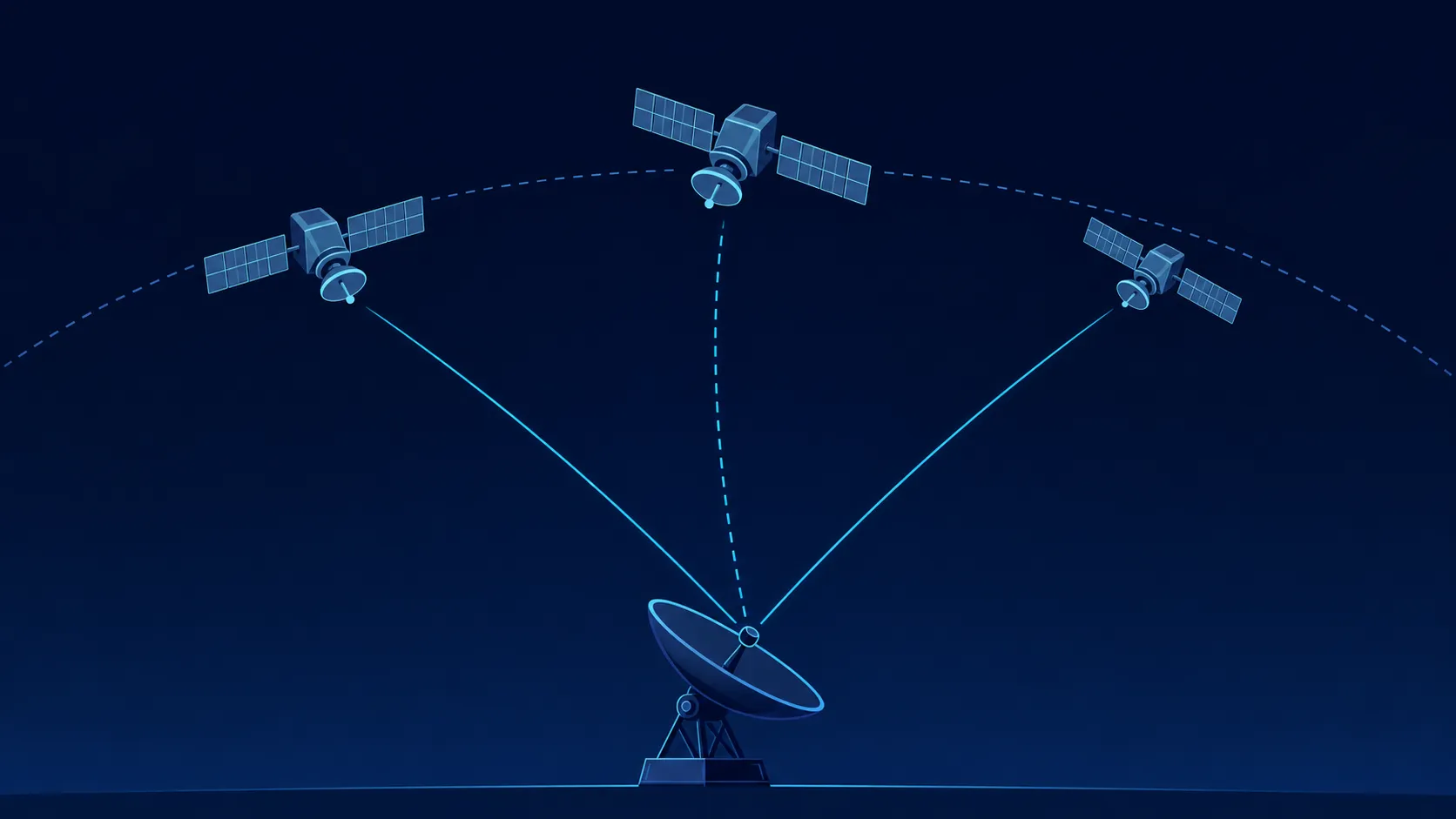
High-availability satellite networks cannot rely on a single path. A single satellite, a single gateway, a single frequency band, or a single orbital plane — any of these creates a single point of failure that puts the entire service at risk when conditions change. Weather events, equipment faults, orbital geometry limitations, and regulatory constraints can all disrupt a link that has no alternative. Satellite diversity is the deliberate use of multiple, independent communication paths to ensure that no single failure takes down the service.
This article explains the full spectrum of diversity techniques used in modern satellite communications: satellite diversity, gateway diversity, site diversity, orbit diversity, and frequency diversity. It covers why each technique exists, how they relate to each other, when they are combined, and what trade-offs network architects face when designing resilient satellite infrastructure. It is written for satellite engineers, enterprise architects, telecom planners, and anyone evaluating satellite services for mission-critical or business-critical applications.
Key terms used in this article — For complete definitions, see the Glossary A–F and Glossary S–Z.
- Satellite diversity: The use of two or more satellites to provide redundant communication paths for the same coverage area or user terminal.
- Gateway diversity: Deployment of geographically separated gateway earth stations so that localized impairments do not take down the feeder link.
- Site diversity: Placement of ground terminals or gateways at different geographic locations to decorrelate weather-related outages.
- Orbit diversity: Using satellites in different orbital regimes (GEO, MEO, LEO) to provide complementary coverage and failover paths.
- Frequency diversity: Operating links across multiple frequency bands so that band-specific impairments do not cause total service loss.
For a detailed treatment of gateway-level redundancy specifically, see Satellite Gateway Diversity Explained. For background on hybrid multi-orbit architectures, see Hybrid Satellite Network: Multi-Orbit Connectivity.
What Is Satellite Diversity?
Satellite diversity in the broadest sense refers to any design strategy that provides multiple independent paths between communicating endpoints in a satellite network. The goal is to ensure that the failure, degradation, or unavailability of any single element — whether a satellite, a ground station, a frequency band, or an orbital plane — does not result in total loss of service.
The concept is grounded in a simple principle from reliability engineering: the probability of two independent systems failing simultaneously is the product of their individual failure probabilities. If a single satellite link has 99.5% availability (roughly 44 hours of outage per year), adding a second independent path with the same availability raises the combined availability to 99.9975% — reducing expected outage to approximately 13 minutes per year. This dramatic improvement depends on the paths being genuinely independent; if both paths share the same vulnerability (same weather cell, same power grid, same satellite), the benefit collapses.
Satellite diversity is not the same as generic redundancy. Redundancy can mean duplicating components within a single system — a spare amplifier, a backup power supply, a secondary modem. Diversity specifically means creating separate paths through different physical or logical domains so that a common-cause failure cannot affect all paths simultaneously. The distinction matters because redundancy within a single site or single satellite does not protect against the dominant failure modes in satellite communications: weather, orbital events, and site-level disasters.
Diversity vs. Redundancy
| Aspect | Redundancy | Diversity |
|---|---|---|
| Scope | Within a single system or site | Across multiple systems, sites, or domains |
| Protection | Component-level failures | Common-cause and site-level failures |
| Example | Spare BUC at the same terminal | Second satellite path via different orbital slot |
| Weather protection | None (same location) | High (geographically separated paths) |
| Cost | Moderate (spare parts) | Higher (duplicate infrastructure) |
Types of Diversity in SATCOM
Diversity in satellite communications operates at multiple architectural layers. Each type addresses different failure modes, and real-world high-availability designs typically combine several types.
Satellite Diversity
Satellite diversity uses two or more satellites to serve the same coverage area. If one satellite experiences a fault — transponder failure, attitude control issue, end-of-life degradation, or complete loss — the user terminal can switch to an alternate satellite. This is the most fundamental form of diversity because the satellite itself is the single most expensive and least repairable element in the network.
Satellite diversity is common in military and government systems where continuity of service is non-negotiable. Commercial implementations exist primarily in maritime and aviation, where terminals with auto-tracking antennas can switch between satellites as coverage zones shift or when a satellite becomes unavailable.
Gateway Diversity
Gateway diversity deploys multiple gateway earth stations capable of serving the same satellite beams. If the primary gateway is impaired — typically by rain fade, but also by equipment failure or backhaul loss — traffic is rerouted through an alternate gateway. This is the most widely deployed form of diversity in commercial Ka-band HTS (High Throughput Satellite) systems, where rain fade at gateway frequencies (27–31 GHz uplink) is the dominant availability threat.
For a comprehensive engineering treatment of gateway diversity, see Satellite Gateway Diversity Explained.
Site Diversity
Site diversity places ground terminals at different geographic locations to ensure that a localized event — weather, power outage, natural disaster — does not simultaneously affect all terminals. While gateway diversity is a specific application of site diversity (applied to the feeder link), site diversity also applies to user terminals and remote sites in enterprise networks.
For example, an enterprise with a primary VSAT terminal at its headquarters and a backup terminal at a disaster recovery site 200 km away has site diversity for its user-side connection. Maritime vessels with both a primary VSAT dome and a backup flat-panel antenna at a different mounting location achieve a form of onboard site diversity, though the geographic separation is minimal.
Orbit Diversity
Orbit diversity uses satellites in different orbital regimes — GEO (geostationary, ~36,000 km), MEO (medium Earth orbit, ~8,000–20,000 km), and LEO (low Earth orbit, 300–2,000 km) — to provide complementary coverage and failover. Different orbits have fundamentally different characteristics: GEO offers continuous coverage of a fixed area but with high latency (~600 ms round-trip); LEO offers low latency (~20–50 ms) but requires constellation handovers and has variable coverage; MEO sits between the two.
Orbit diversity protects against orbital-regime-specific risks. A GEO satellite failure affects a fixed coverage zone permanently until a replacement is launched (typically 2–3 years). A LEO constellation experiencing a partial failure loses capacity but maintains coverage as remaining satellites redistribute. Combining GEO and LEO provides protection against both scenarios.
For details on multi-orbit hybrid architectures, see Hybrid Satellite Network: Multi-Orbit Connectivity.
Frequency Diversity
Frequency diversity operates links across multiple frequency bands — for example, using both Ku-band (12–18 GHz) and Ka-band (26.5–40 GHz), or combining C-band (4–8 GHz) with Ku-band. Different frequency bands experience different levels of rain attenuation: C-band is nearly immune to rain fade, Ku-band is moderately affected, and Ka-band is severely affected. By maintaining the ability to fall back to a lower-frequency band during heavy rain, a network can sustain service through weather events that would cause a total outage on the higher-frequency band alone.
Frequency diversity is expensive because it requires dual-band or multi-band terminals, antennas, and satellite capacity across multiple bands. It is typically reserved for military, government, and critical infrastructure applications where the cost is justified by the availability requirement.
Why Satellite Diversity Is Used
Weather Resilience
Rain fade is the single largest availability threat for satellite networks operating at Ku-band and above. At Ka-band, a severe tropical rainstorm can cause 20–30 dB of signal attenuation — far beyond what any practical fade margin or adaptive coding can absorb. Diversity provides an alternative path that bypasses the weather event entirely.
Gateway diversity is the primary defense against rain fade on the feeder link side. Site diversity protects the user terminal side. Frequency diversity provides a band-specific fallback. Together, these techniques reduce weather-related outage from tens of hours per year to minutes. For detailed rain fade engineering, see Satellite Fade Margin Explained.
Equipment and Platform Faults
Satellites, gateways, and terminals all contain components that can fail. While individual component reliability is high (satellite transponders are designed for 15+ year lifetimes), the aggregate probability of some failure occurring across a large network over time is significant. Satellite diversity ensures that a transponder failure or satellite anomaly does not create a service outage. Gateway diversity ensures that a modem rack failure or power loss at a single ground station does not cascade to all users served by that gateway.
Coverage Overlap and Continuity
In LEO and MEO constellations, individual satellites are visible for only minutes at a time. Diversity in the form of multiple satellites in view simultaneously — and the ability to hand over between them — is not optional but architecturally required. Even in GEO systems, satellites at adjacent orbital slots can provide overlapping coverage that enables diversity switching.
For maritime and aviation users who transit between satellite footprints, having access to multiple satellites ensures continuous service during beam handovers and coverage transitions. See Satellite Beam Handover Explained for details on handover mechanisms.
Business Continuity and Service Assurance
Enterprise customers, government agencies, and critical infrastructure operators (oil and gas, maritime, mining, utilities) require satellite service that meets strict SLA commitments — typically 99.5% to 99.95% availability. Achieving these targets in the presence of weather, equipment faults, and operational disruptions is only possible with diversity at one or more architectural layers.
Diversity is not just a technical requirement but a contractual one: SLA penalties for prolonged outages can far exceed the cost of implementing diversity. For SLA engineering, see Satellite SLA Explained.
Real-World Diversity Models
Dual-Satellite Enterprise Design
A common enterprise design uses two GEO satellites at different orbital slots, each with a dedicated ground terminal or a dual-feed antenna. The primary satellite carries normal traffic. The secondary satellite maintains a warm standby link with periodic keepalive traffic. If the primary satellite or its transponder fails, the terminal switches to the secondary within seconds to minutes, depending on the failover automation level.
This design is used by financial institutions, government agencies, and energy companies where a single satellite failure cannot be tolerated. The cost premium is significant — roughly 60–80% more than a single-satellite design — but the availability improvement from ~99.5% to ~99.99% justifies it for critical links.
GEO + LEO Hybrid Services
The emergence of LEO constellations (Starlink, OneWeb, Telesat Lightspeed, Amazon Kuiper) has created a new diversity model: using GEO as a high-capacity, stable primary link and LEO as a low-latency, diverse backup — or vice versa. This orbit diversity approach protects against GEO-specific risks (single satellite failure, orbital slot congestion) and LEO-specific risks (constellation gaps, handover failures, capacity constraints in congested areas).
Several managed service providers now offer GEO + LEO bonded services with automatic failover. The terminal uses software-defined networking (SD-WAN) to route traffic across both paths based on availability, latency, and application requirements. Maritime operators in particular are adopting this model to combine the proven reliability of GEO VSAT with the low latency of LEO for real-time applications.
For maritime-specific considerations, see Maritime Satellite Internet.
Remote Industrial and Mining Sites
Remote industrial operations — mining sites, oil and gas platforms, construction camps — face unique diversity challenges. These sites are typically in locations with limited terrestrial alternatives, making satellite the only connectivity option. A single satellite link failure at such a site can halt operations, endanger safety systems, and disrupt SCADA telemetry.
Diversity designs for these sites typically combine:
- Primary GEO VSAT with a managed service and SLA
- Backup satellite link on a different satellite or different band
- Site-level redundancy with dual terminals and automatic failover
- Application-aware failover that prioritizes safety and SCADA traffic on the backup link
The cost of diversity is weighed against the cost of operational downtime, which can run to hundreds of thousands of dollars per day for large mining or offshore operations.
Backup Path Strategies
Not all diversity requires full duplicate capacity. Several intermediate strategies exist:
| Strategy | Description | Availability Impact |
|---|---|---|
| Hot standby | Backup link active and carrying traffic, instant failover | Highest (~99.99%) |
| Warm standby | Backup link established but idle, failover in seconds | High (~99.95%) |
| Cold standby | Backup equipment on-site but not connected, failover in minutes to hours | Moderate (~99.7%) |
| Restore-based | Portable or deployable terminal, manual activation | Low (hours to days) |
The choice depends on the required availability, acceptable failover time, and budget. Most enterprise diversity designs use warm standby as the best balance of cost and performance.
Satellite Diversity vs Gateway Diversity
Satellite diversity and gateway diversity are related but distinct concepts that are frequently confused. The following comparison clarifies when each is appropriate and when both are needed.
| Dimension | Satellite Diversity | Gateway Diversity |
|---|---|---|
| What varies | The satellite platform (different spacecraft) | The ground station (different geographic site) |
| Primary threat addressed | Satellite failure, transponder loss, orbital anomaly | Rain fade, ground equipment failure, backhaul loss |
| Where the switch happens | User terminal selects alternate satellite | Network core reroutes traffic to alternate gateway |
| Terminal impact | May require antenna re-pointing or dual-antenna setup | Transparent to user terminal (network-side switch) |
| Typical failover time | Seconds to minutes (antenna re-acquisition) | Milliseconds to seconds (network routing) |
| Cost driver | Dual satellite capacity, dual-feed or tracking antenna | Duplicate gateway infrastructure, fiber backhaul |
| Common in | Military, government, maritime, aviation | Commercial HTS, broadband, enterprise |
When Gateway Diversity Alone Is Sufficient
For most commercial broadband and enterprise VSAT services, gateway diversity provides adequate protection. The satellite itself has high reliability (designed for 15+ year life with redundant subsystems), and the dominant availability threat is rain fade at the gateway — which gateway diversity directly addresses. If the satellite is healthy and the user terminal has clear sky, gateway diversity ensures that a rain event at one ground station does not cause a service outage.
When Satellite Diversity Is Also Needed
Satellite diversity becomes necessary when:
- The application cannot tolerate any satellite-level failure (military, air traffic control, emergency services)
- The satellite is aging and approaching end of life, increasing the probability of anomaly
- The coverage area is served by a single satellite with no adjacent coverage overlap
- The required availability exceeds what gateway diversity alone can deliver (>99.95%)
- Regulatory or contractual requirements mandate satellite-level redundancy
Multi-Layer Diversity
The highest-availability designs combine satellite diversity with gateway diversity and often site diversity as well. A dual-satellite design where each satellite has diverse gateways provides four independent paths: Satellite A via Gateway 1, Satellite A via Gateway 2, Satellite B via Gateway 3, Satellite B via Gateway 4. The probability of all four paths failing simultaneously is vanishingly small, enabling availability targets of 99.999% or better.
For a deep dive into gateway-specific diversity engineering, see Satellite Gateway Diversity Explained. For hub-level redundancy within a single gateway, see Satellite Hub Redundancy Explained.
Engineering Trade-offs
Cost vs. Resilience
Every additional diverse path increases both resilience and cost. The relationship is not linear — the first diverse path provides the largest availability improvement (e.g., from 99.5% to 99.95%), while subsequent paths provide diminishing returns at increasing cost. Network architects must find the inflection point where the marginal cost of additional diversity exceeds the marginal value of improved availability.
| Diversity Level | Typical Availability | Relative Cost | Use Case |
|---|---|---|---|
| None (single path) | 99.0–99.5% | 1.0× | Best-effort broadband |
| Gateway diversity only | 99.5–99.9% | 1.2–1.4× | Commercial enterprise |
| Satellite + gateway diversity | 99.9–99.95% | 1.8–2.2× | Critical enterprise |
| Full multi-layer diversity | 99.95–99.999% | 2.5–4.0× | Military, government, safety-of-life |
Complexity vs. Operational Benefit
Diversity adds operational complexity: more equipment to maintain, more failover logic to test, more network paths to monitor, and more vendor relationships to manage. A dual-satellite, dual-gateway design requires coordination between satellite operators, gateway facility operators, backhaul providers, and the enterprise network operations center. Each additional layer of diversity increases the operational burden.
The benefit must be evaluated against this operational cost. An organization without 24/7 network operations center (NOC) coverage may not benefit from sub-second automatic failover because there is no one to respond to the alerts. A simpler warm-standby design with manual confirmation may be more appropriate.
Antenna and Terminal Architecture
Satellite diversity at the user terminal level often requires specialized antenna systems:
- Dual-antenna systems: Two separate antennas pointed at different satellites, with a switch or combiner. Common on maritime vessels and large enterprise sites.
- Multi-beam antennas: A single antenna capable of simultaneously tracking multiple satellites. Available in electronically steered array (ESA) designs but expensive.
- Auto-tracking antennas: A single dish that can re-point to an alternate satellite on command. Introduces re-acquisition delay (typically 30–120 seconds).
The terminal architecture choice directly impacts failover time, cost, and installation complexity. For maritime and aviation applications where continuous service is required, dual-antenna or multi-beam designs are standard despite the higher cost.
Common Misunderstandings
Gateway Diversity Solves All Outage Risks
Gateway diversity is highly effective against rain fade and ground-station failures, but it does not protect against satellite-level failures, user-terminal impairments, or backhaul failures that affect all gateways (e.g., a shared fiber route). Organizations that assume gateway diversity alone provides "five nines" availability may be surprised when a satellite anomaly or a user-side equipment failure causes an outage that no amount of gateway switching can resolve.
Multi-Orbit Automatically Means Full Diversity
Subscribing to both a GEO and a LEO service does not automatically create diversity unless the network is designed to fail over between them. If the GEO and LEO links terminate on different terminals, use different network stacks, and connect to different applications, they are two separate services — not a diverse pair. True orbit diversity requires integrated failover logic, typically implemented through SD-WAN or a bonding appliance, that treats both paths as part of a single resilient service.
More Satellites Always Means Better Availability
Adding satellites to a network improves capacity, not necessarily availability. If all satellites share the same ground infrastructure, the same backhaul, or the same network management system, the ground segment becomes the bottleneck. Diversity must be end-to-end — from the satellite through the gateway, backhaul, and network core — to deliver genuine availability improvement.
Diversity Eliminates the Need for Fade Margin
Diversity and fade margin are complementary, not substitutes. Diversity provides an alternate path when the primary path degrades beyond recovery. Fade margin keeps the primary path operational through moderate weather events without triggering a switch. A well-designed system uses adequate fade margin to handle routine weather variation and diversity to handle extreme events. Removing fade margin because "we have diversity" leads to frequent unnecessary failovers that disrupt service and increase operational complexity.
Practical Design Considerations
Path Switching Logic
The failover mechanism must be carefully designed to avoid both slow switching (extended outage) and excessive switching (flapping). Key design parameters include:
- Switch threshold: The signal quality level at which failover is triggered. Too sensitive → flapping; too conservative → extended degradation before switching.
- Hold-off timer: A delay before switching to confirm that the degradation is sustained, not transient. Typical values: 2–10 seconds for gateway diversity, 10–60 seconds for satellite diversity.
- Revert behavior: Whether the system automatically returns to the primary path when it recovers, or remains on the backup until manually reverted. Auto-revert introduces the risk of repeated switching during intermittent conditions.
- Make-before-break vs. break-before-make: Whether the backup path is established before the primary is dropped (seamless) or after (brief interruption). Make-before-break requires simultaneous capacity on both paths.
Application Priorities
Not all traffic needs to survive a failover event with the same priority. Diversity designs should include application-aware failover policies:
- Critical traffic (voice, SCADA, safety systems): Highest priority on backup path, minimal acceptable degradation
- Business traffic (email, ERP, web): Medium priority, may accept reduced bandwidth during failover
- Best-effort traffic (software updates, streaming, bulk transfers): Lowest priority, may be suspended during failover to preserve backup capacity for critical applications
This tiered approach allows the backup path to have less capacity than the primary while still meeting availability requirements for the most important applications.
SLA Implications
Diversity directly affects SLA commitments and should be reflected in the service agreement:
- Availability calculation: Does the SLA measure availability of the primary path, the diverse pair, or end-to-end service including the diversity mechanism?
- Failover time exclusion: Is the time to complete a failover counted as downtime? For satellite diversity with antenna re-pointing, this can be 30–120 seconds.
- Partial outage: If the primary path fails but the backup provides reduced capacity, does that count as an outage or as degraded service?
These questions should be resolved during SLA negotiation, not during an outage investigation. For SLA engineering best practices, see Satellite SLA Explained.
Testing and Failover Drills
Diversity systems that are never tested may not work when needed. Regular failover testing is essential:
- Scheduled failover drills: Quarterly or semi-annual deliberate switchovers to verify that the backup path is functional and that failover logic works correctly.
- Monitoring validation: Continuous monitoring of backup path health — signal quality, equipment status, backhaul connectivity — to detect silent failures before they matter.
- Restoration testing: After each drill, verify that the system correctly reverts to the primary path and that all applications resume normal operation.
- Documentation and procedures: Written failover and restoration procedures that operations staff can follow during an actual event, including escalation paths and vendor contact information.
Organizations that invest in diversity infrastructure but neglect operational testing often discover during a real event that the backup path has degraded, the failover logic has a bug, or the operations team does not know the procedure. For broader network resilience considerations, see Satellite Network Brownout Explained.
Frequently Asked Questions
What is satellite diversity?
Satellite diversity is the use of multiple independent communication paths in a satellite network to ensure that the failure or degradation of any single element — a satellite, a gateway, a frequency band, or an orbital plane — does not cause a complete service outage. It encompasses several specific techniques including satellite diversity (multiple spacecraft), gateway diversity (multiple ground stations), site diversity (geographically separated terminals), orbit diversity (multiple orbital regimes), and frequency diversity (multiple frequency bands).
How is satellite diversity different from gateway diversity?
Gateway diversity is a specific type of diversity that focuses on the ground station (gateway) side of the satellite link. It protects against rain fade and gateway equipment failures by maintaining alternate ground stations that can serve the same satellite beams. Satellite diversity is a broader concept that includes gateway diversity but also covers diversity at the satellite level, the orbital level, and the frequency level. Gateway diversity is the most commonly deployed form because gateway-side rain fade is the dominant availability threat in commercial networks.
Do enterprises need dual-satellite designs?
Most commercial enterprise VSAT services do not require dual-satellite designs. Gateway diversity alone provides sufficient availability (99.5–99.9%) for typical business applications. Dual-satellite designs are justified when the application is mission-critical (safety systems, financial trading, military communications), when the required availability exceeds 99.95%, or when the enterprise operates in a region served by only one satellite with no adjacent coverage overlap. The decision should be based on a cost-benefit analysis comparing the cost of dual-satellite infrastructure against the cost of potential downtime.
Is multi-orbit service a form of diversity?
Yes, when properly implemented. A service that uses both GEO and LEO satellites and can automatically fail over between them provides orbit diversity. However, simply having both GEO and LEO subscriptions without integrated failover logic does not constitute diversity — it is two separate services. True orbit diversity requires SD-WAN or bonding technology that treats both orbital paths as part of a single resilient network and can switch traffic between them based on availability and performance.
What is the typical failover time for satellite diversity?
Failover time depends on the type of diversity and the terminal architecture. Gateway diversity switching is the fastest, typically completing in milliseconds to a few seconds because it happens at the network level without affecting the user terminal. Satellite diversity with a dual-antenna system fails over in 1–5 seconds. Satellite diversity with a single auto-tracking antenna requires re-pointing, which takes 30–120 seconds depending on the angular separation between satellites. Orbit diversity failover (GEO to LEO or vice versa) through SD-WAN typically completes in 2–10 seconds.
Does frequency diversity require special terminals?
Yes. Frequency diversity requires terminals capable of operating on multiple frequency bands, which means multi-band feeds, amplifiers (BUCs and LNBs), and modems. These terminals are significantly more expensive than single-band equipment. Some modern terminals integrate Ku-band and Ka-band capability in a single unit, but C-band/Ku-band or C-band/Ka-band combinations typically require separate antenna systems due to the large difference in antenna size requirements. Frequency diversity is primarily deployed in military and government networks where the cost is justified.
How do you test satellite diversity systems?
Testing involves scheduled failover drills (quarterly or semi-annually) where the primary path is deliberately taken offline to verify that the backup path activates correctly and carries traffic as expected. Continuous monitoring of backup path signal quality and equipment health is essential to detect silent failures. After each drill, restoration to the primary path should be verified. All test results, failover times, and any issues discovered should be documented and used to refine procedures and improve the system.
Can satellite diversity protect against cyberattacks?
Satellite diversity provides limited protection against cyber threats. If an attacker compromises the network management system that controls failover logic, diversity may not help — or may even be exploited to force unnecessary switches. However, diversity does provide resilience against denial-of-service attacks targeting a specific satellite or gateway, as traffic can be rerouted to an unaffected path. For comprehensive protection, diversity should be combined with cybersecurity measures including encrypted control planes, network segmentation, and intrusion detection.
Key Takeaways
-
Satellite diversity is not a single technique — it is a family of strategies (satellite, gateway, site, orbit, and frequency diversity) that provide multiple independent communication paths to improve network resilience.
-
Gateway diversity is the most commonly deployed form because rain fade at the gateway is the dominant availability threat in commercial Ka-band and Ku-band networks. For most enterprise applications, gateway diversity alone provides sufficient protection.
-
True diversity requires independence — paths that share the same satellite, the same ground infrastructure, or the same backhaul do not provide genuine diversity. The availability improvement depends on the paths being independently subject to failure.
-
Multi-orbit is not automatic diversity — subscribing to both GEO and LEO services only constitutes diversity when integrated failover logic (SD-WAN, bonding) is in place to automatically switch traffic between orbital paths.
-
Cost scales with resilience — each additional diverse path provides diminishing availability improvement at increasing cost. The right level of diversity depends on the application's availability requirement, the cost of downtime, and the operational capacity to manage complex failover systems.
-
Diversity and fade margin are complementary — fade margin handles routine weather variation; diversity handles extreme events. Neither substitutes for the other.
-
Operational readiness matters as much as architecture — diversity systems that are never tested, never monitored, and never drilled may fail when they are needed most. Regular failover testing and continuous backup path monitoring are essential.
-
Design diversity end-to-end — satellite-level diversity without ground segment diversity, or gateway diversity without satellite diversity, leaves gaps. The highest availability targets require multi-layer diversity across the entire communication chain.
Author

Organizational byline for SATCOM Index technical content. A named technical reviewer appears separately only when identity, scope, and permission are verified.
Categories
More Posts

Satellite Service Providers: Roles and Shortlist Guide
Map operator, reseller, integrator and field-service roles, then shortlist satellite offers using current ownership, coverage, contract and support evidence.
Satellite Transponder Bandwidth and Carrier Planning
Distinguish transponder output bandwidth, carrier span, occupied bandwidth, assigned spectrum, power loading, throughput, and operator acceptance evidence.

How Satellite Internet Works: Architecture, Latency, and Real-World Operation
Learn how satellite internet works, including GEO vs LEO satellites, ground stations, latency, and how data travels through space networks.