
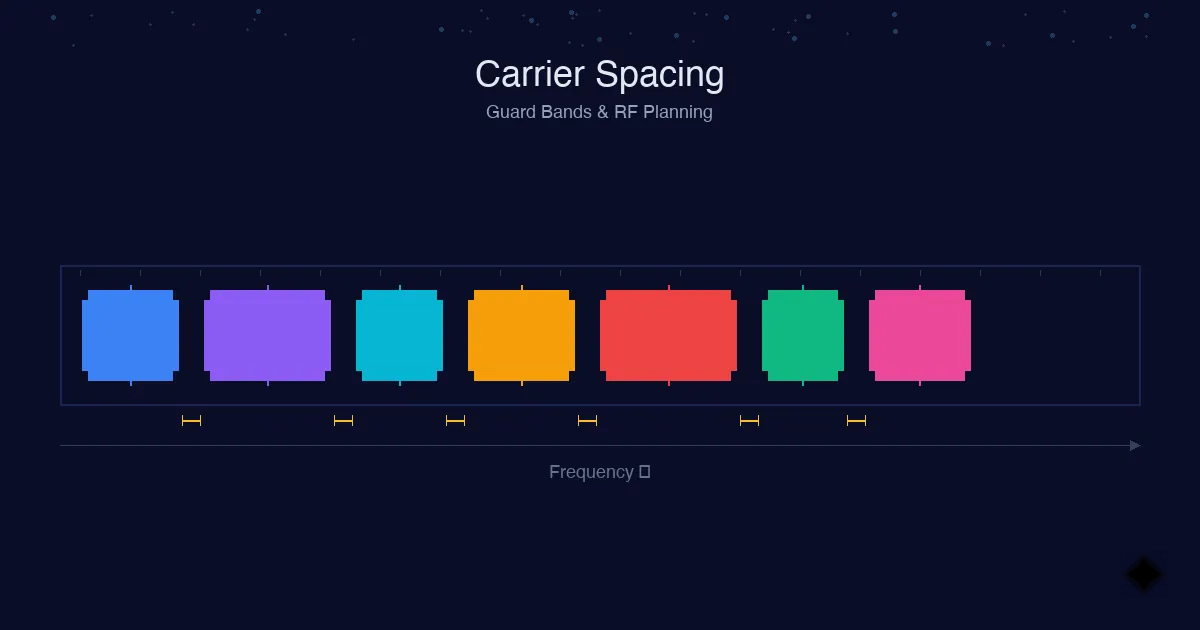
Satellite Carrier Spacing Explained: Why Guard Bands Matter in RF Planning
Engineering guide to satellite carrier spacing covering guard bands, RF planning trade-offs, spectral efficiency, and adjacent carrier interference.
Satellite transponders carry a finite amount of bandwidth — typically 36 MHz, 54 MHz, or 72 MHz depending on the satellite and frequency band. Every carrier placed on a transponder consumes a portion of that bandwidth, and the spacing between carriers determines how many can fit before the transponder is full. Get the spacing right and you maximize the revenue-generating capacity of the satellite asset. Get it wrong and you either waste expensive spectrum through excessive gaps or create adjacent carrier interference that degrades every link sharing that transponder.
Carrier spacing is one of the most practical decisions in satellite RF planning. It sits at the intersection of waveform design, equipment performance, frequency coordination, and commercial pressure to pack more throughput into every megahertz of transponder capacity. Despite its importance, carrier spacing is often treated as an afterthought — a number copied from a template carrier plan without fully understanding the engineering trade-offs behind it.
This article explains what carrier spacing is, why guard bands exist between carriers, what factors determine how much spacing is needed, and how engineers balance spectral efficiency against interference risk. It includes practical examples showing how spacing decisions affect transponder utilization and connects to related topics including symbol rate and roll-off, transponder bandwidth, and interference management.
Key terms used in this article: Carrier spacing — the center-to-center frequency separation between two adjacent carriers on a transponder. Guard band — the unused frequency gap between the edges of adjacent carriers, providing margin against spectral overlap. Occupied bandwidth (OBW) — the actual bandwidth a carrier uses, determined by the symbol rate and roll-off factor: OBW = symbol rate × (1 + roll-off). Roll-off factor (α) — the excess bandwidth beyond the Nyquist minimum, expressed as a fraction (e.g., 0.20 for 20%). Adjacent carrier interference (ACI) — degradation caused when energy from one carrier spills into the frequency band of a neighboring carrier. Spectral density — the power per unit bandwidth of a carrier, which determines how much energy extends into adjacent frequency regions.
What Is Carrier Spacing?
Carrier spacing is the frequency difference between the center frequencies of two adjacent carriers on a satellite transponder. If carrier A is centered at 14,100 MHz and carrier B is centered at 14,103 MHz, the carrier spacing is 3 MHz.
This is distinct from the occupied bandwidth of each individual carrier. A carrier's occupied bandwidth is determined by its symbol rate and roll-off factor: OBW = symbol rate × (1 + α). A 2 Msps carrier with 20% roll-off occupies 2.4 MHz of bandwidth. But the spacing between that carrier and its neighbor must exceed 2.4 MHz to avoid overlap — the spacing must account for the occupied bandwidth of both carriers plus any guard band between them.
The minimum theoretical spacing between two identical carriers is simply the occupied bandwidth of one carrier — placing two 2.4 MHz carriers edge-to-edge with zero gap between them. In practice, spacing always exceeds this theoretical minimum because real-world signals do not have perfectly sharp edges, equipment introduces frequency errors, and any spectral overlap between carriers causes interference that degrades link performance.
The relationship can be expressed as:
Carrier spacing = (OBW_A / 2) + guard band + (OBW_B / 2)Where OBW_A and OBW_B are the occupied bandwidths of the two adjacent carriers. When both carriers are the same size, this simplifies to OBW + guard band. The guard band is the engineering margin that separates operational transponder plans from theoretical exercises.
Why Guard Bands Are Needed
Guard bands exist because the real world is not ideal. Every factor that causes a carrier's energy to extend beyond its nominal occupied bandwidth, or causes a carrier to drift in frequency, requires a guard band to prevent interference with neighboring carriers.
Filter roll-off is not rectangular. The pulse-shaping filters that define a carrier's spectral shape produce a gradual transition from the passband to the stopband — the raised cosine or root-raised cosine shape that the roll-off factor describes. Beyond the nominal occupied bandwidth, carrier energy does not drop to zero instantly. The spectral skirts extend further, and while the energy level decreases with distance from the carrier center, it never truly reaches zero. Without a guard band, these spectral tails overlap with the adjacent carrier and raise its noise floor.
Real-world modulators are imperfect. Theoretical spectral shapes assume ideal digital-to-analog conversion, perfect filtering, and zero nonlinearity. In practice, modulators generate spurious emissions, spectral regrowth from amplifier nonlinearity, and out-of-band emissions that extend the carrier's effective spectral footprint beyond what the roll-off factor alone would predict. Higher power levels and higher-order modulations exacerbate these effects.
Frequency drift and stability limits. The local oscillators (LOs) in BUCs and LNBs are not perfectly stable. Temperature changes, aging, and manufacturing tolerances cause the carrier's actual center frequency to drift from its nominal value. A typical Ku-band BUC might have a frequency stability of ±5 to ±25 kHz, and the satellite's transponder itself introduces additional frequency translation errors. If two adjacent carriers each drift toward each other by their maximum tolerance, the effective guard band shrinks by twice the drift value. See satellite LO frequency for more on oscillator stability and its impact on carrier planning.
Carrier overlap degrades C/N. When spectral energy from one carrier falls within the bandwidth of an adjacent carrier, it acts as interference — raising the effective noise floor and reducing the carrier-to-noise ratio (C/N). The amount of degradation depends on how much energy overlaps and the power differential between the carriers. Even a small amount of overlap can cause measurable C/N degradation, particularly for carriers using higher-order modulation schemes that require higher C/N to maintain acceptable error rates.
Guard band margin is not optional. A carrier plan that works on paper with zero guard band will fail in practice. Frequency drift, spectral regrowth, modem imperfections, and environmental variations all consume the margin that guard bands provide. Always include guard bands — the question is how much, not whether.
Carrier Spacing in Real SATCOM Networks
Carrier spacing practices vary significantly depending on the network architecture, access method, and operational context.
SCPC links. In Single Channel Per Carrier configurations, each link has a dedicated carrier, and the operator or service provider controls the carrier plan. Spacing between SCPC carriers is typically conservative — operators apply guard bands of 10% to 20% of the carrier's occupied bandwidth, sometimes more. This conservatism reflects the fact that SCPC carriers are often managed by different customers or service providers sharing the same transponder, making coordination more difficult. Each party independently configures their modem, and the transponder operator must ensure that no combination of frequency drift or spectral regrowth causes interference between carriers.
TDMA and MF-TDMA platforms. In hub-based TDMA networks, the hub manages the entire carrier plan centrally. Because the same platform controls all carriers, it can enforce tighter spacing — the system knows exactly what each carrier's parameters are and can coordinate frequency assignments with precision. Guard bands in managed TDMA platforms are typically smaller than in independently managed SCPC environments, improving overall transponder utilization. The platform can also dynamically adjust carrier placement as traffic demands change.
Broadcast carriers (DVB-S2/S2X). Large broadcast carriers — such as those carrying DTH television or broadband forward links — occupy significant portions of a transponder's bandwidth. Spacing between these large carriers, especially across adjacent transponders, is critical because their high power levels generate substantial out-of-band emissions. Satellite operators typically enforce strict frequency plans for broadcast carriers, with defined guard bands between transponders. The introduction of DVB-S2X with its support for tighter roll-off factors (down to 5%) has enabled more efficient use of transponder edges.
HTS and dense carrier environments. High-throughput satellites operating with multiple spot beams often carry many narrow-bandwidth carriers per beam. In these environments, spectral efficiency is paramount — every kilohertz of wasted guard band reduces the total throughput of the beam. Carrier plans for HTS systems are engineered with tight spacing, relying on modern modems with excellent frequency stability and sharp spectral roll-off to minimize the required guard bands. The trade-off is that these systems have less tolerance for equipment degradation or configuration errors. See transponder bandwidth for more on how bandwidth allocation relates to carrier planning.
What Affects Carrier Spacing Decisions
Several engineering parameters influence how much spacing is required between carriers on a transponder.
Symbol rate and roll-off factor. The occupied bandwidth of a carrier is directly determined by these two parameters: OBW = symbol rate × (1 + α). A lower roll-off factor produces a more spectrally compact carrier, allowing tighter spacing. The evolution from 35% roll-off (common in legacy DVB-S systems) to 20% (standard in DVB-S2) to 5% (available in DVB-S2X) has progressively reduced the minimum spacing required for a given symbol rate. A 10 Msps carrier occupies 13.5 MHz with 35% roll-off but only 10.5 MHz with 5% roll-off — a 22% reduction in occupied bandwidth that directly enables tighter carrier spacing.
Modulation and coding scheme. Higher-order modulation schemes (16APSK, 32APSK, 64APSK) require higher C/N ratios to achieve acceptable bit error rates. This makes them more sensitive to adjacent carrier interference — the same amount of ACI that is tolerable for a QPSK carrier may be unacceptable for a 32APSK carrier. Links using higher-order modulation typically require wider guard bands or lower-power adjacent carriers to maintain adequate C/N margin. See symbol rate and roll-off for the relationship between modulation, coding, and spectral characteristics.
Power levels and carrier size disparity. When two adjacent carriers have significantly different power levels, the stronger carrier's spectral skirts can overwhelm the weaker carrier. A high-power 20 Msps carrier next to a low-power 1 Msps carrier creates an asymmetric interference scenario — the small carrier receives substantial interference from the large carrier's spectral skirts, while the large carrier is barely affected by the small one. This situation requires a wider guard band than two equal-power carriers would need.
Equipment frequency stability. The frequency accuracy and stability of the entire signal chain — from the modem's internal oscillator through the BUC's LO to the satellite's frequency translation — determines how much frequency uncertainty must be absorbed by the guard band. Higher-quality equipment with better oscillator stability (e.g., oven-controlled crystal oscillators vs. temperature-compensated crystal oscillators) permits tighter spacing because the worst-case frequency drift is smaller.
Transponder characteristics. The satellite transponder itself affects spacing decisions. Transponders operating closer to saturation generate more intermodulation products and spectral regrowth, effectively widening the spectral footprint of each carrier. The transponder's input and output filters define the usable bandwidth and roll-off characteristics at the transponder edges, where guard bands to adjacent transponders must be maintained.
Platform and modem capabilities. Modern satellite modems with advanced digital signal processing can implement sharper spectral shaping, better frequency accuracy, and more effective adjacent carrier rejection. These capabilities allow tighter spacing than what was possible with older modem generations. Some platforms support carrier spacing optimization features that dynamically adjust spacing based on measured interference levels.
Carrier Spacing vs Spectral Efficiency
Spectral efficiency — the amount of useful data throughput per megahertz of transponder bandwidth — is directly affected by carrier spacing. Every megahertz allocated to guard bands is a megahertz that carries no data. Minimizing guard bands maximizes the number of carriers (or the aggregate symbol rate) that fit within a transponder, increasing overall throughput.
The tension is straightforward: tighter spacing improves spectral efficiency but increases the risk of adjacent carrier interference. The engineering task is to find the spacing that maximizes throughput without degrading individual carrier performance below acceptable thresholds.
Roll-off reduction has been the primary enabler of tighter spacing over the past two decades. The transition from 35% roll-off to 20% to 5% has reduced the occupied bandwidth per carrier without changing the symbol rate or data throughput. For a transponder carrying ten 5 Msps carriers, the total occupied bandwidth drops from 67.5 MHz (at 35% roll-off) to 60 MHz (at 20%) to 52.5 MHz (at 5%) — recovering 15 MHz of usable bandwidth that can accommodate additional carriers or wider guard bands for improved reliability.
However, tighter roll-off is not free — sharper spectral roll-off requires more precise filtering, increases peak-to-average power ratio, and makes the signal more sensitive to timing errors. There is always a point of diminishing returns where further spacing reduction causes more performance degradation than the additional capacity is worth.
The relationship extends to spectrum reuse strategies. Frequency reuse through polarization or spatial isolation multiplies the total available spectrum, while tighter carrier spacing maximizes the utilization of each frequency segment. Both approaches contribute to overall spectral efficiency and are often combined in modern satellite systems.
Practical Examples
The following examples illustrate how carrier spacing decisions affect transponder utilization in realistic scenarios.
Example 1: Simple SCPC Pair
Two SCPC carriers, each at 2 Msps with 20% roll-off:
- Occupied bandwidth per carrier: 2 × (1 + 0.20) = 2.4 MHz
- Guard band: 10% of OBW = 0.24 MHz
- Required spacing: 2.4 + 0.24 = 2.64 MHz (center-to-center)
- Total bandwidth for two carriers: 2.4 + 2.64 = 5.04 MHz
With 5% roll-off (same 2 Msps):
- Occupied bandwidth per carrier: 2 × (1 + 0.05) = 2.1 MHz
- Guard band: 10% of OBW = 0.21 MHz
- Required spacing: 2.1 + 0.21 = 2.31 MHz
- Total bandwidth for two carriers: 2.1 + 2.31 = 4.41 MHz
The roll-off reduction saves 0.63 MHz — a 12.5% improvement in bandwidth utilization for this two-carrier case.
Example 2: Dense Transponder Packing
Fitting carriers into a 36 MHz transponder with 5% roll-off, targeting 4 Msps carriers:
- OBW per carrier: 4 × 1.05 = 4.2 MHz
- Guard band between carriers: 0.2 MHz
- Spacing: 4.2 + 0.2 = 4.4 MHz
- Transponder edge guard: 0.4 MHz each side
- Usable bandwidth: 36 - 0.8 = 35.2 MHz
- First carrier center: 0.4 + 2.1 = 2.5 MHz from transponder edge
- Number of carriers: 1 + floor((35.2 - 4.2) / 4.4) = 1 + 7 = 8 carriers
- Total data-carrying capacity: 8 × 4 = 32 Msps aggregate
Example 3: Roll-Off Impact on a 10-Carrier Transponder
Ten carriers at 3 Msps each in a 54 MHz transponder, comparing roll-off factors:
| Roll-off | OBW per carrier | Guard band (10%) | Spacing | Total BW needed | Fits in 54 MHz? |
|---|---|---|---|---|---|
| 35% | 4.05 MHz | 0.41 MHz | 4.46 MHz | 40.5 + 9 × 0.41 = 44.19 MHz | Yes (9.81 MHz margin) |
| 20% | 3.60 MHz | 0.36 MHz | 3.96 MHz | 36.0 + 9 × 0.36 = 39.24 MHz | Yes (14.76 MHz margin) |
| 5% | 3.15 MHz | 0.32 MHz | 3.47 MHz | 31.5 + 9 × 0.32 = 34.38 MHz | Yes (19.62 MHz margin) |
The bandwidth savings from reducing roll-off from 35% to 5% free up nearly 10 MHz — enough to fit three additional 3 Msps carriers with 5% roll-off, increasing the transponder's aggregate capacity by 30%.
Spacing, Guard Band, and Efficiency Summary
| Configuration | Symbol rate | Roll-off | OBW | Guard band | Spacing | Spectral efficiency |
|---|---|---|---|---|---|---|
| Legacy SCPC | 2 Msps | 35% | 2.70 MHz | 0.30 MHz | 3.00 MHz | 67% |
| Standard SCPC | 2 Msps | 20% | 2.40 MHz | 0.24 MHz | 2.64 MHz | 76% |
| Modern DVB-S2X | 2 Msps | 5% | 2.10 MHz | 0.15 MHz | 2.25 MHz | 89% |
| Tight HTS | 5 Msps | 5% | 5.25 MHz | 0.15 MHz | 5.40 MHz | 93% |
Spectral efficiency = symbol rate / spacing × 100, representing how much of the allocated spectrum carries data.
Common Mistakes
Assuming occupied bandwidth equals required spacing. The occupied bandwidth formula (SR × (1 + α)) gives the nominal carrier width, but it does not include the guard band needed for frequency drift, spectral regrowth, and filter imperfections. A carrier plan built with zero guard band will experience interference as soon as equipment tolerances or environmental conditions shift even slightly from nominal values.
Ignoring LO frequency drift. Modems, BUCs, and LNBs all contribute frequency uncertainty. A guard band that works with brand-new equipment may become insufficient after years of oscillator aging, or during temperature extremes that shift LO frequencies. Carrier plans must account for worst-case cumulative frequency drift across the entire signal chain, not just the modem's rated accuracy.
Overpacking without verifying ACI impact. Adding carriers to fill every available kilohertz of transponder bandwidth is tempting when bandwidth costs are high. But each additional carrier increases the ACI environment for all carriers on the transponder. The cumulative effect of multiple closely spaced carriers can degrade C/N for all links, potentially pushing carriers below their required operating thresholds — defeating the purpose of the additional capacity.
Applying uniform spacing regardless of carrier sizes. A 1 Msps carrier adjacent to a 20 Msps carrier needs more guard band than two 1 Msps carriers side by side. The power disparity and spectral density difference between large and small carriers create an asymmetric interference environment that uniform spacing rules do not adequately address. Carrier plans should account for the specific characteristics of each carrier pair, not just apply a single spacing rule across the transponder.
Carrier Spacing, Guard Bands, and Interference
Carrier spacing is the first line of defense against adjacent carrier interference. When spacing is adequate, the spectral energy from one carrier that falls within the bandwidth of its neighbor is low enough to be negligible — effectively lost in the noise. When spacing is insufficient, that spectral energy becomes a meaningful source of interference that degrades link performance.
The relationship between spacing and interference is not linear. Small reductions in guard band from a comfortable starting point have minimal impact on ACI levels. But as guard bands shrink toward zero, each additional reduction in spacing causes a disproportionate increase in interference. There is a practical floor below which further spacing reduction causes unacceptable performance degradation.
Planning discipline matters especially in shared transponder environments. When multiple operators or service providers share a transponder, each managing their own carriers, uncoordinated frequency assignments can create situations where one party's carrier interferes with another's. Satellite operators address this through transponder frequency plans that specify assigned frequency slots and guard bands, but enforcement depends on each user's compliance with the plan and the accuracy of their equipment.
In scenarios where two carriers share a point-to-point duplex link, Carrier-in-Carrier (CnC) technology eliminates the spacing problem entirely for that link pair by overlapping the transmit and receive carriers and using self-interference cancellation. This is a fundamentally different approach — rather than spacing carriers apart to avoid interference, CnC embraces the overlap and removes the interference through signal processing. However, CnC only applies to duplex carrier pairs between two specific sites, not to the general multi-carrier spacing problem.
| Spacing scenario | ACI risk level | Typical use case |
|---|---|---|
| Guard band > 15% of OBW | Low | Conservative SCPC, shared transponders with multiple operators |
| Guard band 5–15% of OBW | Moderate | Managed TDMA platforms, coordinated carrier plans |
| Guard band < 5% of OBW | High | Dense HTS beams, tightly managed systems with modern modems |
| Zero guard band (carrier overlap) | Very high | Only viable with CnC or specialized interference cancellation |
Frequently Asked Questions
What is carrier spacing in satellite communication?
Carrier spacing is the center-to-center frequency separation between two adjacent carriers on a satellite transponder. It equals the sum of half the occupied bandwidth of each carrier plus the guard band between them. Carrier spacing determines how many carriers can fit within a transponder's available bandwidth and directly affects both spectral efficiency and adjacent carrier interference levels. It is a fundamental parameter in satellite RF planning and transponder carrier plan design.
Why do satellite carriers need guard bands?
Guard bands provide frequency margin that absorbs real-world imperfections including equipment frequency drift, spectral regrowth from amplifier nonlinearity, imperfect pulse-shaping filter roll-off, and oscillator aging. Without guard bands, the spectral skirts of adjacent carriers would overlap, causing interference that degrades the carrier-to-noise ratio of both signals. Guard bands ensure that normal equipment tolerances and environmental variations do not cause carriers to interfere with each other.
Can operators reduce carrier spacing to save bandwidth?
Yes, within engineering limits. Operators can reduce spacing by using modems with tighter roll-off factors (e.g., 5% in DVB-S2X instead of 20% in DVB-S2), using equipment with better frequency stability, and implementing more precise carrier planning. However, reducing spacing below the point where adequate guard band margin exists increases interference risk. The trade-off between bandwidth savings and interference margin must be evaluated for each specific carrier plan and equipment configuration.
What happens if carriers are packed too tightly?
Carriers packed with insufficient guard bands experience adjacent carrier interference — energy from one carrier spills into the bandwidth of its neighbor, raising the noise floor and reducing C/N. This can cause increased bit error rates, lower throughput (as adaptive modulation shifts to more robust but less efficient modes), or complete link failure if the C/N drops below the demodulation threshold. The degradation affects all carriers involved, not just the ones closest together.
What is a typical guard band for satellite carriers?
Typical guard bands range from 5% to 20% of the carrier's occupied bandwidth, depending on the network type and management approach. Conservatively managed SCPC environments on shared transponders may use 15% to 20% guard bands. Centrally managed TDMA platforms typically use 5% to 10%. Dense HTS systems with modern modems may operate with guard bands below 5%. The appropriate guard band depends on equipment quality, frequency stability, carrier power levels, and the acceptable risk of ACI degradation.
How does roll-off factor affect carrier spacing?
The roll-off factor directly determines a carrier's occupied bandwidth: OBW = symbol rate × (1 + α). A lower roll-off factor produces a narrower carrier, allowing tighter spacing for the same symbol rate. Reducing roll-off from 20% to 5% on a 10 Msps carrier reduces occupied bandwidth from 12 MHz to 10.5 MHz — a 1.5 MHz savings per carrier. Across multiple carriers on a transponder, this reduction can recover significant bandwidth for additional carriers or improved guard band margins.
Is carrier spacing the same for all satellite bands?
The engineering principles are the same across all satellite frequency bands (C-band, Ku-band, Ka-band), but practical spacing may differ due to band-specific factors. Higher frequency bands (Ka-band) typically have wider transponder bandwidths and may support different carrier plans. Equipment frequency stability requirements scale with operating frequency — a given oscillator stability in parts per million results in larger absolute frequency drift at higher frequencies, potentially requiring wider guard bands. Regulatory and coordination requirements also vary by band.
How does DVB-S2X enable tighter carrier spacing?
DVB-S2X supports roll-off factors of 5%, 10%, and 15%, compared to DVB-S2's minimum of 20%. The 5% roll-off option produces carriers that are only 5% wider than the theoretical minimum (Nyquist) bandwidth, significantly reducing the occupied bandwidth per carrier. This directly enables tighter carrier spacing and higher transponder utilization. DVB-S2X also introduces additional modulation and coding options that, combined with tighter roll-off, allow engineers to maximize spectral efficiency while maintaining required link performance.
Key Takeaways
- Carrier spacing is center-to-center frequency separation — it must exceed the occupied bandwidth of adjacent carriers plus a guard band that accounts for equipment imperfections, frequency drift, and spectral roll-off characteristics.
- Guard bands are essential, not optional — real-world frequency drift, spectral regrowth, and filter imperfections mean that zero-margin carrier plans will experience adjacent carrier interference under operational conditions.
- Roll-off factor is the primary lever for tighter spacing — reducing roll-off from 35% to 5% (as enabled by DVB-S2X) can recover 20% or more of transponder bandwidth across a multi-carrier plan.
- Carrier size disparity increases spacing requirements — large, high-power carriers adjacent to small, low-power carriers need wider guard bands than equally sized carrier pairs.
- Tighter spacing improves efficiency but increases risk — every reduction in guard band trades interference margin for capacity, and the trade-off becomes increasingly unfavorable as spacing approaches zero.
- Centrally managed systems achieve tighter spacing — TDMA platforms and coordinated carrier plans can use smaller guard bands than independently managed SCPC environments where each party controls their own equipment.
- Carrier spacing complements other efficiency techniques — roll-off optimization, spectrum reuse, and interference cancellation (CnC) each address different aspects of spectral efficiency and can be combined for maximum transponder utilization.
Related Articles
- Symbol Rate and Roll-Off Explained — how symbol rate and roll-off factor determine occupied bandwidth, the foundation for carrier spacing calculations.
- Satellite Transponder Bandwidth Explained — understanding transponder bandwidth allocation, the container within which carrier spacing decisions are made.
- Satellite Interference: Causes, Detection, and Coordination — adjacent carrier interference in the broader context of satellite interference management and coordination.
- Carrier-in-Carrier Explained — how CnC eliminates the carrier spacing problem for duplex links by overlapping carriers and canceling self-interference.
- Satellite Spectrum Reuse Explained — frequency reuse through polarization and spatial isolation, complementing carrier spacing optimization for overall spectral efficiency.
- DVB-S2X Explained — the latest broadcast standard enabling 5% roll-off carriers for maximum spectral efficiency and tighter carrier spacing.
Author

Organizational byline for SATCOM Index technical content. A named technical reviewer appears separately only when identity, scope, and permission are verified.
Categories
More Posts
BER, FER, and Packet Loss Explained: How Satellite Link Errors Affect Real Network Performance
Engineering guide to bit error rate, frame error rate, and packet loss in satellite communication covering RF-to-IP error propagation, FEC recovery, ACM interaction, and practical troubleshooting.

Satellite Doppler Shift Explained: Why Frequency Changes in LEO Satellite Communication
Engineering guide to satellite Doppler shift covering frequency drift in LEO and GEO systems, impact on carrier tracking and demodulation, compensation techniques, and design considerations for modern constellations.
CIR vs MIR Explained: Understanding Guaranteed and Burst Bandwidth in Satellite Services
Learn the difference between CIR and MIR in satellite services, why guaranteed bandwidth matters for enterprise procurement, and how to evaluate satellite service plans.