
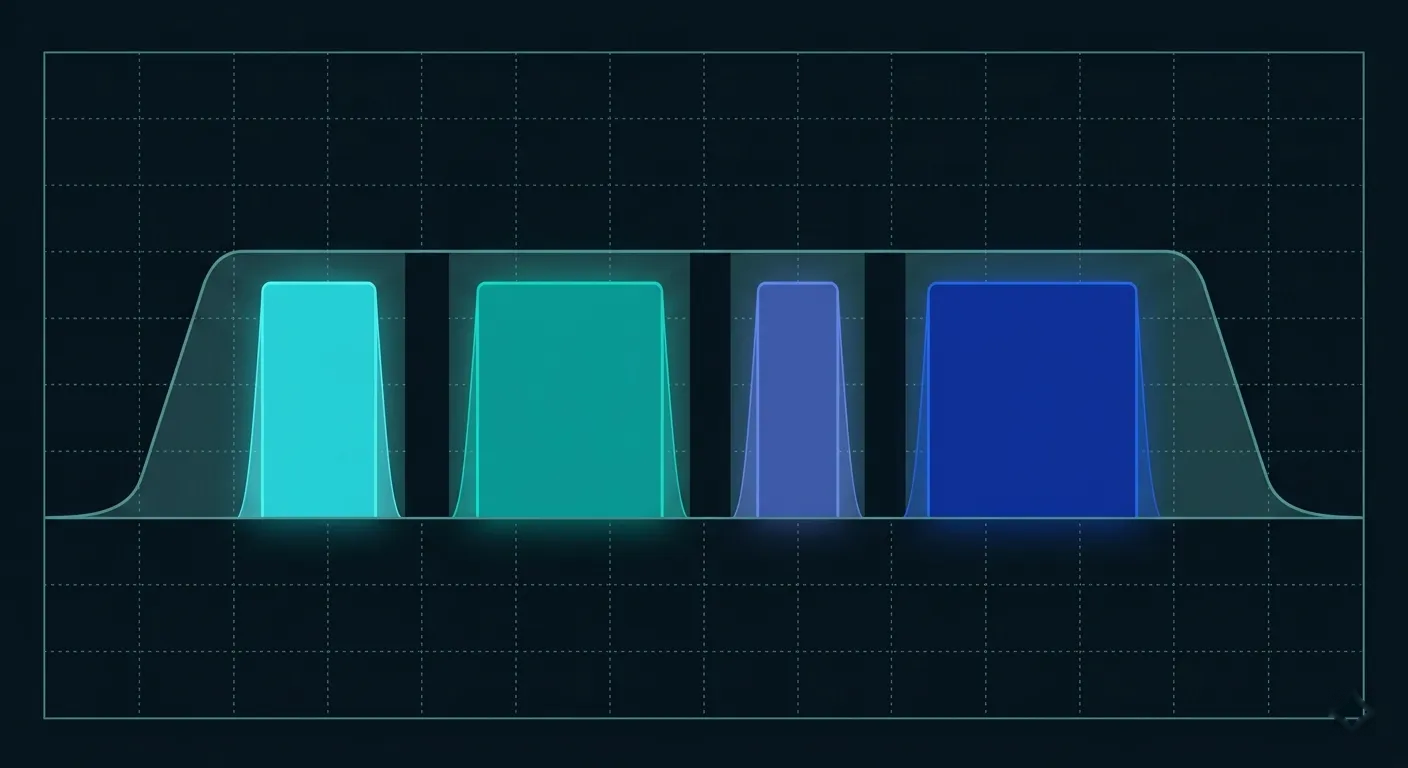
Satellite Transponder Bandwidth and Carrier Planning
Distinguish transponder output bandwidth, carrier span, occupied bandwidth, assigned spectrum, power loading, throughput, and operator acceptance evidence.
What changed: Rebuilt the guide around explicit payload, regulatory, carrier-plan, power, and service reference planes; replaced universal transponder sizes, usable percentages, guard bands, back-off ranges, throughput ratios, and oversubscription examples with reproducible frequency and power ledgers plus operator acceptance evidence.
Satellite transponder bandwidth is a payload parameter, not a ready-made throughput figure. A usable carrier plan must fit an approved frequency window, satisfy the transponder or payload power/loading model, close its link and interference budgets, comply with regulatory and operator masks, and deliver the contracted service rate at a declared interface.
The word bandwidth is especially dangerous here. Transponder output bandwidth, assigned frequency band, necessary bandwidth, occupied bandwidth, raised-cosine support, carrier spacing, leased MHz, receiver noise bandwidth, and user throughput describe different quantities. They cannot be added, divided, or compared until their definitions and reference planes match.
Scope note: Organization fact check updated 27 August 2026 against the primary ITU, ETSI, and operator material listed on this page. All frequency-plan, dB-sum, and DVB examples were independently recalculated. This is not a named payload-engineer approval, satellite-operator loading plan, frequency assignment, emission-compliance result, link budget, lease interpretation, or authorization to transmit. Obtain the current operator transmission plan and complete a controlled line-up before service.
Carrier Bandwidth Definitions | Carrier Spacing | Link Budget
Quick Answer: Keep Two Resource Ledgers
A frequency fit does not prove a power fit, and neither proves throughput.
accepted payload plan
  = regulatory and operator frequency authority
  + carrier spans, centers, gaps, and edge clearances
  + payload gain, total loading, and per-carrier output plan
  + uplink/downlink C/(N+I) and interference closure
  + waveform, framing, and service-throughput calculation
+ controlled line-up and witnessed acceptance| Ledger | Core question | Minimum evidence |
|---|---|---|
| Frequency | Do all emissions fit the approved window and masks? | Exact passband, centers, waveform spans, measured spectra, edge rules, frequency error, and operator plan |
| Power | Can the payload carry this loading without unacceptable distortion or interference? | Reference plane, gain/ALC state, per-carrier input and output, total mean power, back-off definition, PSD, C/I, and operating model |
| Link | Does each path close at the required condition? | Uplink and downlink C/N, interference terms, propagation, implementation losses, thresholds, and margins |
| Service | What rate is actually delivered and guaranteed? | Frame configuration, pilots, encapsulation, traffic policy, measurement interface, interval, SLA, and acceptance result |
Reject any capacity table that supplies only 36 MHz, a peak MODCOD, or saturated beam EIRP. Each omits at least one release gate.
Define the Payload Boundary First
Recommendation ITU-R S.1328-5 separates parameters that informal transponder explanations often combine. Its system-characteristics templates record, among other items:
- transparent or remodulating transponder type;
- uplink and downlink occupied bandwidth per carrier;
- transponder output bandwidth;
- access and modulation type;
- per-carrier uplink and downlink EIRP;
- transparent-transponder transmission gain and automatic level-control range;
- internal and external C/I terms; and
- long- and short-term C/(N+I) requirements.
That Recommendation is intended for FSS sharing studies, not as a lease specification. Its value here is the parameter separation: output bandwidth alone cannot replace the carrier, power, interference, and performance fields.
S.1328-5 describes a transparent transponder as a bent-pipe frequency translation and a remodulating transponder as one that demodulates to baseband. Do not assume every payload is a fixed analogue channel with one input filter, frequency converter, and dedicated HPA. The operator document must state how channels, beams, polarizations, amplifiers, gain control, digital processing, and resource pools map to the capacity being offered.
Use transponder on this page as an operator-identified payload path or channel. For flexible or processed payloads, the relevant commercial and engineering resource may instead be a channel, beam, polarization, gateway/user-link pair, capacity pool, or transponder equivalent.
Eight Bandwidth Terms That Are Not Interchangeable
| Term | Meaning | Evidence/reference plane |
|---|---|---|
| Transponder output bandwidth | The satellite-transponder bandwidth parameter identified in S.1328-5 | Payload/operator data; include beam, polarization, path, configuration, and date |
| Assigned frequency band | The authorized band associated with an assignment under the applicable Radio Regulations and administration | Assignment, licence, filing/coordination context, and national authorization |
| Necessary bandwidth | Width sufficient for the information rate and quality under specified conditions for the emission class | Regulation, emission designation, waveform and service conditions |
| Occupied bandwidth | Frequency interval containing the declared proportion of total mean emission power | ITU definition plus measurement method, reference point, instrument settings, and uncertainty |
Raised-cosine support B_RC | Ideal planning span Rs(1+α) for the declared pulse shaping | Waveform standard and modem configuration |
Available carrier-plan window W | Operator-approved frequency interval in which the plan must fit | Transmission plan; do not derive it from a nominal label |
| Allocated or leased MHz | Commercial quantity and its billing/edge rules | Signed order, lease schedule, service description, and change terms |
| Receiver noise bandwidth | Bandwidth used for noise-power or C/N calculations | Receiver/filter definition and link-budget reference plane |
In the ITU occupied-bandwidth definition, the frequencies below the lower limit and above the upper limit each contain a specified percentage β/2 of total mean power. With the default ITU percentage, 99% of total mean power lies between the limits. This is a measured-emission concept. It is not automatically Rs(1+α), a lease width, or the span from the first carrier edge to the last.
For a multi-carrier emission, internal gaps may lie inside the composite frequency span even though they do not contain carrier power. Calling “sum of carrier bandwidths plus guards” occupied bandwidth therefore obscures the ITU definition. Use required plan span for frequency geometry unless an applicable document defines another term.
Build the Frequency Ledger
For carrier i, use one declared planning-span definition. For a raised-cosine screening calculation:
B_i = Rs_i × (1 + alpha_i)For N carriers inside an approved window W, with left and right clearances E_L and E_R, and internal edge-to-edge gaps G_i:
B_required = E_L + sum(B_i) + sum(G_i) + E_R

B_slack = W - B_required
For adjacent carriers i and i+1:
center spacing = B_i/2 + G_i + B_(i+1)/2These equations prove only geometric fit. The operator-approved clearances and gaps must include the applicable emission masks, frequency tolerance, Doppler where relevant, transponder filtering and translation error, carrier power imbalance, nonlinear spectral regrowth, receiver selectivity, and required adjacent-carrier margin.
Reproducible three-carrier example
Assume only for the arithmetic:
- operator-approved window
W = 34.000 MHz; - Carrier A:
Rs = 10 Msymbol/s,α = 0.20; - Carrier B:
Rs = 8 Msymbol/s,α = 0.20; - Carrier C:
Rs = 6 Msymbol/s,α = 0.10; - approved internal gaps
G_AB = 0.600 MHz,G_BC = 0.500 MHz; - minimum edge clearances
E_L = E_R = 0.700 MHz.
The waveform planning spans are:
B_A = 10(1.20) = 12.000 MHz
B_B =  8(1.20) =  9.600 MHz
B_C =  6(1.10) =  6.600 MHz

B_required = 0.700 + 12.000 + 0.600 + 9.600 + 0.500 + 6.600 + 0.700
           = 30.700 MHz

B_slack = 34.000 - 30.700
        = 3.300 MHz
If the unused 3.300 MHz is split equally between the two edges, each actual edge clearance becomes 2.350 MHz. Relative to the lower edge of the approved window:
| Carrier | Left edge | Center | Right edge | Planning span |
|---|---|---|---|---|
| A | 2.350 MHz | 8.350 MHz | 14.350 MHz | 12.000 MHz |
| B | 14.950 MHz | 19.750 MHz | 24.550 MHz | 9.600 MHz |
| C | 25.050 MHz | 28.350 MHz | 31.650 MHz | 6.600 MHz |
The final right clearance is 34.000 - 31.650 = 2.350 MHz, so the arithmetic closes. No absolute RF frequency is implied. The example does not prove that the gaps, symbol rates, filters, payload, power plan, equipment, or emissions are acceptable on a real satellite.
Build the Power and Loading Ledger Separately
Frequency span and mean carrier power are separate axes. A carrier can fit in MHz and still fail because of payload drive, EIRP/PSD, nonlinearity, C/I, cross-polarization, adjacent-satellite limits, or receive threshold.
At one common reference plane, mean carrier powers add linearly:
P_total,linear = sum(10^(P_i,dB / 10))

P_total,dB = 10 log10(P_total,linear)
If three carrier mean powers are 0 dB, -3 dB, and -6 dB relative to the same reference:
linear sum = 1 + 10^(-3/10) + 10^(-6/10)
           = 1 + 0.501187 + 0.251189
           = 1.752376

total = 10 log10(1.752376)
      = 2.4363 dB relative to the strongest carrier
Likewise, four equal mean-power carriers total 10 log10(4) = 6.0206 dB above one carrier. Do not add dB values directly, and do not mistake this arithmetic for a back-off setting. The actual payload operating point depends on the amplifier/processor, gain state, ALC, waveform peaks, number and levels of carriers, linearization or predistortion, and operator loading rules.
Record at least:
| Power/loading field | Required boundary |
|---|---|
| Uplink drive | Per-carrier earth-station EIRP/PSD, polarization, propagation state, power-control behavior, and satellite receive reference |
| Payload state | Channel/path, gain setting, ALC mode/range, saturation reference, IBO/OBO definitions, amplifier or processor model, and total loading |
| Downlink allocation | Per-carrier EIRP/PSD at the stated beam contour and propagation state; never substitute total saturated beam EIRP |
| Interference | Internal/external C/I, intermodulation, adjacent carrier/satellite, cross-polar, co-channel/reuse, terrestrial, and aggregation assumptions |
| Receiver result | C/N, combined C/(N+I), noise bandwidth, threshold, implementation loss, and margin for each operating state |
The Satellite Link Budget page owns the end-to-end C/N calculation. This page owns the check that every carrier in the payload plan uses a consistent operator-approved power reference.
Back-Off Is Not a Universal Percentage
IBO and OBO are differences from declared input- and output-saturation references. They are not generic deductions that can be copied from another transponder.
A nonlinear payload can create gain compression, AM/AM and AM/PM distortion, spectral regrowth, and multi-carrier intermodulation. The required operating point changes with:
- single- or multi-carrier waveform and peak statistics;
- carrier count, relative levels, spacing, and modulation;
- TWTA, SSPA, linearized amplifier, digital processor, or shared-amplifier architecture;
- predistortion, crest-factor reduction, equalization, and ALC state;
- passband amplitude/group-delay behavior and memory effects; and
- the required C/(N+I), spectral mask, and out-of-band performance.
Therefore a statement such as “multi-carrier OBO is 2–5 dB” is not an engineering input. Use the operator payload model or measured transfer characteristic, simulate the actual loading, and verify it during line-up. A single carrier is not automatically allowed to operate at saturation, and multiple carriers are not automatically assigned equal power.
Spacing and Emission Compliance Are Different Tests
Recommendation ITU-R SM.1541-7 addresses unwanted emissions in the out-of-band domain, including single- and multi-carrier cases and space-service masks. Recommendation ITU-R SM.328-12 supplies the spectrum and bandwidth terminology. Neither turns a generic guard-band percentage into an approved carrier plan.
For every carrier pair, evaluate:
- modulator output mask and measured spectrum;
- center-frequency accuracy, drift, and translation tolerance;
- payload passband, ripple, group delay, and filtering;
- relative carrier PSD and nonlinear regrowth/intermodulation;
- receive filtering and demodulator adjacent-channel behavior;
- adjacent transponder, polarization, beam, and satellite conditions; and
- regulatory, coordination, operator, and lease edge rules.
Lower roll-off narrows the ideal raised-cosine support for the same symbol rate. It does not by itself prove smaller approved gaps, additional billable capacity, or acceptable interference. Detailed geometry remains in Carrier Spacing.
Convert Carrier Configuration to Rate—Not MHz to “Internet Speed”
For a standard that publishes spectral efficiency normalized to symbol rate:
R_standard = Rs × eta_Rs

eta_RC = eta_Rs / (1 + alpha)
ETSI EN 302 307-1 Table 13 lists 1.487473 bit/symbol for DVB-S2 QPSK 3/4 with a normal FECFRAME and no pilots. At Rs = 10 Msymbol/s:
R_standard = 10 × 1.487473
           = 14.87473 Mbit/s
With α = 0.20, the raised-cosine planning span is 12.000 MHz, so the efficiency normalized to that span is:
eta_RC = 14.87473 / 12.000
       = 1.23956 bit/s/Hz of B_RC
This is a standard-layer example, not IP throughput and not total transponder capacity. Frame length, pilots, input mode, BBFRAME data field, padding, encapsulation, packet headers, idle/dummy frames, ACM distribution, packet loss/retransmission, contention, and the measured service interface can change the delivered rate.
Never multiply transponder output bandwidth by a MODCOD label without declaring:
- which carrier symbol rates fit the approved plan;
- the exact standard table, frame, pilots, and roll-off;
- which MODCODs close the link and for what percentage of time;
- power, interference, and payload nonlinear losses;
- service and encapsulation overhead; and
- whether the result is one carrier, one beam, one polarization, or an aggregate reused system figure.
A Transponder Is Not the Whole Satellite Capacity
The same frequency may be reused across beams or orthogonal polarizations under a coordinated payload design. Conversely, channels can share amplifiers, gateways, feeder links, power, processing, or interference limits. A bandwidth figure must therefore carry its scope.
| Scope field | Question to answer |
|---|---|
| Frequency | Is this one RF interval, both polarizations, or a reuse aggregate? |
| Direction | Uplink, downlink, or a paired end-to-end service? |
| Payload | Physical transponder, processed channel, beam resource, shared HPA, or commercial equivalent? |
| Geography | Which beam contour, service area, gateway, and interference environment? |
| Time | Fixed assignment, scheduled booking, beam-hopping slot, ACM state, or statistical average? |
| Rate | Coded rate, DVB information rate, payload/service rate, CIR, peak information rate, or measured IP goodput? |
Do not multiply a channel width by a beam count and call the result usable capacity unless reuse, power, gateway, interference, scheduling, waveform, and traffic constraints are all included.
Operator Evidence Package
Before configuring a modem or transmitting, obtain a dated package for the named satellite and payload path:
- approved transmission plan or booking reference;
- satellite, transponder/channel, beam, polarization, and gateway/path identifiers;
- exact uplink/downlink center frequencies and inversion/translation rules;
- authorized carrier span, symbol rate, roll-off, waveform, FEC/MODCOD, pilots, and emission mask;
- edge clearances, adjacent carriers, frequency tolerance, PSD and EIRP limits;
- payload gain/ALC state, loading, per-carrier output allocation, and back-off definitions;
- link and interference budgets with clear-sky/faded operating states;
- terminal model, approvals, pointing/cross-polar results, and control interlocks;
- service-rate definitions, contention/traffic policy, monitoring point, and SLA; and
- line-up procedure, NOC contacts, stop-transmission authority, rollback, and change record.
Eutelsat's public space-segment access material is one operator example: its line-up information requires a valid transmission plan, the correct satellite/transponder, transmit frequency or carrier ID, polarization, and operating parameters such as EIRP, bit rate, and FEC. Apply the actual procedure of the selected operator; do not treat one operator's document as universal.
Controlled Line-Up and Acceptance
Before radiation
- Confirm regulatory authorization and the operator-approved plan revision.
- Validate frequency conversion, spectrum inversion, symbol rate, roll-off, waveform, and polarization offline.
- Load power limits, mute/fail-safe behavior, remote control, and escalation contacts.
- Verify instrument calibration, reference planes, RBW/VBW/detector settings, and measurement uncertainty.
During line-up
- Follow NOC instructions and begin at the authorized test condition.
- Verify satellite/channel identity, pointing, cross-polar performance, center frequency, and carrier ID.
- Measure carrier spectrum, EIRP/PSD, frequency error, C/N or C/(N+I), and adjacent effects at the declared points.
- Increase drive or enable traffic only as instructed; stop immediately on operator command or abnormal interference.
After activation
- Confirm user-interface throughput separately from DVB and RF rates.
- Exercise ACM/power-control states, traffic loading, alarms, mute, restoration, and rollback where applicable.
- Preserve the final plan, payload state, modem configuration, measurements, screenshots/traces, exceptions, approver, and date.
Common Mistakes
| Shortcut | Why it fails | Correct evidence |
|---|---|---|
| “A 36 MHz transponder has 34 MHz usable.” | No universal edge deduction exists; nominal, operator window, lease, and measured passband may differ | Exact dated payload and transmission-plan limits |
| “Occupied bandwidth is carrier bandwidth plus guards.” | ITU occupied bandwidth is a mean-power interval; plan span is frequency geometry | Declared bandwidth definition and measurement method |
| “36 MHz means 36 Mbps.” | MHz is not bit/s; waveform, link state, overhead, contention, and interface matter | Exact frame-rate calculation and service measurement |
| “All transponders are transparent bent pipes.” | S.1328-5 distinguishes transparent and remodulating payloads; flexible mappings also require operator definition | Payload functional diagram and operator data |
| “One carrier gets all rated watts.” | Total/beam/saturation values are not automatically per-carrier output allocations | Per-carrier power plan at a stated reference plane |
| “Multi-carrier OBO is always 2–5 dB.” | Operating point is payload-, waveform-, loading-, and acceptance-specific | Operator nonlinear model and line-up result |
| “Smaller roll-off eliminates guard bands.” | Ideal support narrows, but masks, error, filtering, power imbalance, and interference remain | Approved spacing plus measured acceptance |
| “HTS beam MHz equals satellite throughput.” | Reuse, power, feeder links, gateways, scheduling, waveform, and traffic all constrain the aggregate | End-to-end payload/network capacity model |
| “Oversubscription is an RF transponder parameter.” | Contention and traffic policy are service/network decisions layered on physical capacity | Contract, scheduler policy, telemetry, and peak-load test |
FAQ
What is satellite transponder bandwidth?
Recommendation ITU-R S.1328-5 uses transponder output bandwidth as a space-station parameter. For design or procurement, add the exact payload path, frequency limits, beam, polarization, direction, configuration, gain/loading state, and date. The number alone does not state an approved carrier window or throughput.
Is a 36 MHz transponder exactly 36 MHz usable?
Do not assume so. 36 MHz may be a nominal channel label, physical parameter, lease unit, or transponder equivalent. Request the exact operator-approved frequency window, edge rules, payload response, power allocation, and commercial definition. There is no defensible universal 5–10% deduction.
How many carriers fit in one transponder?
First calculate the frequency geometry using compatible carrier-span definitions, approved gaps, and edge clearances. Then validate total and per-carrier power, nonlinear distortion, interference, link margin, equipment support, and operator acceptance. A carrier count from MHz alone is incomplete.
How does bandwidth become throughput?
Calculate each carrier from its symbol rate and the exact waveform/frame spectral-efficiency definition. Then apply pilots, framing, encapsulation, padding/idle behavior, ACM distribution, traffic policy, and service-interface measurement. There is no fixed Mbps value for a transponder width.
Why is transponder back-off required?
Back-off can be part of controlling payload nonlinearity, distortion, spectral regrowth, and intermodulation. The required value depends on the actual payload and loading. Use the operator model and measured line-up rather than a generic dB range.
Can one carrier fill the whole transponder?
Only if the approved plan, payload passband, power/loading model, waveform, mask, link/interference budget, equipment, and lease allow it. A single-carrier configuration is not automatically authorized to use every nominal MHz or the saturated output condition.
What is a transponder equivalent?
It is a commercial or planning normalization, often expressed as a bandwidth-equivalent quantity. It need not map one-to-one to a physical filter or amplifier. The contract must define bandwidth, power, beam/polarization, time, pre-emption, and performance rights.
Summary
Transponder bandwidth planning is a four-stage proof:
- define the exact payload and regulatory boundary;
- fit the carriers inside the approved frequency window;
- close the payload power/loading, link, and interference cases; and
- verify waveform-to-service throughput during a controlled operator line-up.
The useful result is not “a 36 MHz transponder carries X Mbps.” It is a dated carrier and power plan whose definitions, calculations, operator approvals, measurements, and service boundary can all be audited.
Related Articles
- Symbol Rate and Roll-Off — Raised-cosine span, regulatory occupied bandwidth, spacing, and throughput definitions
- Satellite Carrier Spacing — Center-frequency geometry and adjacent-carrier acceptance inputs
- Satellite Link Budget Calculation — Per-carrier EIRP, G/T, C/N, interference, and margin
- C/N, C/N0, Eb/N0 and Es/N0 — Ratio definitions and conversions at declared bandwidth reference planes
- Carrier-in-Carrier — Frequency-overlap geometry, power limits, product support, and ROI boundaries
- Satellite Network Topology — End-to-end paths, hop count, control, and failure boundaries
Author

Organizational byline for SATCOM Index technical content. A named technical reviewer appears separately only when identity, scope, and permission are verified.
Categories
More Posts

How Satellite Internet Works: Architecture, Latency, and Real-World Operation
Learn how satellite internet works, including GEO vs LEO satellites, ground stations, latency, and how data travels through space networks.
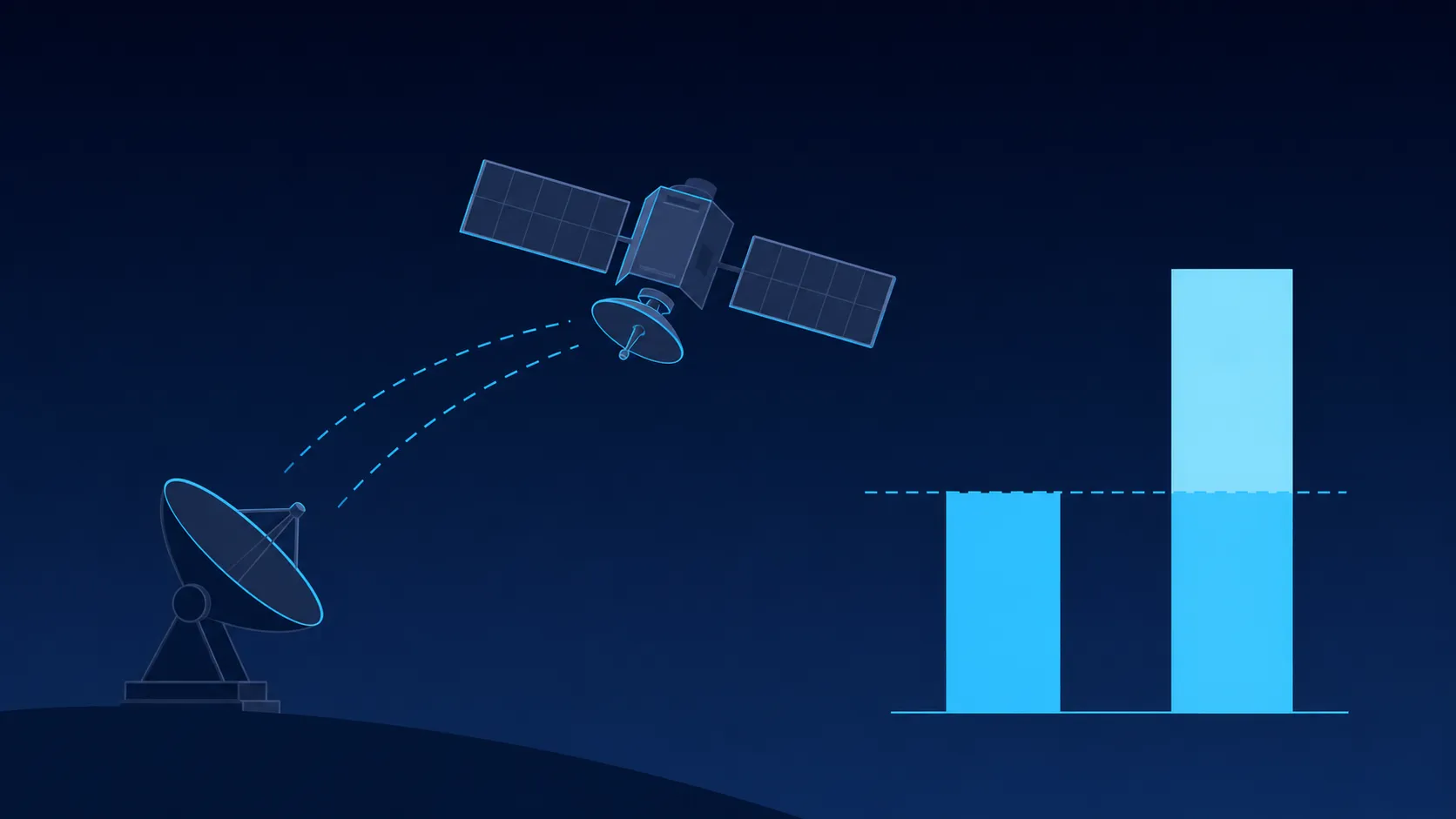
CIR vs MIR Explained: Understanding Guaranteed and Burst Bandwidth in Satellite Services
Learn the difference between CIR and MIR in satellite services, why guaranteed bandwidth matters for enterprise procurement, and how to evaluate satellite service plans.
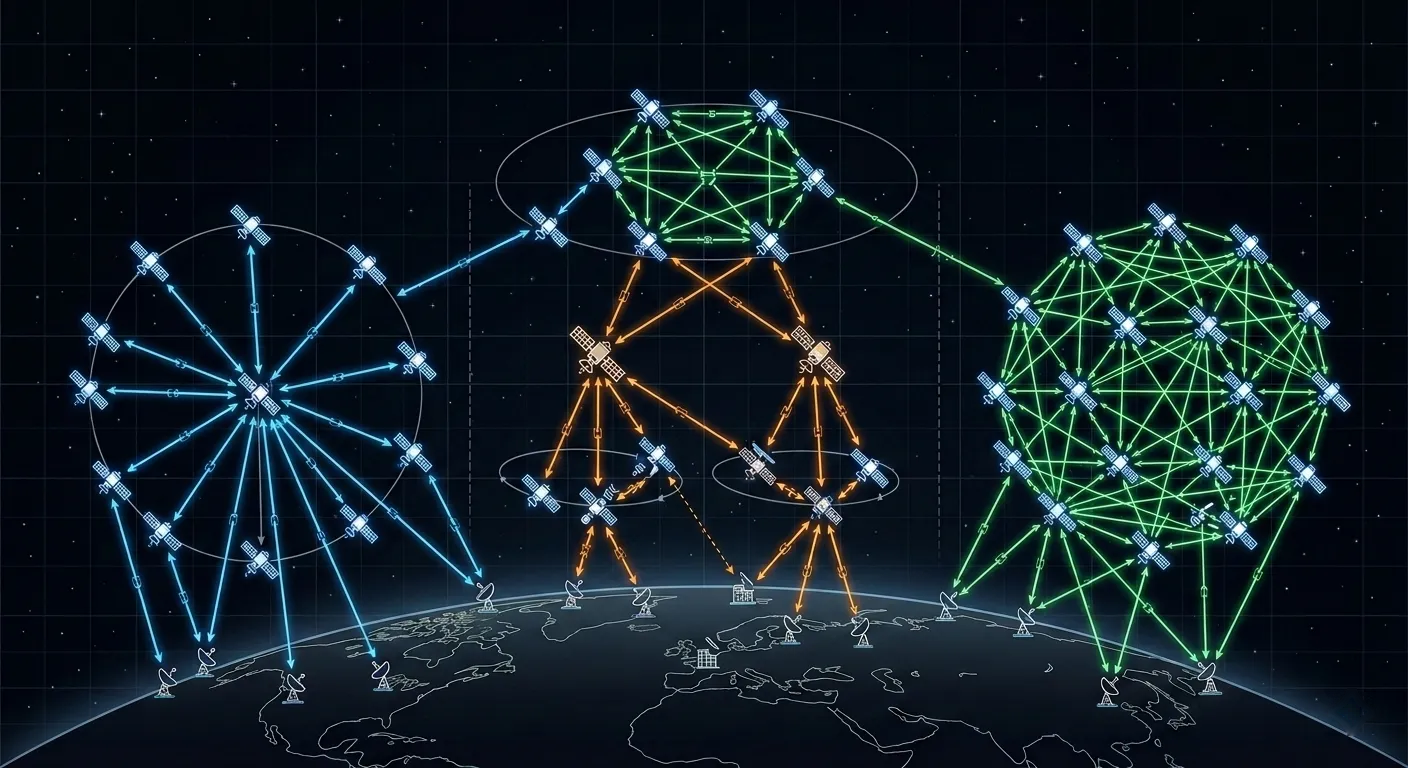
Satellite Network Topology: Star, Mesh, and Hybrid
Compare star, mesh, and hybrid satellite network topologies using GEO hop counts, traffic matrices, fault domains, capacity accounting, and design examples.