Satellite Interference Explained: Causes, Types, and Mitigation in SATCOM Systems
Engineering guide to satellite interference covering adjacent satellite interference, cross-polarization, co-channel, and terrestrial interference types with detection and mitigation techniques.
Introduction
Satellite interference is a fundamental engineering challenge that directly determines the performance ceiling of any SATCOM link. While operational procedures and coordination frameworks address interference from a workflow and regulatory perspective, the engineering foundations—how interference physically degrades a link, how to quantify it, and how to design systems that tolerate it—require a separate, deeper treatment.
Every satellite link operates within a finite carrier-to-noise ratio (C/N) budget. When unwanted RF energy enters that budget, the effective metric shifts from C/N to C/(N+I), where I represents the aggregate interference power. Even modest interference—a few dB of C/I degradation—can push an adaptive coding and modulation system to fall back by two or three MODCODs, cutting throughput by 30–50% without any visible hardware failure. Understanding the physics, quantifying the margins, and designing mitigation into the system from the outset is what separates robust SATCOM engineering from reactive troubleshooting.
This article provides that engineering foundation. It covers the physics and mathematics of each interference type, quantifies the impact on link performance, and details the design-level techniques that minimize interference risk. It assumes familiarity with satellite link budget calculations and basic antenna concepts.
What Is Satellite Interference
Satellite interference is any unwanted RF energy that enters the signal path of a satellite communication link, degrading the received signal quality. In engineering terms, interference adds to the system noise, reducing the carrier-to-interference ratio (C/I) and, consequently, the combined carrier-to-noise-plus-interference ratio C/(N+I).
The relationship between interference and system performance is captured by the concept of equivalent noise temperature increase. Every interference source can be expressed as an equivalent noise temperature contribution ΔT. The fractional degradation to the system is:
ΔT/T = (C/N) / (C/I)where T is the system noise temperature without interference. The ITU coordination framework uses the ΔT/T metric to quantify acceptable interference levels between satellite networks—typically limiting single-entry interference to a 6% increase in equivalent noise temperature (ΔT/T ≤ 0.06, corresponding to C/I exceeding C/N by approximately 12.2 dB).
The aggregate effect of multiple interference sources combines as:
1/(C/(N+I)) = 1/(C/N) + 1/(C/I₁) + 1/(C/I₂) + ... + 1/(C/Iₙ)This reciprocal addition means that even individually small interference contributions can collectively degrade a link significantly—a critical consideration in link budget design.
Types of Satellite Interference
Adjacent Satellite Interference (ASI)
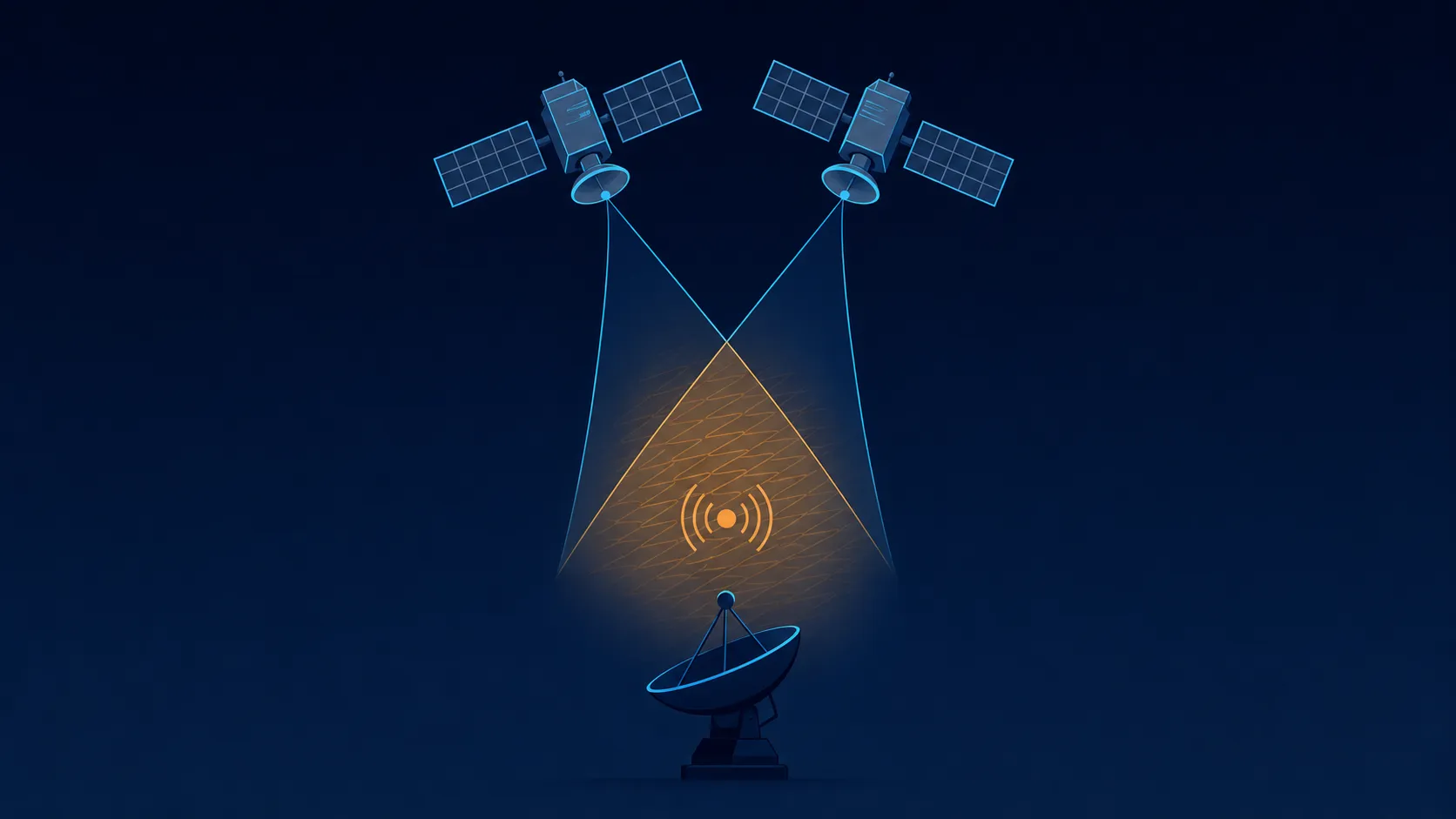
Adjacent satellite interference is the most prevalent interference type on the geostationary arc. It occurs when an earth station's antenna sidelobes direct uplink energy toward—or receive downlink energy from—a satellite in a neighboring orbital slot.
The physics is governed by the relationship between antenna aperture size, beamwidth, and off-axis gain. For a parabolic reflector antenna, the half-power beamwidth (HPBW) is approximately:
θ₃dB ≈ 70λ/D (degrees)where λ is the wavelength and D is the antenna diameter. A 1.2 m antenna at Ku-band (12 GHz, λ = 0.025 m) has a 3 dB beamwidth of approximately 1.46°—meaning that a satellite at 2° spacing is well within the first sidelobe region. Reducing ASI fundamentally requires either larger antennas (narrower beams) or wider orbital spacing.
The ITU reference radiation pattern (Recommendation ITU-R S.580) defines the maximum permissible off-axis EIRP density for earth stations:
G(θ) = 29 – 25 log₁₀(θ) dBi for 1° ≤ θ ≤ 20°This 29–25log(θ) envelope is the cornerstone of ASI control. Earth station antennas must demonstrate sidelobe performance that falls below this envelope during type approval. Non-compliant terminals—those with degraded or undersized antennas—are the primary ASI source. A 0.3° pointing error on a 1.2 m antenna can increase off-axis EIRP toward an adjacent satellite by 3–5 dB, potentially violating the coordination threshold.
The C/I due to ASI for a single adjacent satellite can be estimated as:
C/I_ASI = EIRP_on-axis – EIRP_off-axis(θ) + G_sat_victim(0) – G_sat_victim(Δθ)where Δθ is the orbital spacing. For typical 2° GEO spacing, well-designed terminals maintain ASI C/I above 25 dB. The detailed relationship between antenna size and interference is explored in Satellite Antenna Types Guide.
Cross-Polarization Interference
Geostationary satellites use orthogonal polarizations—vertical/horizontal (linear) or RHCP/LHCP (circular)—to double available spectrum through frequency reuse. Cross-polarization interference occurs when energy leaks between the intended and orthogonal polarization channels.
The key metric is cross-polarization discrimination (XPD), measured in dB. A well-aligned system achieves 25–35 dB of XPD. The polarization mismatch loss for an angular misalignment φ is:
L_pol = 20 log₁₀(cos φ) dB    (co-polar component)
XPD = –20 log₁₀(tan φ) dB     (cross-polar isolation)
A polarization alignment error of just 5° degrades XPD to approximately 21 dB—potentially insufficient for dual-polarization frequency reuse. At 10° error, XPD drops to 15 dB, causing severe co-channel interference on the orthogonal polarization.
Rain depolarization is a significant XPD degradation mechanism, particularly at Ku-band and Ka-band. Raindrops are oblate (flattened), causing differential attenuation and phase shift between horizontal and vertical polarization components. The empirical relationship between rain attenuation and XPD degradation follows:
XPD_rain = U – V × log₁₀(A_rain) dBwhere A_rain is the co-polar rain attenuation in dB, and U, V are frequency-dependent coefficients (e.g., U ≈ 30, V ≈ 20 at 12 GHz). During a rain event causing 6 dB of attenuation at Ku-band, XPD degrades by approximately 15 dB—a critical consideration for rain fade margin calculations covered in Rain Fade in Satellite Communications.
Circular polarization, used on many C-band satellites, is immune to Faraday rotation but experiences differential rain depolarization differently. The choice between linear and circular polarization is partly driven by interference resilience requirements for the target frequency band and coverage area.
Co-Channel Interference in HTS Systems
Co-channel interference (CCI) in high-throughput satellite (HTS) systems is not accidental—it is a designed-in consequence of aggressive frequency reuse. HTS platforms divide their coverage into spot beams and reuse the same frequency/polarization combination across non-adjacent beams to maximize total system capacity.
The standard approach is a four-color frequency reuse scheme: four combinations of two frequency sub-bands and two polarizations. Beams assigned the same color are separated by at least one beam diameter, relying on antenna sidelobe suppression for isolation. The resulting co-channel C/I at beam center is typically 20–25 dB, but degrades to 12–18 dB at beam edges where the gain of the wanted beam decreases while the interfering beam's sidelobe gain remains relatively constant.
The aggregate co-channel C/I from N interfering beams is:
C/I_aggregate = –10 log₁₀(Σ 10^(–C/Iₖ/10)) for k = 1 to NFor a typical seven-beam cluster (six surrounding beams of the same color), the aggregate C/I may be 3–5 dB worse than the single-entry C/I from the nearest co-channel beam. This directly impacts beam-edge users, who experience lower throughput and require more robust MODCODs. System designers account for this by including an interference margin in the link budget for beam-edge terminals, typically 2–4 dB.
Terrestrial Interference
Terrestrial interference has become an increasingly critical concern as ground-based wireless networks expand into spectrum adjacent to—or overlapping with—satellite bands.
5G and C-band coexistence. The allocation of the 3.3–4.2 GHz range for 5G terrestrial services directly overlaps with the satellite C-band downlink (3.4–4.2 GHz). In markets where 5G has been deployed in this range, satellite earth stations receive interference from base stations and user equipment. The interference level depends on geographic separation, antenna discrimination, and filtering. The FCC's C-band transition in the US mandated the installation of band-pass filters on all registered earth stations and provided for exclusion zones around major teleports. Satellite operators in affected frequency bands must account for terrestrial interference floors in their link budgets.
Radar interference near Ka-band. Military and meteorological radars operating in the 26.5–40 GHz range can generate pulsed interference into Ka-band satellite receivers. The intermittent, high-peak-power nature of radar signals creates burst errors that are poorly handled by typical satellite forward error correction.
Terrestrial microwave links. Point-to-point microwave links sharing frequencies with satellite bands (particularly extended C-band and Ku-band) can create localized interference at earth stations within their coverage area. Site surveys during ground segment planning should include spectrum scans to identify existing terrestrial transmitters.
Filtering is the primary defense against terrestrial interference. High-quality bandpass filters at the earth station LNB input can reject out-of-band terrestrial signals with 40–60 dB of suppression, though in-band terrestrial signals (as in the 5G/C-band case) require geographic separation or physical shielding.
Sources of Interference
Understanding the practical sources—not just the physical types—helps engineers design prevention into systems.
Misaligned antennas are the single largest interference source, responsible for approximately 40% of all reported interference events according to the Satellite Interference Reduction Group (sIRG). A pointing error of just 0.5° can increase off-axis EIRP by 3–5 dB toward an adjacent satellite. Maritime and aeronautical platforms with stabilized antennas are especially vulnerable: platform motion, gyro drift, and tracking algorithm failures cause intermittent mispointing that may not trigger alarms. Proper terminal commissioning is the primary defense.
Uplink power errors directly affect interference levels. An HPA driven 2 dB above its intended operating point increases both on-axis and off-axis EIRP by 2 dB. In multi-carrier configurations, overdrive pushes the amplifier into compression, generating intermodulation products that affect all carriers on the transponder. Automatic uplink power control (AUPC) systems are designed to maintain constant EIRP under varying atmospheric conditions, but miscalibrated AUPC can overdrive during clear sky conditions.
Spectrum reuse conflicts arise when frequency plans overlap due to coordination failures, database errors, or unauthorized transmissions. In VSAT networks operating on shared transponders, each operator must carefully control their carriers' spectral boundaries to avoid adjacent channel interference.
Equipment faults create interference signatures that mimic other types. A block upconverter (BUC) with a drifting local oscillator shifts the uplink carrier frequency, causing adjacent channel interference. Degraded phase noise in oscillators raises the noise floor. Corroded connectors and water-ingressed waveguide assemblies generate passive intermodulation (PIM) products—spurious emissions at algebraic combinations of carrier frequencies.
For detailed case studies of interference events, see SATCOM Interference: Causes, Detection, and Frequency Coordination.
Impact on Satellite Networks
The engineering impact of interference is quantified through the transition from C/N to C/(N+I):
C/(N+I) = 1 / (1/(C/N) + 1/(C/I))| C/N (dB) | C/I (dB) | C/(N+I) (dB) | Degradation (dB) |
|---|---|---|---|
| 12.0 | 25.0 | 11.8 | 0.2 |
| 12.0 | 20.0 | 11.6 | 0.4 |
| 12.0 | 15.0 | 10.8 | 1.2 |
| 12.0 | 12.0 | 9.0 | 3.0 |
| 12.0 | 10.0 | 7.8 | 4.2 |
The table illustrates a critical non-linearity: interference with C/I well above C/N causes negligible impact, but as C/I approaches C/N, degradation accelerates rapidly. At C/I = C/N, the link loses 3.0 dB—typically pushing the system below threshold.
BER degradation. For a QPSK-modulated carrier at a target BER of 10⁻⁶, the required Eb/N₀ is approximately 10.5 dB. A 2 dB degradation in C/(N+I) pushes the BER to approximately 10⁻³—a three-order-of-magnitude increase that overwhelms forward error correction and renders the link unusable for real-time applications.
ACM fallback behavior. Modern DVB-S2X systems use adaptive coding and modulation to optimize throughput for the available C/(N+I). When interference reduces C/(N+I), the hub instructs the remote to fall back to a lower MODCOD. Each MODCOD step typically represents 0.5–1.0 dB of threshold difference and 15–25% throughput change. A 3 dB interference event can cause a fallback from 16APSK 3/4 to QPSK 3/4—approximately 50% throughput reduction.
Link availability impact. Satellite links are designed with rain fade margins to achieve target availability (typically 99.5–99.9%). Interference consumes part of this margin, effectively reducing link availability. A persistent 2 dB interference reduces the rain fade margin by 2 dB, which at Ku-band may decrease availability from 99.7% to 99.3%—a significant impact for enterprise SLA commitments. The interaction between interference and availability is a core topic in Satellite Link Availability.
Detection and Monitoring
Detecting interference requires distinguishing unwanted signals from the composite transponder spectrum, often under challenging signal-to-noise conditions.
Spectrum monitoring systems. Satellite operators deploy carrier monitoring systems at teleport facilities that continuously sample each transponder's spectrum. These systems capture full-bandwidth snapshots at intervals ranging from seconds to minutes, building a historical baseline of the "clean" spectrum. Automated algorithms flag deviations: new carriers, power level shifts, noise floor elevation, and spectral regrowth. Modern systems use machine learning to distinguish interference events from normal traffic variations.
Carrier-to-interference measurement. Quantifying C/I in the field requires isolating the interference contribution from the noise. The standard approach uses the carrier-off/carrier-on method: measure the total received power with the wanted carrier active (C+N+I), then with the carrier muted (N+I), then with both the carrier and suspected interferer inactive (N only). The C/I is derived from:
C/I = (C+N+I) – (N+I) / ((N+I) – N) [in linear power ratios]In practice, the "interferer off" state is often unavailable, requiring estimation techniques based on spectral analysis of the interference signature.
Automated anomaly detection. Network management systems correlate spectrum data with performance metrics—Eb/N₀ readings, MODCOD distributions, packet error rates—to automatically detect interference before it triggers service alarms. A sudden shift in MODCOD distribution across multiple terminals in a beam, without corresponding weather events, strongly suggests interference.
For details on Carrier Identification (CID), geolocation techniques, and the operational workflow for interference resolution, see SATCOM Interference: Causes, Detection, and Frequency Coordination.
Interference Mitigation Techniques
Uplink Power Control
Automatic uplink power control (AUPC) adjusts the earth station's transmit power to compensate for atmospheric attenuation, maintaining constant EIRP at the satellite. Without AUPC, operators must either accept variable satellite EIRP (degrading performance during clear sky by operating below optimal power) or set fixed power for worst-case conditions (causing interference during clear sky by overdriving).
AUPC operates in a closed loop: the hub monitors the uplink power level at the satellite (via a transponder beacon or loopback measurement) and commands the remote terminal's BUC to adjust output power. The control range is typically 5–10 dB, matching the expected range of atmospheric variation for the frequency band and climate zone.
Uplink power control (UPC) is the open-loop variant used when closed-loop feedback is unavailable. The terminal estimates atmospheric loss from a downlink beacon measurement and adjusts transmit power proportionally, applying a scaling factor based on the uplink/downlink frequency ratio. UPC is less precise than AUPC—typically ±1 dB accuracy versus ±0.5 dB for AUPC—but requires no hub-side infrastructure.
Both techniques are critical for ASI control: maintaining EIRP at the minimum level needed for the target MODCOD prevents unnecessary off-axis emissions.
Antenna Pointing and Off-Axis Compliance
Maintaining antenna pointing within specification is the single most effective interference mitigation measure. For fixed VSAT terminals, the pointing accuracy requirement is typically ±0.1° to ±0.2°, achieved through careful installation and periodic verification.
For maritime and aeronautical terminals, continuous tracking is required. The antenna control unit (ACU) must maintain pointing accuracy within 0.3–0.5° during platform motion, using rate sensors (gyroscopes) for short-term stabilization and satellite beacon tracking for long-term reference. When the tracking system detects that pointing error exceeds the threshold, a transmit inhibit circuit automatically mutes the uplink to prevent ASI—a mandatory feature for maritime terminals operating under EIRP coordination agreements.
Off-axis EIRP compliance verification is performed during terminal commissioning by measuring the antenna's radiation pattern across the coordination arc. The measured pattern must fall below the 29–25log(θ) envelope at all off-axis angles from 1° to 20°.
Polarization Alignment
Achieving and maintaining adequate cross-polarization discrimination requires precise alignment of the feed horn's polarization orientation relative to the satellite. The standard alignment procedure involves:
- Pointing the antenna at the satellite and peaking on the co-polar beacon.
- Rotating the feed to null the cross-polar component, maximizing XPD.
- Verifying XPD exceeds the required minimum (typically ≥25 dB for dual-pol systems).
For linearly polarized systems, the required rotation depends on the earth station's geographic location relative to the satellite sub-point—the polarization offset angle varies across the coverage area.
Frequency Coordination
Frequency coordination—the systematic process of ensuring co-existence between satellite networks—is the preventive foundation of interference management. It encompasses ITU filing coordination (Articles 9 and 11 of the Radio Regulations), bilateral operator agreements, and terminal type-approval specifications.
For the complete treatment of coordination processes, regulatory framework, and operational coordination workflows, see SATCOM Interference: Causes, Detection, and Frequency Coordination.
Operational Procedures
When interference occurs, a structured response workflow minimizes impact and resolution time.
Golden Rule
Never increase your own transmit power to overcome interference. This worsens interference for all other users on the transponder and may violate coordination agreements.
Operator response workflow:
- Detect — Spectrum monitoring or performance alarms identify the interference event.
- Characterize — Capture spectrum screenshots, record C/(N+I) degradation, log affected carriers and MODCODs.
- Report — Notify the satellite operator's NOC with spectrum captures, Carrier ID, and impact assessment.
- Diagnose — The operator's interference team uses CID, spectral analysis, and geolocation to identify the source.
- Resolve — Contact the responsible party for corrective action; implement temporary workarounds (frequency shift, power reduction, carrier protection).
Maritime and aeronautical considerations. Mobile platforms present unique challenges: the antenna is continuously tracking, the RF environment changes with geographic position, and the responsible terminal may be on a vessel in international waters. Transmit inhibit systems are mandatory—they automatically mute the uplink when pointing accuracy degrades beyond the threshold, preventing ASI during heavy seas or tracking transients. The detailed mitigation playbook is covered in the companion operational article.
Engineering Best Practices
Designing interference resilience into a SATCOM system from the outset is far more effective than reactive troubleshooting.
Terminal Commissioning Checklist
Before activating any VSAT or gateway uplink, verify: (1) antenna pointing within ±0.1° of nominal, (2) cross-polarization isolation ≥25 dB, (3) uplink EIRP within licensed limits, (4) off-axis EIRP below the 29–25log(θ) envelope, (5) Carrier ID enabled and registered, (6) AUPC calibrated and operational, (7) transmit inhibit tested (maritime/aero only).
Antenna specification guidelines. Select antennas that exceed the ITU sidelobe envelope by at least 3 dB margin. For 2° orbital spacing at Ku-band, a minimum 1.2 m aperture is recommended; for Ka-band, 0.75 m provides equivalent beamwidth. Maritime terminals should specify tracking accuracy ≤0.2° RMS to maintain adequate off-axis margin during platform motion.
HPA back-off design. Multi-carrier HPA configurations require sufficient output back-off (OBO) to suppress third-order intermodulation products below the transponder noise floor. A rule of thumb: the required OBO in dB is approximately 10 log₁₀(N) + 2 for N equal-power carriers, though precise values depend on the HPA's AM/AM and AM/PM characteristics. Single-carrier operation typically requires 1–2 dB OBO for QPSK and 3–4 dB for higher-order modulations.
Interference budget in link design. Robust link budgets include an explicit interference margin, typically allocated as:
| Interference Source | Typical C/I Allowance (dB) |
|---|---|
| ASI (uplink) | 25–28 |
| ASI (downlink) | 25–28 |
| CCI (HTS beam edge) | 15–20 |
| Cross-polarization | 25–30 |
| Terrestrial | 30+ (with filtering) |
| IMD (transponder) | 22–25 |
| Aggregate C/I | 15–18 |
The aggregate C/I is calculated using reciprocal addition and should exceed the required C/N by at least 10 dB for a well-engineered system.
Monitoring integration. Integrate spectrum monitoring and C/(N+I) tracking into the network management platform. Establish baselines during commissioning and configure alarms for deviations exceeding 1–2 dB. Correlate interference events with external data sources—weather, vessel tracking, 5G deployment schedules—to accelerate root cause identification.
Frequently Asked Questions
What causes satellite interference? Satellite interference is caused by unwanted RF energy entering the satellite communication link. The most common causes are misaligned earth station antennas directing energy toward adjacent satellites, cross-polarization leakage due to feed misalignment or rain depolarization, frequency reuse in HTS spot beam systems, terrestrial transmitters operating in shared or adjacent spectrum, and equipment faults generating intermodulation or spurious emissions.
How is interference detected in satellite networks? Operators detect interference through continuous spectrum monitoring at teleport facilities, where automated systems compare live transponder spectra against baseline references. Performance metrics—Eb/N₀ readings, MODCOD distributions, and error rates—are correlated with spectrum data to identify interference events. Carrier Identification (CID) signals embedded in uplink carriers enable rapid identification of interference sources.
What is cross-polarization interference? Cross-polarization interference occurs when energy leaks between the two orthogonal polarization channels (V/H or RHCP/LHCP) used for frequency reuse on a satellite. It is measured by cross-polarization discrimination (XPD) in dB. Causes include feed horn misalignment, rain depolarization (oblate raindrops rotate the polarization plane), and antenna reflector imperfections. Well-aligned systems maintain XPD above 25 dB.
How does adjacent satellite interference occur? Adjacent satellite interference (ASI) occurs when an earth station's antenna sidelobes direct uplink energy toward a neighboring satellite or receive downlink energy from it. The primary cause is undersized or mispointed antennas—a smaller dish has a wider beam, capturing more energy from adjacent orbital slots. ASI is controlled by the ITU 29–25log(θ) off-axis EIRP envelope and adequate antenna sizing for the orbital spacing.
What is terrestrial interference in satellite systems? Terrestrial interference occurs when ground-based transmitters—5G base stations, radar systems, or microwave links—emit energy into satellite receive bands. The most significant current example is 5G deployment in the 3.3–4.2 GHz range, which overlaps with the satellite C-band downlink. Mitigation relies on bandpass filtering at earth stations, geographic separation, and physical shielding.
How does interference affect satellite link budgets? Interference is accounted for in link budgets by replacing C/N with C/(N+I). Each interference source contributes a C/I component; these combine reciprocally with thermal C/N to yield the effective C/(N+I). A typical well-engineered link includes 15–18 dB of aggregate C/I margin. When actual interference exceeds the budgeted allowance, the system experiences BER degradation, ACM fallback to lower MODCODs, and reduced throughput.
What is the 29–25log(θ) antenna sidelobe envelope? The 29–25log(θ) formula (ITU-R S.580) defines the maximum permissible off-axis gain of an earth station antenna as a function of the off-axis angle θ in degrees. At 2° off-axis (typical GEO orbital spacing), the limit is approximately 21.5 dBi. This envelope ensures that earth station antennas do not direct excessive energy toward adjacent satellites, and it is the primary regulatory tool for controlling adjacent satellite interference.
How do operators prevent interference during terminal installation? Terminal installation includes a commissioning procedure: peak the antenna on the satellite beacon to optimize pointing (±0.1°), rotate the feed to maximize cross-polarization isolation (≥25 dB), verify uplink EIRP against licensed limits using the satellite operator's beacon or test carrier, confirm off-axis EIRP compliance against the 29–25log(θ) envelope, enable and register Carrier ID, and calibrate AUPC. Maritime terminals additionally test transmit inhibit functionality.
Key Takeaways
- Interference degrades C/(N+I), not just noise — The reciprocal addition of C/I components with C/N means that aggregate interference effects can be much larger than individual contributions suggest.
- Adjacent satellite interference dominates — Misaligned or undersized antennas cause approximately 40% of all interference events; proper antenna sizing and pointing are the most effective prevention measures.
- Cross-polarization isolation degrades with rain — At Ku-band and Ka-band, rain depolarization can reduce XPD by 10–15 dB during fade events, compounding the throughput impact of rain attenuation itself.
- HTS beam-edge users face inherent co-channel interference — The four-color reuse scheme produces 12–18 dB C/I at beam edges; link budgets must include this as a design parameter, not a fault condition.
- Terrestrial interference is a growing challenge — 5G C-band deployments, radar, and terrestrial microwave links increasingly impinge on satellite receive bands, requiring filtering and coordination investment.
- Design interference margins from the start — Allocating explicit C/I budgets for each interference source during link design prevents costly mitigation retrofits and ensures predictable link availability.
Related Articles
- SATCOM Interference: Causes, Detection, and Frequency Coordination — Operational companion: CID, geolocation, and coordination framework
- Satellite Frequency Bands Explained — Band-specific interference characteristics and spectrum sharing
- Satellite Polarization: Linear vs Circular — Polarization fundamentals and XPD performance
- Satellite Link Budget Calculation — C/N and C/I in link design
- Rain Fade in Satellite Communications — Precipitation effects including depolarization
- HTS Spot Beams and Beamforming — Co-channel interference in multi-beam architectures
- Satellite Antenna Types Guide — Antenna sidelobe performance and off-axis compliance
Author

Organizational byline for SATCOM Index technical content. A named technical reviewer appears separately only when identity, scope, and permission are verified.
Categories
More Posts
4 Types of Satellite Antennas: Parabolic to Phased Array
Compare parabolic dishes (41 dBi at 1.2 m), phased arrays, flat panels, and stabilized maritime antennas — with gain, size, and VSAT selection guidance.
CIR vs MIR Explained: Understanding Guaranteed and Burst Bandwidth in Satellite Services
Learn the difference between CIR and MIR in satellite services, why guaranteed bandwidth matters for enterprise procurement, and how to evaluate satellite service plans.
Adaptive Coding and Modulation (ACM) Explained: How Satellite Networks Maintain Link Quality
Engineering guide to adaptive coding and modulation in satellite systems covering signal quality measurement, MODCOD selection algorithms, DVB-S2/S2X ACM capabilities, rain fade response, and ACM design for HTS and LEO networks.