

Satellite Doppler Shift Explained: Why Frequency Changes in LEO Satellite Communication
Engineering guide to satellite Doppler shift covering frequency drift in LEO and GEO systems, impact on carrier tracking and demodulation, compensation techniques, and design considerations for modern constellations.
Every satellite link is a radio connection between two objects in relative motion. When a satellite moves toward a ground terminal, the received frequency is higher than what was transmitted; when the satellite moves away, the received frequency is lower. This phenomenon—Doppler shift—is one of the most fundamental RF challenges in satellite communication, and it becomes a dominant engineering constraint in low-Earth-orbit (LEO) systems where satellites travel at 7.5 km/s relative to the ground.
In geostationary (GEO) systems, Doppler shift is small enough to be absorbed by normal receiver tracking loops. In LEO constellations like Starlink, OneWeb, and Kuiper, Doppler shift can exceed ±50 kHz at Ka-band, changing at rates that stress even modern carrier recovery circuits. An engineer designing a LEO terminal or selecting a modem must understand how much frequency offset to expect, how fast it changes, and what compensation strategies the system must employ.
This article provides an engineering-level treatment of Doppler shift in satellite communications: the physics behind it, how it differs between GEO and LEO, its impact on demodulation and carrier tracking, the compensation techniques used in practice, and the additional challenges posed by high-mobility platforms like aircraft and ships.
Key terms used in this article: Doppler shift (change in received frequency due to relative motion between transmitter and receiver), carrier frequency offset (CFO — the difference between expected and actual received carrier frequency), frequency drift rate (how fast the Doppler-induced offset changes over time, in Hz/s), automatic frequency control (AFC — receiver subsystem that tracks and corrects frequency offsets), phase-locked loop (PLL — feedback circuit that locks onto and tracks a carrier frequency), ephemeris (predicted orbital position and velocity data used to pre-compute Doppler profiles).
What Is Doppler Shift
Doppler shift is the change in observed frequency of a wave when the source and observer are in relative motion. The effect applies to all waves—sound, light, and radio. In satellite communications, it applies to the RF carrier that transports data between the satellite and the ground terminal.
The fundamental relationship is:
f_received = f_transmitted × (1 + v_r / c)
where v_r is the radial velocity between the satellite and the terminal (positive when approaching, negative when receding) and c is the speed of light (approximately 3 × 10⁸ m/s). The radial velocity is the component of the satellite's velocity vector along the line-of-sight to the terminal—not the satellite's total orbital velocity.
For a practical example: a LEO satellite at 550 km altitude passes nearly overhead at approximately 7.5 km/s orbital velocity. When the satellite is on the horizon and approaching, the radial velocity component is at its maximum—roughly ±7.5 km/s for low elevation angles. At Ka-band (20 GHz downlink), this produces a Doppler shift of:
Δf = 20 × 10⁹ × (7,500 / 3 × 10⁸) = ±500 kHz
As the satellite rises, passes overhead, and sets, the radial velocity traces an S-curve—positive (approaching) before the closest approach, zero at the point of closest approach (where the satellite's motion is purely transverse), and negative (receding) afterward. The total frequency swing from maximum positive to maximum negative Doppler can be twice the peak value, or about 1 MHz at Ka-band for a LEO system.
The Doppler shift is directly proportional to frequency. At Ku-band (12 GHz), the same orbital geometry produces roughly 60% of the Ka-band Doppler shift. At L-band (1.5 GHz), the shift is only about 7.5% as large. This is why Doppler shift is a much more severe problem for the high-frequency bands used by modern broadband LEO constellations than for traditional L-band mobile satellite services.
Why Doppler Shift Happens in Satellites
Doppler shift in satellite communications arises from the relative motion between the satellite and the ground terminal. Unlike terrestrial wireless systems—where both the base station and the user device may be stationary or moving at modest speeds—satellite systems involve at least one endpoint moving at orbital velocity.
Geostationary orbit. A GEO satellite orbits at 35,786 km altitude with a period of exactly one sidereal day, so it appears stationary relative to the ground. In theory, there is no relative motion and therefore no Doppler shift. In practice, GEO satellites are not perfectly stationary—they drift within a "station-keeping box" of approximately ±0.05° in both latitude and longitude, and their orbits have small eccentricity and inclination residuals. These imperfections produce slow, predictable Doppler variations on the order of ±1 Hz per MHz of carrier frequency—negligible for most communication systems.
Low-Earth orbit. A LEO satellite at 550 km altitude orbits at approximately 7.5 km/s. Its position changes continuously relative to any ground terminal. The radial velocity component between the satellite and terminal depends on the satellite's elevation angle: it is maximum when the satellite is near the horizon (approaching or receding) and zero when the satellite is at its highest elevation during the pass. This creates a continuously changing Doppler profile throughout each satellite pass.
Medium-Earth orbit. MEO satellites (at altitudes of 2,000–20,000 km) experience intermediate Doppler effects. The orbital velocity is lower than LEO (approximately 3–5 km/s depending on altitude), and the satellite is visible for longer periods (2–6 hours), resulting in moderate Doppler shifts that change more slowly than in LEO systems.
Terminal motion. When the ground terminal itself is moving—on a ship, aircraft, or vehicle—its velocity adds to (or subtracts from) the satellite-induced Doppler. An aircraft at 900 km/h (250 m/s) contributes an additional ±1.7 kHz at Ka-band. While small compared to LEO satellite motion, this additional Doppler must be accounted for in the receiver's frequency tracking loop, and it complicates ephemeris-based Doppler prediction because the terminal's future trajectory is less deterministic than the satellite's orbit.
Doppler Shift in GEO vs LEO Systems
The practical impact of Doppler shift differs by orders of magnitude between GEO and LEO satellite systems. This comparison is fundamental to understanding why LEO terminal design requires a completely different approach to frequency management.
| Parameter | GEO (36,000 km) | LEO (550 km) | LEO (1,200 km) |
|---|---|---|---|
| Orbital velocity | 3.07 km/s | 7.59 km/s | 7.26 km/s |
| Max radial velocity | ~1 m/s (station-keeping) | ~7.5 km/s | ~7.1 km/s |
| Doppler at Ku-band (12 GHz) | ±40 Hz | ±300 kHz | ±284 kHz |
| Doppler at Ka-band (20 GHz) | ±67 Hz | ±500 kHz | ±473 kHz |
| Doppler rate (Ka-band) | < 0.1 Hz/s | Up to 40 kHz/s | Up to 25 kHz/s |
| Satellite pass duration | Continuous | 5–10 min | 8–15 min |
| Doppler profile | Nearly constant | S-curve, rapid swing | S-curve, moderate swing |
| Compensation requirement | Standard receiver AFC | Dedicated Doppler correction | Dedicated Doppler correction |
GEO impact: negligible. The ±40–67 Hz Doppler at GEO is well within the pull-in range of any standard DVB-S2X receiver's carrier recovery loop. No special Doppler compensation is needed. The receiver's normal automatic frequency control handles it transparently. This is why Doppler shift is rarely discussed in GEO satellite engineering—it simply isn't a problem.
LEO impact: dominant design constraint. At ±300–500 kHz of offset and up to 40 kHz/s drift rate at Ka-band, Doppler shift in LEO systems is a first-order design challenge. A receiver that cannot track this offset will fail to demodulate the signal. The frequency plan must account for Doppler-induced spectral spreading. The modem's carrier recovery loop must have sufficient acquisition range and tracking bandwidth. And the system must decide whether to pre-correct Doppler at the transmitter, track it at the receiver, or use a combination of both.
Impact on Communication Systems
Doppler shift affects nearly every layer of the satellite communication physical layer, from carrier acquisition to symbol timing to burst demodulation. Understanding these impacts is essential for selecting appropriate hardware and designing robust link budgets.
Carrier Tracking and Recovery
The most direct impact of Doppler shift is on the receiver's ability to lock onto and track the incoming carrier frequency. A DVB-S2X receiver uses a carrier recovery loop—typically a combination of automatic frequency control (AFC) and a phase-locked loop (PLL)—to estimate and remove the carrier frequency offset before demodulation.
When the Doppler offset exceeds the receiver's acquisition range, the receiver cannot initially lock onto the signal. When the Doppler rate exceeds the tracking loop's bandwidth, the receiver loses lock during the pass. Both failure modes result in complete loss of communication. For LEO systems at Ka-band, the receiver must have an acquisition range of at least ±500 kHz and a tracking loop that can follow frequency changes of up to 40 kHz/s—specifications that significantly exceed typical GEO receiver requirements.
Symbol Timing
Doppler shift also affects the received symbol rate. A Doppler shift of Δf/f compresses or expands the received symbol timing by the same ratio. At Ka-band with a LEO satellite, the relative frequency shift Δf/f is approximately ±25 parts per million (ppm). For a 100 Msym/s signal, this corresponds to a ±2,500 symbol/s timing offset. Symbol timing recovery loops must accommodate this offset in addition to the normal clock recovery function.
Burst Demodulation
In time-division multiple access (TDMA) systems—the upstream access method for most satellite broadband—terminals transmit in short bursts. Each burst includes a preamble that the hub receiver uses for carrier and timing acquisition. In a LEO system, the Doppler offset varies not only between passes but between consecutive bursts within the same pass (because the satellite has moved between bursts). The hub receiver must acquire each burst's carrier frequency independently or use inter-burst prediction, and the preamble must be long enough to accommodate the Doppler uncertainty—potentially reducing spectral efficiency.
Wideband Signal Effects
For wideband carriers—common in modern HTS systems using 250–500 MHz transponder bandwidths—Doppler shift is not uniform across the signal bandwidth. The Doppler offset at the upper edge of a 500 MHz carrier at Ka-band differs from the offset at the lower edge by approximately 0.6 kHz (at maximum LEO Doppler). While this differential Doppler is small compared to the carrier-level offset, it introduces a slight compression or expansion of the received spectrum. For narrowband signals this effect is negligible, but for very wideband signals or systems with tight spectral masks, it must be calibrated.
DVB-S2X Implications
The DVB-S2X standard—the dominant satellite broadband waveform—was designed with GEO systems in mind. Its carrier recovery and timing synchronization algorithms assume relatively small and slowly changing frequency offsets. LEO implementations of DVB-S2X require extended acquisition preambles, wider frequency search ranges, and faster tracking loops than the baseline standard specifies. Several modem manufacturers have introduced "LEO-optimized" DVB-S2X implementations that address these requirements, though they remain proprietary extensions. For more on modulation and coding, see our dedicated guide.
Doppler Compensation Techniques
Satellite systems use several strategies to manage Doppler shift, ranging from simple receiver-side tracking to sophisticated transmitter pre-correction based on orbital predictions. The choice depends on the orbit type, frequency band, terminal capability, and system architecture.
Receiver-Side AFC/PLL Tracking
The simplest approach is to let the receiver handle the full Doppler offset through its automatic frequency control and phase-locked loop. The receiver searches for the carrier within a defined frequency window, acquires it, and tracks the offset as it changes.
- Advantages: No coordination required between transmitter and receiver; works without ephemeris data; simple implementation.
- Disadvantages: Requires wide acquisition range (increasing acquisition time); tracking loop bandwidth must be wide enough to follow the Doppler rate, which increases phase noise and degrades demodulation performance; not practical for the largest LEO Doppler offsets at Ka-band without assistance.
Transmitter Pre-Correction
The transmitting side (either the terminal or the satellite) adjusts its transmit frequency to compensate for the expected Doppler shift, so the received signal arrives at or near the nominal frequency. This requires knowing the current Doppler offset, which is computed from ephemeris data and the terminal's known position.
- Advantages: Receiver sees near-zero frequency offset; relaxes receiver acquisition and tracking requirements; preserves narrow receiver loop bandwidth for low phase noise; simplifies burst detection at the hub.
- Disadvantages: Requires accurate ephemeris and terminal position data; adds computation and frequency agility requirements to the transmitter; errors in Doppler prediction translate to residual frequency offset at the receiver.
Ephemeris-Based Prediction
Orbital mechanics are deterministic—given accurate ephemeris data (satellite position and velocity as a function of time), the Doppler profile for any terminal location can be computed precisely for hours or days in advance. The network distributes ephemeris data (typically as two-line element sets or proprietary high-precision formats) to terminals, which compute the Doppler offset in real-time and apply pre-correction.
- Advantages: Enables highly accurate Doppler prediction (residual error typically < 1 kHz after correction); supports open-loop pre-correction without requiring closed-loop tracking; prediction can be computed for future satellite passes, enabling seamless handover planning.
- Disadvantages: Requires timely ephemeris distribution; accuracy degrades if ephemeris data is stale; terminal must know its own position accurately (typically from GPS).
Open-Loop vs Closed-Loop Compensation
| Aspect | Open-Loop | Closed-Loop |
|---|---|---|
| Method | Pre-compute Doppler from ephemeris | Track received signal in real-time |
| Accuracy | ±100 Hz to ±1 kHz residual | Converges to < 10 Hz residual |
| Latency | Immediate (no acquisition time) | Requires lock-in time (10–100 ms) |
| Data required | Ephemeris + terminal position | None (signal-based) |
| Best for | Transmit pre-correction, burst acquisition | Continuous carrier tracking |
| Typical use | LEO terminal uplink pre-correction | Receiver fine tracking after acquisition |
In practice, most LEO systems use a hybrid approach: open-loop ephemeris-based pre-correction removes the bulk of the Doppler offset (bringing the residual to within a few hundred Hz), and a closed-loop AFC/PLL at the receiver tracks the residual. This combination provides the accuracy of closed-loop tracking with the speed and robustness of open-loop prediction.
Doppler in Modern LEO Constellations
The new generation of LEO broadband constellations—Starlink, OneWeb, Kuiper, and others—has pushed Doppler compensation from a niche concern to a mass-market engineering challenge. Each constellation handles Doppler slightly differently based on its orbital parameters, frequency band, and system architecture.
Starlink. Operating at 550 km altitude in Ku/Ka-band, Starlink user terminals experience the full LEO Doppler profile—up to ±500 kHz at Ka-band with drift rates up to 40 kHz/s. The terminals use phased-array antennas with integrated modem processing that performs real-time Doppler pre-correction on the uplink based on ephemeris data from the constellation's network management system. The phased array's electronic beam steering also interacts with Doppler: as the beam steers to track a satellite across the sky, the effective radial velocity changes, requiring continuous Doppler recalculation.
OneWeb. Operating at approximately 1,200 km altitude, OneWeb's higher orbit results in slightly lower maximum Doppler (due to lower orbital velocity) but longer satellite passes. OneWeb uses a more traditional gateway-centric architecture where the gateway earth stations handle much of the Doppler compensation for the feeder links, while user terminals manage Doppler on the user links.
Kuiper. Amazon's Kuiper constellation operates at multiple orbital shells (590–630 km), with Doppler characteristics similar to Starlink. Kuiper's phased-array terminals incorporate ephemeris-based Doppler prediction as part of the terminal's signal acquisition and tracking algorithm.
Phased array interaction. In all these systems, the phased-array antenna introduces an additional consideration: as the beam electronically steers to different angles, the effective aperture and gain pattern change. The Doppler compensation must be coordinated with beam steering commands to ensure that the transmitted frequency pre-correction accounts for the changing geometry as the beam tracks across the sky. During beam handover, the Doppler profile changes abruptly as the terminal switches from a setting satellite (receding, negative Doppler) to a rising satellite (approaching, positive Doppler)—a frequency swing of up to 1 MHz at Ka-band within the handover transition window.
Inter-satellite links (ISLs). LEO constellations that use laser or RF inter-satellite links also experience Doppler between spacecraft. Two satellites in the same orbital plane at 550 km move at the same velocity and experience zero relative Doppler. Satellites in adjacent planes or at crossing points have relative velocities that produce Doppler shifts on the ISL frequencies. For laser ISLs at optical frequencies (~200 THz), even modest relative velocities produce significant Doppler—manageable through precision frequency tracking but an important design parameter for the optical terminal.
Engineering Challenges
Several engineering challenges make Doppler compensation more difficult in real-world deployments than the idealized orbital mechanics suggest.
High-mobility platforms. An aircraft at 900 km/h (250 m/s) adds ±1.7 kHz of Doppler at Ka-band from its own motion. When combined with LEO satellite Doppler of ±500 kHz, the platform contribution is small in magnitude but problematic in unpredictability—the aircraft's velocity vector changes with heading, altitude, and turbulence, making it harder to predict than the satellite's deterministic orbit. Maritime platforms at 30 knots contribute less additional Doppler (~±0.2 kHz at Ka-band) but introduce antenna stabilization challenges that interact with Doppler tracking. For more on the challenges of maritime satellite connectivity, see our dedicated article.
Combined motion effects. When both the satellite and the terminal are moving, the total Doppler is the sum of both contributions. For an aircraft communicating with a LEO satellite, the combined Doppler can exceed ±502 kHz at Ka-band—still dominated by the satellite's orbital velocity but with an unpredictable component from the aircraft. The Doppler rate also becomes more complex, as both the satellite's orbital geometry and the aircraft's flight dynamics contribute to the time derivative of the frequency offset.
Wideband and multi-carrier systems. Modern HTS transponders use carrier bandwidths of 250–500 MHz. Across such wide bandwidths, the Doppler shift varies slightly from one edge of the carrier to the other (differential Doppler). While typically small (< 1 kHz across a 500 MHz carrier), this differential shift can cause slight spectral tilt or inter-carrier interference in OFDM-based waveforms. Multi-carrier configurations where different carriers serve different beams may experience different Doppler shifts depending on the beam geometry, complicating the frequency plan.
Oscillator stability. The terminal's and satellite's local oscillators contribute their own frequency uncertainty, which adds to the Doppler-induced offset. A typical terminal oscillator with ±5 ppm stability at Ka-band (20 GHz) introduces ±100 kHz of additional uncertainty—comparable to the Doppler itself in some scenarios. High-stability oscillators (OCXO or GPS-disciplined) reduce this contribution to ±1 kHz or less but increase cost and power consumption.
Doppler in regenerative payloads. Satellites with regenerative (onboard processing) payloads demodulate and re-modulate the signal onboard. The Doppler between the terminal and the satellite affects the uplink, but the satellite can measure and remove it during onboard demodulation. The downlink Doppler is then a fresh contribution from the satellite-to-ground geometry. In bent-pipe (transparent) payloads, by contrast, the uplink Doppler passes through the transponder and adds to the downlink Doppler, potentially doubling the total offset at the receiving ground station.
Practical Engineering Considerations
Designing a satellite communication system that handles Doppler shift reliably requires attention to several practical factors throughout the system design lifecycle.
Modem selection criteria. When selecting a modem for LEO applications, the critical Doppler-related specifications are:
- Carrier acquisition range: Must exceed the maximum expected Doppler offset (±500 kHz for Ka-band LEO at 550 km) plus oscillator uncertainty
- Tracking loop bandwidth: Must follow the maximum Doppler rate (up to 40 kHz/s for low-elevation LEO passes at Ka-band)
- Acquisition time: Must be fast enough to acquire the carrier within the burst preamble (for TDMA) or within the handover transition window
- Pre-correction capability: Ability to apply ephemeris-based Doppler pre-correction on the transmit side
Link budget considerations. Doppler shift itself does not change the link budget (received power is unaffected), but the mechanisms used to track Doppler do. A wider carrier tracking loop bandwidth admits more noise, degrading the effective C/N₀. A typical trade-off: widening the PLL bandwidth from 100 Hz to 10 kHz (to track LEO Doppler rates) increases the implementation loss by 0.5–1.5 dB. This loss must be included in the link budget as an implementation margin, alongside the allocations for rain fade and other impairments.
Frequency plan design. The system frequency plan must account for Doppler-induced spectral spreading. Adjacent carriers must have sufficient guard bands to prevent overlap when one carrier is Doppler-shifted toward its neighbor. In LEO systems at Ka-band, this means guard bands of at least 1 MHz between adjacent carriers in the worst case—significantly more than the few kHz sufficient for GEO systems. This guard band overhead reduces the overall spectral efficiency.
Test and verification. Validating Doppler handling requires testing with realistic Doppler profiles, not just static frequency offsets. Test equipment must generate the time-varying Doppler S-curve characteristic of LEO passes, including the rapid transition through zero Doppler at closest approach. Channel emulators with programmable Doppler profiles (based on actual orbital parameters) are essential for modem qualification. Laboratory testing should cover worst-case scenarios: maximum-Doppler low-elevation passes, handover transitions with abrupt Doppler reversal, and combined satellite + platform motion.
Handover coordination. During inter-satellite beam handover, the Doppler offset can change by up to 1 MHz at Ka-band within milliseconds as the terminal switches from a receding satellite to an approaching one. The modem must re-acquire the carrier at the new Doppler offset instantly, or the system must pre-compute and apply the new satellite's Doppler correction before the handover instant. This is one of the most demanding Doppler scenarios in LEO operations and a key reason why ephemeris-based pre-correction is essential for seamless handover.
Frequently Asked Questions
What is Doppler shift in satellite communications?
Doppler shift is the change in received frequency caused by relative motion between the satellite and the ground terminal. When the satellite moves toward the terminal, the received frequency is higher than transmitted; when moving away, it is lower. The magnitude is proportional to the relative radial velocity divided by the speed of light, multiplied by the carrier frequency. In LEO systems at Ka-band, Doppler shift can reach ±500 kHz—a significant engineering challenge. In GEO systems, it is negligible (±40–67 Hz) because the satellite appears nearly stationary.
How much Doppler shift does a LEO satellite produce?
At Ka-band (20 GHz) with a 550 km orbit, the maximum Doppler shift is approximately ±500 kHz, occurring when the satellite is near the horizon. The total frequency swing during a single pass (from maximum positive to maximum negative) is about 1 MHz. At Ku-band (12 GHz), the values are proportionally lower—approximately ±300 kHz. The Doppler drift rate peaks at about 40 kHz/s at Ka-band during the closest approach. Higher orbits (e.g., 1,200 km) produce slightly lower values due to reduced orbital velocity.
Why is Doppler shift negligible in GEO satellite systems?
A GEO satellite orbits at the same angular rate as Earth's rotation, so it appears nearly stationary relative to the ground. The only relative motion comes from imperfect station-keeping (small oscillations within a ±0.05° box) and residual orbital eccentricity. These produce radial velocities of only about 1 m/s, compared to 7,500 m/s for a LEO satellite. The resulting Doppler shift is approximately ±40 Hz at Ku-band—easily absorbed by any standard receiver's carrier recovery loop without special compensation.
How do LEO terminals compensate for Doppler shift?
Most LEO terminals use a hybrid approach. First, ephemeris-based pre-correction: the terminal computes the expected Doppler offset from the satellite's orbital parameters and its own GPS-derived position, then adjusts its transmit frequency to cancel the predicted offset. This removes the bulk of the Doppler, leaving a residual of typically ±100 Hz to ±1 kHz. Second, the receiver's automatic frequency control (AFC) and phase-locked loop (PLL) track and remove the residual offset in real-time. This combination achieves both fast acquisition and precise tracking.
Does Doppler shift affect internet speed over satellite?
Doppler shift does not directly reduce data throughput—it does not remove energy from the signal. However, the mechanisms used to track Doppler (wider carrier recovery loop bandwidth) introduce additional noise that slightly degrades demodulation performance, resulting in 0.5–1.5 dB of implementation loss. This is typically absorbed in the link budget margin. The more significant impact is on spectral efficiency: guard bands between carriers must be wider to accommodate Doppler-induced spectral spreading, and preamble overhead may increase for burst-mode acquisition.
What happens during beam handover with Doppler shift?
During inter-satellite handover in LEO systems, the Doppler offset changes abruptly as the terminal switches from a receding satellite (negative Doppler) to an approaching satellite (positive Doppler). This can produce a frequency step of up to 1 MHz at Ka-band within the handover transition window. The terminal must re-acquire the new satellite's carrier at a very different frequency, or—more commonly—pre-compute the new satellite's Doppler from ephemeris data and apply the correction before the handover instant, enabling seamless frequency transition.
How does aircraft speed affect satellite Doppler?
An aircraft at 900 km/h (250 m/s) adds approximately ±1.7 kHz of Doppler at Ka-band from its own motion. This is small compared to LEO satellite Doppler (±500 kHz) but adds unpredictability because the aircraft's velocity vector changes with heading and flight dynamics. For GEO satellite links used by in-flight connectivity services, the aircraft's Doppler contribution is actually the dominant source—but at ±1.7 kHz, it is still easily handled by standard receiver tracking loops.
Does Doppler shift apply to satellite internet services like Starlink?
Yes, Doppler shift is a major design consideration for Starlink and all LEO broadband constellations. Starlink terminals at Ka-band experience up to ±500 kHz of Doppler offset. The terminal's phased-array antenna and integrated modem handle this through a combination of ephemeris-based transmit pre-correction and receiver-side carrier tracking. The system is designed so that Doppler compensation is completely transparent to the user—there is no perceptible effect on the internet experience.
Key Takeaways
-
Doppler shift is proportional to both relative velocity and carrier frequency. LEO satellites at 7.5 km/s produce shifts of ±500 kHz at Ka-band—five orders of magnitude larger than GEO systems, making Doppler the dominant frequency management challenge in LEO.
-
GEO systems can ignore Doppler; LEO systems cannot. Standard receiver AFC handles the ±40–67 Hz Doppler in GEO. LEO systems require dedicated Doppler correction architectures spanning transmitter pre-correction, wide-acquisition receivers, and ephemeris-based prediction.
-
Hybrid open-loop plus closed-loop compensation is the industry standard. Ephemeris-based pre-correction removes the bulk offset; receiver AFC/PLL tracks the residual. This combination achieves fast acquisition and precise tracking simultaneously.
-
Doppler impacts system design beyond the modem. Guard bands, preamble lengths, frequency plans, link budget margins, and handover algorithms must all account for Doppler-induced frequency spreading and drift rates.
-
High-mobility platforms add unpredictable Doppler. Aircraft and maritime terminals contribute additional frequency offsets that cannot be predicted from orbital mechanics alone, requiring robust real-time tracking in addition to ephemeris-based correction.
-
Inter-satellite handover is the most demanding Doppler scenario. The abrupt frequency step of up to 1 MHz at Ka-band during LEO handover requires pre-computed Doppler correction to maintain seamless connectivity.
Related Articles
- Satellite Frequency Bands Explained — Frequency planning, band allocation, and reuse strategies across satellite systems
- Satellite Modulation and Coding Guide — DVB-S2X waveform design, carrier recovery, and adaptive coding for varying link conditions
- Hybrid Satellite Networks — Multi-orbit constellation architectures and inter-orbit coordination
- Satellite Beam Handover Explained — How terminals switch between beams and satellites during LEO passes
- Satellite Latency Comparison — Propagation delay analysis across GEO, MEO, and LEO orbits
- Rain Fade in Satellite Communications — Atmospheric impairments and link budget margin allocation
Author

Organizational byline for SATCOM Index technical content. A named technical reviewer appears separately only when identity, scope, and permission are verified.
Categories
More Posts
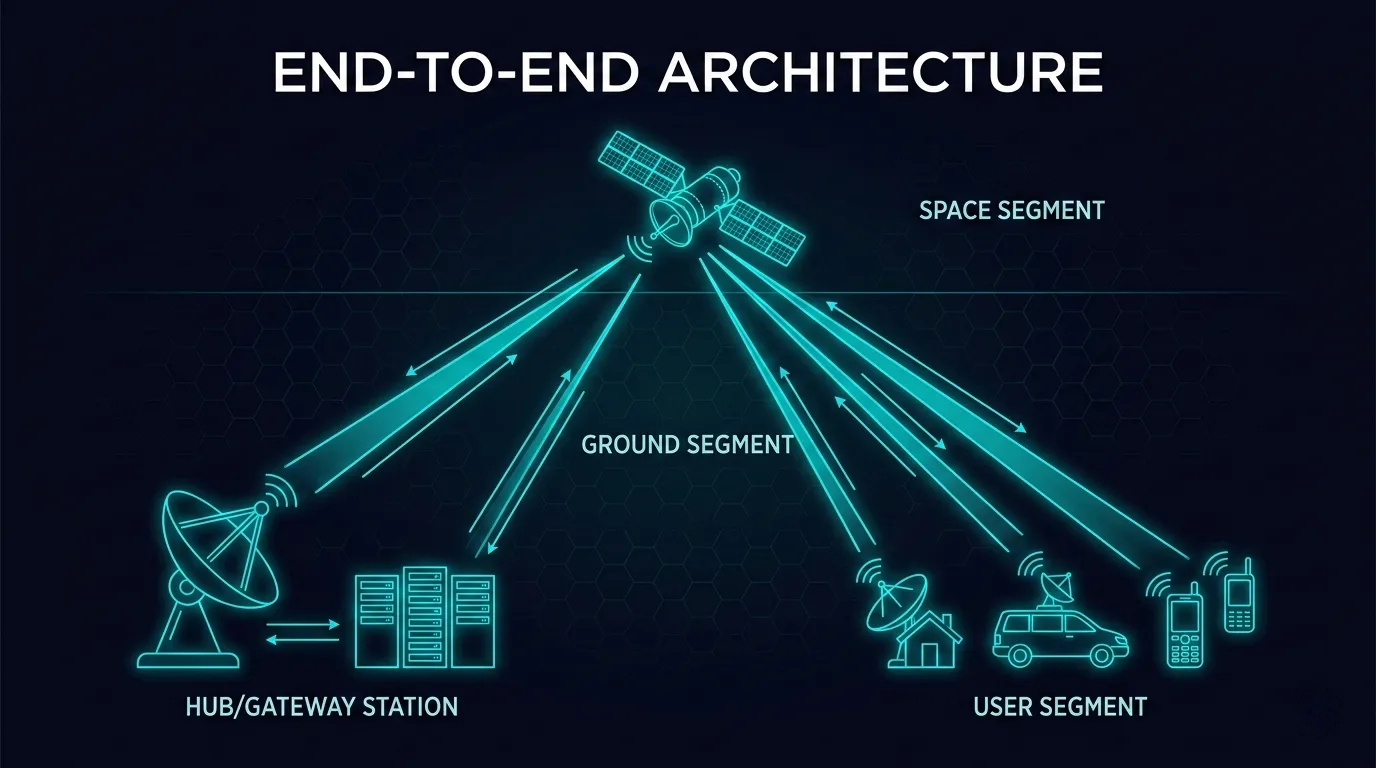
End-to-End Architecture
Complete overview of satellite communication system architecture from space segment to user terminals.
Rain Fade in Satellite Communications: Why It Happens and How Fade Mitigation Works
Engineering guide to rain fade in satellite communications covering absorption and scattering physics, specific attenuation formulas, Ku vs Ka band impact, ACM, UPC, site diversity, and design workflow.
Satellite Link Availability Explained: How Engineers Design 99.9% and 99.99% Satellite Networks
Engineering guide to satellite link availability covering uptime targets, rain fade impact, fade margin design, redundancy strategies, and practical design checklists for 99.5% to 99.99% satellite networks.