Satellite Polarization Explained: Linear vs Circular Polarization in SATCOM
Engineering guide to satellite polarization covering linear and circular polarization, cross-polarization interference, antenna alignment, polarization reuse in HTS, and Ku/Ka band polarization schemes.
Polarization is one of the most fundamental—and most frequently misunderstood—properties of electromagnetic waves used in satellite communications. Every satellite link depends on polarization for two critical functions: spectrum reuse (doubling available bandwidth by transmitting on orthogonal polarizations simultaneously) and interference isolation (providing 25–35 dB of discrimination between co-frequency signals). When polarization goes wrong—misaligned feeds, rain depolarization, Faraday rotation—link budgets erode, cross-polarization interference rises, and service quality degrades.
Despite its importance, polarization is often treated as an installation detail rather than an engineering discipline. This article provides a comprehensive technical reference covering the physics of polarization, the engineering trade-offs between linear and circular polarization, cross-polarization interference mechanisms, antenna alignment procedures, and how modern HTS systems exploit polarization for capacity scaling.
Key terms used in this article: linear polarization (LP), circular polarization (CP), vertical polarization (V), horizontal polarization (H), right-hand circular polarization (RHCP), left-hand circular polarization (LHCP), cross-polarization discrimination (XPD), cross-polarization interference (XPI), skew angle, axial ratio, Faraday rotation, depolarization, polarization reuse.
What Is Polarization
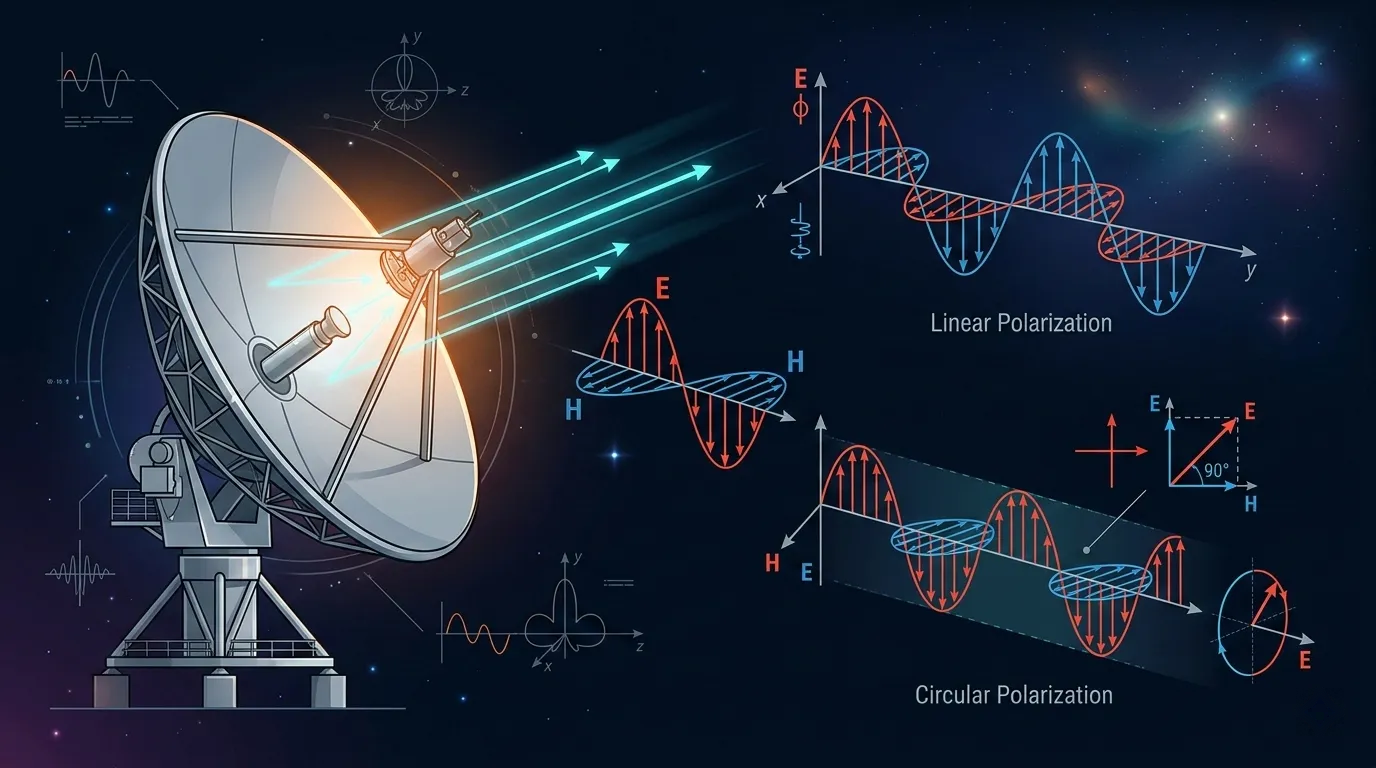
An electromagnetic wave consists of oscillating electric and magnetic fields perpendicular to each other and to the direction of propagation. Polarization describes the orientation and behavior of the electric field vector as the wave propagates through space. If the electric field oscillates in a single plane, the wave is linearly polarized. If the electric field vector rotates in a circle as the wave propagates, the wave is circularly polarized. The general case is elliptical polarization, where the electric field traces an ellipse—linear and circular polarization are special cases of elliptical polarization with axial ratios of infinity and unity, respectively.
It is important to distinguish between the polarization state of the wave (a property of the radiated electromagnetic field) and the polarization of the antenna (the polarization of the wave that the antenna is designed to transmit or receive most efficiently). A well-designed system matches the antenna polarization to the wave polarization. Any mismatch introduces polarization loss, reducing the received signal power according to the polarization loss factor.
In satellite communications, two orthogonal polarization states are used simultaneously to carry independent signals on the same frequency—effectively doubling the available spectrum. The degree to which these orthogonal channels remain isolated from each other determines the system's cross-polarization performance and ultimately its capacity.
Linear Polarization
Linear polarization is the simplest form: the electric field oscillates in a fixed plane as the wave propagates. In satellite systems, the two orthogonal linear polarizations are designated vertical (V) and horizontal (H), defined relative to the satellite's antenna coordinate system (typically referenced to the local horizon at the sub-satellite point).
How linear polarization is generated. A linearly polarized wave is produced by a linearly oriented radiating element—a dipole, a rectangular waveguide, or a feed horn with a single-mode excitation. The polarization direction corresponds to the orientation of the electric field in the aperture. For a satellite antenna, the feed horn is designed to excite either the vertical or horizontal mode of the waveguide, producing V or H polarization. Dual-polarized feeds support both V and H simultaneously through orthogonal ports, enabling dual-polarization operation from a single antenna.
Advantages of linear polarization:
- Simpler feed design. Single-mode excitation is straightforward to implement and produces clean polarization with high cross-polarization discrimination.
- Well-established in Ku-band FSS. The majority of Ku-band fixed satellite service (FSS) transponders use linear polarization. The installed base of Ku-band terminals worldwide is predominantly designed for linear operation.
- Clear orthogonality. V and H are geometrically orthogonal and intuitive for installation technicians to understand and align.
Disadvantages of linear polarization:
- Sensitive to Faraday rotation. The ionosphere rotates the polarization plane of a linearly polarized wave. At C-band and below, Faraday rotation can exceed several degrees, degrading cross-polarization isolation unless the terminal compensates. This is discussed further in Satellite Frequency Bands Explained.
- Sensitive to rain depolarization. Oblate raindrops cause differential attenuation and phase shift between V and H components, coupling energy from one polarization into the other.
- Requires skew angle correction. Because the satellite's V/H reference frame differs from the terminal's local V/H frame (due to the geometry of the GEO arc), the terminal must rotate its feed to match—an additional installation step that introduces alignment error.
Circular Polarization
Circular polarization occurs when two equal-amplitude, orthogonal linear components are combined with a 90° phase difference. The resulting electric field vector rotates in a circle as the wave propagates. The direction of rotation defines the handedness: right-hand circular polarization (RHCP) when the field rotates clockwise as viewed from behind the wave (in the direction of propagation), and left-hand circular polarization (LHCP) when it rotates counterclockwise. RHCP and LHCP are orthogonal to each other and can carry independent signals simultaneously.
How circular polarization is generated. A circularly polarized wave is produced by exciting two orthogonal linear modes with equal amplitude and 90° relative phase. In practice, this is achieved using a quarter-wave plate (a dielectric slab in the waveguide that introduces 90° differential phase), a septum polarizer (a stepped metallic septum in a circular waveguide), or a dual-mode coupler with an external 90° hybrid. The choice of component affects bandwidth, axial ratio performance, and power handling. For antenna feed design details, see Satellite Antenna Types Guide.
Advantages of circular polarization:
- Immune to Faraday rotation. A circularly polarized wave remains circularly polarized after any amount of Faraday rotation—the rotation simply shifts the phase of the received signal without coupling energy into the orthogonal polarization. This makes circular polarization the standard choice at C-band and L/S-band, where ionospheric effects are significant.
- Tolerant of antenna rotational misalignment. If a circularly polarized antenna is rotated about its boresight axis, the received signal phase changes but the polarization match remains perfect. This is critical for mobile terminals (maritime, aero) where the platform rotates continuously.
- Simplified consumer installation. DBS (direct broadcast satellite) systems use circular polarization so that consumer dish installers do not need to set a precise skew angle—reducing installation errors and service calls.
Disadvantages of circular polarization:
- Axial ratio penalty. A perfect circularly polarized wave has an axial ratio of 0 dB (equal V and H components). In practice, feed imperfections produce slightly elliptical polarization with an axial ratio of 0.5–2 dB. The polarization mismatch loss between a nominally circular antenna and an imperfectly circular wave can reach 0.5–1.0 dB—a non-trivial hit in a tight link budget.
- More complex feed. Generating circular polarization requires additional components (quarter-wave plate, septum polarizer, hybrid coupler) compared to a simple linearly polarized feed. This adds mass, cost, and potential failure modes.
- Rain depolarization. While circular polarization is immune to Faraday rotation, it is more susceptible to rain depolarization than linear polarization in certain geometries, because oblate raindrops convert circular polarization into elliptical polarization, coupling energy into the orthogonal hand.
Why Polarization Matters
Polarization serves two essential roles in satellite system design:
1. Spectrum reuse. By transmitting independent signals on two orthogonal polarizations (V/H or RHCP/LHCP) at the same frequency, a satellite effectively doubles its usable bandwidth per transponder. A Ku-band transponder with 36 MHz bandwidth carrying both V and H polarizations provides 72 MHz of effective spectrum. Across a full satellite payload of 24–48 transponders, dual-polarization operation doubles the total capacity without requiring additional orbital spectrum allocations.
2. Interference isolation. Orthogonal polarizations provide 25–35 dB of cross-polarization discrimination (XPD) under well-aligned conditions. This isolation allows co-frequency carriers on opposite polarizations to coexist with minimal mutual interference—analogous to having two independent channels sharing the same frequency band. Without adequate XPD, the co-frequency signal on the orthogonal polarization becomes an interference source that degrades C/I and reduces throughput.
| Parameter | Linear Polarization (V/H) | Circular Polarization (RHCP/LHCP) |
|---|---|---|
| Typical XPD (clear sky) | 27–35 dB | 25–33 dB |
| Faraday rotation sensitivity | High (significant below 4 GHz) | Immune |
| Rain depolarization | Moderate | Moderate to high |
| Feed complexity | Lower | Higher |
| Alignment requirement | Skew angle correction required | No rotational alignment needed |
| Typical bands | Ku-band FSS, Ka-band HTS | C-band, L/S-band, DBS |
| Mobile terminal suitability | Requires feed rotation tracking | Naturally suited |
Cross-Polarization Interference
Cross-polarization discrimination (XPD) is the ratio of the co-polarized signal power to the cross-polarized signal power at the receive antenna output. A higher XPD means better isolation between the two polarization channels. Cross-polarization interference (XPI) or cross-polarization isolation (XPI) is the system-level metric that accounts for XPD contributions from both the transmit and receive antennas, the propagation path, and the satellite payload.
Sources of cross-polarization degradation include:
Antenna misalignment. The most controllable—and most common—source of XPD degradation. A linearly polarized antenna rotated by angle ε from the nominal polarization produces a cross-polarized component proportional to sin(ε). A 3° alignment error reduces XPD by approximately 5 dB; a 5° error can degrade XPD to below 20 dB. Circular polarization antennas are immune to rotational misalignment but still affected by axial ratio imperfections.
Feed imperfections. Manufacturing tolerances in feed horns, polarizers, and orthomode transducers (OMTs) produce residual cross-polarized radiation. High-quality feeds achieve 30–40 dB of port-to-port isolation; lower-quality feeds may manage only 25–30 dB.
Rain depolarization. Raindrops are oblate—wider than they are tall—due to aerodynamic drag. When a polarized wave passes through rain, the differential attenuation and phase shift between components aligned with and perpendicular to the raindrop's symmetry axis couples energy from the intended polarization into the orthogonal channel. The effect increases with rain rate and frequency. At Ka-band, heavy rain (50 mm/hr) can degrade XPD to 15–18 dB—a significant concern for dual-polarization HTS systems. This is one of the key propagation effects covered in Rain Fade in Satellite Communications.
Faraday rotation. The Earth's ionosphere, a magnetized plasma, rotates the polarization plane of linearly polarized waves. The rotation angle is proportional to the total electron content (TEC) along the path and inversely proportional to the square of the frequency. At C-band (4 GHz), Faraday rotation can reach 3–5° under high solar activity; at Ku-band (12 GHz) it is typically less than 1°; at Ka-band (20 GHz) it is negligible. Circular polarization is inherently immune.
Cross-polarization interference directly impacts the link budget by reducing the effective C/I. For systems using dual-polarization frequency reuse, the XPD sets a floor on the C/I available to each carrier. Engineers must account for worst-case XPD (including rain depolarization at the target availability) when designing the link budget. See Satellite Link Budget Calculation for the complete link budget methodology, and SATCOM Interference Causes, Detection, and Coordination for cross-pol interference diagnosis and mitigation procedures.
Polarization in Ku and Ka Band Systems
The choice of polarization varies by frequency band, service type, and operator preference.
Ku-band (10.7–12.75 GHz downlink, 13.75–14.5 GHz uplink). Ku-band FSS overwhelmingly uses linear polarization (V/H). The ITU frequency plan for the Ku-band FSS allocations is structured around linear polarization, and the global installed base of Ku-band VSAT terminals is designed for linear operation. Terminals must apply a skew angle correction—the rotation of the feed/LNB to align with the satellite's polarization plane as projected at the terminal's geographic location. Skew angle varies with terminal latitude and longitude relative to the satellite sub-point; values of ±20° or more are common at high latitudes or longitudes far from the satellite.
Ka-band (17.7–21.2 GHz downlink, 27.0–31.0 GHz uplink). Ka-band systems show more diversity. BSS/DBS services (direct-to-home television) typically use circular polarization (RHCP/LHCP) to simplify consumer dish installation—no skew adjustment required. Ka-band HTS user links often use linear polarization for the user beams, following the four-color reuse pattern (two frequency sub-bands × two linear polarizations). Feeder links between gateways and the satellite may use a different polarization scheme than the user links, depending on the payload architecture.
Ka-band depolarization in rain is more severe than at Ku-band due to the shorter wavelength. Operators designing Ka-band dual-polarization systems must include adequate XPD margin in the link budget for the target rain rate and availability. For detailed rain fade analysis at Ka-band, see Rain Fade in Satellite Communications.
Antenna Installation and Polarization Alignment
Proper polarization alignment during terminal installation is critical for both maximizing the wanted signal and minimizing interference to other users on the orthogonal polarization.
Skew angle. For linearly polarized systems, the skew angle (also called polarization angle or tilt angle) is the rotation that must be applied to the terminal's feed or LNB to align its V/H plane with the satellite's V/H reference. The skew angle is determined by the geometry of the earth station's position relative to the satellite sub-point:
- At the satellite sub-point (0° latitude, satellite longitude), skew = 0°.
- As the terminal moves east or west of the satellite longitude, the skew angle increases.
- Latitude also affects the skew angle—terminals at high latitudes and longitudes far from the satellite require the largest corrections.
Satellite operators and modem manufacturers provide skew angle calculators that output the required feed rotation for any terminal location and satellite orbital position.
Alignment procedure. The standard polarization alignment procedure for a VSAT terminal is:
- Point the antenna to the target satellite and peak on the satellite beacon for maximum signal.
- Set the feed/LNB rotation to the calculated skew angle as a starting point.
- Transmit a CW (continuous wave) test carrier on the wanted polarization.
- Monitor the cross-polarization level on a spectrum analyzer at the satellite operator's monitoring station, or use the modem's built-in cross-pol measurement function.
- Fine-adjust the feed rotation to minimize the cross-polarized signal (maximize XPD).
- Verify XPD meets the operator's specification—typically ≥25 dB for VSAT terminals.
Tolerances. VSAT operators typically require polarization alignment within ±1° of optimal, corresponding to a worst-case XPD degradation of approximately 1 dB. Consumer DTH installations using circular polarization are more forgiving—±2–3° is acceptable since rotational alignment does not affect circular polarization performance.
Motorized feeds. Large earth stations and tracking antennas often use motorized feed rotation systems that continuously adjust polarization alignment. This is essential for antennas that track multiple satellites or for terminals at locations where diurnal variation in ionospheric Faraday rotation causes measurable polarization drift (primarily C-band). For an overview of antenna mount types and tracking systems, see Satellite Antenna Types Guide.
Polarization in Modern Satellites
Modern HTS and VHTS satellites exploit polarization as a core capacity-scaling mechanism alongside frequency reuse.
The four-color reuse scheme. The standard HTS frequency reuse pattern divides the allocated spectrum into two sub-bands (e.g., F1 and F2) and assigns each sub-band to two orthogonal polarizations (e.g., V and H, or RHCP and LHCP). This creates four distinct frequency-polarization combinations—"colors"—that are assigned to spot beams in a tessellated pattern. Adjacent beams receive different colors; beams sufficiently separated reuse the same color. Polarization provides half of the isolation between co-color beams (the other half comes from the angular separation between beams). For a detailed explanation of the four-color scheme and beam architecture, see HTS Spot Beams and Beamforming Explained.
Polarization doubles the reuse factor. Without dual-polarization, a two-frequency reuse plan provides a reuse factor of 2. Adding orthogonal polarizations doubles this to 4. For a satellite with 100 spot beams and a four-color plan, each color is used in 25 beams—meaning the satellite reuses its total spectrum 25 times. Removing polarization reuse would halve this to 12.5 (requiring either twice the spectrum or half the beams), making dual-polarization essential to HTS economics.
Flexible payloads and switchable polarization. Next-generation software-defined satellites (e.g., SES mPOWER, Eutelsat KONNECT VHTS) support reconfigurable polarization on a per-beam basis. The satellite can switch individual beams between V and H (or RHCP/LHCP) by ground command, allowing operators to adapt the polarization plan to changing interference environments, customer requirements, or regulatory constraints. This flexibility represents a significant advance over legacy satellites where the polarization plan is fixed at manufacture.
LEO constellations and polarization. LEO satellite constellations (Starlink, OneWeb, Kuiper) use dual polarization for spectrum reuse across their beam plans. The rapid motion of LEO satellites relative to ground terminals means the polarization reference frame changes continuously—requiring terminal antennas to track polarization dynamically or use circular polarization to avoid rotational alignment issues. Phased-array terminals with electronic beam steering inherently manage polarization through their beamforming weights.
Frequently Asked Questions
What is cross-polarization interference?
Cross-polarization interference occurs when energy from a signal on one polarization (e.g., vertical) leaks into the orthogonal polarization channel (e.g., horizontal), appearing as unwanted noise or interference to the signal on that channel. The primary causes are antenna polarization misalignment, feed imperfections, rain depolarization, and Faraday rotation. Cross-polarization interference degrades the carrier-to-interference ratio (C/I) and reduces throughput for systems that use dual-polarization frequency reuse.
How do you adjust satellite dish polarization?
For linearly polarized systems, polarization is adjusted by rotating the feed horn or LNB to the correct skew angle for your geographic location relative to the satellite. Start with the calculated skew angle, then fine-tune by monitoring cross-polarization isolation—either through the satellite operator's monitoring system or the modem's built-in cross-pol measurement. Rotate the feed in small increments (0.5°) until the cross-polarized signal is minimized. For circularly polarized systems, no rotational adjustment is needed—the installer only needs to ensure the correct LNB type (RHCP or LHCP) is installed.
Why do some satellites use circular polarization?
Circular polarization is chosen when Faraday rotation immunity is required (C-band, L/S-band), when terminals are mobile and cannot maintain a fixed rotational orientation (maritime, aeronautical), or when simplified consumer installation is a priority (DBS/DTH). The trade-off is slightly more complex feed hardware and a small axial ratio penalty compared to linear polarization.
What is polarization skew angle?
Skew angle is the rotation that must be applied to a linearly polarized terminal's feed or LNB to align its polarization plane with the satellite's reference polarization plane. The skew angle depends on the terminal's geographic position relative to the satellite's sub-satellite point. At the sub-satellite point, skew is zero; it increases as the terminal moves east, west, or to higher latitudes. Incorrect skew angle directly degrades cross-polarization isolation.
Does rain affect satellite polarization?
Yes. Raindrops are oblate (flattened), and when a polarized signal passes through a rain cell, the differential attenuation and phase shift between the horizontal and vertical components depolarize the signal—coupling energy from the intended polarization into the orthogonal channel. The effect is proportional to rain rate and increases with frequency. At Ka-band, heavy rain can degrade cross-polarization discrimination (XPD) from 30+ dB to 15–18 dB, significantly impacting dual-polarization systems.
What is the difference between RHCP and LHCP?
RHCP (right-hand circular polarization) and LHCP (left-hand circular polarization) are the two orthogonal states of circular polarization. In RHCP, the electric field vector rotates clockwise when viewed from behind the wave (looking in the direction of propagation); in LHCP, it rotates counterclockwise. RHCP and LHCP are orthogonal—they can carry independent signals at the same frequency with 25–33 dB of isolation, just as V and H linear polarizations can.
Can you receive both polarizations simultaneously?
Yes. A dual-polarized feed with an orthomode transducer (OMT) outputs both orthogonal polarizations through separate ports simultaneously. This is standard in satellite terminals that need to receive carriers on both polarizations—for example, a DTH receiver accessing channels on both RHCP and LHCP, or a VSAT modem operating in a dual-polarization frequency reuse scheme. The OMT provides 25–35 dB of isolation between the two ports.
How much isolation does dual polarization provide?
Under well-aligned, clear-sky conditions, dual polarization provides 27–35 dB of cross-polarization discrimination (XPD). This isolation degrades in rain (to 15–25 dB depending on rain rate and frequency), with antenna misalignment (5 dB loss per 3° of rotational error), and at lower frequencies where Faraday rotation is significant. System designers typically budget 20–25 dB of usable cross-pol isolation after accounting for worst-case degradation.
Key Takeaways
-
Polarization is a capacity multiplier. Dual-polarization operation doubles the usable spectrum per satellite transponder, and polarization reuse is essential to the four-color frequency plan used by all modern HTS systems.
-
Linear and circular polarization serve different needs. Linear polarization (V/H) dominates Ku-band FSS with simpler feeds but requires skew angle correction; circular polarization (RHCP/LHCP) is preferred at C-band, for mobile terminals, and for consumer DBS due to Faraday immunity and rotational tolerance.
-
Cross-polarization isolation sets the interference floor. XPD of 25–35 dB under clear sky degrades to 15–20 dB in heavy rain at Ka-band—a critical link budget parameter for dual-polarization systems.
-
Antenna alignment is the most common source of XPD degradation. Proper skew angle setting and fine-tuning during installation prevents the majority of cross-polarization interference events.
-
Rain depolarization is frequency-dependent. Ka-band systems require additional XPD margin in the link budget to maintain dual-polarization performance at the target availability in rain-prone regions.
-
Flexible payloads enable adaptive polarization. Next-generation satellites with switchable per-beam polarization can adapt to changing interference environments and customer requirements—a significant operational advantage over fixed-polarization legacy spacecraft.
Related Articles
- Satellite Antenna Types Guide — Feed horn design, OMTs, and polarization alignment for different antenna architectures
- Satellite Frequency Bands Explained — Band-specific polarization conventions and propagation characteristics
- Satellite Link Budget Calculation — Incorporating XPD and polarization loss into end-to-end link analysis
- Rain Fade in Satellite Communications — Rain depolarization physics and XPD degradation models
- SATCOM Interference Explained — Cross-polarization interference diagnosis and mitigation
- HTS Spot Beams and Beamforming — Four-color reuse, polarization reuse factor, and beam isolation
Author

Organizational byline for SATCOM Index technical content. A named technical reviewer appears separately only when identity, scope, and permission are verified.
Categories
More Posts
Satellite Doppler Shift Explained: Why Frequency Changes in LEO Satellite Communication
Engineering guide to satellite Doppler shift covering frequency drift in LEO and GEO systems, impact on carrier tracking and demodulation, compensation techniques, and design considerations for modern constellations.
Adaptive Coding and Modulation (ACM) Explained: How Satellite Networks Maintain Link Quality
Engineering guide to adaptive coding and modulation in satellite systems covering signal quality measurement, MODCOD selection algorithms, DVB-S2/S2X ACM capabilities, rain fade response, and ACM design for HTS and LEO networks.
Rain Fade in Satellite Communications: Why It Happens and How Fade Mitigation Works
Engineering guide to rain fade in satellite communications covering absorption and scattering physics, specific attenuation formulas, Ku vs Ka band impact, ACM, UPC, site diversity, and design workflow.