
CIR vs MIR Explained: Understanding Guaranteed and Burst Bandwidth in Satellite Services
Learn the difference between CIR and MIR in satellite services, why guaranteed bandwidth matters for enterprise procurement, and how to evaluate satellite service plans.
When satellite service providers present a bandwidth proposal, the headline number — 10 Mbps, 50 Mbps, or more — rarely tells the full story. What matters is not the maximum speed printed on the quote, but how much of that capacity is actually guaranteed under real-world operating conditions. The distinction between guaranteed and burst bandwidth is defined by two parameters that appear in nearly every satellite service agreement: CIR (Committed Information Rate) and MIR (Maximum Information Rate).
For enterprise buyers, network architects, and procurement teams, understanding the difference between CIR and MIR is essential. These two numbers determine whether a remote site can reliably run business-critical applications during busy hours or whether performance will degrade unpredictably when shared capacity is under load. Getting this distinction wrong leads to under-provisioned links, failed SLA expectations, and costly mid-contract upgrades.
This article explains what CIR and MIR mean in satellite communications, how they interact with contention, QoS, and service-level agreements, and how to use these parameters effectively when evaluating and procuring satellite services. If you are evaluating providers more broadly, How to Evaluate a Satellite Internet Provider provides additional procurement context.
What Is CIR?
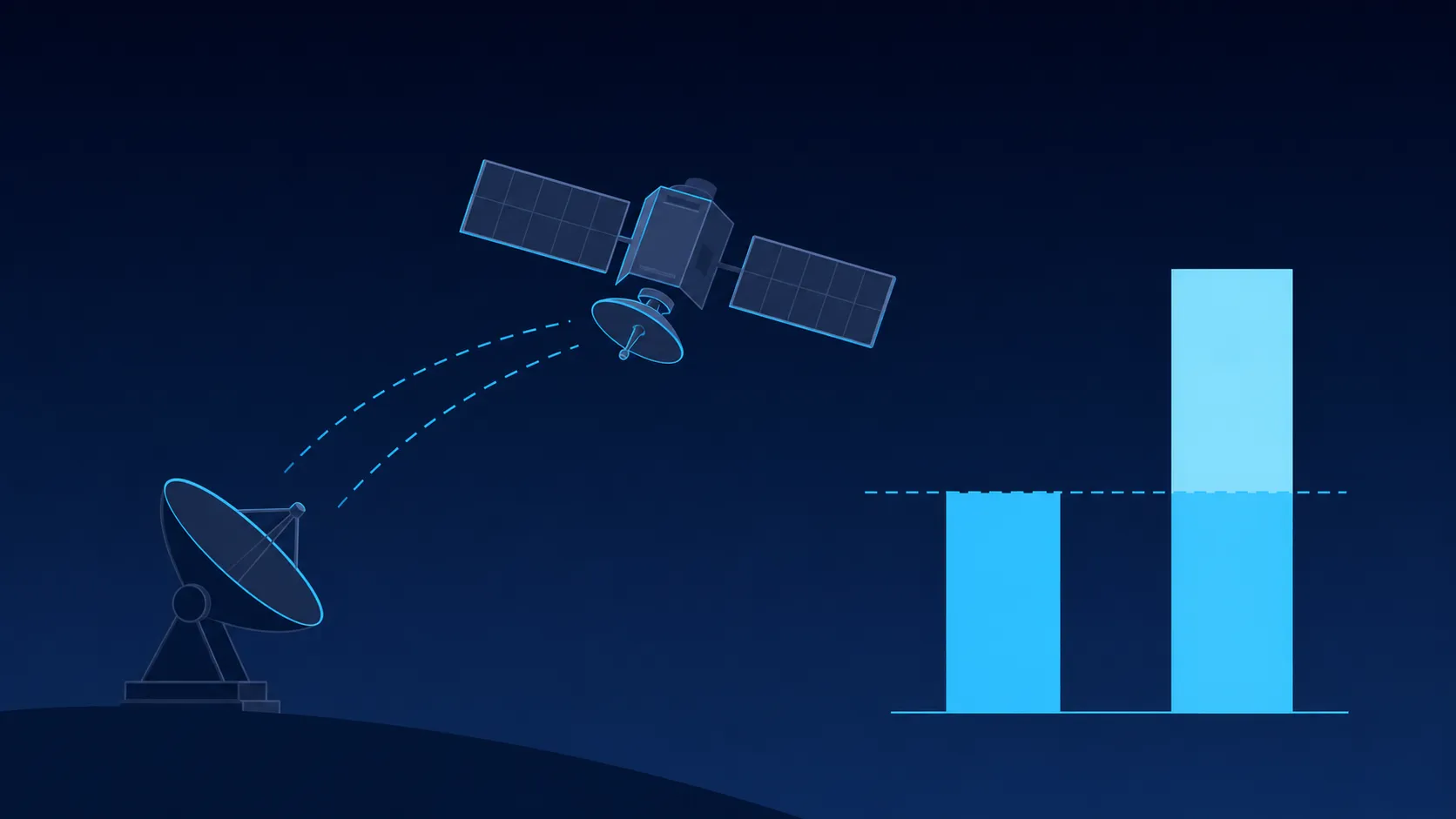
CIR stands for Committed Information Rate. It is the minimum bandwidth throughput that a satellite service provider contractually guarantees to deliver to a customer at all times, regardless of how many other users are sharing the same capacity pool. CIR represents the floor — the lowest performance level the customer should expect under any network condition.
In a managed satellite service, CIR is typically enforced at the hub through traffic scheduling and bandwidth allocation mechanisms. When a remote terminal has a CIR of 2 Mbps, the hub reserves capacity equivalent to that rate for the terminal even during peak demand. Other users sharing the same transponder or beam cannot consume capacity that has been committed to CIR allocations.
CIR matters most for business-critical traffic. Applications like voice over IP, video conferencing, SCADA telemetry, point-of-sale transactions, and ERP synchronization require consistent, predictable throughput. If bandwidth drops below application requirements during busy hours, the result is degraded call quality, transaction timeouts, or data synchronization failures. CIR provides the performance baseline that these applications need to function reliably.
CIR is a contractual guarantee, not a physical limit. It defines what the provider commits to deliver. The actual mechanism for enforcing CIR varies by platform — some providers use dedicated time slots in TDMA, others use weighted fair queuing or priority reservation. What matters to the buyer is that the guarantee is backed by an SLA with measurable terms.
In typical enterprise satellite services, CIR values range from a fraction of the MIR (e.g., 1 Mbps CIR on a 10 Mbps MIR plan) to fully committed 1:1 services where CIR equals MIR. The ratio between CIR and MIR is one of the most important indicators of service quality and directly affects pricing. Higher CIR relative to MIR means more reserved capacity per user, which costs the provider more transponder resources and therefore costs the customer more.
What Is MIR?
MIR stands for Maximum Information Rate. It is the highest throughput a terminal can achieve when sufficient shared capacity is available on the network. MIR represents the ceiling — the best-case performance when network conditions are favorable and contention is low.
Unlike CIR, MIR is not guaranteed. It represents opportunistic capacity that is available when other users on the same shared pool are inactive or generating low traffic. During off-peak hours — early morning, late night, or outside business hours in the beam's coverage area — a terminal may regularly achieve throughput at or near its MIR. During busy hours, when many terminals are actively transmitting, the achievable throughput drops toward the CIR level as the shared capacity is divided among more users.
MIR is set by the service plan configuration at the hub. The hub's traffic scheduler allows a terminal to burst up to its MIR when unused capacity is available, but caps it at that rate even if more capacity is theoretically free. This prevents any single terminal from monopolizing the shared pool and ensures that burst capacity is distributed across all active users.
The relationship between MIR and actual throughput is probabilistic, not deterministic. A terminal with 20 Mbps MIR might achieve 18–20 Mbps during quiet periods, 8–12 Mbps during moderate load, and 3–5 Mbps during peak congestion (assuming, for example, a 2 Mbps CIR). The exact throughput at any moment depends on the contention ratio, the number of simultaneously active terminals, the traffic patterns of other users in the same beam, and the QoS policies configured at the hub.
MIR is not average throughput. Providers sometimes present MIR as if it represents typical performance. In practice, average throughput over a business day is usually well below MIR and closer to a value determined by the contention ratio and traffic patterns. Ask providers for busy-hour throughput estimates, not just MIR.
CIR vs MIR: Key Differences
Understanding the distinction between CIR and MIR is critical for setting realistic expectations and making informed procurement decisions. The following table summarizes the key differences:
| Parameter | CIR (Committed Information Rate) | MIR (Maximum Information Rate) |
|---|---|---|
| Definition | Minimum guaranteed bandwidth | Maximum achievable bandwidth |
| Guarantee | Contractually guaranteed at all times | Not guaranteed — depends on available capacity |
| Availability | Available regardless of network load | Available only when shared capacity is underutilized |
| Performance role | Throughput floor | Throughput ceiling |
| SLA backing | Typically backed by SLA with penalties | Rarely backed by SLA commitments |
| Cost impact | Higher CIR = higher cost | Higher MIR with low CIR = lower cost |
| Use case alignment | Business-critical, latency-sensitive traffic | Bulk transfers, software updates, non-critical browsing |
| Measurement | Continuous or interval-averaged (varies by provider) | Instantaneous peak rate |
The ratio between CIR and MIR tells you how much of the advertised speed is actually reliable. A plan with 2 Mbps CIR and 10 Mbps MIR (1:5 ratio) guarantees only 20% of the headline speed. A plan with 5 Mbps CIR and 10 Mbps MIR (1:2 ratio) guarantees 50%. A fully dedicated service where CIR equals MIR (1:1 ratio) guarantees 100% but costs significantly more.
For enterprise procurement, the CIR-to-MIR ratio is more informative than either number alone. Two proposals might both offer 20 Mbps MIR, but if one has 4 Mbps CIR and the other has 10 Mbps CIR, the real-world performance difference during peak hours will be substantial.
Why CIR and MIR Matter in Satellite Networks
The CIR/MIR model exists because satellite bandwidth is an inherently shared, finite resource. Unlike terrestrial fiber, where capacity can be scaled relatively easily by lighting additional wavelengths or adding cables, satellite transponder capacity is physically limited by the spacecraft's power, spectrum allocation, and orbital slot. This scarcity makes bandwidth sharing an economic necessity for most satellite services.
Shared Service Plans
Most satellite service plans use a shared model where multiple terminals access a common pool of bandwidth. The contention ratio determines how many users share the pool, while CIR and MIR define each user's guaranteed minimum and burst maximum within that pool. In a typical shared plan with a 1:10 contention ratio, the provider sells ten times more aggregate MIR than the physical capacity available, relying on the statistical probability that not all users will demand peak throughput simultaneously.
CIR acts as the safety net within this shared model. Without CIR guarantees, all bandwidth would be purely contended, and during busy hours every user's throughput would drop proportionally. By committing a CIR to each user, the provider guarantees a minimum service level and limits how much any individual terminal's performance can degrade under load.
Dedicated Enterprise Links
For mission-critical applications — financial trading, emergency communications, military operations, primary enterprise WAN links — fully dedicated services with CIR equal to MIR (1:1) eliminate contention entirely. The customer pays for exclusive access to a defined portion of transponder capacity, and no other user can consume that bandwidth. This is the most expensive option but provides the most predictable performance.
Some enterprise services offer a hybrid approach: a moderate CIR for guaranteed baseline performance, combined with a higher MIR that allows bursting into a shared pool during off-peak periods. This balances cost with performance predictability and is common in enterprise satellite internet deployments.
Remote, Maritime, and Industrial Connectivity
In maritime satellite and remote industrial environments, the CIR/MIR distinction takes on additional importance. A vessel at sea or a mining site in a remote region cannot fall back on terrestrial connectivity when satellite performance degrades. The CIR defines the minimum operational capability for safety systems, SCADA telemetry, and essential communications.
For SCADA over satellite deployments, even small CIR values (64–256 kbps) can be sufficient for telemetry and control traffic, while a higher MIR allows occasional firmware updates or bulk data transfers during quiet periods. The key is ensuring that the CIR is sized appropriately for the application's minimum requirements.
Interaction with QoS and Traffic Shaping
CIR and MIR do not operate in isolation. They interact with QoS policies configured at the satellite hub. Traffic shaping, priority queuing, and weighted fair scheduling determine how available bandwidth is distributed among different traffic classes within a single terminal's allocation and across the shared pool.
A well-configured service plan might prioritize voice and video traffic to consume the CIR allocation first, ensuring that latency-sensitive applications maintain quality even during congestion, while bulk transfers and non-critical traffic burst into MIR capacity opportunistically. Without proper QoS alignment, even adequate CIR can be wasted on low-priority traffic while critical applications suffer.
Real-World Engineering and Commercial Trade-offs
Cost Implications
CIR is the primary cost driver in satellite service pricing. Transponder capacity committed as CIR cannot be resold or shared with other customers, so the provider must recover the full cost of that capacity from the customer receiving the guarantee. MIR, by contrast, leverages statistical multiplexing — the same physical capacity can be sold as burst bandwidth to multiple customers, spreading the cost.
As a rough guide, doubling the CIR on a satellite service plan typically increases the monthly cost by 40–80%, depending on the provider, band, and region. Increasing MIR while keeping CIR constant has a much smaller cost impact because the provider is only allowing access to shared capacity that may or may not be available.
This cost dynamic creates a procurement tension: enterprise customers want the highest possible CIR for predictability, but budgets often constrain them to lower CIR with higher MIR plans. The goal is to find the CIR level that meets minimum application requirements without overpaying for guaranteed capacity that is not actually needed at all times.
Burst Unpredictability
One of the most common procurement mistakes is evaluating satellite services primarily on MIR. A plan with 50 Mbps MIR and 2 Mbps CIR looks impressive on paper, but the 50 Mbps is only available when no one else on the beam is using capacity heavily. During peak business hours — precisely when enterprise users need bandwidth most — throughput may drop to near the CIR level.
The unpredictability of burst bandwidth is particularly problematic for applications with minimum throughput requirements. Video conferencing that requires 4 Mbps cannot function reliably on a plan with 2 Mbps CIR, even if the MIR is 50 Mbps. The application needs at least 4 Mbps during the call, and if the burst capacity is unavailable at that moment, the call degrades or fails.
Application Type Matters More Than Headline Speed
When sizing CIR and MIR, the application profile of the remote site matters more than the total headline speed. A site running a mix of VoIP, ERP, and web browsing has different CIR requirements than a site primarily doing bulk data backup to the cloud.
For latency-sensitive, real-time applications (voice, video, SCADA), CIR should be sized to meet the application's minimum throughput requirement at all times. For bulk, delay-tolerant applications (file transfer, software updates, email sync), MIR is more relevant because the application can tolerate variable throughput and burst when capacity is available.
The most effective approach is to map the site's traffic profile, identify which applications are CIR-critical (must work at all times) and which are MIR-tolerant (can burst opportunistically), and size the service plan accordingly. This prevents both over-provisioning (paying for CIR that is not needed) and under-provisioning (guaranteeing less than the minimum the site requires).
CIR/MIR and SLA Discussions
The CIR and MIR values in a satellite service proposal are only meaningful if they are backed by clear, measurable service-level agreements. Without SLA commitments, CIR is merely a marketing statement rather than a contractual guarantee.
What Buyers Should Ask Providers
When evaluating satellite service proposals, enterprise buyers should ask the following questions about CIR and MIR:
-
How is CIR measured? Is it a guaranteed instantaneous minimum, or an average over a measurement interval (e.g., 15 minutes, 1 hour)? Interval-averaged CIR allows momentary drops below the guaranteed rate, which may affect latency-sensitive applications.
-
What happens if CIR is not met? Are there SLA credits, service penalties, or escalation procedures? A CIR guarantee without remedies is effectively unenforceable.
-
Is CIR symmetrical or asymmetrical? Many satellite plans have different CIR values for forward (download) and return (upload) links. Ensure both directions are specified and aligned with application requirements.
-
What is the contention ratio on the MIR? A high MIR with aggressive contention (1:20 or higher) means burst bandwidth is rarely achievable during business hours.
-
How is MIR capped? Is there a hard cap at the MIR, or does the provider use traffic shaping that gradually reduces throughput as usage increases?
-
Are CIR and MIR measured at Layer 2 or Layer 3? Protocol overhead can reduce effective throughput by 5–15% compared to the advertised rate.
-
Can CIR be upgraded without hardware changes? Some platforms allow CIR adjustments through software configuration at the hub, while others require physical changes to the terminal or modem.
Documentation Clarity
Insist that CIR and MIR values are explicitly stated in the service agreement, not just in marketing materials or pre-sales presentations. The contract should specify the CIR value in each direction, the MIR value, the measurement methodology, the reporting mechanism, and the SLA remedies for non-compliance.
For deeper guidance on satellite service agreements, see Satellite SLA Explained for SLA structure and How to Evaluate a Satellite Internet Provider for broader procurement criteria.
Common Misunderstandings
Several persistent misconceptions about CIR and MIR lead to procurement errors and unrealistic performance expectations.
Assuming MIR Is Always Available
The most frequent mistake is treating MIR as the expected throughput rather than the best-case ceiling. Buyers evaluate proposals based on MIR and are disappointed when real-world throughput during business hours is far lower. MIR is only achievable when the shared capacity pool is underutilized — a condition that is least likely during the hours when enterprise users need bandwidth most.
Treating CIR as Full Line Speed
Some buyers assume that CIR means the terminal will always operate at that speed. CIR is a minimum guarantee, not a fixed allocation. The terminal can and usually does burst above CIR when capacity is available. A 2 Mbps CIR does not mean the terminal is limited to 2 Mbps — it means 2 Mbps is the floor, and throughput can burst up to the MIR ceiling when conditions allow.
Ignoring Busy-Hour Behavior
Network performance varies significantly between off-peak and peak hours. Testing a satellite link during off-peak hours may show throughput near MIR, leading to false confidence about the service's performance. The real test of a satellite service is its performance during the busiest hours, when contention is highest and throughput drops toward CIR. Always request busy-hour performance data or conduct acceptance testing during peak periods.
Confusing CIR with Bandwidth Reservation
CIR guarantees a minimum throughput, but it does not necessarily mean that capacity is statically reserved and unused when the terminal is idle. Most modern satellite platforms use dynamic bandwidth allocation — capacity committed as CIR is available for other users when the CIR subscriber is not actively transmitting, then reclaimed when the subscriber becomes active. This is different from a dedicated SCPC channel, which reserves capacity whether or not it is being used.
Overlooking Asymmetry
Satellite services almost always have different CIR and MIR values for the forward (download) and return (upload) links. A plan advertised as "10 Mbps CIR" might provide 10 Mbps CIR on the forward link but only 1–2 Mbps CIR on the return. For applications that require symmetrical throughput (video conferencing, VPN tunnels, database replication), the lower of the two CIR values is the effective constraint.
Practical Examples
Remote Office — Shared Enterprise Service
A regional office with 25 users running cloud-based ERP, email, web browsing, and occasional video conferencing subscribes to a satellite plan with 4 Mbps CIR / 20 Mbps MIR on the forward link and 1 Mbps CIR / 5 Mbps MIR on the return link.
During morning hours (off-peak for the beam), users experience 12–18 Mbps forward throughput, allowing fast cloud application response and smooth video calls. During peak business hours (10 AM–3 PM), throughput drops to 4–6 Mbps as other terminals in the beam become active. The 4 Mbps CIR ensures that ERP transactions and email continue to function acceptably, while QoS policies prioritize ERP and voice traffic over web browsing.
The office could upgrade to 8 Mbps CIR for more consistent peak-hour performance, but the additional monthly cost may not be justified unless video conferencing becomes a daily requirement.
Maritime — Shared Capacity at Sea
A commercial vessel subscribes to a maritime satellite service with 1 Mbps CIR / 10 Mbps MIR, shared with other vessels in the same beam coverage area. The vessel uses the link for crew welfare (internet access), operational reporting, electronic chart updates, and weather data.
During port approaches and busy shipping lanes where many vessels share the same beam, throughput drops to 1–2 Mbps. The 1 Mbps CIR ensures that safety-critical weather data and operational reporting always function. Crew welfare browsing adapts to available capacity — sometimes near 10 Mbps in open ocean with few other active vessels, sometimes 1–2 Mbps in congested areas.
The vessel operator negotiated a CIR that covers operational minimum requirements (navigation data, reporting) and accepts variable performance for non-critical crew traffic, avoiding the cost of a higher CIR that would rarely be utilized at sea.
Industrial Monitoring — Low CIR, Burst for Updates
A pipeline monitoring station in a desert region uses satellite for SCADA telemetry and occasional firmware updates. The service plan provides 128 kbps CIR / 2 Mbps MIR.
SCADA polling data requires only 20–50 kbps continuously, well within the 128 kbps CIR. The CIR ensures telemetry is never interrupted, even during satellite brownout conditions or high contention in the beam. Firmware updates (typically 50–200 MB) are scheduled during off-peak hours when burst throughput near 2 Mbps is available, completing in minutes rather than the hours that CIR-only transfer would require.
This plan optimizes cost by keeping the guaranteed CIR low (matching the continuous telemetry requirement) while providing adequate burst capacity for periodic maintenance tasks. The alternative — a higher CIR to speed firmware updates — would cost significantly more for a capability needed only a few times per year.
Frequently Asked Questions
What is CIR in satellite communication?
CIR (Committed Information Rate) is the minimum bandwidth throughput that a satellite service provider contractually guarantees to deliver at all times, regardless of network congestion or the number of other users sharing the same capacity. It represents the guaranteed floor of the service performance.
What is MIR in satellite internet?
MIR (Maximum Information Rate) is the maximum bandwidth throughput a satellite terminal can achieve when spare capacity is available on the shared network. It represents the best-case throughput ceiling but is not guaranteed and depends on current network load and contention conditions.
Is MIR guaranteed?
No. MIR is an opportunistic rate that depends on available shared capacity. During off-peak hours, terminals may achieve throughput near MIR. During busy hours, throughput typically drops toward the CIR level as more users contend for the same bandwidth pool.
How much CIR does an enterprise site need?
The required CIR depends on the site's critical application profile. Identify the applications that must function at all times (VoIP, ERP, SCADA, video conferencing) and size CIR to meet their aggregate minimum throughput requirements. Non-critical applications (web browsing, software updates) can rely on burst MIR capacity.
What is the difference between CIR and contention ratio?
CIR is the guaranteed minimum throughput for a specific user, measured in Mbps or kbps. Contention ratio is the number of users sharing a bandwidth pool, expressed as a ratio (e.g., 1:10). They are related but distinct: a service can have a high contention ratio (many users sharing) but still provide meaningful CIR to each user, or it can have a low contention ratio but no formal CIR guarantee.
Can I get satellite service with 1:1 CIR (no contention)?
Yes. Fully dedicated satellite services where CIR equals MIR are available, typically provisioned as dedicated SCPC (Single Channel Per Carrier) links or dedicated TDMA allocations. These services eliminate contention entirely but cost significantly more than shared plans because the transponder capacity is exclusively reserved for a single customer.
Does higher MIR always mean better service?
Not necessarily. A plan with 50 Mbps MIR and 1 Mbps CIR may perform worse during business hours than a plan with 10 Mbps MIR and 5 Mbps CIR. The guaranteed CIR is more indicative of real-world peak-hour performance than the headline MIR. Evaluate proposals based on the CIR-to-MIR ratio and the contention ratio, not MIR alone.
How do CIR and MIR relate to satellite SLAs?
CIR is the parameter most commonly backed by SLA commitments with financial penalties for non-compliance. MIR is typically described as "best effort" and is not covered by SLA guarantees. When reviewing satellite service agreements, focus on the CIR guarantee, how it is measured, and what remedies apply if the provider fails to deliver. See Satellite SLA Explained for detailed guidance.
Key Takeaways
- CIR (Committed Information Rate) is the guaranteed minimum bandwidth — the throughput floor backed by the service provider's contractual commitment. It defines the worst-case performance you can rely on.
- MIR (Maximum Information Rate) is the burst ceiling — the highest throughput achievable when shared capacity is available. It is not guaranteed and should not be treated as expected performance.
- The CIR-to-MIR ratio is the most informative metric for comparing satellite service plans. A higher ratio means more predictable performance but higher cost.
- Size CIR to your critical applications, not to your total bandwidth wish list. Applications that must function at all times need CIR; applications that can tolerate variable throughput can rely on MIR.
- Demand SLA backing for CIR values. A CIR without SLA penalties is a marketing statement, not a guarantee. Clarify measurement methodology, reporting, and remedies.
- Evaluate busy-hour performance, not off-peak speed tests. The value of CIR is most apparent during peak congestion when MIR-only services degrade.
- Consider the total cost of under-provisioning. A lower CIR saves on monthly fees but may cost more in degraded productivity, failed applications, and mid-contract upgrades.
- Align CIR/MIR with QoS policies to ensure guaranteed bandwidth is allocated to the right traffic classes, maximizing the value of every committed kilobit.
Author

Organizational byline for SATCOM Index technical content. A named technical reviewer appears separately only when identity, scope, and permission are verified.
Categories
More Posts

Satellite Glossary: S-Z
Satellite communication terminology and definitions from S to Z.
Carrier-in-Carrier Satellite Links: How CnC Actually Works
Calculate Carrier-in-Carrier satellite bandwidth savings, then verify modem compatibility, transparent-payload loopback, power ratios, commissioning, and ROI.

Satellite Latency Optimization: Techniques to Reduce Delay in SATCOM Networks
Engineering guide to satellite latency optimization covering propagation delay, TCP acceleration, performance enhancing proxies, caching, application tuning, and future LEO and optical technologies for low-latency satellite networks.