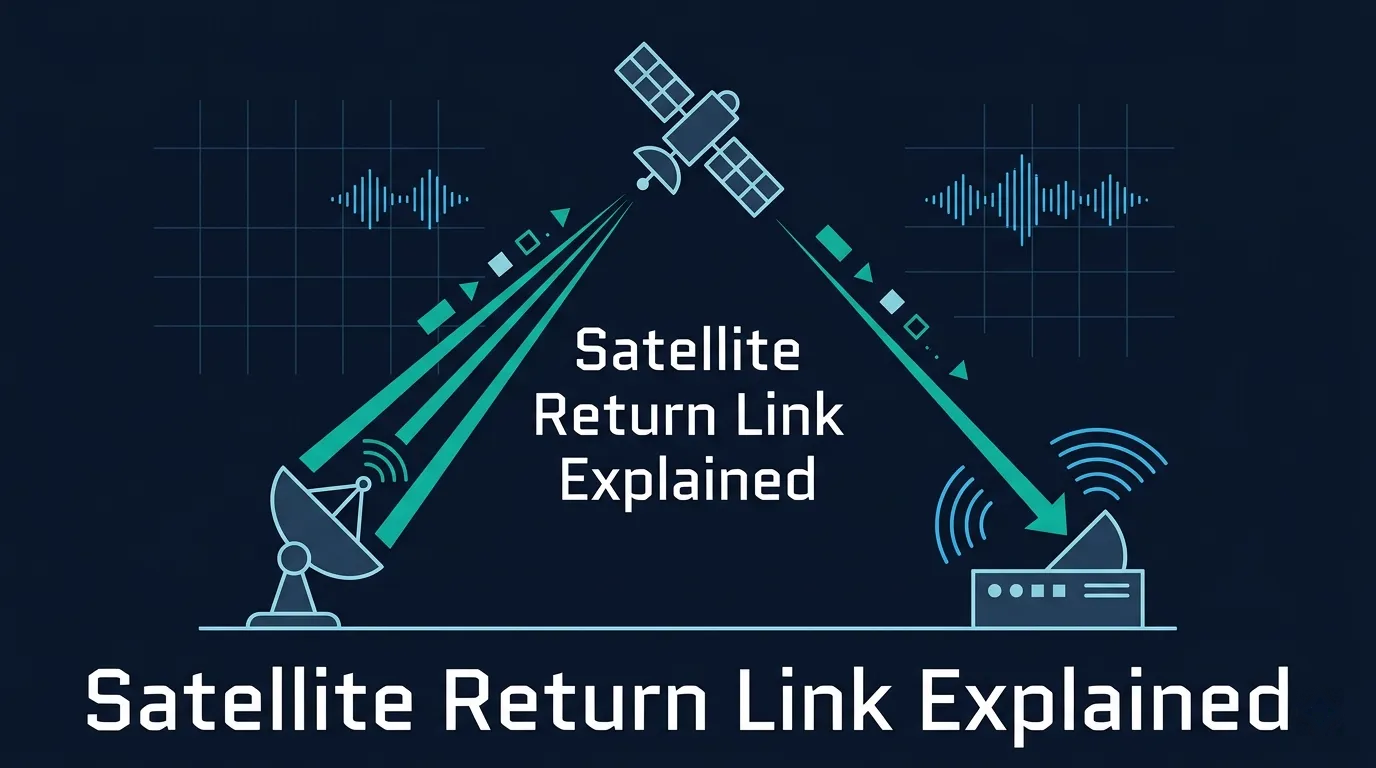
Satellite Return Link Explained: How Remote Terminals Send Traffic Back to the Network
Learn how the satellite return link works, including TDMA and SCPC return channels, performance factors, and engineering trade-offs for VSAT networks.
In every satellite communication network, data flows in two directions. The forward link carries traffic from the hub to remote terminals. The return link carries traffic the other way — from remote terminals back to the hub. While the forward link tends to get more attention because it delivers the bulk of downstream bandwidth, the return link is what makes satellite communication interactive. Without it, remote sites cannot send emails, upload files, make VoIP calls, acknowledge received data, or do anything that requires transmitting information back to the network.
The return link is also where most of the engineering complexity lives. On the forward link, a single powerful hub transmitter broadcasts to many receivers — a relatively straightforward one-to-many architecture. On the return link, many small terminals must share limited satellite capacity to send data back to the hub — a many-to-one problem that requires careful coordination of access methods, power levels, timing, and bandwidth allocation.
This article explains how the satellite return link works, what technologies and access methods are used, what affects performance, and what trade-offs engineers face when designing return channels for real VSAT networks. For related background, see our guides on satellite terminal architecture and satellite hub architecture.
Key terms used in this article: Return link (the communication path from a remote terminal through the satellite to the hub), forward link (the communication path from the hub through the satellite to remote terminals), TDMA (Time Division Multiple Access — terminals share a carrier by transmitting in assigned time slots), SCPC (Single Channel Per Carrier — each terminal gets a dedicated frequency allocation), MF-TDMA (Multi-Frequency TDMA — bursts assigned across both time slots and frequency channels), CIR (Committed Information Rate — guaranteed minimum bandwidth), BUC (Block Up Converter — the transmit amplifier on a remote terminal), EIRP (Effective Isotropic Radiated Power — a measure of transmitted signal strength).
What Is the Satellite Return Link?
The satellite return link is the communication path that carries data from a remote terminal, up to the satellite, and back down to the hub earth station. In industry terminology, this is sometimes called the "inbound" link, the "upstream" path, or simply the "return channel."
In a typical star-topology VSAT network, the return link operates as follows:
- A remote terminal generates data (user traffic, acknowledgments, signaling messages)
- The terminal's modem encodes and modulates the data onto a carrier signal
- The BUC (Block Up Converter) amplifies the signal and transmits it through the antenna toward the satellite
- The satellite's transponder receives the signal, frequency-converts it, amplifies it, and retransmits it back toward Earth
- The hub earth station receives the signal, demodulates it, and extracts the original data
- The data is routed into the terrestrial network for delivery to its destination
The return link is fundamentally different from the forward link in several important ways. On the forward link, the hub has a large antenna (typically 4.5 m to 13 m), a high-power amplifier, and full control over what gets transmitted and when. On the return link, each remote terminal has a small antenna (typically 0.75 m to 2.4 m), a relatively low-power BUC (typically 1 W to 4 W for Ku-band VSAT), and must coordinate with many other terminals to avoid interference.
This asymmetry — powerful hub transmitter versus many small remote transmitters — is one of the defining characteristics of satellite network design and directly shapes how return link capacity is engineered.
How the Return Link Works
Signal Path
The return link signal follows a well-defined physical path. The remote terminal's indoor unit (modem) takes digital data, applies forward error correction coding, modulates it onto an intermediate frequency (IF) carrier, and passes it to the outdoor unit. The BUC converts this IF signal to the transmit frequency (for example, 14.0–14.5 GHz in Ku-band) and amplifies it. The antenna focuses the signal into a narrow beam aimed at the satellite.
At the satellite, the transponder receives the signal on the uplink frequency, translates it to the downlink frequency (for example, 11.7–12.2 GHz in Ku-band), amplifies it, and retransmits it. The hub's large antenna receives the signal with high gain, and the hub's demodulator recovers the original data.
The entire one-way trip takes approximately 120–140 ms for a geostationary satellite, depending on the geometry between the terminal, satellite, and hub. The round-trip delay (terminal → satellite → hub → satellite → terminal) is approximately 480–560 ms, which has significant implications for protocols like TCP and for interactive applications. For more on latency effects, see our guide on satellite burst timing.
Channel Access Methods
The core engineering challenge on the return link is how multiple terminals share the available satellite capacity. Unlike the forward link where the hub has sole control of the carrier, the return link must accommodate transmissions from dozens, hundreds, or even thousands of independent terminals. Several access methods address this:
TDMA (Time Division Multiple Access) — Terminals share a single carrier frequency by transmitting in assigned time slots. A central controller (typically at the hub) allocates time slots to terminals based on their traffic demands. Each terminal transmits a burst of data during its assigned slot and remains silent during other terminals' slots. TDMA is the most common return link access method in modern VSAT networks.
MF-TDMA (Multi-Frequency TDMA) — An extension of TDMA where the available bandwidth is divided into multiple carriers, each subdivided into time slots. Terminals can be assigned slots on different carriers, providing more flexibility in bandwidth allocation. Most modern VSAT platforms (iDirect, Hughes, Newtec/ST Engineering) use MF-TDMA for return channels.
SCPC (Single Channel Per Carrier) — Each terminal is assigned its own dedicated carrier frequency with fixed or dynamically allocated bandwidth. There is no time-sharing with other terminals. SCPC provides predictable, low-jitter performance but uses spectrum less efficiently when traffic is bursty. It is typically used for high-throughput or latency-sensitive applications.
Aloha and Slotted Aloha — Random-access methods where terminals transmit whenever they have data, without pre-assigned slots. Collisions are handled through retransmission. Used primarily for signaling channels, low-rate telemetry, or initial network entry — not for sustained data traffic due to throughput limitations under load.
For a detailed comparison of contention-based and assigned access methods, see our guide on satellite contention ratios.
Bandwidth Allocation
Return link bandwidth is a scarce resource. A typical VSAT remote terminal might have only 128 kbps to 2 Mbps of return link capacity, compared to 2–20 Mbps or more on the forward link. This asymmetry reflects both the physical limitations (small antenna, low-power BUC) and the typical traffic pattern (most users download more than they upload).
In TDMA systems, bandwidth allocation is dynamic. The hub monitors each terminal's traffic queue and assigns time slots accordingly. When a terminal has data to send, it requests capacity from the hub, and the hub allocates slots in subsequent frames. This demand-assigned multiple access (DAMA) approach ensures that satellite capacity is directed to terminals that need it, rather than sitting idle at terminals with no traffic.
In SCPC systems, bandwidth can be fixed (a permanent allocation regardless of traffic) or dynamic (adjusted by the hub based on traffic patterns). Dynamic SCPC, sometimes called DAMA-SCPC, provides the dedicated-carrier benefits of SCPC with better spectral efficiency.
Return Link in Real VSAT Systems
TDMA Return (Shared Broadband)
The most common return link configuration in broadband VSAT networks uses MF-TDMA. This is what you find in networks serving internet access, enterprise branch connectivity, and general-purpose communication.
In a typical MF-TDMA return channel configuration:
- The return bandwidth might be 2–10 MHz of transponder space, divided into multiple carriers (e.g., four 2.5 MHz carriers)
- Each carrier is divided into time slots, with frame lengths typically 10–100 ms
- Terminals are assigned slots dynamically based on traffic demand
- CIR (Committed Information Rate) guarantees each terminal a minimum return rate (e.g., 128 kbps or 256 kbps)
- MIR (Maximum Information Rate) allows terminals to burst above CIR when capacity is available
- Contention ratios of 10:1 to 40:1 are common, meaning the total CIR sold exceeds the raw capacity
This architecture serves the majority of VSAT deployments well. Most remote sites have bursty return traffic — occasional web requests, email, small file uploads — and the statistical multiplexing of TDMA handles this efficiently.
SCPC Return (Dedicated Enterprise)
For applications requiring guaranteed, constant return bandwidth with minimal jitter and latency variation, SCPC return channels are used. Typical applications include:
- Voice trunking: Carrying multiple simultaneous phone calls requiring constant bitrate
- SCADA and industrial telemetry: Continuous streams of sensor data from oil platforms, pipelines, or mining operations (see our guide on QoS over satellite)
- Video contribution: Sending video feeds from remote locations back to a broadcast center
- Financial transactions: Applications where latency consistency matters more than raw throughput
In an SCPC return configuration, each terminal is assigned a dedicated carrier — perhaps 256 kbps, 512 kbps, or several Mbps depending on requirements. The terminal transmits continuously on this carrier. There is no contention with other terminals, so performance is predictable. The trade-off is spectral efficiency: if the terminal's traffic is bursty, the allocated bandwidth sits unused during idle periods.
Shared Broadband with QoS Tiers
Many modern VSAT platforms offer hybrid approaches that combine TDMA efficiency with QoS guarantees:
- Priority queuing: Return traffic is classified into queues (real-time, interactive, bulk) and higher-priority traffic gets slots first
- Guaranteed CIR with burst capability: Each terminal has a guaranteed minimum rate but can use additional capacity when available
- Dynamic carrier allocation: The hub can add or remove return carriers based on aggregate demand across the network
Dedicated Enterprise with Dynamic SCPC
Some platforms offer dynamic SCPC, where terminals are assigned dedicated carriers but the carrier bandwidth is adjusted in real time based on traffic. When the terminal has heavy return traffic, the carrier expands. When traffic drops, the carrier shrinks and the freed spectrum is available for other users. This provides SCPC-like dedicated performance with better overall spectrum utilization.
What Affects Return Link Performance?
Several factors determine how well the return link performs in a given deployment:
Terminal Hardware
The remote terminal's transmit chain directly limits return link capability:
- Antenna size: A larger antenna provides more gain, which translates to either higher data rates or better link margin. A 1.2 m antenna has roughly 4 dB more gain than a 0.75 m antenna at the same frequency.
- BUC power: Higher BUC power means more EIRP, enabling higher symbol rates or more robust coding. Typical VSAT BUCs range from 1 W to 4 W; larger installations may use 8 W or 16 W.
- Modem capability: The modem determines which modulation and coding schemes are available. Modern modems supporting DVB-RCS2 or proprietary waveforms can use adaptive coding and modulation (ACM) on the return link, adjusting to link conditions in real time.
Satellite Parameters
The satellite itself affects return link performance:
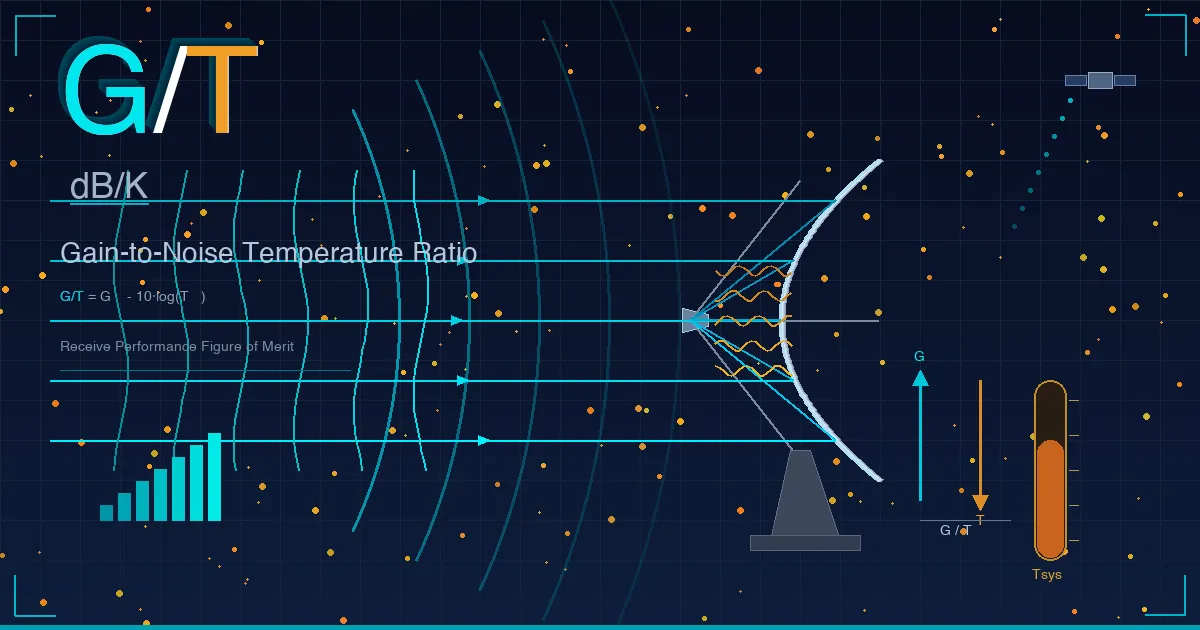
- Transponder gain (G/T): The satellite's receive sensitivity determines how well it can capture weak signals from small remote terminals
- Transponder bandwidth: The total available bandwidth limits how many return carriers or time slots can be supported
- Beam coverage: Spot beams concentrate satellite receive power over smaller areas, improving G/T for terminals in the beam footprint
- Transponder loading: Other carriers sharing the same transponder create intermodulation products that raise the noise floor
Atmospheric Conditions
Weather significantly impacts the return link, particularly at higher frequencies:
- Rain fade: Rain attenuates the uplink signal from the remote terminal. At Ku-band, heavy rain can cause 5–15 dB of signal loss. At Ka-band, losses can exceed 20 dB. This is more critical on the return link because the terminal has less power margin than the hub. See our detailed guide on satellite ranging for how terminals compensate.
- Uplink power control (UPC): Terminals can increase their transmit power during rain events to compensate for atmospheric loss, but only up to the BUC's maximum output. Beyond that, the link degrades.
- ACM (Adaptive Coding and Modulation): Modern systems can shift to more robust (lower rate) coding and modulation when link conditions deteriorate, maintaining connectivity at reduced throughput rather than losing the link entirely.
Network Loading
The number of active terminals and their traffic patterns affect return link performance:
- Contention: In TDMA systems, when many terminals request capacity simultaneously, not all requests can be served immediately. Terminals experience increased latency as they wait for slot assignments.
- Queue depth: If a terminal generates data faster than its allocated return rate, packets queue in the modem buffer. Excessive queuing adds latency (bufferbloat) and can cause packet drops.
- Overhead: TDMA systems have overhead from guard times, preambles, and signaling. As the number of terminals increases, aggregate overhead increases, reducing the fraction of capacity available for user data.
Return Link vs Forward Link
Understanding the differences between the return and forward links is essential for satellite network design:
| Parameter | Forward Link | Return Link |
|---|---|---|
| Direction | Hub → satellite → terminals | Terminal → satellite → hub |
| Transmitter | Single high-power hub | Many low-power terminals |
| Antenna size (typical) | 4.5 m – 13 m | 0.75 m – 2.4 m |
| BUC/HPA power | 50 W – 400 W | 1 W – 4 W (VSAT) |
| Access method | TDM (single carrier, continuous) | TDMA, MF-TDMA, SCPC, Aloha |
| Bandwidth (typical per terminal) | 2–50 Mbps shared | 128 kbps – 2 Mbps |
| Modulation | DVB-S2/S2X, high-order (up to 32APSK) | DVB-RCS2 or proprietary, lower-order |
| ACM control | Hub adjusts per-terminal | Terminal adjusts or hub commands |
| Rain fade impact | Affects hub uplink (large margin) | Affects terminal uplink (smaller margin) |
| Complexity | Straightforward broadcast | Multiple access coordination required |
| Typical traffic | Downloads, streaming, web pages | Uploads, acknowledgments, VoIP, telemetry |
The asymmetry between forward and return links is not a design flaw — it reflects the fundamental asymmetry of most satellite communication applications. Most remote sites consume more data than they generate, so allocating more capacity to the forward link and less to the return link is economically efficient. However, this asymmetry must be carefully managed. Applications like VoIP, video conferencing, and cloud backup generate significant return traffic, and undersizing the return link for these use cases causes performance problems.
Engineering Trade-offs
Designing the return link involves balancing several competing objectives:
Throughput vs Efficiency
Higher per-terminal throughput requires either more bandwidth (expensive) or more aggressive modulation (requires better link conditions). SCPC provides consistent throughput but wastes spectrum during idle periods. TDMA provides statistical multiplexing that improves aggregate efficiency but introduces contention and variable latency.
Latency vs Capacity
TDMA systems add access delay — the time a terminal waits for a slot assignment — on top of the inherent satellite propagation delay. Shorter TDMA frames reduce access delay but increase the ratio of overhead to payload. SCPC eliminates access delay but at the cost of dedicated spectrum per terminal.
Terminal Cost vs Performance
Larger antennas and higher-power BUCs improve return link performance (more throughput, better rain margin) but increase the cost and complexity of each remote installation. For a network with thousands of terminals, even a small increase in per-terminal cost multiplies significantly.
Contention Ratio vs User Experience
Higher contention ratios (more terminals sharing the same return capacity) reduce per-terminal cost but increase the probability that terminals compete for bandwidth during peak hours. Finding the right contention ratio requires understanding the traffic patterns of the specific user base.
Rain Margin vs Throughput
Designing for high link availability (e.g., 99.9%) requires reserving power and coding margin for rain events. This reserved margin is "wasted" during clear-sky conditions when higher-rate modulation could be used. ACM helps by dynamically adjusting to conditions, but even ACM systems must be designed with a target availability in mind.
Common Problems
Insufficient Return Bandwidth
Symptom: Slow uploads, high latency on interactive applications, TCP performance degradation, VoIP quality issues.
Cause: The return link CIR is too low for the traffic demand. This is the most common return link problem, often caused by optimistic contention ratio assumptions or changing traffic patterns (e.g., adding cloud-based applications that generate more upstream traffic than expected).
Resolution: Increase CIR allocation per terminal, add return carriers, reduce contention ratio, or implement traffic shaping to prioritize critical return traffic.
Terminal Transmit Issues
Symptom: Intermittent connectivity, high error rates on return channel, frequent re-ranging.
Cause: BUC degradation, antenna mispointing, cable losses, or incorrect transmit frequency/power configuration. A BUC that has lost 2–3 dB of output power may work in clear sky but fail during any rain event.
Resolution: Verify BUC output power with a spectrum analyzer or power meter, check antenna pointing (cross-pol alignment is often overlooked), inspect cable connections and weatherproofing, verify modem transmit configuration.
TDMA Timing Failures
Symptom: Burst collisions, CRC errors on return channel, terminal unable to acquire network.
Cause: Incorrect ranging, timing drift due to oscillator instability, or hub receiver synchronization issues. Timing errors as small as a few microseconds can cause burst overlap in TDMA systems. See our detailed guide on satellite burst timing and satellite ranging.
Resolution: Re-range affected terminals, verify terminal oscillator stability, check hub timing reference, verify that guard times are adequate for the network geometry.
Rain Fade Degradation
Symptom: Reduced return rates during rain events, link drops in heavy rain, increased error rates.
Cause: Atmospheric attenuation exceeding the link's fade margin. This is more impactful on the return link because terminals have less power margin than the hub.
Resolution: Ensure UPC is properly configured, verify BUC has adequate power headroom, consider ACM if not already enabled, evaluate whether the antenna size provides sufficient margin for the climate zone.
Interference
Symptom: Elevated noise floor on return carriers, reduced throughput across all terminals, intermittent errors.
Cause: Adjacent satellite interference, cross-pol leakage, terrestrial interference, or intermodulation from other carriers on the same transponder.
Resolution: Use carrier monitoring tools to identify interference sources, verify terminal antenna cross-pol isolation, coordinate with satellite operator, adjust carrier frequencies or power levels if needed.
Practical Design and Troubleshooting Notes
Sizing the Return Link
When designing a return link for a new network, consider these practical guidelines:
- Start with application requirements: Determine the minimum return rate each terminal needs for its applications (VoIP needs ~90 kbps per call, web browsing acknowledgments need 64–128 kbps, cloud backup may need 512 kbps or more)
- Apply contention ratio: For general broadband, 10:1 to 20:1 is reasonable. For enterprise with SLAs, 4:1 to 8:1. For critical applications, 1:1 (SCPC)
- Add overhead: TDMA overhead (guard times, preambles, signaling) typically consumes 10–20% of raw capacity
- Calculate transponder bandwidth: Total return bandwidth = (number of terminals × CIR per terminal) / contention ratio + overhead
- Validate link budget: Verify that the terminal's EIRP can close the link at the required data rate with adequate margin for rain fade and other impairments
Monitoring Return Link Health
Key metrics to monitor in an operational network:
- Es/No (or Eb/No): Signal quality on each terminal's return bursts — trending downward indicates terminal or link issues
- Transmit power: If terminals are consistently at maximum power, there is no margin for rain events
- CIR utilization: If terminals regularly exhaust their CIR, they may need more allocation
- Burst error rate: Increasing errors indicate link quality degradation
- Queue depth / buffer occupancy: High queue depths cause latency spikes and eventual packet loss
Troubleshooting Workflow
When investigating return link problems:
- Check the hub receiver: Verify that the hub is receiving return carriers at expected levels. If all terminals show degraded performance, the problem may be at the hub or satellite level.
- Isolate to a single terminal: If only one terminal is affected, the problem is likely terminal-specific (hardware, pointing, local interference).
- Check spectrum: A spectrum analyzer view of the return band reveals interference, carrier levels, and unexpected signals.
- Verify link budget: Compare actual received Es/No against the link budget prediction. A mismatch indicates a hardware problem (BUC degradation, cable loss, antenna mispointing) or an environmental factor (rain, humidity, ice on antenna).
- Check timing: For TDMA systems, verify that the terminal's burst timing is within specification. Timing errors cause burst overlap and affect not just the misbehaving terminal but also adjacent terminals in the TDMA frame.
FAQ
What is the satellite return link?
The satellite return link is the communication path from a remote terminal, through the satellite, to the hub earth station. It carries all traffic that originates at the remote site — uploads, voice calls, acknowledgments, signaling messages, and any other data that needs to reach the hub or the wider network.
Why is the return link slower than the forward link?
The return link is typically slower because remote terminals have smaller antennas and lower transmit power than the hub. This limits the data rate that can be reliably transmitted. Additionally, most satellite applications are download-heavy (web browsing, streaming, file downloads), so network designs intentionally allocate more capacity to the forward link and less to the return link to match typical usage patterns.
What is the difference between TDMA and SCPC on the return link?
In TDMA, multiple terminals share a carrier by transmitting in assigned time slots. This provides efficient use of spectrum when traffic is bursty but introduces variable latency. In SCPC, each terminal has a dedicated carrier with its own frequency allocation. This provides consistent, low-jitter performance but uses spectrum less efficiently when traffic is intermittent. TDMA is more common for broadband VSAT; SCPC is used for applications requiring dedicated, predictable bandwidth.
How does rain affect the return link?
Rain attenuates the radio signal between the terminal and the satellite. Because the terminal has limited transmit power, rain fade can reduce the signal-to-noise ratio below the threshold needed for reliable communication. Modern systems use uplink power control (increasing BUC power during rain) and adaptive coding and modulation (switching to more robust but lower-rate transmission) to maintain connectivity during rain events. The return link is typically more vulnerable to rain fade than the forward link because the terminal has less power margin than the hub.
Can the return link use adaptive coding and modulation (ACM)?
Yes. Modern VSAT platforms support ACM on the return link, allowing terminals to adjust their modulation and coding scheme based on current link conditions. In clear sky, a terminal might use 8PSK with high-rate coding for maximum throughput. During rain, it can fall back to QPSK with lower-rate coding to maintain the link at reduced throughput. This is a significant improvement over older fixed-coding systems that had to be designed for worst-case conditions at all times.
What is CIR and MIR on the return link?
CIR (Committed Information Rate) is the guaranteed minimum bandwidth allocated to a terminal on the return link. The network guarantees this rate will be available regardless of how many other terminals are active. MIR (Maximum Information Rate) is the maximum rate a terminal can achieve when spare capacity is available. For example, a terminal might have a CIR of 256 kbps and a MIR of 2 Mbps — it always gets at least 256 kbps but can burst up to 2 Mbps when the return channel is lightly loaded.
How do I know if my return link is undersized?
Signs of an undersized return link include: consistently high CIR utilization across terminals, frequent congestion during business hours, slow uploads, degraded VoIP or video conferencing quality, high TCP round-trip times beyond what satellite delay alone would explain, and user complaints about interactive application performance. Monitoring CIR utilization and queue depths at the hub provides the most direct indication.
What is the typical return link bandwidth for a VSAT terminal?
For broadband VSAT services, typical CIR on the return link ranges from 128 kbps to 512 kbps, with MIR up to 2–5 Mbps. Enterprise VSAT services may offer 512 kbps to 2 Mbps CIR. SCPC links for dedicated applications can range from 256 kbps to 10 Mbps or more depending on the application and terminal hardware. The specific allocation depends on the service plan, terminal hardware capabilities, and the satellite network's capacity design.
Key Takeaways
- The return link carries traffic from remote terminals through the satellite to the hub — it is what makes satellite networks interactive rather than broadcast-only
- TDMA (specifically MF-TDMA) is the most common return link access method, offering efficient spectrum sharing through dynamic time-slot assignment
- SCPC provides dedicated, predictable return bandwidth but is less spectrally efficient for bursty traffic
- Return link performance depends on terminal hardware (antenna size, BUC power), satellite parameters (G/T, transponder bandwidth), atmospheric conditions (rain fade), and network loading (contention ratio)
- The return link is inherently asymmetric compared to the forward link — smaller antennas, lower power, lower data rates — reflecting the typical download-heavy traffic pattern of most satellite applications
- ACM on the return link is a critical capability that maintains connectivity during rain events by dynamically adjusting modulation and coding
- Proper return link sizing requires understanding application requirements, contention ratios, overhead, and link budget — undersizing the return link is one of the most common VSAT network design mistakes
- Monitoring return link metrics (Es/No, transmit power, CIR utilization, queue depth) is essential for maintaining network health and identifying problems before they affect users
For further reading on related topics, explore our guides on satellite hub architecture, satellite terminal architecture, QoS over satellite, and satellite contention ratio.
Author

Organizational byline for SATCOM Index technical content. A named technical reviewer appears separately only when identity, scope, and permission are verified.
Categories
More Posts
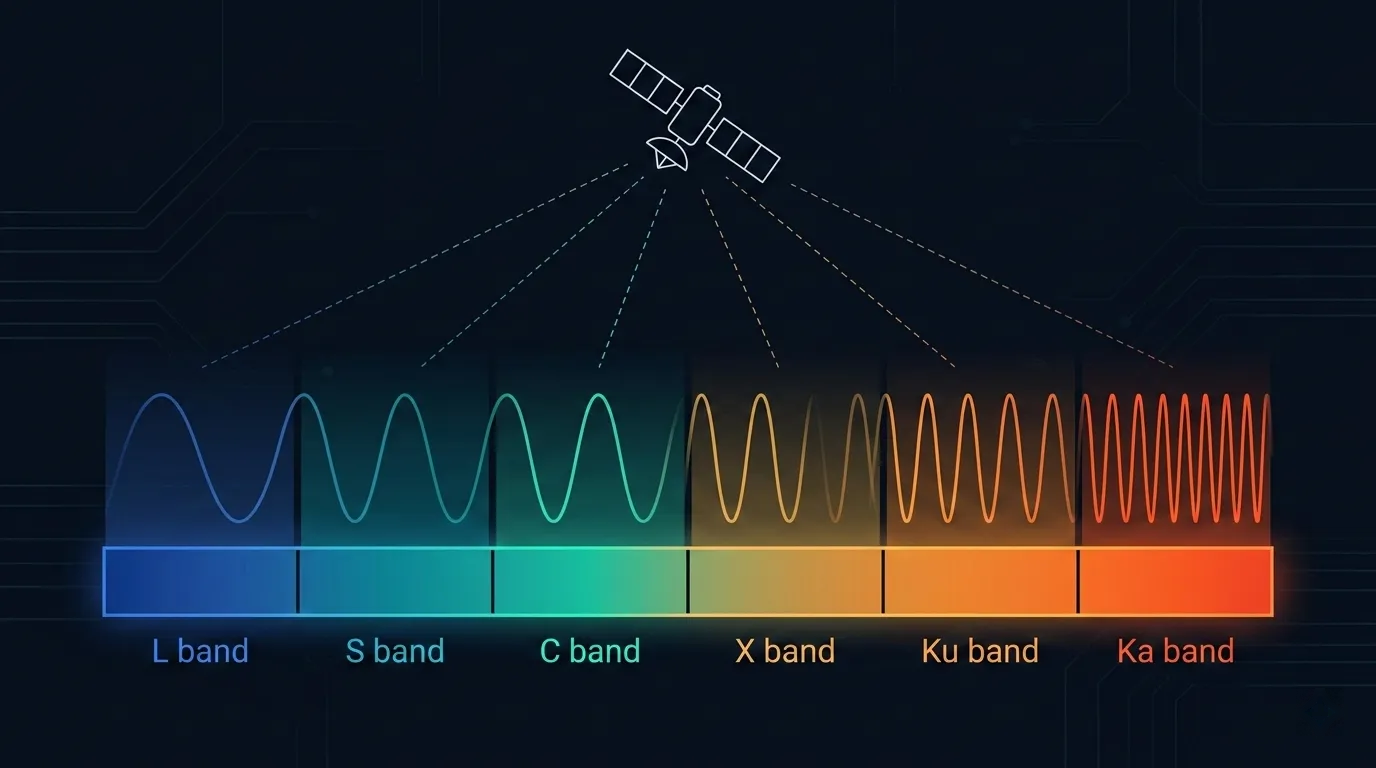
Satellite Frequency Bands: L, S, C, X, Ku and Ka
Understand L, S, C, X, Ku and Ka labels, ITU allocations, uplink/downlink direction, propagation, antenna scaling, and a defensible selection workflow.
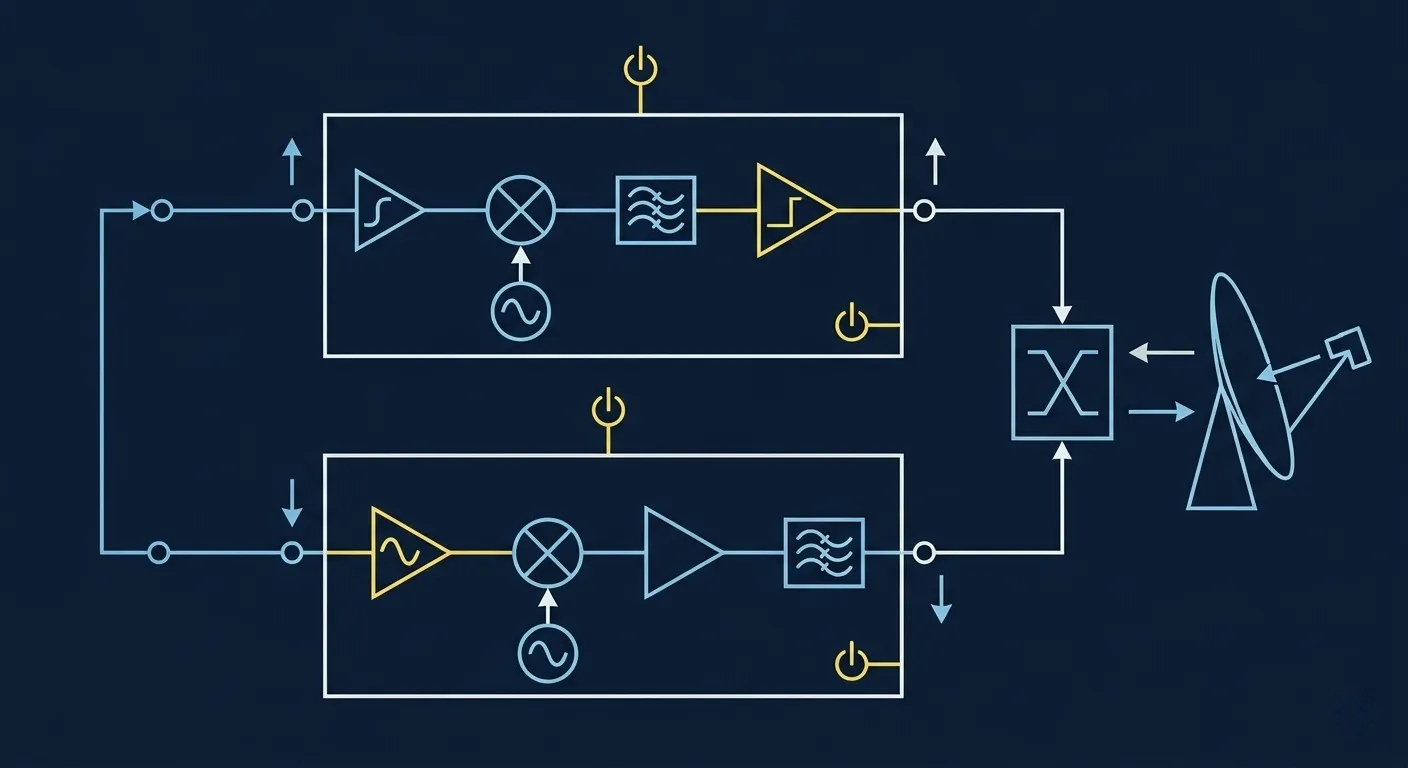
BUC vs LNB vs LNA in Satellite Systems Explained
Engineering guide comparing BUC, LNB, and LNA satellite RF components covering signal flow, selection criteria, failure modes, and practical troubleshooting.
Satellite G/T Explained | Why Antenna Gain-to-Noise Temperature Matters in SATCOM
Engineering guide to satellite G/T covering definition, formula, system noise temperature, receive chain design, VSAT and maritime examples, and comparison with EIRP, antenna gain, and C/N.