
MCPC vs SCPC Explained: How Satellite Networks Choose Between Shared and Dedicated Carriers
Technical comparison of MCPC and SCPC satellite carrier architectures covering capacity allocation, cost trade-offs, use cases, and how real VSAT networks combine both models.
MCPC vs SCPC Explained
Every satellite link begins with a carrier — a modulated RF signal occupying a specific frequency slot on a transponder. How traffic is mapped onto those carriers is one of the most consequential architectural decisions in satellite network design. The two fundamental models are SCPC (Single Channel Per Carrier), where each traffic stream gets its own dedicated carrier, and MCPC (Multi-Channel Per Carrier), where multiple traffic streams are multiplexed onto a single shared carrier. This choice shapes bandwidth efficiency, cost structure, performance guarantees, and operational complexity for the entire network.
The distinction between dedicated and shared capacity models runs through nearly every aspect of satellite engineering. It determines how transponder bandwidth is consumed, how equipment at the hub and remote sites is configured, and how the network scales as new sites are added. Understanding MCPC and SCPC is essential for anyone designing, procuring, or operating satellite communication systems — and for understanding why most production VSAT networks use both models simultaneously.
This article provides a detailed technical comparison of MCPC and SCPC carrier architectures. It covers how each model works, their engineering trade-offs, where each architecture fits best, and how real-world VSAT systems combine them. This comparison complements the broader discussion of SCPC vs TDMA, which covers access methods on the return channel rather than carrier architecture on the forward path.
Key terms used in this article: SCPC (Single Channel Per Carrier) — a carrier architecture where each traffic stream is assigned a dedicated carrier with fixed bandwidth. MCPC (Multi-Channel Per Carrier) — a carrier architecture where multiple traffic streams are time-division multiplexed onto a single aggregate carrier. TDM (Time Division Multiplexing) — a technique that combines multiple data streams into one carrier by assigning each stream a time slot. Statistical multiplexing — a bandwidth-sharing technique where total allocated capacity is less than the sum of all users' peak rates, relying on the statistical improbability of all users peaking simultaneously. Forward link — the hub-to-remote direction in a VSAT network. Return link — the remote-to-hub direction.
What Is SCPC?
SCPC — Single Channel Per Carrier — is the most straightforward carrier architecture in satellite communications. Each traffic stream is assigned its own dedicated carrier, occupying a fixed frequency slot on the transponder. A 2 Mbps link between two sites gets a carrier sized to carry exactly that throughput, and that carrier remains active and allocated regardless of whether the link is fully loaded or idle.
Each SCPC carrier operates independently on the transponder. The carrier's bandwidth is determined by its symbol rate and modulation/coding configuration, and the carrier spacing between adjacent SCPC carriers must include appropriate guard bands to prevent interference. A transponder carrying multiple SCPC links will have a series of individual carriers spread across its bandwidth, each serving a single point-to-point connection.
The defining characteristic of SCPC is deterministic performance. Because the carrier is dedicated, there is no contention for bandwidth — the link delivers its full rated throughput at all times. Latency is consistent and predictable, with no queuing delays from competing traffic. Jitter is minimal because the carrier operates continuously at a fixed rate. These properties make SCPC the natural choice for applications that demand guaranteed performance: enterprise point-to-point links, cellular backhaul trunks, voice trunking, and financial data circuits.
SCPC's simplicity extends to troubleshooting and monitoring. Each carrier represents a single link, so performance metrics map directly to a specific connection. If a carrier shows degraded C/N or increased errors, the affected link is immediately identifiable. There is no need to untangle the performance of multiple traffic streams sharing a common carrier.
SCPC in one sentence: Each traffic stream gets its own dedicated carrier with fixed bandwidth — no sharing, no contention, guaranteed throughput at the cost of dedicated transponder capacity per link.
The trade-off is efficiency. An SCPC carrier sized for peak demand wastes capacity during off-peak periods. A 2 Mbps carrier carrying 500 kbps of actual traffic still occupies 2 Mbps of transponder bandwidth. Across a network with dozens or hundreds of links, this over-provisioning can result in significant transponder waste — and transponder bandwidth is one of the most expensive recurring costs in satellite operations.
What Is MCPC?
MCPC — Multi-Channel Per Carrier — takes the opposite approach. Instead of assigning each traffic stream its own carrier, MCPC multiplexes multiple traffic streams onto a single, larger aggregate carrier using time-division multiplexing (TDM). One carrier on the transponder serves many destinations, with the receiving equipment at each site extracting only the traffic addressed to it.
In a typical MCPC implementation, a hub station assembles traffic destined for all remote terminals into a single TDM stream. This stream is modulated onto one carrier, uplinked to the satellite, and broadcast across the coverage area. Each remote terminal receives the entire carrier but only processes the packets or time slots addressed to it — conceptually similar to how Ethernet operates on a shared segment, where all stations receive all frames but only process those matching their address.
The key advantage of MCPC is statistical multiplexing. When many traffic streams share a single carrier, the aggregate bandwidth can be substantially less than the sum of each stream's peak rate. If 50 remote sites each have a peak demand of 1 Mbps but their average utilization is 200 kbps, an MCPC carrier sized at 15-20 Mbps can serve all 50 sites effectively — compared to 50 Mbps of dedicated SCPC carriers that would be required to guarantee each site 1 Mbps individually. This statistical gain is the fundamental economic argument for MCPC.
MCPC is the standard architecture for the outbound (forward) link in hub-spoke VSAT networks. The DVB-S2 and DVB-S2X broadcast standards are inherently MCPC — the hub generates a single wideband TDM carrier that contains traffic for every remote in the beam. This is not a design choice but a structural feature of these standards: the forward carrier is always a shared, multiplexed stream.
MCPC in one sentence: Multiple traffic streams are multiplexed onto one shared carrier, enabling statistical multiplexing gains and efficient transponder utilization at the cost of contention-based performance variability.
MCPC's efficiency comes with a performance trade-off. Because bandwidth is shared, individual sites experience variable throughput depending on aggregate demand. During peak periods, sites may receive less than their maximum allocation. Quality of Service (QoS) mechanisms — traffic prioritization, bandwidth guarantees, and fair-use policies — become essential to ensure that critical traffic receives adequate bandwidth even when the shared carrier is heavily loaded.
MCPC vs SCPC: Core Differences
The fundamental distinction between MCPC and SCPC is shared versus dedicated capacity, but this difference cascades into nearly every aspect of network design and operation.
| Parameter | SCPC | MCPC |
|---|---|---|
| Carrier allocation | One dedicated carrier per traffic stream | One shared carrier for multiple traffic streams |
| Bandwidth per user | Fixed, guaranteed at all times | Variable, shared via statistical multiplexing |
| Contention | None — dedicated capacity | Present — users share aggregate capacity |
| Latency predictability | Highly predictable, no queuing variability | Slightly variable due to TDM scheduling |
| Scalability | Linear cost increase per new link | Incremental cost per new site on shared carrier |
| Equipment complexity | Simple per-link modems | Hub-based multiplexer and scheduler required |
| Cost model | Dedicated cost per link | Shared cost distributed across users |
| Typical direction | Point-to-point, or return link for high-traffic remotes | Forward (outbound) link in hub-spoke VSAT |
The capacity allocation difference is the most significant. SCPC guarantees each link a fixed portion of transponder bandwidth, regardless of actual utilization. MCPC allocates transponder bandwidth to an aggregate carrier that is shared across many links, with individual allocations managed dynamically by the hub. This means SCPC is bandwidth-guaranteed but potentially wasteful, while MCPC is bandwidth-efficient but performance-variable.
Cost implications follow directly from the allocation model. SCPC costs scale linearly — each new link requires dedicated transponder bandwidth, and the cost per link is independent of how many other links exist on the network. MCPC costs are shared — adding a new remote site to an existing MCPC carrier requires minimal additional transponder bandwidth (only the incremental average traffic), making the marginal cost per site significantly lower. For networks with many sites and bursty traffic, MCPC can reduce total transponder costs by 50% or more compared to equivalent SCPC provisioning.
The performance predictability trade-off is equally important. SCPC provides deterministic throughput, latency, and jitter — the link behaves identically whether the rest of the network is idle or fully loaded. MCPC performance depends on aggregate demand from all users sharing the carrier. Well-engineered MCPC systems with appropriate QoS deliver consistent service for most applications, but they cannot match SCPC's absolute predictability under all conditions.
Where SCPC Works Best
SCPC is the right choice when guaranteed, predictable performance outweighs the cost of dedicated bandwidth. Several application profiles consistently favor SCPC.
Enterprise point-to-point links requiring guaranteed bandwidth are the classic SCPC use case. A corporate headquarters connecting to a regional office over satellite needs a link that delivers its rated throughput at all times — not "most of the time" or "on average." SCPC provides this guarantee without depending on traffic patterns at other sites.
Cellular backhaul is increasingly served by SCPC. Base stations generate continuous, high-volume traffic that is poorly suited to statistical multiplexing — when a cell tower is active, its traffic load is relatively constant and high. SCPC ensures the backhaul link can carry the base station's full capacity without contention from other sites.
Trunking between hub locations — connecting two major network nodes that exchange large, continuous traffic volumes — is a natural SCPC application. These links operate at high utilization with predictable traffic profiles, meaning SCPC's dedicated allocation closely matches actual demand and the statistical multiplexing gains of MCPC would be minimal.
High-priority, latency-sensitive applications such as voice trunks, financial transaction data, and real-time telemetry benefit from SCPC's deterministic latency. While the satellite propagation delay itself is the same for both SCPC and MCPC, SCPC eliminates the variable queuing and scheduling delays that MCPC can introduce under load. For applications where even a few milliseconds of jitter matters, SCPC provides cleaner, more predictable timing.
Links with continuous, predictable traffic profiles are generally better served by SCPC. When a link operates at 70-90% utilization throughout the day with minimal variation, SCPC's dedicated allocation closely matches demand and the efficiency penalty of unused bandwidth is small. The statistical multiplexing gains that justify MCPC only materialize when traffic is bursty and utilization varies significantly across sites and time periods. See network topology for how point-to-point SCPC links fit within broader network architectures.
Where MCPC Works Best
MCPC excels in scenarios where many sites share a common carrier and traffic patterns are sufficiently bursty to generate statistical multiplexing gains.
The shared outbound (forward) channel in hub-spoke VSAT networks is the most widespread MCPC application. In this architecture, a central hub serves hundreds or thousands of remote terminals over a single MCPC carrier. Each remote receives the full carrier and extracts its addressed traffic. This model is fundamental to modern VSAT platforms — every major hub-spoke system uses MCPC on the forward link because it is the only practical way to serve large remote populations without dedicating a separate carrier to each site.
Broadcast and multicast content distribution is inherently MCPC. When the same content must reach many receivers simultaneously — software updates, digital signage, market data feeds, or video distribution — MCPC delivers the content once on a shared carrier rather than duplicating it across individual SCPC carriers for each receiver. The bandwidth efficiency gain is proportional to the number of receivers.
Multi-site enterprise networks with many small remote offices represent MCPC's economic sweet spot. A retail chain with 500 stores, each needing 256 kbps average throughput with 1 Mbps peak capacity, would require 500 Mbps of SCPC capacity to guarantee peak rates. An MCPC carrier sized at 60-80 Mbps can serve the same network effectively, because the probability of all 500 stores peaking simultaneously is negligibly small. The transponder cost savings are substantial.
Hub-based environments where centralized scheduling optimizes bandwidth naturally pair with MCPC. The hub has complete visibility into all traffic flows and can dynamically allocate capacity on the shared carrier based on real-time demand, QoS policies, and service-level commitments. This centralized intelligence enables MCPC to deliver reliable per-site performance despite shared capacity — provided the network is properly engineered with adequate aggregate bandwidth and appropriate overbooking ratios.
Networks where traffic is bursty and intermittent benefit most from MCPC's statistical multiplexing. Remote sites that generate traffic in bursts — web browsing, email, periodic file transfers, IoT telemetry — rarely need their peak bandwidth simultaneously. MCPC captures these statistical gains automatically, making it dramatically more efficient than SCPC for this traffic profile.
Engineering Trade-offs
The choice between MCPC and SCPC involves several interconnected engineering trade-offs that affect network performance, cost, and operational complexity.
Efficiency vs. determinism. MCPC maximizes transponder utilization by sharing capacity across many users, but this sharing introduces performance variability. SCPC guarantees deterministic performance but wastes capacity during off-peak periods. The trade-off is quantifiable: if a network's aggregate peak-to-average ratio is 3:1 (meaning peak demand is three times average demand), MCPC can theoretically achieve 3x better transponder utilization than SCPC. In practice, the gain depends on the number of users, traffic burstiness, and the acceptable probability of congestion.
Dedicated vs. shared cost. SCPC's cost is predictable and per-link — each connection costs a fixed amount of transponder bandwidth regardless of network size. MCPC's cost is shared — the total transponder cost is divided across all users on the carrier, and adding new users costs incrementally less as the statistical multiplexing gain improves. For small networks (fewer than 10 sites), the difference may be modest. For large networks (hundreds of sites), MCPC's cost advantage can be decisive.
Scalability. MCPC scales more gracefully for large remote populations. Adding site number 501 to an existing MCPC carrier requires a fractional increase in carrier bandwidth to accommodate the incremental average traffic. Adding link number 501 to an SCPC network requires a full additional carrier, with its associated transponder bandwidth, guard band, and frequency coordination overhead. However, SCPC scales more predictably — each new link's performance is independent of existing links, while adding users to an MCPC carrier affects the contention ratio for all existing users.
Simplicity. SCPC is simpler to plan, provision, and troubleshoot. Each carrier is a self-contained link with directly observable performance metrics. MCPC requires hub-based scheduling intelligence, QoS configuration, bandwidth management algorithms, and more sophisticated monitoring to ensure that shared capacity is distributed appropriately. The operational complexity of MCPC is justified by its efficiency gains in large networks but may not be worth the overhead for small deployments.
Choosing SCPC "just to be safe" on every link is a common and costly mistake. Dedicating fixed carriers to links that carry bursty, low-utilization traffic wastes transponder capacity and inflates costs. SCPC should be reserved for links that genuinely require guaranteed throughput — not applied as a default because it feels safer. Proper traffic analysis and honest assessment of performance requirements prevent this over-provisioning trap.
MCPC / SCPC in Real VSAT Systems
Production VSAT networks rarely use MCPC or SCPC exclusively. Most real-world systems combine both architectures, applying each where its strengths are most valuable.
The most common hybrid pattern is MCPC for the outbound (forward) direction and SCPC or TDMA for the inbound (return) direction. On the forward link, the hub transmits a single MCPC carrier — typically DVB-S2 or DVB-S2X — containing TDM traffic for all remotes in a beam. This is inherently MCPC: one aggregate carrier, many traffic streams, statistical multiplexing at the hub. On the return link, each remote transmits back to the hub, and the access method varies based on traffic profile.
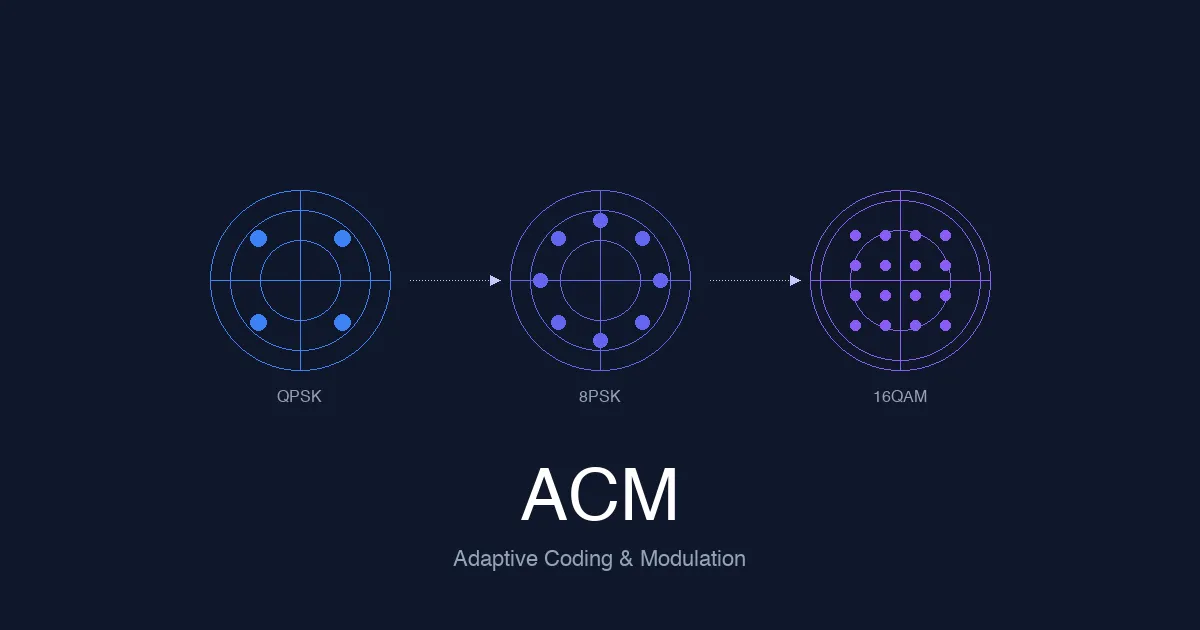
DVB-S2 and DVB-S2X based forward carriers are structurally MCPC. The standard defines a continuous TDM stream where the hub inserts addressed data frames (BBFrames) that are modulated and broadcast to all remotes. Each remote demodulates the entire carrier and extracts frames addressed to it. This architecture provides the statistical multiplexing and broadcast efficiency that MCPC offers, combined with adaptive coding and modulation that optimizes link efficiency for each remote's channel conditions.
Return channels present the architectural choice most clearly. High-traffic remotes — those with continuous, high-volume traffic like cellular backhaul or enterprise trunking — often use dedicated SCPC return carriers. The remote transmits on its own fixed-frequency carrier, providing guaranteed return-path bandwidth. Lower-traffic remotes with bursty demand typically share return capacity via MF-TDMA, which is a shared access method but differs from MCPC (see the Common Mistakes section below). Some platforms allow dynamic switching: a remote may use shared TDMA during low-traffic periods and switch to a dedicated SCPC carrier when sustained high-throughput demand is detected.
Carrier-in-carrier technology is an efficiency technique specific to SCPC links. By overlapping the transmit and receive carriers on the same frequency and canceling the self-interference, carrier-in-carrier can reduce the transponder bandwidth required for an SCPC link by up to 50%. This makes SCPC more competitive with MCPC on a cost-per-megabit basis for point-to-point links, though it does not change the fundamental dedicated vs. shared capacity distinction.
Mixed architectures allow operators to optimize each direction and each site independently. A network might use MCPC forward carriers for all remotes, SCPC return carriers for 10 high-priority sites, and shared TDMA return channels for the remaining 200 lower-priority sites. The hub architecture manages these diverse carrier types through a unified bandwidth management system that allocates capacity across all links based on traffic demand, QoS policies, and contractual commitments.
Common Mistakes
Several persistent misconceptions about MCPC and SCPC lead to suboptimal network designs and unnecessary costs.
"SCPC is always better because it's dedicated." This reasoning sounds logical but ignores efficiency. A dedicated carrier that sits at 15% average utilization is wasting 85% of its transponder allocation — expensive bandwidth that could serve other traffic. SCPC is better only when the traffic profile genuinely requires dedicated capacity. For bursty, variable-rate applications, MCPC with proper QoS delivers equivalent user experience at a fraction of the transponder cost.
"MCPC means poor performance." This misconception conflates shared capacity with degraded service. A well-engineered MCPC system with appropriate aggregate bandwidth, properly configured QoS policies, and realistic overbooking ratios delivers reliable, consistent performance for the vast majority of applications. The critical word is "well-engineered" — an MCPC carrier that is severely overbooked or lacks QoS differentiation will indeed deliver poor performance, but this is a design failure, not an inherent limitation of the architecture.
"MCPC and TDMA are the same thing." This is perhaps the most common confusion. MCPC is a carrier architecture — it describes how traffic is mapped onto carriers (multiple channels per carrier, using TDM). TDMA is an access method — it describes how multiple transmitters share a common time-frequency resource (by dividing access into time slots). They often coexist in the same network (MCPC on the forward link, TDMA on the return link), and MCPC uses TDM internally, but they are fundamentally different concepts operating at different layers of the system.
MCPC is not the same as TDMA. MCPC describes a carrier architecture where one carrier transports multiple multiplexed channels — typically on the forward (hub-to-remote) link using TDM. TDMA describes a multiple-access method where multiple transmitters share a carrier by taking turns in assigned time slots — typically on the return (remote-to-hub) link. Confusing the two leads to incorrect architecture comparisons and flawed network designs.
Frequently Asked Questions
What does MCPC stand for in satellite communication?
MCPC stands for Multi-Channel Per Carrier. It refers to a carrier architecture where multiple independent traffic streams or channels are multiplexed onto a single satellite carrier using time-division multiplexing. The receiving equipment demultiplexes the aggregate carrier to extract the specific channels addressed to each destination.
What does SCPC stand for in satellite communication?
SCPC stands for Single Channel Per Carrier. It refers to a carrier architecture where each traffic stream is assigned its own dedicated carrier on the satellite transponder. Each carrier occupies a distinct frequency slot and carries traffic for only one point-to-point connection.
Can MCPC and SCPC be used on the same satellite link?
Yes, and most production VSAT networks do exactly this. A typical configuration uses MCPC on the forward (hub-to-remote) link — a single DVB-S2/S2X carrier carrying multiplexed traffic for all remotes — and SCPC on the return (remote-to-hub) link for high-traffic sites that need guaranteed bandwidth. The two architectures operate on different carriers in different frequency bands or time slots.
Is MCPC the same as TDM?
MCPC uses TDM (Time Division Multiplexing) as its internal multiplexing technique, but the two terms are not synonymous. TDM is the method of interleaving multiple data streams into time slots on a single carrier. MCPC is the carrier architecture that results from applying TDM to combine multiple channels onto one satellite carrier. TDM is the technique; MCPC is the architecture built using that technique.
Which is more cost-effective, MCPC or SCPC?
MCPC is generally more cost-effective for networks with many sites and bursty traffic, because statistical multiplexing allows the aggregate carrier to be sized well below the sum of all users' peak rates. SCPC is more cost-effective for a small number of high-utilization, continuous-traffic links where statistical multiplexing gains would be minimal. The breakeven depends on the number of sites, traffic profiles, and required performance guarantees.
Does SCPC provide lower latency than MCPC?
The satellite propagation delay is identical for both SCPC and MCPC — approximately 270 ms one-way for GEO. However, SCPC eliminates the variable queuing and scheduling delays that MCPC can introduce when the shared carrier is heavily loaded. In practice, the difference is typically a few milliseconds under normal conditions, but it can grow during peak congestion on an overloaded MCPC carrier. For most applications, the latency difference is not operationally significant.
How does MCPC handle traffic prioritization?
MCPC relies on the hub's QoS (Quality of Service) engine to prioritize traffic on the shared carrier. The hub classifies traffic by type (voice, video, data, best-effort), assigns priority levels, and schedules high-priority traffic ahead of lower-priority traffic in the TDM stream. Bandwidth reservation mechanisms can guarantee minimum throughput for critical traffic classes even when the carrier is fully loaded. Effective QoS configuration is essential for MCPC networks serving mixed traffic types.
When should I choose SCPC over MCPC for a remote site?
Choose SCPC when the remote site has continuous, high-volume traffic that operates near peak capacity for extended periods — such as cellular backhaul, inter-site trunking, or real-time financial data. If the site's traffic is bursty with significant peak-to-average variation, MCPC with proper QoS is likely more cost-effective. The decision should be based on measured or projected traffic profiles, not assumptions about which architecture is "safer."
Key Takeaways
- SCPC assigns a dedicated carrier per link — providing guaranteed throughput, deterministic latency, and zero contention at the cost of fixed transponder allocation that may be underutilized during off-peak periods.
- MCPC multiplexes multiple channels onto one shared carrier — enabling statistical multiplexing that can reduce transponder costs by 50% or more for large, bursty networks, but introducing performance variability that must be managed through QoS.
- Most production VSAT networks combine both architectures — using MCPC (DVB-S2/S2X) on the forward link for bandwidth-efficient hub-to-remote delivery, and SCPC on the return link for high-priority remotes that need guaranteed bandwidth.
- SCPC suits high-priority, continuous, predictable traffic — cellular backhaul, enterprise trunking, voice trunks, and financial data where guaranteed performance justifies dedicated bandwidth costs.
- MCPC suits shared, bursty, multi-site deployments — retail networks, maritime fleets, remote office connectivity, and any environment where many sites with variable traffic can benefit from statistical multiplexing.
- The right choice depends on traffic profile, not a universal rule — analyzing actual traffic patterns (peak-to-average ratio, utilization distribution, QoS requirements) is the only reliable method for selecting between MCPC and SCPC for a given network or link.
Related Articles
- SCPC vs TDMA Satellite — comparing dedicated and shared access methods on the return channel, a closely related but distinct architectural choice.
- Satellite Transponder Bandwidth Explained — understanding the transponder capacity that MCPC and SCPC carriers consume.
- Satellite Carrier Spacing Explained — how guard bands and carrier placement affect transponder utilization for SCPC deployments.
- Satellite Hub Architecture Explained — how hubs manage MCPC forward carriers and coordinate return channel access.
- Carrier-in-Carrier Explained — an SCPC efficiency technique that overlaps transmit and receive carriers to reduce bandwidth consumption.
- Satellite Network Topology — how star, mesh, and hybrid topologies relate to MCPC and SCPC carrier choices.
Author
Categories
More Posts

Satellite Doppler Shift Explained: Why Frequency Changes in LEO Satellite Communication
Engineering guide to satellite Doppler shift covering frequency drift in LEO and GEO systems, impact on carrier tracking and demodulation, compensation techniques, and design considerations for modern constellations.

Satellite Cellular Backhaul | Remote Cell Tower Connectivity Guide
Technical guide to satellite backhaul for mobile networks — architecture, LEO vs GEO tradeoffs, performance, cost factors, and best practices for remote cell tower connectivity.

Enterprise Satellite Internet: Use Cases, Architecture, and Vendor Selection
Comprehensive guide to enterprise satellite internet covering use cases, hybrid WAN architecture, performance SLAs, vendor selection criteria, and procurement best practices.
Newsletter
Join the community
Subscribe to our newsletter for the latest news and updates